
Japan is running out of workers. Its working-age population has been shrinking since 1995, falling from 87.3 million to just 73.7 million in 2024, a 16% decline that shows no signs of slowing. By 2040, the country faces a projected shortfall of 11 million workers, according to the independent think tank Recruit Works Institute. That’s roughly the entire population of Belgium, simply missing from the labor force.
But 2026 has marked a dramatic turning point. Rather than brace for decline, Japan is building its way out with humanoid robots. In the span of just a few months, the country has seen an unprecedented wave of announcements: an automaker converting idle factory space to mass-produce humanoids, a major airline deploying robots for baggage handling, construction giants field-testing bipedal workers, and startups unveiling robots that learn by watching videos. The age of humanoid robots in Japan is no longer theoretical; it has arrived.
The Workforce Crisis Driving Japan’s Robot Revolution
The numbers paint a stark picture. Nearly one in three Japanese citizens, 29.3%, is now aged 65 or older, the highest proportion of any country in the world. The nation recorded just 686,601 births in 2024 against 1.6 million deaths, the largest natural population decline since records began. With a fertility rate of 1.15, well below the replacement level of 2.1, the demographic math is unforgiving.
Businesses are already feeling the strain. A Reuters survey published in May 2026 found that approximately one in three Japanese companies are either already using AI-driven robots or actively considering them. Among transportation equipment manufacturers, the figure jumps to 80%. According to the ManpowerGroup 2026 Global Talent Shortage report, 84% of Japanese employers report difficulty filling positions, the third-highest rate in the world. The squeeze is most acute in information and IT services (75% of employers reporting shortages, with an estimated deficit of 790,000 to 800,000 tech roles) and hospitality (74% unable to find sufficient staff). In construction and civil engineering, Japan’s Ministry of Health, Labour and Welfare reports 6.68 job openings per applicant, the tightest labor gap of any sector in the country.
The OECD projects Japan’s working-age population will decline by an additional 31% between 2023 and 2060, pushing the old-age dependency ratio to 74%. In other words, for every 100 working-age people, there will be 74 elderly dependents. The Bank of Japan’s Tankan survey shows employment condition indexes at their worst levels in three decades, confirming that the labor shortage has intensified rather than eased. Immigration, while increasing, cannot close a gap of this magnitude. The only viable answer, increasingly, is automation, and specifically, automation in human form.
2026: The Tipping Point for Japanese Humanoid Robots
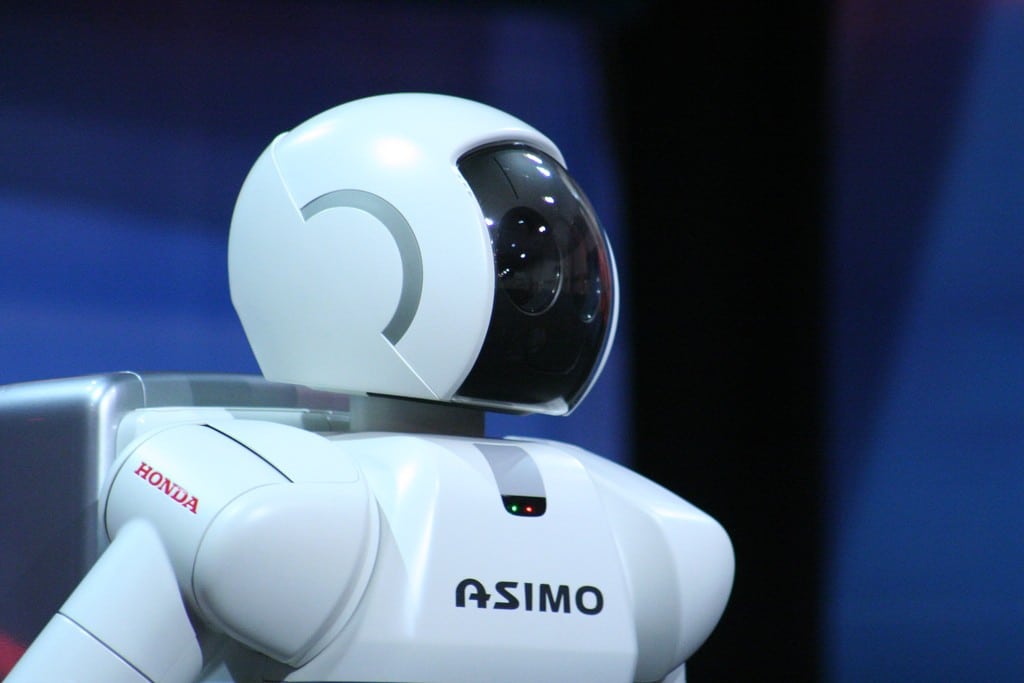
While Japan has been experimenting with humanoid robots for decades, Honda’s ASIMO debuted in 2000 and SoftBank’s Pepper launched in 2014; 2026 stands apart.
This is the year the technology moved from demonstrations and trade-show floors to real production environments. The momentum began building in late 2025 and accelerated into a cascade of landmark announcements:
Late 2025: Kawasaki Heavy Industries unveiled the Kaleido 9, a 180 cm, 86 kg humanoid robot designed for industrial applications, including parts assembly and logistics support. With 41 degrees of freedom and the ability to lift 25 kg per arm, it is one of the most capable Japanese-designed humanoids in development. Kawasaki also also produces Nyokkey, a compact social robot with humanoid characteristics introduced in 2023 for public interaction and service roles, a compact social robot with humanoid characteristics designed for public interaction and service roles.
April 2026: At SusHi Tech Tokyo, Asia’s largest innovation conference, Tokyo-based startup donut robotics unveiled cinnamon mini, a 130 cm humanoid capable of learning movements from video rather than conventional motion capture. The company also showcased cinnamon 1, a full-sized bipedal humanoid designed for factory and construction work, marking the first mass-produced humanoid from a Japanese brand.
May 2026: Japan Airlines, in partnership with GMO AI & Robotics, launched a trial deploying humanoid robots for baggage handling and cabin maintenance at Tokyo’s Haneda Airport, which serves over 60 million passengers annually. The two-year trial aims to address chronic staffing shortages in ground operations.
May 2026: The Humanoids Summit convened in Tokyo, bringing together global leaders, including Boston Dynamics, whose VP of policy Brendan Schulman highlighted that falling birth rates globally mean “we just don’t have the birth rates to sustain the workforce that we need.”
June 2026: Toyota placed humanoid prototypes on a components line at its Aichi plant for evaluation. In a separate and more ambitious initiative, Toyota Research Institute (TRI) partnered with Boston Dynamics to develop AI-powered Atlas robots capable of general-purpose tasks, releasing a joint demonstration video in mid-2026 showing the robot performing complex object manipulation. The TRI collaboration signals that Japan’s largest automaker is serious about humanoid robotics at multiple levels.
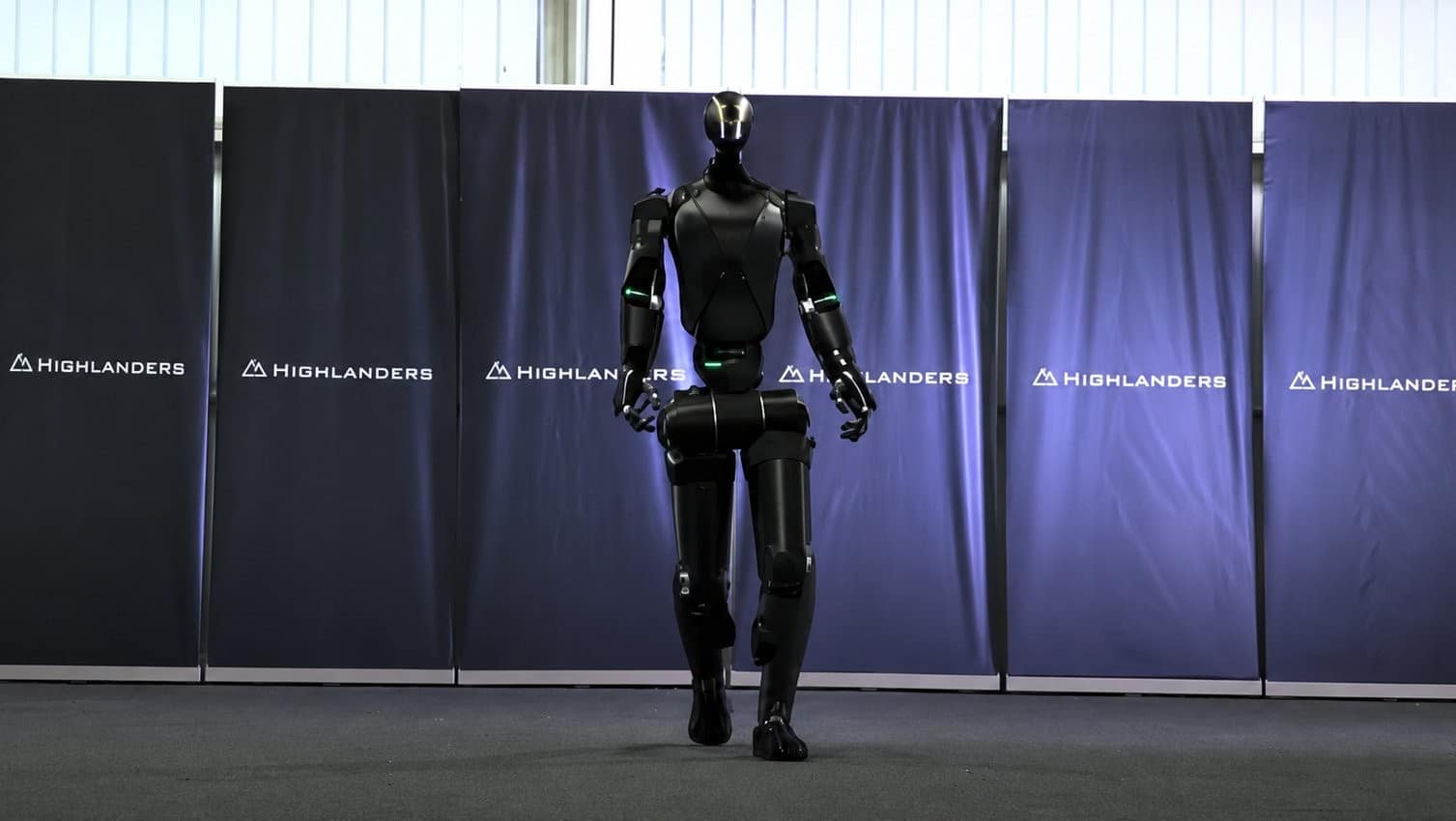
July 2026: In the most significant announcement yet, Mitsubishi Motors signed a Memorandum of Understanding with Highlanders, Inc., a University of Tokyo robotics startup, to jointly develop and mass-produce humanoid robots at Mitsubishi’s Kyoto plant. The target: 1,000 units per month starting as early as 2027. The robots will first work on Mitsubishi’s own assembly lines before being sold to other businesses.
July 2026: Shimizu Corporation, one of Japan’s largest general contractors, announced full-scale development of AI-powered humanoid robots for construction sites, targeting practical deployment around fiscal 2030 for tasks including painting, plastering, and site inspection.
Ongoing: Tokyo Robotics has been developing Torobo, a humanoid robot platform designed to perform skilled manual tasks. In demonstrations, Torobo has shown the ability to hammer nails with precision, a task requiring adaptive force control that most robots cannot perform reliably. The company is also advancing a bipedal prototype, Torobo Prototype B, targeting more mobile applications.
What Is Physical AI? The Technology Powering Japan’s New Robots

Behind every one of these announcements is a technological shift that separates today’s humanoid robots from the industrial automation of the past. The key term is “Physical AI,” artificial intelligence that perceives and acts in the real, physical world, not just in software.
Traditional industrial robots excel at repetitive, pre-programmed tasks in highly structured environments. They weld the same joint on the same car frame thousands of times and cannot deviate. Physical AI, by contrast, enables a robot to walk into an unfamiliar workspace, visually assess its surroundings, understand spoken instructions, and execute non-repetitive tasks that require judgment and adaptation.
The core technology stack involves three integrated layers: computer vision (to see and interpret the environment), a Vision-Language-Action model or VLA (to understand instructions and decide what to do), and precise motor control (to physically execute those decisions). Donut robotics’ cinnamon mini demonstrated one of the most striking advances in this field: the ability to learn movements simply by watching video. Instead of requiring expensive motion-capture setups, where a human wears a sensor suit and performs each motion, the robot’s AI can analyze a dance video and replicate the choreography. This dramatically reduces the time and cost of training robots for new tasks.
Japan’s Ministry of Economy, Trade and Industry (METI) has identified Physical AI as a national strategic priority. In March 2026, the ministry announced plans to build a domestic Physical AI sector with the goal of capturing 30% of the global market by 2040. The government also allocated ¥90 billion per year for local manufacturing of assistive robots. A formal AI Robotics Strategy is expected later in fiscal 2026 to provide regulatory frameworks and early demand creation in key sectors. On a longer horizon, Japan’s Moonshot R&D Program includes Goal 3: Coevolution of AI and Robots, a national initiative aiming to develop autonomous AI robots that learn, adapt, and work alongside humans by 2050, placing today’s humanoid breakthroughs within a decades-long national technology roadmap.
The Key Players Shaping Japan’s Humanoid Landscape
Japan’s humanoid robot ecosystem in 2026 spans startups, automotive giants, industrial robot makers, construction firms, and university-led research consortia. Here is how the major players compare:
| Organization | Robot / Project | Target Sector | Status (2026) |
|---|---|---|---|
| Mitsubishi Motors + Highlanders | 175 cm humanoid, 75 kg | Manufacturing, assembly lines | Mass production by 2027; 1,000 units/month |
| donut robotics | cinnamon 1 (170 cm, 70 kg); cinnamon mini (130 cm, 35 kg) | Factories, construction, retail, entertainment | cinnamon 1 announced (pricing TBD); mini unveiled April 2026 |
| Toyota | In-house humanoid prototypes | Components line, Aichi plant | Evaluation phase (June 2026) |
| Shimizu Corporation | Humanoid + robotic arm for painting | Construction: painting, plastering, inspection | Field trials underway; target deployment ~FY 2030 |
| JAL + GMO AI & Robotics | Humanoid (based on Unitree system) | Airport baggage handling, cabin maintenance | Two-year trial at Haneda Airport (from May 2026) |
| Kawasaki Heavy Industries | Kaleido 9 (180 cm, 86 kg) | Parts assembly, logistics, industrial tasks | Unveiled late 2025; ongoing development |
| Tokyo Robotics | Torobo, Torobo Prototype B | Skilled manual labor, hammering, adaptive tasks | Demonstrations ongoing; bipedal prototype in development |
| Kyoto Humanoid Association (KyoHA) | Two models: disaster response (250 cm) and research (160–180 cm) | Disaster response, research platform | Prototype by March 2026; mass production by 2027 |
The KyoHA consortium deserves special attention because of its collaborative model. Launched in July 2025, it pools expertise from Waseda University, tmsuk, Murata Manufacturing, Renesas Electronics, and Sumitomo Heavy Industries, an approach that contrasts with the go-it-alone strategies of US firms like Tesla and Figure AI. Each member contributes core technologies: sensors, motors, control microcontrollers, and AI, creating an integrated domestic supply chain that reduces reliance on overseas components.
Among the consortium’s early outputs is SEIMEI, a prototype humanoid built as a research platform to test integrated domestic components. Waseda University’s Sugano Project is separately developing AIREC (also known as Dry-AIREC), a humanoid robot designed to operate in real-world environments with a focus on physical interaction and adaptability. Both projects feed into the broader KyoHA goal of producing fully Japanese-made humanoid robots.
From Airports to Assembly Lines: Where Robots Are Already Working
The shift from prototype to deployment is happening across multiple sectors simultaneously, each driven by acute labor pressures:
Manufacturing: This is the leading edge. Mitsubishi’s plan to deploy humanoids on its own production lines before selling them externally is a pragmatic approach: the company becomes its own first customer, accumulating operational data and proving reliability. Toyota’s Aichi evaluation and Shimizu’s construction trials follow the same pattern of learning by doing. The advantage of humanoid-form robots in manufacturing is that they can be inserted into existing production lines without the costly factory redesigns that fixed robotic arms require.
Aviation: Haneda Airport’s baggage handling trial with humanoid robots addresses a sector where labor demand has surged alongside tourism while the available workforce continues to shrink. “While airports may seem highly automated and uniform, their backend operations still depend significantly on human labor and are experiencing acute labor shortages,” said Tomohiro Uchida, president of GMO AI and Robotics. The robots, which can operate for two to three hours on a charge, transport luggage and freight across the tarmac. The robot being trialed is Unitree’s G1, a Chinese-manufactured humanoid model, reflecting how Japan’s robotics deployments often pair domestic AI software with overseas hardware.
Construction: Perhaps the most challenging environment of all. Construction sites change daily; no two days present the same layout, obstacles, or tasks. Shimizu Corporation’s approach combines a humanoid robot for autonomous navigation and site inspection with a separate robotic arm system for painting and plastering. In a recent trial at the Tokiwabashi Project in Tokyo, a humanoid autonomously navigated the site at 1.0 meters per second while carrying a camera, using AI to analyze the captured footage for site management.
Retail and Hospitality: Donut robotics’ cinnamon 1 and cinnamon mini point toward a future where humanoid robots handle customer service, in-store patrol, and even entertainment. The cinnamon 1 is equipped with a Vision-Language Model that understands images and language, the world’s first silent gesture control system, and is designed for construction sites and factory floors. The company has not yet disclosed pricing for the bipedal humanoid, though its earlier cinnamon guide communication robot, aimed at retail and hospitality, sells for ¥2.2 million with a ¥62,000 monthly subscription.
How Much Does a Humanoid Robot Cost in 2026?
Pricing remains one of the biggest variables in the humanoid robot market, and one of the fastest-moving targets. Costs are dropping rapidly as production scales and AI eliminates the need for expensive manual programming:
- donut robotics cinnamon 1: Pricing has not yet been disclosed for the full-sized bipedal humanoid. The company’s earlier cinnamon guide communication robot sells for ¥2.2 million with a ¥62,000 monthly subscription, giving a rough benchmark for the company’s pricing model.
- donut robotics cinnamon mini: Approximately ¥12 million (~73,000) per unit, though pricing is still being finalized. The higher cost reflects its more advanced Physical AI capabilities and video-based learning system.
- Industrywide trends: Goldman Sachs estimates that humanoid robot production costs fell approximately 40% in a single year, with model base prices now around $30,000.
- Cost trajectory: The price of humanoid robots is dropping rapidly. Unitree’s R1 launched at just $6,000 in 2025, making humanoid robotics accessible to individual innovators for the first time, a fraction of what comparable robots cost just two years earlier.
- Comparison context: A typical industrial robotic arm costs $25,000–$50,000 but requires a dedicated workstation. A humanoid robot that can move between workstations and adapt to different tasks offers a fundamentally different value proposition: one that makes economic sense when labor is simply unavailable at any price.
While Japan’s domestic industry is accelerating, humanoid robots are already reaching the consumer market globally. Chinese automaker Chery recently listed its Mornine M1 humanoid on JD.com for $41,000, signaling that the retail era for embodied AI is arriving alongside industrial deployment, a milestone that industry observers have been anticipating for years.
According to Goldman Sachs Research, the global humanoid robot market could reach $38 billion by 2035, driven by a 40% reduction in hardware component costs and rapid advances in artificial intelligence, with annual shipments reaching 1.4 million units.
The Road Ahead: Japan’s 2027 Mass Production Target
If 2026 was the year of announcements and pilot deployments, 2027 is shaping up to be the year Japan begins producing humanoid robots at industrial scale. Mitsubishi Motors’ target of 1,000 units per month from its Kyoto plant represents the most concrete production commitment from any Japanese manufacturer. If achieved, it would make Japan one of the world’s largest producers of humanoid robots almost overnight.
The government is moving quickly to provide a supporting framework. METI’s target of capturing 30% of the global Physical AI market by 2040 signals that Tokyo sees humanoid robotics as a national economic priority, not merely an interesting technology. The ministry’s forthcoming AI Robotics Strategy, expected in fiscal 2026, is expected to address critical gaps including safety regulations, standardization, and early-demand creation in priority sectors.
Safety standards remain a work in progress. Japan’s current industrial safety rules were written for caged robots that stop when a human enters their zone, not for autonomous machines designed to share the floor with people. A working group at the trade ministry is expected to issue draft guidance later in 2026, which will be essential for wider deployment.
Japan is not alone in this race. China has surged ahead in humanoid robot manufacturing, with companies like Unitree and Agibot shipping thousands of units and benefiting from aggressive government support embedded in the latest five-year plan. Chinese firm Booster Robotics made headlines in 2026 by becoming the first company to ship 10,000 humanoid units globally. The United States, meanwhile, has Tesla’s Optimus program, Boston Dynamics’ electric Atlas, and well-funded startups like Figure AI and Apptronik. China’s humanoid industry has also advanced rapidly, though not every viral robot video reflects commercial reality, all targeting factory deployment between 2026 and 2028. Hyundai, through its acquisition of Boston Dynamics, plans to deploy Atlas humanoid robots in its U.S. factories by 2028, starting with parts sequencing.
Yet Japan brings distinct advantages to this competition: deep expertise in precision manufacturing, a cultural acceptance of robots that makes deployment socially smoother, and a demographic crisis so severe that the economic case for automation is beyond dispute. As Yoichi Takamoto, chairman of tmsuk, put it: “It will come down to data.” Whoever can train humanoid robots fastest on real-world tasks, and Japan’s factory floors are generating that data right now, will lead the next wave.
Frequently Asked Questions
Why is Japan investing so heavily in humanoid robots?
Japan faces the world’s most severe demographic crisis. With 29.3% of the population over 65, a working-age population that has been declining since 1995, and a projected shortfall of 11 million workers by 2040, automation is not a choice; it is an economic necessity. Humanoid robots offer a unique advantage because they can operate in environments built for humans without requiring expensive infrastructure changes.
Which Japanese companies are leading humanoid robot development?
The field is led by a mix of startups and industrial giants. Mitsubishi Motors and Highlanders are partnering on mass production. Donut robotics has launched the first Japanese-brand mass-produced humanoid. Toyota is running factory pilots with humanoid prototypes. Shimizu Corporation is developing construction humanoids. The Kyoto Humanoid Association (KyoHA) consortium includes Waseda University, tmsuk, Murata Manufacturing, Renesas Electronics, and Sumitomo Heavy Industries working on domestically produced models.
What can humanoid robots actually do in 2026?
Current humanoid robots can handle parts loading on assembly lines, transport luggage at airports, conduct autonomous site inspections at construction projects, perform customer service and translation in retail settings, and learn new physical movements by watching videos. However, they cannot yet perform highly precise manipulation tasks, navigate extremely uneven terrain reliably, or handle complex multi-step reasoning; these remain active areas of research.
Are humanoid robots going to replace human workers in Japan?
The goal, as framed by Japanese companies and the government, is not replacement but supplementation. With 600,000 unfilled industrial jobs and entire sectors struggling to find workers at any wage, humanoid robots are being deployed to fill gaps that humans are not available to fill. They are expected to take over repetitive, physically demanding, and hazardous tasks while creating new jobs in robot maintenance, supervision, programming, and fleet management. As donut robotics CEO Ono Taisuke noted, “When the number of robots becomes comparable to the human population, new jobs related to them will appear.”
When will humanoid robots be available for businesses to purchase?
Some models are already available. Donut robotics’ cinnamon 1 has been announced but pricing has not yet been disclosed. The company’s earlier cinnamon guide robot sells for ¥2.2 million with a monthly subscription. Mitsubishi and Highlanders aim to begin mass production in early 2027, with a 1,000-unit-per-month capacity. Most other Japanese manufacturers are in pilot or evaluation phases and have not yet announced commercial availability dates. Industry analysts expect a significant expansion of purchasing options between 2027 and 2028 as production scales.
How is Japan’s approach different from China’s and the United States’?
Japan is pursuing a collaborative, consortium-based model, epitomized by KyoHA, that pools expertise across universities, component makers, and heavy industry. The strategy focuses on high-reliability, safety-certified robots for manufacturing and infrastructure, leveraging Japan’s precision engineering heritage. China, by contrast, is pursuing aggressive cost reduction and rapid scaling of simpler humanoid designs, supported by state industrial policy. The United States favors a venture-capital-funded, company-versus-company approach with firms like Tesla, Figure AI, and Boston Dynamics competing independently. Japan’s collaborative model may prove slower to market but potentially more resilient once deployed.
Conclusion
Japan’s 2026 humanoid robot revolution is not a story about technology alone; it is a story about necessity. When a country loses workers faster than any other developed nation, the question is no longer whether robots will enter the workforce but how quickly. The announcements of 2026, from Mitsubishi’s factory conversion to JAL’s airport robots to donut robotics’ video-learning humanoids, collectively represent a national response to a demographic reality that can no longer be ignored.
The economics are shifting rapidly. Robot costs are falling 40% year-over-year. AI is enabling machines to learn tasks in hours rather than weeks. And Japan’s factory floors, construction sites, and airports are becoming living laboratories where the technology is tested, refined, and proven at scale. The 2027 mass-production target is ambitious, but the infrastructure, the investment, and, most importantly, the desperate need for workers are all in place. What began as science fiction is becoming Japan’s industrial reality, and the rest of the aging world is watching closely.


