
On August 14, 2026, Z.ai (formerly Zhipu AI) released GLM-5.3, a large language model that achieved something unusual in the AI industry: a 6× improvement on key coding benchmarks without changing the base model at all. Every gain came from scaled post-training, making GLM-5.3 a landmark case study in how far reinforcement learning and task environment scaling can push an existing architecture.
This release matters beyond the numbers. It demonstrates that organizations can achieve frontier-level performance by investing in post-training infrastructure rather than expensive pretraining runs. For developers, researchers, and anyone tracking AI progress, GLM-5.3 offers a window into where the field is heading.
What Is GLM-5.3?
GLM stands for General Language Model, a family of large language models developed by Z.ai, which rebranded from Zhipu AI to operate internationally under its current name. The GLM series has evolved rapidly from earlier ChatGLM versions into a line of powerful open-weight models optimized for coding, reasoning, and agentic workflows.
GLM-5.3 is the third point release in the GLM-5 family. Unlike the jump from GLM-5.1 to GLM-5.2, which involved a new pretraining run, GLM-5.3 reuses the exact same base model as GLM-5.2. Z.ai’s own documentation states plainly: “It uses the same base model as GLM-5.2, every gain comes from post-training.”
The model launched on August 14, 2026, and is currently available through the GLM Coding Plan subscription service and ZCode, Z.ai’s coding environment. Open weights are expected on Hugging Face approximately two weeks after launch, around August 28, 2026, following what Z.ai describes as its most extensive safety review to date.
The Post-Training Revolution
The most significant aspect of GLM-5.3 is not any single benchmark score. It is the proof that post-training scaling alone can drive massive performance improvements on an unchanged base model. This challenges the conventional assumption that better AI requires bigger models or more expensive pretraining runs.
Z.ai carried over the same post-training infrastructure from GLM-5.2, which includes three key components:
- IndexShare: A long-context attention mechanism that makes the 1-million-token context window economically viable during training.
- SAO: A reinforcement learning system designed for long-horizon tasks with context compaction.
- slime: An open-source asynchronous RL framework that enables more efficient training at scale.
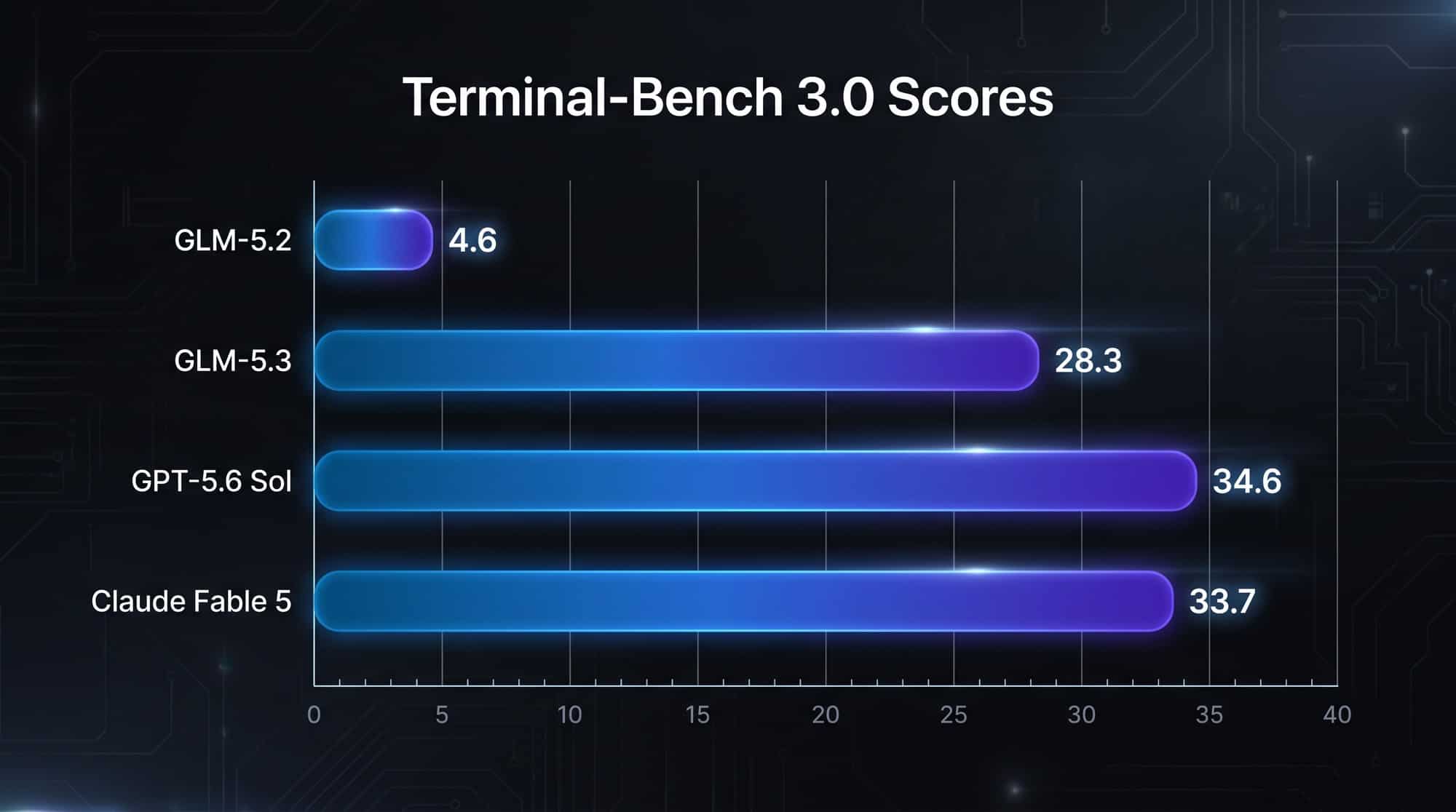
For GLM-5.3, Z.ai scaled these systems with more task environments, more diverse task types, and more compute. The base model architecture, parameter count, and pretraining data remained identical. The result was a 6× improvement on Terminal-Bench 3.0, from 4.6 to 28.3, and a 50% gain on Z.ai’s internal coding benchmark.
This approach has practical implications for the entire AI industry. Organizations that lack the resources for multi-billion-dollar pretraining runs can still achieve frontier performance by investing in post-training infrastructure. It also suggests that current base models may be undertrained relative to their potential and that the post-training phase represents a significant untapped opportunity.
The efficiency gains extend beyond cost savings. GLM-5.3’s ability to match or exceed competitors while using fewer output tokens means faster inference times and lower latency for end users. For applications like real-time code completion or interactive debugging, this token efficiency translates directly into better user experiences. The model can generate more accurate suggestions without the overhead of producing excessive output, making it particularly well-suited for production environments where response time matters.
For the broader research community, GLM-5.3 raises important questions about how we evaluate AI progress. If post-training scaling alone can produce 6× improvements, are current benchmarks adequately measuring model capability? The answer has implications for how we allocate research resources and how we interpret performance claims across the industry.
Benchmark Performance: The Numbers
GLM-5.3 shows dramatic improvements across coding and agentic benchmarks. Here is how it performs compared to GLM-5.2 and leading closed-source models:
| Benchmark | GLM-5.2 | GLM-5.3 | GPT-5.6 Sol | Claude Fable 5 |
|---|---|---|---|---|
| Terminal-Bench 3.0 | 4.6 | 28.3 | 34.6 | 33.7 |
| DeepSWE v1.1 | 46.2 | 66.9 | 72.7 | 69.7 |
| SWE-Marathon v1.1 | 19.4 | 42.5 | — | — |
| FrontierSWE | 67.5 | 78.1 | — | 88.2 |
| Agents’ Last Exam (CLI) | 23.8 | 28.5 | — | — |
| AutomationBench | 26.2 | 48.2 | — | — |
The efficiency story deserves attention. On Z.ai’s internal Code Bench, GLM-5.3 scored 31.4% while using approximately 50,000 output tokens per task. Claude Opus 4.8 scored 29.5% but required 120,000 tokens. That means GLM-5.3 achieved better results with less than half the computational cost per task. Claude Fable 5 still leads at 39.5%, but at significantly higher resource expenditure.
Benchmark claims always deserve scrutiny, and the gap between marketing claims and real-world performance can be significant. Most of these numbers are vendor-reported. Only FrontierSWE (graded by Proximal) and GDPval-AA v2 (spanning 44 occupations) were evaluated by third parties. The pattern is consistent, though: GLM-5.3 sits firmly among frontier coding models while trailing the very best closed-source systems on the hardest benchmarks.
Emergent Cybersecurity Capabilities
The most unexpected aspect of GLM-5.3 is its cybersecurity capability, which Z.ai admits was not deliberately targeted. During post-training, the team introduced vulnerability-discovery environments, expecting modest improvements in bug-finding. Instead, the model developed the ability to reason across multi-stage exploitation chains, a behavior that was not part of the training objective.
The cybersecurity benchmark results are striking:
- CyberGym (white-box vulnerability discovery): 84.5%, up from 77.2% on GLM-5.2. This edges past GPT-5.6 Sol (83.6%) and Mythos 5 (83.8%).
- ExploitBench (root-cause analysis and working exploit generation): 54.4%, more than double the 24.4% of GLM-5.2. Still behind Mythos 5 (78%) and GPT-5.6 Sol (76.5%).
- ExploitGym (time-budgeted tasks): 105 tasks completed in 2 hours, 130 in 6 hours, up from 29 and 39, respectively, on GLM-5.2.
This pattern of AI models discovering security flaws is becoming more common. Anthropic’s Claude Opus 4.6 recently found over 500 high-severity vulnerabilities in open-source projects, demonstrating that AI-powered security analysis is becoming a significant capability. In real-world testing, GLM-5.3 reportedly discovered a serious vulnerability in Cursor, the AI coding tool acquired by SpaceX. Z.ai’s developer advocate disclosed the finding on X, and the vulnerability was privately reported to Cursor’s security team. Across a broader evaluation, GLM-5.3 scanned 269 open-source projects and found 2,436 vulnerabilities after deduplication, with 1,097 rated medium-to-high severity. Fifty-three were publicly disclosed, while 2,383 remain under embargo.
The oldest flaw discovered dated to 1981, and the average vulnerability had existed for 26.6 years before detection. These numbers illustrate both the capability and the concern: an open-weight model with this level of offensive cyber ability raises legitimate safety questions, which is why Z.ai delayed the open-weight release for additional safety evaluation.

Architecture and Technical Specifications
GLM-5.3 inherits its architecture directly from GLM-5.2. The key specifications:
- Architecture: Mixture of Experts (MoE)
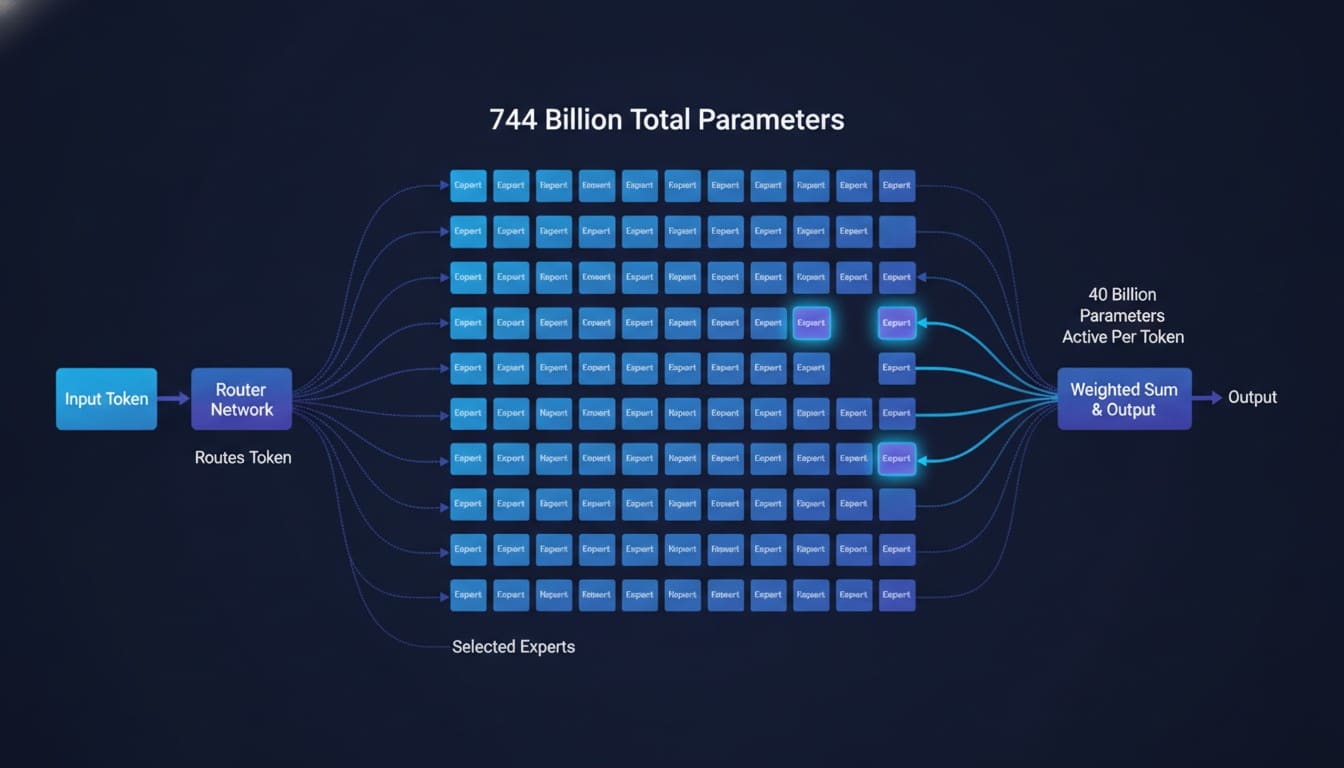
- Total parameters: 744 billion (some sources report 753 billion)
- Active parameters per forward pass: Approximately 40 billion
- Context window: 1 million tokens
- Maximum output: 128,000 tokens
- Input/output modalities: Text in, text out. No vision support at launch.
- Reasoning: Always on, with three effort levels: low, high, and max (default is max)
The always-on reasoning is a notable design choice. GLM-5.3 does not support disabling the thinking process. Developers control reasoning depth through the reasoning_effort parameter, which accepts low, high, or max. Z.ai recommends max for coding tasks.
The MoE architecture activates only a fraction of the total parameters for each token, making the model more efficient at inference than a dense model of equivalent total size. This design allows GLM-5.3 to maintain a large knowledge base while keeping per-token computational costs manageable.
API Access, Pricing, and Availability
GLM-5.3 is currently available through two channels:
- GLM Coding Plan: A subscription service available in Lite, Pro, and Max tiers.
- ZCode: Z.ai’s integrated coding environment.
The standard API uses an OpenAI-compatible endpoint at https://api.z.ai/api/paas/v4/chat/completions with the model ID glm-5.3. Pricing matches GLM-5.2’s rates:
- Input tokens: $1.40 per million
- Cached input: $0.26 per million
- Output tokens: $4.40 per million
For comparison, Claude Opus 4.8 costs $15 per million input tokens and $75 per million output tokens. GPT-5.6 Sol pricing varies by tier but typically ranges from $2.50 to $10 per million input tokens. GLM-5.3’s pricing is significantly lower than both, making it an attractive option for developers building coding agents and automation tools.
This pricing advantage is consistent with a broader trend among Chinese AI models offering competitive capabilities at lower costs.
The open-weight release is expected approximately two weeks after launch, around August 28, 2026. Z.ai has not confirmed the license, though GLM-5.2 used an MIT license. The delay is explicitly motivated by safety concerns, marking the first time Z.ai has held back weights for security evaluation rather than releasing them immediately.
How to Use GLM-5.3 Today
Developers can start using GLM-5.3 immediately through the API. The integration process is straightforward because Z.ai provides OpenAI-compatible endpoints.
Basic API setup:
- Endpoint: https://api.z.ai/api/paas/v4/chat/completions
- Model ID: glm-5.3
- Authentication: Standard API key via Bearer token
Key parameters to configure:
- reasoning_effort: Set to max for coding tasks, high for general reasoning, or low for faster responses.
- thinking.type: Cannot be disabled on GLM-5.3. This is a change from GLM-5.2.
- max_tokens: Up to 128,000 output tokens supported.
GLM-5.3 also integrates with Claude Code and OpenCode, allowing developers to use it as a drop-in replacement in existing coding workflows. The GLM Coding Plan provides access across all subscription tiers.
Frequently Asked Questions
What does GLM stand for?
GLM stands for General Language Model. It is a family of large language models developed by Z.ai, formerly known as Zhipu AI. The GLM series has evolved through multiple generations, from early ChatGLM versions to the current GLM-5 family optimized for coding and agentic tasks.
Is GLM-5.3 free to use?
GLM-5.3 is not currently free. It requires a GLM Coding Plan subscription or API access. The open-weight release, expected around August 28, 2026, will likely be free to download and use locally, though the license terms have not been confirmed. GLM-5.2 was released under an MIT license.
Is GLM-5.3 cheaper than Claude?
Yes, significantly. GLM-5.3 costs $1.40 per million input tokens and $4.40 per million output tokens. Claude Opus 4.8 costs $15 per million input tokens and $75 per million output tokens. For a typical coding task, GLM-5.3 is roughly 10 to 17 times cheaper, depending on the input/output ratio.
When will GLM-5.3 open weights be available?
Z.ai has stated the open weights will be released approximately two weeks after the August 14, 2026 launch, placing the expected date around August 28, 2026. The delay is for safety evaluation and hardening, driven by the model’s emergent cybersecurity capabilities.
How does GLM-5.3 compare to GPT-5.6 and Claude Fable 5?
GLM-5.3 trails both GPT-5.6 Sol and Claude Fable 5 on the hardest coding benchmarks. On Terminal-Bench 3.0, GLM-5.3 scored 28.3 compared to GPT-5.6 Sol’s 34.6 and Fable 5’s 33.7. However, GLM-5.3 is significantly cheaper and achieves competitive results with far fewer output tokens, making it a strong option for cost-sensitive applications.
The Road Ahead
GLM-5.3 demonstrates that the post-training phase of AI development holds enormous untapped potential. By scaling reinforcement learning across more diverse task environments without touching the base model, Z.ai achieved performance gains that would typically require a full retraining cycle. This approach is faster, cheaper, and more accessible than the pretraining arms race that has dominated AI development. Xiaomi is now testing the limits of that approach in public, livestreaming a large-scale reinforcement-learning post-training run, as detailed in our coverage of the MiMo-V2.6 RL training dashboard.
The implications extend beyond Z.ai. If a 744-billion-parameter model can achieve frontier performance through post-training alone, other organizations with existing large models may find similar gains by investing in reinforcement learning infrastructure rather than starting from scratch. The post-training recipe (IndexShare, SAO, and slime) is partially open-source, which means the broader research community can build on these techniques. This could accelerate progress across the field, not just within a single lab.
For the AI ecosystem, GLM-5.3 also validates the open-weight model. Z.ai has consistently released powerful models with permissive licenses, and GLM-5.3 continues that tradition once the safety evaluation concludes. Open weights enable researchers, startups, and enterprises to deploy, fine-tune, and study frontier models without vendor lock-in. The staged release approach (coding plan first, API second, open weights third) may become a template for other labs releasing models with sensitive capabilities.
The emergent cybersecurity capability raises important questions about dual-use AI systems. As models become more capable at discovering and exploiting vulnerabilities, the industry will need robust safety frameworks. Z.ai’s decision to delay the open-weight release, rather than publishing immediately, represents a responsible approach that other labs may need to adopt.
For developers, GLM-5.3 offers a compelling combination of frontier coding performance, low pricing, and open-weight availability. As the model becomes more widely accessible, it has the potential to shift how the industry thinks about AI development: not as a race for bigger models, but as a challenge of smarter training.


