
Xiaomi’s MiMo team has made the MiMo-V2.6 RL training process visible in a way that frontier-model labs have not done before. Since September 15, 2026, the live dashboard at mimo.xiaomi.com/rl/ has been streaming steps, reward curves, token throughput, benchmark scores, and a running cost counter for two reinforcement-learning post-training runs: MiMo-V2.6-Pro and MiMo-V2.6-Flash. The setup was launched on X around September 17 by Fuli Luo (Luo Fuli), the MiMo team lead and former DeepSeek researcher, who framed it as the first-ever public livestream of a full frontier-scale RL post-training run. Coverage from the NYU Shanghai RITS dashboard analysis team and outlets including World Journal cost reporting has tracked the figures as they climb. As of a September 19, 2026 snapshot, combined reported spend across the two models had passed $3 million.
What the Dashboard Shows
The dashboard exposes an unusually granular view of how a multi-task agent training job runs in production. Each step in the pipeline processes roughly 2 to 2.6 billion tokens, organized as a batch of 1,568 prompts fed through 16 asynchronous rollouts. The average context window sits at about 89,000 tokens. A full step takes approximately 126 minutes, split between roughly 58 minutes of generation and about 64 minutes of backpropagation, a split observed in earlier readings.
What distinguishes this from a typical training log is the fully asynchronous architecture. Rollout generation, environment execution, reward scoring, and parameter updates do not run in lockstep. Multiple agent environments and harnesses operate inside a single job, and the system uses agentic in-group credit assignment with test-case and rubric-style rewards. At the scale reported by the dashboard, more than 60,000 active Linux and Docker sandboxes, approximately 23,000 for the Pro run and 38,000 for the Flash run, execute model-generated code in parallel.
Model specifications surfaced through the dashboard and accompanying coverage place MiMo-V2.6-Pro at roughly 1.02 trillion total parameters with 42 billion active (a mixture-of-experts architecture) and MiMo-V2.6-Flash at approximately 309 billion total with 15 billion active. These figures make the live observability of the run notable: watching a trillion-parameter MoE system update its weights in real time is not something any public RL training log has offered before.
The Cost Ticker: $3 Million and Climbing
The dashboard’s most watched figure is the running cost counter. As of the September 19, 2026 snapshot, combined reported spend across the two models had passed $3 million. Earlier snapshots provide context for how quickly the total climbed: roughly $1.06 million on the morning of September 17, then approximately $1.13 million, and by midday September 17, about $1.23 million (with Pro at approximately $853,000 and Flash at approximately $378,000). All of these are snapshot readings, not fixed tariffs; the figures move continuously as the runs proceed.
Per-model burn rates reported in the same snapshots show Pro at roughly $20,000 per hour (around $493,000 per day, approximately $70,000 per step, and about $33.91 per million tokens) and Flash at roughly $10,000 per hour (around $247,000 per day, approximately $21,000 per step, and about $9.25 per million tokens). These rates matter to anyone tracking why Chinese AI labs are building capable models at a fraction of Western pricing, a dynamic explored in detail in Why Are Chinese AI Models So Much Cheaper Than OpenAI and Anthropic? The numbers also land against a backdrop of pricing pressure from other labs; recent DeepSeek price increases have already shifted the competitive cost floor for API access, making the raw training spend visible here a useful benchmark for the industry’s broader cost structure.
Coverage from World Journal and Sina Tech reporting both flagged the $3 million figure as a notable public data point, particularly because most labs treat training spend as confidential. The live counter effectively converts what is usually a private budget line into a public, continuously updating number.
The Benchmark Jump: DeepSWE v1.1 and AutomationBench 1.0.6
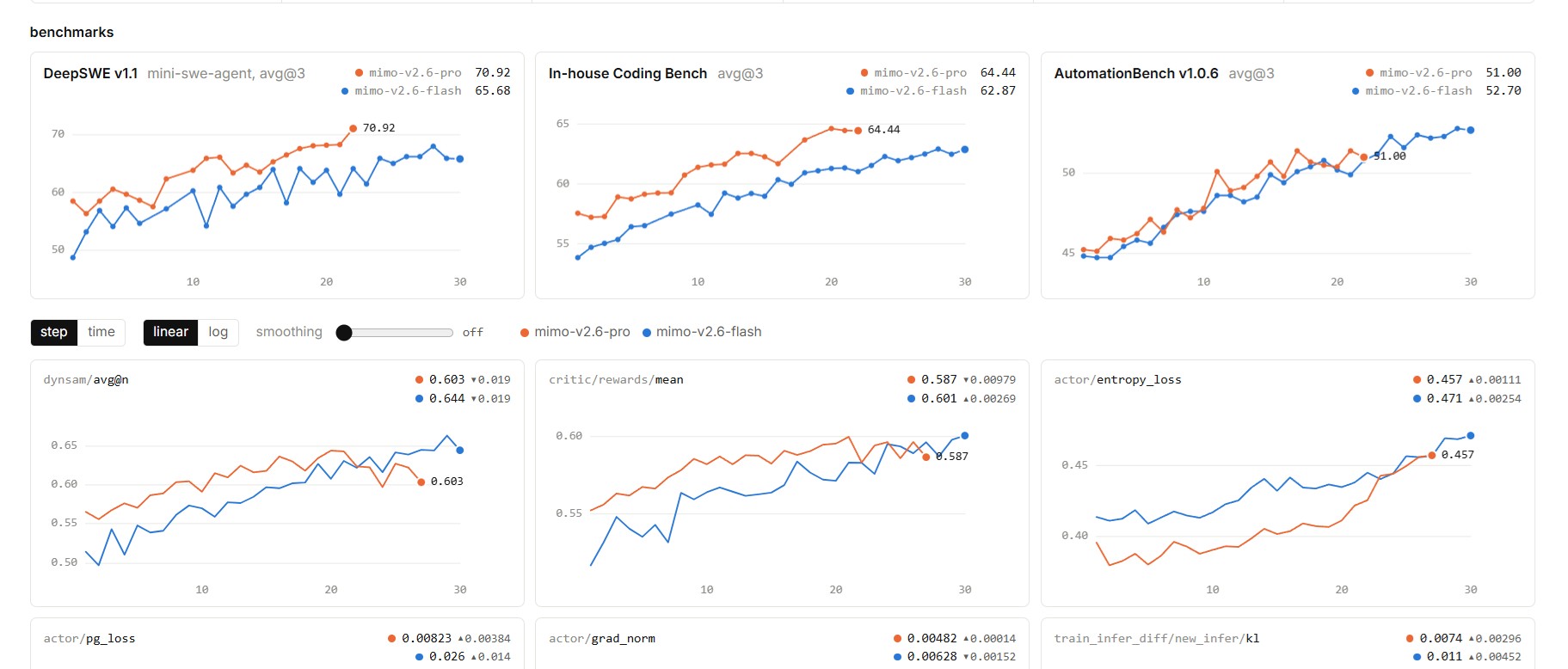
The dashboard also publishes live benchmark scores as the runs progress. The September 19, 2026 snapshot shows the following:
- DeepSWE v1.1: MiMo-V2.6-Pro at 70.92, MiMo-V2.6-Flash at 65.68
- AutomationBench 1.0.6: MiMo-V2.6-Pro at 51.00, MiMo-V2.6-Flash at 52.70
DeepSWE v1.1 is Datacurve’s benchmark of 113 long-horizon software engineering tasks, scored with the mini-swe-agent harness at an average of 3 attempts (avg@3). Earlier mid-training readings placed DeepSWE scores in the 62 to 64 range (Pro at 63.72 at step 10, Flash at 60.77 at step 12), with the reward metric dynsam/avg@n at 0.624 for Pro and 0.596 for Flash. The jump from those mid-training figures to the September 19 snapshot marks a substantial improvement over the course of the run.
What stands out in the September 19 data is that Flash actually outscores Pro on AutomationBench 1.0.6 (52.70 versus 51.00), while both lead the earlier MiMo V2.5 generation by a wide margin. For readers tracking how mid-tier Flash models are closing the gap with flagship Pro tiers, the Gemini 3.8 Flash benchmarks and pricing article and the Agnes 3.0 Flash piece offer useful comparisons of the same industry pattern. The DeepSeek V4.1 Flash release also illustrates how the Flash tier has become a primary entry point rather than a reduced version of the flagship.
The “Flash as Base Model” Reading
The dashboard figures suggest a trend that mirrors strategies at other providers: the smaller, cheaper Flash model is emerging as the capable default. If MiMo-V2.6-Flash is indeed outperforming the earlier MiMo V2.5 Pro on DeepSWE v1.1 (65.68 versus the V2.5 Pro range) and beating its own larger sibling on AutomationBench, the commercial logic follows the pattern seen in Google’s Gemini Flash line and similar tier structures. In that model, the Flash tier becomes the base model that developers reach for by default, while the Pro tier handles the heaviest workloads.
This is interpretation, not confirmation. Xiaomi has not announced a product strategy tied to these results, and the dashboard is a training-observability tool, not a marketing page. That said, the NYU Shanghai RITS dashboard analysis notes that the gap between Flash and Pro on one of the two headline benchmarks has essentially closed, which is a notable signal if the goal is to make Flash the workhorse.
A separate open question the coverage has not resolved: MiMo-X Pro Preview and MiMo-X Flash Preview models are currently circulating as part of Xiaomi’s preview lineup. Published sources do not clarify the relationship between the V2.6 lineage being trained on the dashboard and the MiMo-X preview models. Readers should treat any claimed lineage or succession link as unconfirmed.
What Skeptics Say and What Comes Next
The public RL console is the news regardless of how one frames it, but outside labs have raised methodological questions. The main critique concerns live continuity: whether the dashboard numbers fully prove that the training is running without gaps, pauses, or offline segments that would make the “livestream” framing less precise than it appears. Additional questions include how much unreported distillation traffic or offline data pass might factor into the benchmark scores displayed. Xiaomi has not addressed these points publicly.
On the forward-looking side, Luo Fuli stated that related technical details will be open-sourced in the coming weeks. That commitment, if honored, would make the MiMo-V2.6 RL training setup a rare public artifact of frontier-scale post-training and would allow the community to replicate or stress-test the pipeline independently.
It is also worth distinguishing this release from Xiaomi’s earlier Robotics-U0 embodied world-model announcement. That project concerned robotics and embodied AI; the MiMo-V2.6 dashboard is a language and agent post-training observability release. The two are separate workstreams within Xiaomi’s AI portfolio.
Frequently Asked Questions
What is the MiMo-V2.6 RL training livestream?
The MiMo-V2.6 RL training livestream is a public dashboard at mimo.xiaomi.com/rl/ that streams real-time steps, reward curves, token throughput, benchmark scores, and a cost counter for two reinforcement-learning post-training runs on MiMo-V2.6-Pro and MiMo-V2.6-Flash. It was launched by MiMo team lead Fuli Luo on X around September 17, 2026, and is claimed to be the first public livestream of a full frontier-scale RL post-training run. Both runs started on September 15, 2026.
How much has Xiaomi spent on MiMo-V2.6 RL training so far?
As of a September 19, 2026, dashboard snapshot, combined reported spend across the two models had passed $3 million. Earlier snapshots showed roughly $1.06 million on the morning of September 17 and about $1.23 million by midday the same day. Burn rates at that point were approximately $20,000 per hour for Pro and $10,000 per hour for Flash. These figures are snapshot readings and continue to climb; they are not fixed tariffs.
Is MiMo-V2.6-Flash training finished?
The dashboard shows MiMo-V2.6-Flash as STOPPED after 30 steps. However, Xiaomi has not confirmed whether the run is complete. The STOPPED status could indicate that the Flash run has finished, or it could reflect a pause, a checkpoint save, or another operational state. As of the September 19 snapshot, no official statement has been issued to confirm completion.
How does MiMo-V2.6 relate to MiMo-X?
Published sources do not clarify the relationship between the MiMo-V2.6 lineage being trained on the dashboard and the MiMo-X Pro Preview and MiMo-X Flash Preview models currently circulating in Xiaomi’s preview lineup. Any claimed succession or lineage link is unconfirmed. The two naming families may represent separate product tracks, or one may feed into the other, but Xiaomi has not publicly stated the connection. Readers should treat any speculation on this point as open.

