Developers and enterprise teams worldwide were taken by surprise when Chinese artificial intelligence lab DeepSeek published a formal update to its commercial platform. Effective August 16, 2026, at 16:00 UTC, the company is retiring its legendary flat-rate billing structure for its flagship DeepSeek V4 Pro and DeepSeek V4 Flash models in favor of a dynamic peak and off-peak pricing system. With output token costs climbing by up to 355% and peak-hour multipliers doubling standard rates, engineering teams that engineered their entire inference pipelines around near-zero token costs are now forced to re-evaluate their architectural budgets and explore competitive DeepSeek alternatives across the AI ecosystem. Since then, DeepSeek has launched V4.1 Flash pricing and Pro routing with lower Flash rates effective September 10. The price pressure is only intensifying. Z.ai’s GLM-5.3-Flash launched in late August 2026 at $0.075 per million input tokens, undercutting even DeepSeek’s off-peak rate and shipping with MIT-licensed open weights. DeepSeek itself answered on September 10, 2026 with V4.1 Flash, a cheaper and stronger successor that costs less than V4 Flash did before the hike, and since September 14 all deepseek-v4-pro requests have been served by V4.1 Flash at Flash rates until a V4.1 Pro arrives.
DeepSeek’s August 2026 Price Hike: Breaking Down the New Peak & Off-Peak Structure
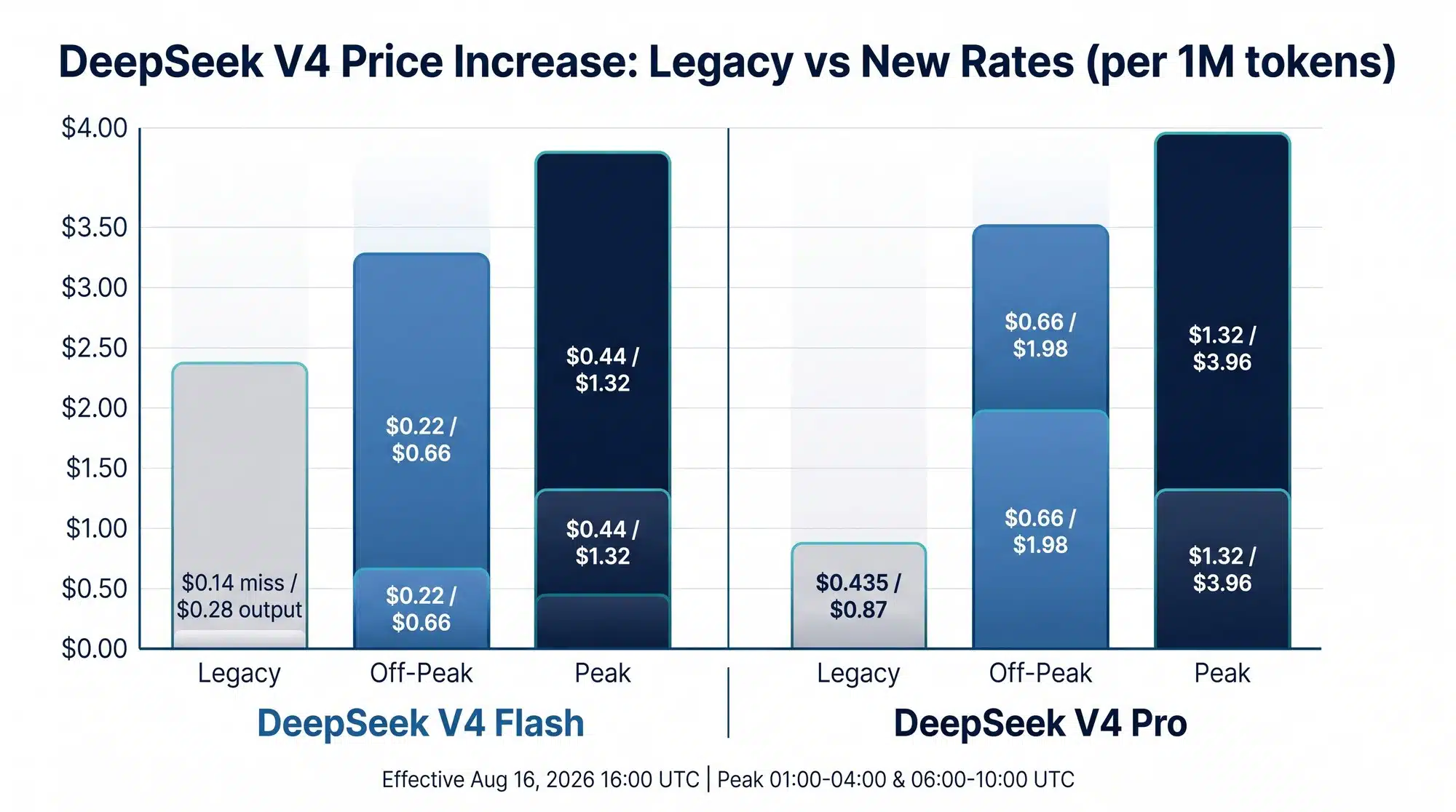
The revised billing model represents the first major upward pricing revision in DeepSeek’s operational history. Under the new terms published in the official DeepSeek API documentation, billing will be split into two defined UTC time windows:
- 1. Peak Hours (weekdays): 01:00 to 04:00 UTC and 06:00 to 10:00 UTC (coinciding with peak Asian business hours and European morning overlap).
- 2. Off-Peak Hours: All remaining 17 weekday hours, billed at exactly half the peak rate.
- 3. Weekends: Since August 23, 2026, Saturdays and Sundays are billed entirely at off-peak rates, with no peak-hour distinction.
The price adjustments affect both uncached prompt inputs, cached prompt reads, and generated output tokens. The table below details the exact shift across the V4 product suite.
| Model Tier | Token Type | Legacy Flat Rate (per 1M) | New Off-Peak (per 1M) | New Peak (per 1M) | Effective Increase |
|---|---|---|---|---|---|
| DeepSeek V4 Flash | Cached Input (Hit) | $0.0028 | $0.0070 | $0.0140 | +150% to +400% |
| Uncached Input (Miss) | $0.1400 | $0.2200 | $0.4400 | +57% to +214% | |
| Output Generation | $0.2800 | $0.6600 | $1.3200 | +135% to +371% | |
| DeepSeek V4 Pro | Cached Input (Hit) | $0.003625 | $0.0220 | $0.0440 | +507% to +1,113% |
| Uncached Input (Miss) | $0.4350 | $0.6600 | $1.3200 | +51% to +203% | |
| Output Generation | $0.8700 | $1.9800 | $3.9600 | +127% to +355% |
The most striking shift occurs in cached input rates for DeepSeek V4 Pro, which previously cost less than 1% of the uncached rate. While cached reads remain heavily discounted at $0.022 to $0.044 per million tokens, the multiplication factor directly impacts long-context agentic workloads where millions of system prompt tokens and tool definitions are repeatedly queried.
Why Did Prices Rise? Chip Constraints, Demand, and Capital
Following the price announcement, initial commentary across developer communities speculated whether DeepSeek was suffering from acute compute shortages. Chinese industry reporting and supply-chain analysis suggest hardware constraints are, in fact, a central driver, though not an emergency. DeepSeek cannot buy the latest US-designed accelerators under export controls, so most of its tokens still run on older Western chips rather than the newest NVIDIA hardware.
Demand has outpaced that constrained fleet. Traffic surged after aggressive price cuts undercut Western models like GPT-5.6 Luna, and the strain has occasionally surfaced. On August 4, 2026, the official status page logged two degraded-performance incidents affecting V4 Flash, V4 Pro, and Expert Mode, lasting 1 hour 18 minutes and 36 minutes, respectively. OpenCode cited capacity issues driven by unprecedented demand, and Chinese outlets, including Yicai, confirmed the episodes were brief and quickly resolved.
The domestic alternative is real but slow. Huawei’s Ascend 950PR, which DeepSeek validated for V4 inference (as detailed in our analysis of the Huawei Ascend hardware architecture), is in production, but the higher-bandwidth 950DT variant needed for training is not expected until Q4 2026, and the entire line is constrained by high-bandwidth-memory supply. Component shortages are expected to persist through 2026, which is why DeepSeek has also leased additional capacity from existing data center operators.
Financially, DeepSeek is not a distressed company. It has reported positive inference margins, with a disclosed theoretical cost-profit margin of roughly 545%, and in June 2026 it closed a maiden funding round of more than $7.4 billion at a valuation above $50 billion, with Tencent and CATL among the investors; a second round seeking nearly $8 billion was reported in August 2026. Peak and off-peak billing is best understood in this context as a load-shaping mechanism that spreads demand across DeepSeek’s roughly 20,000-strong GPU fleet while lifting margins, which together make further infrastructure investment more likely. The weekend extension announced on August 23, which bills Saturdays and Sundays entirely at off-peak rates, is a further load-shaping move aimed at steering elastic demand away from weekday peaks.
The long-term fix is years away. Bloomberg reported DeepSeek is building a 1-gigawatt data center in Ulanqab, Inner Mongolia, with only partial capacity expected online in late 2027 or early 2028. Construction and grid-connection delays have become routine for projects of this scale, so the new capacity will not relieve the current compute squeeze any time soon.

The Best Direct Alternatives: Chinese Frontier & Efficiency Models
Developers who need to preserve ultra-low operating budgets have a growing number of highly capable foundation models to choose from, particularly within the fast-moving Asian AI ecosystem. You can explore broader market trends in our analysis of why Chinese AI models remain so competitively priced.
Staying on DeepSeek: When the Higher Price Still Wins
Pricing verdict: Higher headline, still cheapest at real hit rates. Even at peak ($0.044 cached / $1.32 miss / $3.96 output for Pro), DeepSeek’s free-write automatic prefix caching holds ~95% hit rates in production. On our 10M workload, that is $8.78 peak and $4.39 off-peak, cheaper than Gemini 3.7 Flash ($11.70 at ~40% hits) and Claude 4.5 Haiku ($10.48 at ~75% hits) despite their lower headline input numbers. If your prefixes are stable, staying and shifting batch jobs to the 17 off-peak weekday hours, or to the weekend, now billed entirely at off-peak rates, can beat migrating to a host with a lower hit rate.
September update: DeepSeek rewrote its own answer. The September 10, 2026 launch of DeepSeek V4.1 Flash changed the calculus: at $0.15 input / $0.003 cached / $0.60 output off-peak (peak rates double that), the 552B successor is cheaper than V4 Flash was before the hike while beating V4 Pro on agentic and coding tests. Since 04:00 UTC on September 14, 2026, every deepseek-v4-pro request has been served by V4.1 Flash at Flash rates until a V4.1 Pro ships, so the effective cost of staying on DeepSeek has fallen far below the peak Pro rates modeled in this article.
Benchmark verdict: strong value, with an index-version caveat. On Artificial Analysis’s August (v4.1.1) scale, DeepSeek V4 Pro scored 53 and V4 Flash 52, just behind Gemini 3.7 Flash (56) and Muse Spark 1.2 (57) at a fraction of their per-token cost. Artificial Analysis has since revised its index: the current (v4.3.2) scale puts DeepSeek V4 Pro at 36 and DeepSeek V4.1 Flash at 39, while Xiaomi’s new MiMo-V2.6-Pro reaches 46. DeepSeek remains the cheaper engine per effective token, but the benchmark crown over Xiaomi has moved.
Stay if: You already achieve 90% prefix reuse, can schedule non-urgent evaluations overnight UTC, and want zero prompt re-engineering. Migrate only if the replacement preserves the same hit rate; otherwise, the “cheaper” headline rate costs more.
1. Xiaomi MiMo-V2.6 Flash & MiMo-V2.6 Pro: The Price-Parity Clone, Now Smarter
Pricing verdict: still an exact match to DeepSeek’s legacy rates. Xiaomi held prices flat when it launched the MiMo V2.6 family on September 21, 2026, so MiMo-V2.6 Flash still mirrors the old DeepSeek V4 Flash rate at $0.0028 cached / $0.14 miss / $0.28 output per 1M, and MiMo-V2.6 Pro still mirrors the old DeepSeek V4 Pro rate at $0.0036 cached / $0.435 miss / $0.87 output per 1M. Against DeepSeek’s current peak rates ($0.044 / $1.32 / $3.96 for Pro), MiMo is 92% cheaper on cached input and 78% cheaper on the full 10M workload ($1.94 vs $8.78). Xiaomi lists the older MiMo-V2.5 and MiMo-V2.5-Pro for deprecation, so new projects should start on V2.6. Our MiMo V2.6 Pro analysis covers the full release.
Benchmark verdict: now ahead of DeepSeek on the composite index. On Artificial Analysis’s current index, MiMo-V2.6-Pro scores 46, the highest of any open-weights model, well clear of DeepSeek V4 Pro (36) and DeepSeek V4.1 Flash (39), while the outgoing MiMo-V2.5-Pro managed just 26 on the same scale. V2.6 also fixes V2.5’s speed problem: Artificial Analysis measured about 130 output tokens per second, up from 46. The edge is not universal, though. On individual coding runs (vendor-reported), DeepSeek V4.1 Flash still edges MiMo-V2.6-Pro on Terminal-Bench 2.1 (90.6 vs 89.9) and DeepSWE v1.1 (74.2 vs 71.9), and V2.6-Flash’s independent scores are still pending.
Choose MiMo if: You want DeepSeek’s old economics with zero billing shock, automatic prefix caching, MIT-licensed weights for self-hosting, and multimodal input (text, image, audio, video) across a 1M-token window, all now paired with frontier-class benchmarks. The caveat is stability: our own launch-day testing surfaced intermittent API errors and runaway parallel tool calls, typical first-week teething problems worth planning a fallback around. A newer challenger, Unisound’s U2-Flash, targets this same tier from another angle: it matches MiMo’s standard token pricing while posting higher vendor-reported scores on coding and office benchmarks.
2. Moonshot AI: Kimi K2.5, K2.6, K2.7 Code, and K3: Long-Context Specialists
Pricing verdict: Mid-tier, not a DeepSeek price clone. Kimi K2.5 ($0.60 miss / $0.10 cached / $3.00 output) and K2.6 ($0.95 / $0.16 / $4.00, 262K context) cost 2–3× legacy DeepSeek on uncached input but include automatic prefix caching ideal for document-dense workloads. Kimi K2.7 Code, a coding-only spin of K2.6 that drops the vision encoder for a pure code focus, lists at the same headline rate as K2.6 ($0.95 miss / $0.19 cached / $4.00 output; high-speed variant $1.90 / $0.38 / $8.00 at ~180–260 tok/s) so it sits just above K2.6 on cached cost and well below the flagship Kimi K3 ($3.00 / $15.00, 1M context), which is a frontier reasoning tier, not a budget swap.
Benchmark verdict: Competitive on reasoning, not on the composite Intelligence Index. Kimi leads on ultra-long context recall and math reasoning rather than the Artificial Analysis composite; K2.7 Code is coding-only, and Moonshot reports ~21.8% gain on Kimi Code Bench v2 over K2.6, so for general coding per dollar, Gemini 3.7 Flash and DeepSeek V4 Pro still rank higher. Flagship K3 is the true reasoning/frontier alternative. Tencent’s new open-weight flagship now trades blows with it directly; see our Tencent Hy4 preview breakdown for the full benchmark comparison and pricing.
Choose Kimi if: Your workload is 100K–1M token documents, multi-file repos, or research synthesis where 262K–1M stable context matters more than shaving $0.20 per million tokens. Choose K2.7 Code specifically if you need a coding-only model for repository-scale generation and tool loops and can live without vision/multimodal support; for standard chat/agentic loops under 32K, MiMo-V2.5-Pro or MiniMax M3 are cheaper.
3. Zhipu AI: GLM-5.2: Matched Intelligence, Premium Price
Pricing verdict: Premium, not cheap. $1.40 miss / ~0.24 cached (83% discount) / $4.40 output per 1M, roughly 3–5× legacy DeepSeek and 2× DeepSeek off-peak. You pay for reliability and speed (115 tok/s), not savings.
Benchmark verdict: Tied for intelligence lead. GLM-5.2 scores 53 on the Artificial Analysis Intelligence Index, exactly matching DeepSeek V4 Pro (53) per benchmarking data from Artificial Analysis, with strong GPQA and GDPval-AA results.
Choose GLM if: You need DeepSeek V4 Pro-class reasoning with enterprise SLA and high throughput and can absorb a higher per-token bill. For budget preservation, MiMo-V2.6-Pro or MiniMax M3 deliver far lower costs at the modest Intelligence Index trade-off.
Newer and much cheaper: GLM-5.3-Flash. Z.ai followed in late August with GLM-5.3-Flash, the model that debuted anonymously as Ox Alpha and topped OpenRouter’s usage charts within a week of appearing. Its 320B-parameter MoE body lists at $0.15 input / $0.03 cached / $0.50 output per 1M after the launch promotion, roughly one-third of GLM-5.2’s input price, with a 1M-token multimodal context window, MIT-licensed weights, and 44 on the current Artificial Analysis index. Our GLM-5.3-Flash investigation covers the reveal.
4. MiniMax M3 and M2.7: Bulk Throughput Value
Pricing verdict: Cheap at scale. M3 at $0.30 miss / $0.06 cached / $1.20 output per 1M with automatic prefix caching and a 1M window undercuts DeepSeek V4 Pro legacy by 31% on input and beats DeepSeek V4 Pro Peak by 66% on our 10M workload ($2.98 vs $8.78).
Benchmark verdict: Solid mid-frontier. Intelligence Index 45 (vs DeepSeek V4 Pro 53, Gemini 3.7 Flash 56), but strong GPQA Diamond at 92.9%, ideal for bulk reasoning tasks where top-5 composite points matter less than throughput.
Choose MiniMax if: You run high-volume classification, extraction, or conversational agents at 1M context where sparse attention and low output cost ($1.20) matter more than peak coding Elo. Complex agentic coding still favors Gemini 3.7 Flash or DeepSeek V4 Pro.
5. Meta Muse Spark 1.2: The Contributor-Priced Outlier
Pricing verdict: Cheapest in the table, with a catch. Contributor tier at $0.10 miss / $0.015 cached / $0.20 output per 1M drives our 10M workload to just $0.55 (72% cheaper than legacy DeepSeek V4 Pro). The standard commercial rate is $1.25 / $4.25, 3 to 5 times higher and not competitive without data sharing.
Important privacy note: Contributor pricing requires opting in to let Meta use your prompts, outputs, and related telemetry to train future models. The coding-focused layer Meta ships on top of this model, Meta’s new Muse Code CLI coding agent, competes directly with Claude Code on terminal-agent workloads while undercutting Anthropic’s per-token price by roughly 12 to 20 times at the Contributor tier. It is not suitable for sensitive workloads that handle personal client data, passwords, private code repositories, medical records, or other confidential information. Use it only for synthetic tests, public code validation, or disposable experiments where training reuse is acceptable.
Benchmark verdict: Intelligence Index leader. Muse Spark 1.2 scores 57 on the Artificial Analysis Intelligence Index (above Gemini 3.7 Flash 56 and DeepSeek V4 Pro 53) with 90.4% GPQA and 80.1% Terminal-Bench, making it the only model that is both cheaper and smarter than DeepSeek on paper.
Choose Muse Spark if: You can tolerate data sharing and disposable workload constraints for synthetic testing and code validation. For production PII workloads requiring strict privacy, MiMo-V2.6-Pro or DeepSeek off-peak are safer despite higher cost.
6. Four New Entrants: Agnes 3.0 Flash, Hy4, Step 5, and U2-Flash
Agnes 3.0 Flash (free right now). Singapore’s Sapiens AI released Agnes 3.0 Flash in September 2026 at $0.05 input / $0.005 cached / $0.15 output per 1M, and its API is currently running a free period at $0. Artificial Analysis estimates 36 on its current index, level with DeepSeek V4 Pro (36), at roughly one-eighth DeepSeek’s input price. Our Agnes 3.0 Flash breakdown has the details.
Tencent Hy4 preview. Released August 28, 2026 as a 770B-parameter MoE under Apache 2.0 with a 1M-token context, Hy4 preview costs $0.834 input / $0.042 cached / $2.501 output per 1M via OpenRouter, about a third of Kimi K3’s output rate. Vendor-reported scores include 85.4 on Terminal-Bench 2.1 and 92.3 on GPQA Diamond, but no independent Intelligence Index score exists yet. See our Hy4 preview benchmark breakdown.
Step 5 Preview. Beijing lab StepFun’s 600B proprietary reasoning model launched September 18, 2026 at $1.00 input / $0.05 cached / $2.70 output per 1M, scoring 44 on the current Artificial Analysis index at a measured $0.71 per benchmark task, matching Grok 4.6 and Kimi K3 for a fraction of their per-task cost. Our Step 5 Preview analysis covers the price-to-intelligence case.
Unisound U2-Flash. Hong Kong-listed Unisound’s 266B-total, 10B-active MoE is the sharpest knife at the bottom of the market: a launch promotion running through September 30, 2026 prices it at $0.08 input / $0.02 cached / $0.17 output per 1M, with list rates around $0.14 / $0.28, matching DeepSeek V4 Flash and MiMo V2.6 Flash outright. Vendor benchmarks claim 92.4 on GPQA Diamond, though independent verification is pending. Our U2-Flash coverage explains the promo window.

Western Competitor Showdown: OpenAI, Google, Anthropic, and xAI
Western frontier providers have responded to market pressure with their own aggressive pricing adjustments and specialized model tiers. For a comprehensive overview of global offerings, check our detailed LLM API pricing comparison.
OpenAI: GPT-5.6 Luna and GPT-5.6 Terra: Headline Cheap, Cache Write Expensive
Pricing verdict: Luna looks cheap and writes erode savings. Luna at $0.20 miss / $0.02 cached / $1.20 output appears cheaper than DeepSeek V4 Pro Peak on paper, but GPT-5.6 now bills cache writes at 1.25× input ($0.25/M) automatically with no opt-out, anchored at a fixed breakpoint (latest tool message). With a ~50% real hit rate, our 10M workload lands at $3.48, 79% more than legacy DeepSeek V4 Pro ($1.94) but 60% cheaper than DeepSeek V4 Pro Peak ($8.78). Caches also expire after ~30 min inactivity, re-triggering the write fee. Terra ($2.00 / $12.00) is a frontier tier, not a budget swap.
Benchmark verdict: Near-parity. Luna scores 52 on the Intelligence Index (vs DeepSeek V4 Pro 53) with 91.1% GPQA and 80.9% Terminal-Bench, essentially tied with DeepSeek V4 Pro on coding.
Choose Luna if: You value OpenAI ecosystem tooling and can tolerate breakpoint caching. For pure cost at 90% prefix reuse, MiMo-V2.5-Pro or MiniMax M3 are cheaper.
Google: Gemini 3.7 Flash and 3.5 Flash Lite: Best Benchmarks, Highest Real Bill
Pricing verdict: Half-price promo, still most expensive at real hit rates. Gemini 3.7 Flash at $0.75 miss / $0.1875 cached (75% discount) / $3.75 output is marketed as half-price through end-2026, but with ~40% implicit/explicit hit rate our 10M workload hits $11.70, 33% more than DeepSeek V4 Pro Peak and 6× MiMo-V2.5-Pro. 3.5 Flash Lite is ultra-cheap for lightweight classification but trails on benchmarks.
Benchmark verdict: Clear Intelligence leader. Gemini 3.7 Flash scores 56 on the Artificial Analysis Intelligence Index (vs DeepSeek V4 Pro 53), 94.5% GPQA Diamond, 85.8% Terminal-Bench, 340 tok/s, and Google DeepMind model card cites 1588 Elo on WebDev Code Arena and 43.6% FrontierCode 1.1, beating Claude Sonnet 5. It is also multimodal (text/image/video/audio) vs. DeepSeek’s text-only V4.
Choose Gemini if: You need top coding/agentic reasoning and multimodal input and can absorb the higher effective bill. For cost-sensitive coding, DeepSeek off-peak or Muse Spark Contributor are far cheaper.
Anthropic: Claude 4.5 Haiku and Claude 5 Sonnet: Manual Caching Friction
Pricing verdict: Small model, large bill. Haiku at $0.80 miss / $0.08 cached / $4.00 output looks modest, but manual breakpoint headers, 1,024-token minimum, and 1.25× write fees plus ~75% hit rate push our 10M workload to $10.48, 19% more than DeepSeek V4 Pro Peak. Sonnet 5 is 2× Haiku and not price-competitive vs. DeepSeek without heavy prompt engineering.
Benchmark verdict: Haiku trails, Sonnet edges DeepSeek on agentic tasks. Haiku scores just 30 on the Intelligence Index (67.2% GPQA, 44.2% Terminal-Bench), well below DeepSeek V4 Pro (53) and Flash (52). Sonnet 5 at 55 edges DeepSeek V4 Pro on agentic/multimodal tasks, while DeepSeek V4 Pro wins on coding and token cost.
Choose Anthropic if: You already live in Claude Code/Chat where caching is managed for you. For API pipelines outside that product line, the manual caching overhead and higher effective cost make DeepSeek, MiMo, or MiniMax cheaper.
NVIDIA Nemotron 3 Super and Alibaba Qwen 3.8 Max: Throughput vs. Frontier
Pricing verdict: Mid-to-premium, not budget. Nemotron 3 Super (120B total, 12B active, hybrid Mamba-Transformer via NVIDIA technical release) is priced for speed on NIM/OpenRouter, not for undercutting DeepSeek. Qwen 3.8 Max at $2.00 miss / $6.00 output on 2.4T parameters, plus sibling tiers Qwen 3.7 Max ($2.50 / $7.50, ~50% off promo, $0.25 cached) and Qwen 3.7 Plus ($0.40 / $1.60, ~20% off, $0.08 cached, multimodal), all sit 4–14× above legacy DeepSeek miss pricing.
Benchmark verdict: Complementary, not replacements. Nemotron trades composite intelligence for throughput on agentic loops; Qwen Max tiers offer near-frontier reasoning but do not beat DeepSeek V4 Pro (53) or Gemini 3.7 Flash (56) on cost-adjusted Intelligence Index. Qwen’s value is configurability, the same 1M window across price tiers with image/video on Plus.
Choose them if: You need Nemotron’s inference speed for high-throughput agents or Qwen’s tiered pricing to dial cost vs capability at 1M context. For the cheapest DeepSeek-like bills, MiMo-V2.5-Pro and MiniMax M3 remain ahead.
xAI’s Grok 4.6 ($2.00 input / $6.00 output, $0.50 cached) sits in the frontier price bracket, so it does not compete with DeepSeek on price. Cheaper Grok Fast tiers exist, but they are older, weaker models that trail the benchmark leaders above.
Comprehensive Benchmark & Cost Comparison: 10 Million Token Simulation
To provide a realistic assessment of what these changes mean for a production workload, we modeled a standardized high-volume workload consisting of 10,000,000 total tokens:
- Total Prompt Input: 8,000,000 tokens
- Total Output Generated: 2,000,000 tokens
- Cache Hit Rate: Approximate, modeled for an optimized stable-prefix workload; measured real-world averages span wide ranges (DeepSeek ~48–98%, OpenAI ~36–80%, Gemini ~10–41%, Claude ~57–78%). We use ~95% (auto-prefix), ~50% (GPT-5.6), ~40% (Gemini), and ~75% (Claude).
- Cache Writes: 1.25× input on miss tokens for GPT-5.6 and Claude only; all other providers bill writes for free.
| Model & Tier | Uncached Input (/1M) | Cached Input (/1M) | Output (/1M) | Cache Hit Rate | Caching Type | 10M Workload Total |
|---|---|---|---|---|---|---|
| DeepSeek V4 Flash (Legacy) | $0.14 | $0.0028 | $0.28 | ~95% | Automatic Prefix | $0.64 |
| DeepSeek V4 Flash (New Off-Peak) | $0.22 | $0.0070 | $0.66 | ~95% | Automatic Prefix | $1.46 |
| DeepSeek V4 Flash (New Peak) | $0.44 | $0.0140 | $1.32 | ~95% | Automatic Prefix | $2.92 |
| DeepSeek V4 Pro (Legacy) | $0.435 | $0.003625 | $0.87 | ~95% | Automatic Prefix | $1.94 |
| DeepSeek V4 Pro (New Off-Peak) | $0.66 | $0.0220 | $1.98 | ~95% | Automatic Prefix | $4.39 |
| DeepSeek V4 Pro (New Peak) | $1.32 | $0.0440 | $3.96 | ~95% | Automatic Prefix | $8.78 |
| Xiaomi MiMo-V2.6-Pro | $0.435 | $0.0036 | $0.87 | ~95% | Automatic Prefix | $1.94 |
| OpenAI GPT-5.6 Luna | $0.20 | $0.0200 | $1.20 | ~50% | Automatic (Breakpoint) | $3.48 |
| MiniMax M3 | $0.30 | $0.0600 | $1.20 | ~95% | Automatic Prefix | $2.98 |
| Google Gemini 3.7 Flash | $0.75 | $0.1875 | $3.75 | ~40% | Explicit + Implicit | $11.70 |
| Anthropic Claude 4.5 Haiku | $0.80 | $0.0800 | $4.00 | ~75% | Manual Breakpoints | $10.48 |
| Meta Muse Spark 1.2 (Contrib.) | $0.10 | $0.0150 | $0.20 | ~95% | Automatic Prefix | $0.55 |
| DeepSeek V4.1 Flash (Off-Peak) | $0.15 | $0.0030 | $0.60 | ~95% | Automatic Prefix | $1.27 |
| DeepSeek V4.1 Flash (Peak) | $0.30 | $0.0060 | $1.20 | ~95% | Automatic Prefix | $2.54 |
| Xiaomi MiMo-V2.6 Flash | $0.14 | $0.0028 | $0.28 | ~95% | Automatic Prefix | $0.64 |
| Unisound U2-Flash (Promo) | $0.08 | $0.0200 | $0.17 | ~95% | Automatic Prefix | $0.52 |
| Agnes 3.0 Flash (Free/List) | $0.05 | $0.0050 | $0.15 | ~95% | Automatic Prefix | $0.35 |
| Z.ai GLM-5.3-Flash (List) | $0.15 | $0.0300 | $0.50 | ~95% | Automatic Prefix | $1.28 |
| Tencent Hy4 Preview | $0.834 | $0.0420 | $2.501 | ~95% | Automatic (OpenRouter) | $5.59 |
| StepFun Step 5 Preview | $1.00 | $0.0500 | $2.70 | ~95% | Automatic Prefix | $6.10 |
Recalculating with provider-specific hit rates changes the picture. DeepSeek V4 Pro’s peak-hour bill on a 10M workload rises to $8.78, but its ~95% hit rate keeps it below the Western alternatives. Xiaomi MiMo-V2.5-Pro holds the legacy $1.94 total (about 78% cheaper than DeepSeek peak), while MiniMax M3 ($2.98) and OpenAI GPT-5.6 Luna ($3.48) remain competitive. Gemini 3.7 Flash ($11.70) and Claude 4.5 Haiku ($10.48) still exceed DeepSeek’s peak total, showing how lower hit rates and write fees reshape real-world bills.
For capability and value, the same models rank as follows across five benchmarks:
| Model & Tier | Intelligence Index | GPQA Diamond | Terminal-Bench 2.1 | GDPval-AA v2 | Speed (tok/s) |
|---|---|---|---|---|---|
| DeepSeek V4 Flash | 52 | 90.8% | 78.7% | 1558 | 121 |
| DeepSeek V4 Pro | 53 | 92.8% | 78.7% | 1590 | 78 |
| Xiaomi MiMo-V2.6-Pro | 46* | — | 89.9 | 1673 | 130 |
| OpenAI GPT-5.6 Luna | 52 | 91.1% | 80.9% | 1581 | 152 |
| MiniMax M3 | 45 | 92.9% | 65.2% | 1388 | 89 |
| Google Gemini 3.7 Flash | 56 | 94.5% | 85.8% | 1525 | 340 |
| Anthropic Claude 4.5 Haiku | 30 | 67.2% | 44.2% | 913 | 92 |
| Meta Muse Spark 1.2 | 57 | 90.4% | 80.1% | 1628 | — |
| DeepSeek V4.1 Flash | 39* | 90.9% | 90.6 | 1600 | 206 |
| Z.ai GLM-5.3-Flash | 44* | — | — | — | — |
| StepFun Step 5 Preview | 44* | — | — | — | 100 |
| Agnes 3.0 Flash | 36* | — | — | — | 235 |
| Tencent Hy4 Preview | — | 92.3% | 85.4 | 1678 | — |
| Unisound U2-Flash | — | 92.4% | — | — | 300 |
All scores are from Artificial Analysis unless noted; higher is better. Rows marked * use Artificial Analysis’s current index version (v4.3.2); unmarked rows use the earlier v4.1.1 scale on which the August models were scored, so the two are not directly comparable. Hy4 preview, U2-Flash, and Terminal-Bench figures for those models are vendor-reported pending independent evaluation. GPQA Diamond = graduate-level reasoning, Terminal-Bench 2.1 = agentic CLI coding, GDPval-AA v2 = economically-valuable knowledge work, Speed = output tokens/second. A dash means no published score.
Aggregator vs. Native API: Evaluating OpenRouter and Alternative Hosts
Many teams access DeepSeek V4 through aggregators like OpenRouter, DeepInfra, Together AI, Fireworks, and SiliconFlow for multi-model routing and US-based compliance. If you are hunting for a cheaper DeepSeek, the aggregator route is counterintuitively not it: across 16 tracked hosts, DeepSeek’s own API is still the cheapest per-token option. Third-party retail pricing adds infrastructure margin, weaker caching, and separate billing for cache writes.
| Provider / Route | Input (Miss) /1M | Output /1M | Cached Input /1M | Cache & Routing Notes |
|---|---|---|---|---|
| DeepSeek (official) | $0.435 | $0.87 | $0.0036 | Automatic prefix caching, disk-backed since Aug 2024; ~90–100% hit rate in production; no headers required |
| OpenRouter, DeepSeek provider (direct) | $0.435 | $0.87 | $0.0036 | Passthrough to DeepSeek infra when you pin provider to [‘deepseek’]; ~70% hit rate reported vs 90%+ native |
| OpenRouter, routed / balanced | $0.632 | $1.263 | $0.053 | 45% markup over official; load-balanced across multiple upstreams |
| GMI Cloud / Novita / StreamLake | $0.59–$0.63 | $1.18–$1.26 | $0.049–$0.053 | Lowest third-party cluster; 36–45% above official |
| DeepInfra | $1.30 | $2.60 | $0.145 | 3× official; clear cached-token billing |
| Together AI / Fireworks / Parasail | $1.74 | $3.48 | $0.10–$0.145 | 4× official; US-hosted, 150–300ms TTFT, compliance / reserved capacity |
| SiliconFlow / Alibaba Cloud | $1.42–$1.50 | $2.83–$3.14 | $0.118–$0.135 | China-hosted alternative infra; similar markup |
Three realities make the official API hard to beat on pure cost:

- Routing markup is real: Even the cheapest third-party hosts (GMI Cloud, Novita) charge 36–45% above DeepSeek direct; mainstream US hosts (Together, Fireworks) charge exactly 4× ($1.74 vs $0.435). There is no discount aggregator for this model.
- Cache hit rate collapses off-platform: Community telemetry shows DeepSeek native ~90–100% prefix hits over 12-hour windows, OpenRouter DeepSeek ~70%, general western inference for open weights ~50%, and some long-context Chinese hosts (e.g., GLM) as low as 25% after 5 minutes without sticky routing. Lower hits mean you pay full miss price on repeat prefixes.
- Staying vs. moving: If you already run on DeepSeek, the cheapest “alternative” is often to stay and optimize: pin stable system prompts/tools to the exact prefix start, batch non-urgent jobs to the 17 off-peak hours (50% cheaper), and avoid routed aggregators unless you need US data residency or multi-model fallback.
Frequently Asked Questions
When do the new DeepSeek V4 API prices take effect?
The revised pricing schedule officially becomes active on August 16, 2026, at 16:00 UTC. Requests submitted prior to this timestamp are billed under the legacy flat rate.
How does automatic prompt caching differ from manual prompt caching?
DeepSeek, Xiaomi MiMo, MiniMax, and OpenAI utilize server-side automatic prefix caching. If the beginning of your prompt matches a previously processed request, the system automatically applies the cached read discount without code changes. In contrast, providers like Anthropic require explicit cache control headers and minimum token thresholds to activate caching benefits.
Which alternative model provides the best balance of coding benchmarks and pricing?
For high-end agentic coding and complex tool use, Google Gemini 3.7 Flash and Xiaomi MiMo-V2.5-Pro offer strong benchmark performance and aggressive caching discounts. For teams specifically seeking to preserve legacy DeepSeek pricing, MiMo-V2.6-Pro matches previous rates while posting the highest intelligence score of any open-weights model. For high-volume execution, MiniMax M3 and OpenAI GPT-5.6 Luna provide the highest cost savings on bulk generation. Singapore’s Agnes 3.0 Flash is worth adding to that list: it matches DeepSeek V4 Pro on the Artificial Analysis Intelligence Index at a fraction of the price, and it is currently free through the Agnes AI API.
Why did DeepSeek implement peak and off-peak billing?
Time-of-day pricing incentivizes batch processing and background workloads to run during off-peak hours (17 hours daily), reducing peak load on inference clusters during heavy business hours and improving compute utilization across global regions.
Conclusion & Strategic Recommendations for Developers
DeepSeek’s transition to peak/off-peak billing marks a pivotal milestone in the maturation of the AI API economy. The company’s product experiments now extend past the API as well: DeepSeek is gray-testing in-app voice chat with four TTS voices, raising the question of whether its pricing playbook will follow it into voice AI. While the era of flat, rock-bottom inference rates is evolving, developers can preserve budget efficiency by adopting three core strategies:
- Schedule Batch Jobs for Off-Peak Windows: Route evaluations, document indexing, and non-real-time agent workflows between 10:00 and 01:00 UTC to secure a 50% discount.
- Optimize Prefix Cache Architecture: Structure system prompts, tool definitions, and few-shot examples at the exact beginning of requests to maximize the 90% cache read discount.
- Implement Multi-Model Routing: Direct complex reasoning to MiMo V2.6 Pro, DeepSeek V4.1 Flash, Gemini 3.7 Flash, or GLM-5.3-Flash, while offloading high-volume classification and extraction to GPT-5.6 Luna, MiniMax M3, or U2-Flash.
By actively monitoring token distribution and taking advantage of competitive foundation models, engineering teams can maintain cutting-edge AI capabilities while keeping operational expenses strictly under control.