
Zhipu AI’s GLM-5 marks a high-capacity, open-weights advancement in long-horizon engineering and precision tool use. This shift allows developers to move beyond simple automation toward complex, multi-stage problem-solving. Approximately 40 billion parameters activate at inference within this 744-billion-parameter mixture-of-experts model, allowing for a balance between massive representational power and operational efficiency. Z.ai’s February 2026 release update signals a clear shift from basic code completion toward full-scale, agentic engineering workflows.
Engineering teams can scale multi-stage planning and autonomous debugging using GLM-5’s expansive 200K context window. By pairing this large memory with an efficiency-focused attention stack, the model handles complex system-style execution without the typical latency overhead. Technical claims in the following sections translate into what matters for product teams, developers, and engineering leads: verified facts, practical limits, and a simple checklist to decide whether GLM-5 belongs in a real pipeline.

GLM-5 Core Specifications and the Shift to Agentic Engineering Workflows
Verified GLM-5 Technical Specifications and Confirmed Features
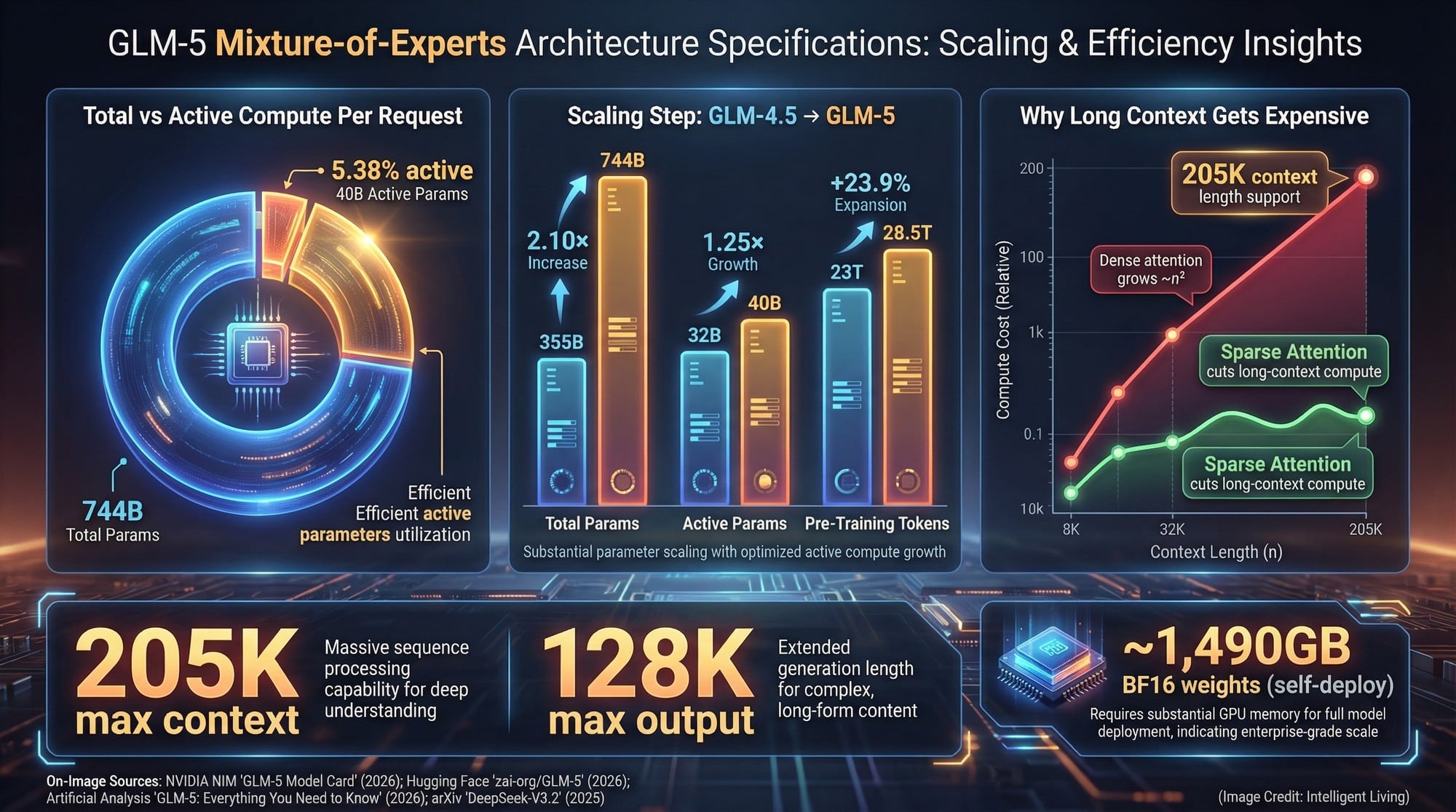
- Developers can now access the 744B mixture-of-experts design through the MIT-licensed GLM-5 weights, which confirms roughly 40B active parameters per request.
- Advanced GLM-5 tool calling and context features support long-horizon engineering tasks by generating structured outputs for programmatic tool integration.
- Vendor-published specs include a 205K maximum context length, pre-training on 28.5T tokens, integration of DeepSeek Sparse Attention, and an asynchronous RL infrastructure called “slime,” alongside the 77.8 SWE-bench Verified number shown on the SWE-bench Verified leaderboard.
- A 200K-plus context window maintains full incident timelines, multi-file change sets, and relevant documentation in active memory without constant chunking.
- Open weights provide more deployment control but do not eliminate verification, testing, or permission boundaries in production workflows.
The Headline Change: From “Vibe Coding” to “Agentic Engineering”
GLM-5 replaces the ‘vibe coding’ era of plausible but unverified snippets with disciplined, agentic engineering. Models are expected to plan multi-step tasks, invoke tools reliably, and maintain state across long documents or repositories. This transition redefines success as a model’s ability to sequence logic and recover state across complex repositories. Correctness is no longer a single snippet’s output but the model’s ability to sequence, verify, and recover across steps. This verification challenge has led researchers to explore adversarial code review protocols where multiple AI agents check each other’s work through structured disagreement.
Defining Agentic Orchestration Within Modern Coding Pipelines
An agentic workflow treats the model less like an autocomplete engine and more like an orchestrator that can break work into steps, call tools, and return structured outputs that downstream systems can safely parse. Z.ai prioritizes thinking modes, function calling, and structured formats, establishing tool calling and structured outputs as essential capabilities rather than optional add-ons.
A pragmatic example shows why this matters. A small team can ship a prototype fast with a code assistant, then lose the next week to brittle assumptions, missing imports, and edge cases that only appear when the whole change lands in CI. An agentic model is trying to reduce that cleanup tax by behaving more like a disciplined workflow: plan first, act in steps, validate, and revise.
Practical Benefits of GLM-5 for Software Engineering Teams
The primary impact appears in high-friction, repetitive workflows: extensive refactor campaigns, test-failure log analysis, and rigid migration checklists. A common voice-search question from engineers sounds like, “What model can handle a large codebase without forgetting earlier constraints?” which is why long context and state retention are now part of the headline.
Technical details regarding long-horizon agent behavior explain the architecture choices Zhipu AI utilized to sustain coherence across multi-file repositories.
Scaling Performance with MoE Architecture and Long-Context Sparse Attention
Architecture in Plain English: 744B MoE, 40B Active, and Why That Matters
Mixture-of-experts (MoE) models optimize performance by routing inputs to specialized subsets of parameters rather than activating the entire network. GLM-5’s 744B design signals a massive representational budget, while the 40B active parameter figure describes the compute used for each request.
GLM-5 builds on established sparse expert routing principles, where only a slice of the model activates per token. This foundation is explored in the Switch Transformers MoE routing paper. Historical context helps explain why active parameters are often a better mental model than total parameters when teams are estimating latency, throughput, and operating costs.
For teams, the practical upshot is cost-versus-capacity tradeoffs. Active-parameter routing reduces steady-state inference costs while preserving specialization. Quantization is a complementary lever, with 1-bit and ternary LLMs now shrinking 27B-class AI to laptop size. This efficiency is why active parameters are a recurring theme in new MoE releases and in comparisons of why active parameters matter for real deployment.
Workflow design remains a secondary practical note. When a model is built to route computation, teams often get the best results by routing tasks too: keep trivial prompts small and reserve the heavy planning mode for repo-scale work.
Managing Long-Context Efficiency with DeepSeek Sparse Attention (DSA)
Standard attention mechanisms struggle with quadratic complexity as context grows. GLM-5 adopts DeepSeek Sparse Attention (DSA) as part of its long-context efficiency stack, reducing compute and memory pressure by focusing attention on the most relevant token relationships rather than treating every past token as equally important.
DeepSeek Sparse Attention (DSA) distinguishes models that maintain coherence across a full codebase from those requiring fragmented chunking. The underlying approach is described in the DeepSeek Sparse Attention method.
A context window is simply the amount of text a model can keep in working memory at once, which is why long-context releases often get framed around how much it can hold without forgetting. Industry shifts toward expanded context windows illustrate the growing demand for deep working memory.
The broader open-weights trend has been moving in this direction, where long context and tool use are paired with efficiency layers so the model can stay useful outside a hyperscale-only budget, a pattern that shows up in the wider open-weights long-context efficiency stack.

Benchmark Performance: Coding Proficiency and Long-Horizon Coherence
Essential AI Coding Benchmarks for Product Development
Defining the SWE-Bench Verified Dataset and Selection Criteria
The SWE-bench Verified benchmark definition describes “Verified” as a curated subset of programming tasks checked by engineers for solvability and correctness. The Verified label signals that results reflect tasks closer to real software engineering work than many generic coding benchmarks.
Environment drift can make a correct patch look wrong, which is why reproducible harnesses and well-scoped tests matter as much as the model itself. Recent discussion of benchmark contamination and limitations has also pushed teams to treat Verified as a useful signal, not a final verdict, which is the core message in OpenAI’s note on SWE-bench evaluation constraints.
Interpreting GLM-5 Performance Scores on SWE-Bench Verified
A reported 77.8 indicates strong performance on Verified tasks, though a single number rarely guarantees a production fit. IBM’s Granite 4.2, by contrast, scored 57.00 on the same benchmark at just 30 billion parameters, demonstrating that smaller open-weights reasoning models can also reach competitive tiers when trained with agentic reinforcement learning. It helps to remember the context of the human-validated 500-task SWE-bench Verified subset. It is designed to reduce evaluation noise rather than replace real CI.
Teams get more value by translating benchmarks into a pilot plan. Effective testing involves a small batch of representative issues where a model must:
- Modify multiple source files across the repository.
- Run localized unit and integration tests.
- Produce a patch that survives strict linting and security checks.
Operational choices also dictate success, such as whether the agent installs dependencies or pulls external documentation. These factors determine how well the model handles real-world complexity.
Beyond raw scores, engineering reality dictates that even an impressive refactor remains unproven without passing integration tests. These validation steps ensure changes align with existing security protocols and team-specific styles.
Evaluating Agentic Task Completion and Narrative Coherence
Independent Validation: Artificial Analysis Agentic Index Results
Independent evaluation from the Artificial Analysis GLM-5 benchmark summary places the model at the top of the open-weights cohort for agentic performance.
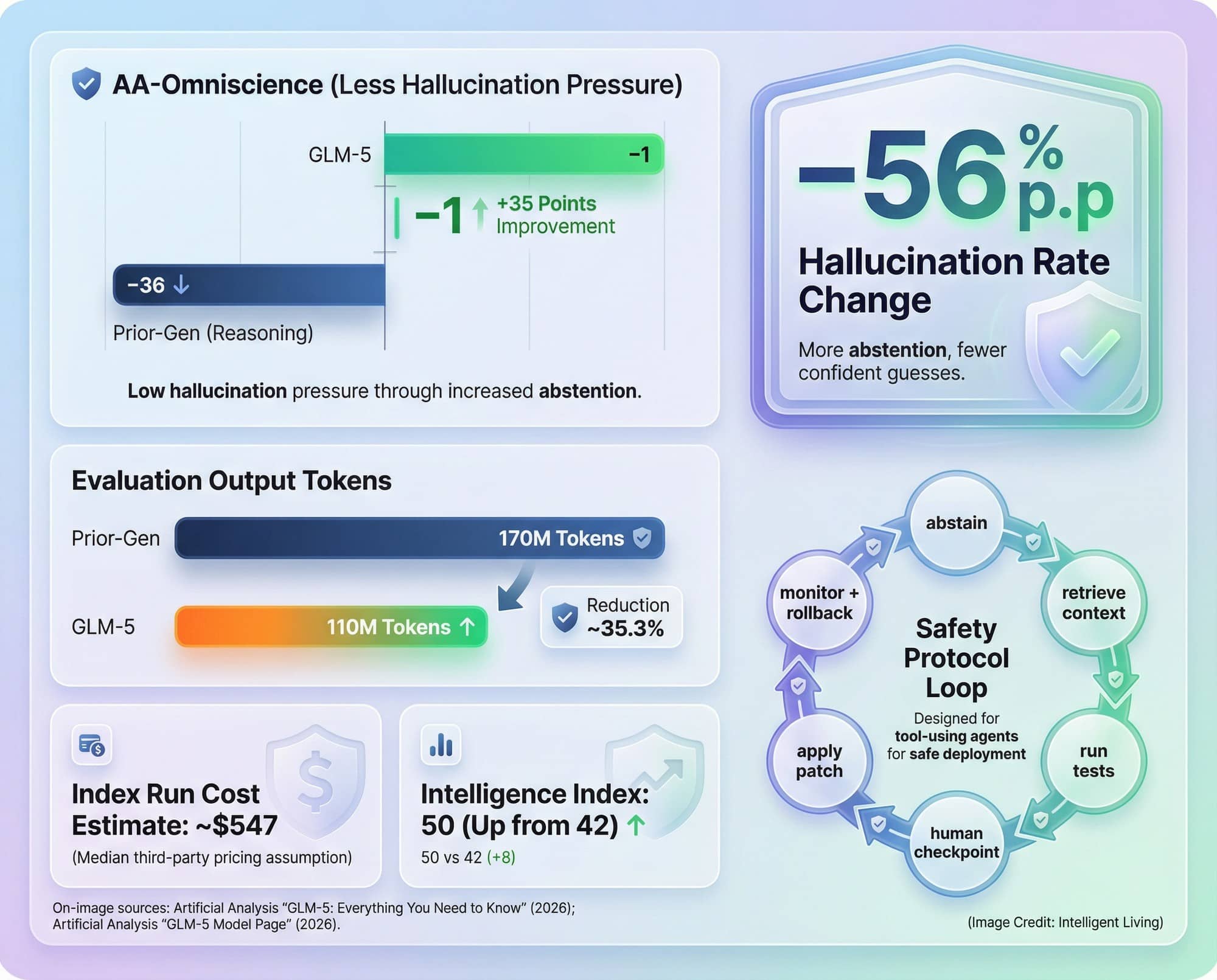
This review highlights a low hallucination pressure. The model abstains more often instead of guessing, which reduces downstream debugging churn when encountering ambiguous requirements.
Think about these scores through a single question: does the agent verify its work, or does it guess to be helpful? In production, helpfully-at-all-costs often increases manual verification overhead in production environments.
Simulating Real-World Business Environments with Vending-Bench 2
The year-long Vending-Bench 2 simulation describes a business environment where success depends on maintaining goals, tracking constraints, and adapting decisions over time. That is a useful proxy for agentic work that spans many steps, such as multi-stage migrations, incident response playbooks, or refactor campaigns that unfold over weeks.
A small but relatable pattern shows up here. A product manager has seen onboarding automations fail when each step forgets the last, forcing humans to restate constraints repeatedly. Long-horizon coherence is the opposite: fewer resets, more continuity, and fewer tiny errors that snowball.
Additional Benchmarks for Terminal Interaction and Browser Persistence
Long-horizon agents are often evaluated on tasks that look like real computer use rather than pure text generation. In Terminal-Bench 2.0, success requires interacting with dockerized terminal environments and passing test scripts, which is why it is described as a benchmark for terminal-based agent task completion. BrowseComp is another angle on persistence, measuring whether a model can hunt down a hard-to-find fact online using targeted search strategies, captured in OpenAI’s overview of browsing agent evaluation.
Establishing Model Reliability through Abstention and Safety Protocols
Balancing Reliable Output with the Trust by Refusal Tradeoff
A model that can call tools and edit files changes what failure looks like. In those contexts, refusal can be safer than confident, incorrect output. The tradeoff is experience: abstention can feel slower or less helpful on simple questions, and teams need fallbacks that convert “I’m not sure” into a verification step rather than a dead end.
Reliability, ethics, and operational costs converge when teams move from experimentation to production integration. AI code hallucinations increase operational risk by forcing teams to spend resources on unverified changes, a theme explored through how hallucinated code turns into rework and risk.
Some teams treat agent output like a junior engineer’s draft: useful, fast, and never merged without tests.
Accelerating Behavior Refinement with the Slime Asynchronous RL Framework
Slime is an asynchronous reinforcement learning infrastructure used in GLM-5’s post-training iteration loop, designed to increase training throughput and speed up behavior refinement. Training supports frequent cycles of try, evaluate, and adjust, which matters when the goal is stable tool use and predictable multi-step planning. The implementation is described in the slime asynchronous RL framework.
Large-scale training and post-training work also depend on storage and I/O systems that can keep GPU clusters fed, a quieter part of the stack that often determines iteration speed, including high-throughput patterns discussed in parallel file systems for big-model training.

Deployment Strategies and Operational Guardrails for GLM-5
Evaluating Deployment Realities and Global Hardware Constraints
Optimized Deployment via Managed Packaging and NVIDIA NIM APIs
Managed packaging offers the most efficient path for testing GLM-5 by standardizing deployment and minimizing integration overhead. Managed endpoints accelerate initial evaluation by removing self-hosting overhead through the NVIDIA NIM GLM-5 API reference.
Hosted endpoints can also shorten the first test cycle. The GLM-5 hosted API option is one example of a provider surface that lets teams benchmark workflows without self-hosting first.
Hardware Requirements for Local Inference and Self-Hosting
Open weights do not mean lightweight hardware. High-capacity models require data-center GPUs or precise quantization, especially for long-context agentic planning. Modern low-bit compression makes these deployments more practical, as detailed in the rise of quantization stacks like AutoRound and low-bit inference.
Compact systems with large unified memory are expanding local experimentation options. A breakdown of desktop-class mini AI supercomputers explores current performance ceilings for these setups.
Speed also matters when agents run many short tool calls. Purpose-built hardware efforts have been chasing real-time inference to reduce the wait between steps, part of the broader race toward real-time tokens per second.
Teams that need predictable latency often end up tuning kernels and memory paths, which is why practical ideas for CUDA kernel tuning and GPU performance work show up alongside model news more often than people expect.
When cost is part of the decision, public dashboards help teams sanity-check assumptions about price, speed, and verbosity across providers, including the GLM-5 performance and price analysis.
Geographic Supply Chain Implications for AI Accelerator Procurement
Geographical factors determine where large-scale deployments are feasible under export constraints, as Reuters reported in its GLM-5 launch coverage.
Standardized packaging layers ensure teams spend less time fighting deployment mechanics and more time evaluating whether the model helps their work, which aligns with how NIM packaging can reduce integration friction.
Practical Evaluation Checklist for Implementing GLM-5 Workflows
- Define the Task Scale: Reserve GLM-5 for long-horizon planning and multi-step engineering tasks rather than quick trivia.
- Pilot Through a Controlled Surface: Start with managed deployment or a provider endpoint so telemetry, rate limits, and safety controls are in place before deeper integration.
- Design for Abstention: Convert refusals into verification steps using retrieval, test harnesses, and human review checkpoints.
- Automate Testing: Enforce inference cost optimization by requiring unit and integration tests to pass before any generated change is merged.
- Govern Tool Calls: Improve tool calling reliability by logging every external action and treating tool invocation as a strictly auditable interface.
Teams that treat agents as governed workflows lean on tool catalogs, permission boundaries, and explicit review checkpoints as standard operating procedure, a theme reflected in enterprise agent workflow controls and MCP-style tooling.

Maximizing Engineering Velocity with GLM-5 Agentic Workflows
Streamlining long-horizon tasks necessitates a foundation of rigorous verification. While GLM-5 automates complex workflows, it demands disciplined engineering loops—including robust telemetry and strict tool permissions—to prevent technical debt. Teams that maintain strict tool permissions and robust telemetry will find this model a powerful ally in reducing the ‘cleanup tax’ often associated with large-scale code migrations.
Advanced GPU-accelerated engineering pipelines demonstrate how agentic logic can serve as a genuine productivity multiplier when governed correctly. By treating GLM-5 as a governed orchestrator rather than a simple autocomplete engine, engineering leads can secure more reliable outcomes while maintaining complete deployment control.
GLM-5 Technical FAQ: Deployment and Performance
1. What is the active parameter count for GLM-5 during inference?
GLM-5 uses a 744B mixture-of-experts architecture but only activates roughly 40 billion parameters per request to optimize speed and cost.
2. Does GLM-5 support autonomous debugging in long contexts?
Yes. The model is optimized for agentic workflows, multi-stage planning, and maintaining state across its 200K-plus context window.
3. How does DeepSeek Sparse Attention (DSA) improve efficiency?
DSA reduces compute and memory pressure by focusing on relevant token relationships, preventing the performance degradation often seen in long-context models.
4. Can I deploy GLM-5 on local hardware?
GLM-5 is an open-weights model, but its size typically requires data-center-class GPUs or advanced quantization stacks like AutoRound for local testing.
5. Is GLM-5 compatible with SWE-bench Verified benchmarks?
GLM-5 identifies its own limitations by:
- Refusing ambiguous requests.
- Highlighting missing context.
- Flagging uncertain outputs for human review.


