
Carrying revolving credit balances costs more now than at any point in recent history. Average credit card interest rates near 21 percent mean small financial oversights compound into major liabilities almost overnight. Data from the New York Fed Q4 2025 household debt update shows total liabilities reaching $18.8 trillion, with credit card balances making “small” interest leaks feel like monthly rent.
Debt inventory guides convert financial uncertainty into a single source of truth, plugging interest leaks and establishing a stable payoff path within thirty days. Practical debt payoff strategies help readers select a path to stabilize finances within a single month.
Immediate action secures the relief necessary to stop aggressive interest compounding. Proactive planning helps readers evade the minimum payment trap and protects long-term wealth from aggressive interest compounding.

High-Interest Debt Reality Check: Credit Card APRs, Minimum Payment Traps, and the Debt Map Reset
Quick Facts: Credit Card APR Reality and Debt Payoff Basics
- Average bank credit card rates currently hover near 21 percent, driving the cost of revolving balances to extreme highs.
- Latest household credit metrics indicate credit card balances remain elevated through 2026.
- Reliable debt inventories utilize CFPB tracking fields to ensure no obligations are overlooked.
- Prioritizing monthly bills during lean cycles reduces chaos when expenses outpace income.
The High-Interest Era: Why “Just Pay the Minimum” Breaks Down
Minimum payments maintain account standing but fail to impact principal. Persistent minimum-only payments inflate total interest and extend payoff horizons for years, a reality documented in analyses of how minimum payments stretch payoff timelines. Statement disclosures clarify why minimum payments fail to reduce principal balances significantly.
One household’s recovery process illustrates the impact of reallocation:
- Identified that nearly all monthly payments were consumed by interest.
- Compiled a total monthly minimum baseline to negotiate a hardship plan.
- Reallocated freed cash to principal, reducing interest charges by the next cycle.
Strategic Overview: Creating a One-Page Debt Map Reset
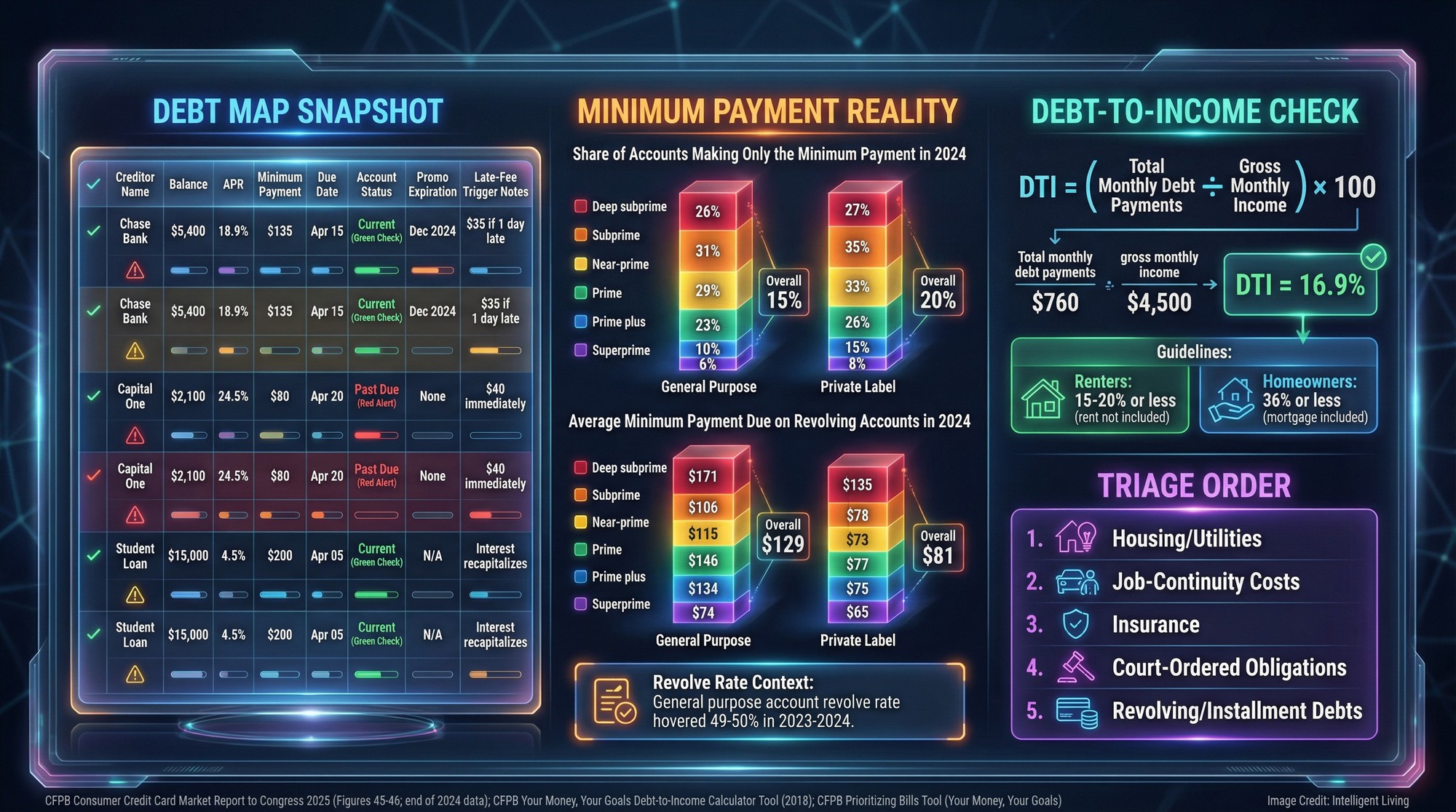
- Create a one-page map listing each account and the five critical data points: creditor, outstanding balance, APR, minimum payment, and due date, using the debt worksheet fields as the template.
- Include a second column for special notes: late-fee triggers, promotional APR expiration, and the rules on when a credit card payment is considered late.
- Calculate a total monthly minimum baseline.
- Pressure-test obligations against income utilizing the debt-to-income calculator tool.
The Debt Map Reset Method: Inventory Triage, APR Cuts, Payoff Strategy, and Trap-Proofing
Step 1: Build Your Debt Inventory “Map”
What to Collect and Why
Document balances, APRs, and due dates from recent statements while noting penalty triggers or scheduled rate increases. The debt log tool provided by the CFPB matches these fields and captures the exact information needed to make a payoff plan work.
How to Keep the Map Usable
Consistent weekly reviews require a single sheet or spreadsheet. Specialized debt tracking tool that keeps APR and due dates visible provides the raw financial data often obscured by generic dashboards. Utilizing debt consolidation planning tools that centralize balances and payments helps centralize balances while preserving the critical details of your inventory. Auditing recurring expenses and seasonal bills reveals quiet cash flow leaks caused by forgotten subscriptions.
Minimal Anecdote: Tracking every payment for sixty days revealed a forgotten high-APR store card. Closing that account and shifting the funds significantly reduced monthly interest outflows.
Step 2: Triage When You Can’t Pay Everything
Consequence-Based Prioritization
Payment orders must reflect the severity of consequences:
- Housing and Utilities: Essential to maintain safety; immediate consequences for non-payment are severe.
- Transportation and Essential Insurance: Critical for maintaining employment and basic mobility.
- High-Risk Creditors: Obligations with judgment or repossession risk follow essential services using a prioritizing bills tool.
Practical Weekly Ritual
A 10-minute weekly review reconciles the debt map against incoming pay, identifying which creditors require immediate contact for hardship or temporary repayment plans. managing variable earnings simplifies the triage routine for freelancers and gig workers. organizing household finances reduces decision fatigue for single parents during tight weeks. overcoming financial hardship requires keeping decisions focused strictly on essential obligations.
Anecdote: Weekly checks prioritized for rent and utilities allowed a freelancer to predict shortfalls early. This consistency enabled proactive creditor negotiations and eliminated recurring late fees.

Step 3: Reduce APR and Fees Before You Pay Extra
Why Contacting Creditors Early Works
Initiating contact before a missed payment frequently secures hardship programs, lower rates, or fee waivers. Proactive outreach prevents the damage of penalty APRs and establishes structured repayment. Initiating direct creditor negotiations with your credit card company first reflects the preferred starting point for many major issuers.
How to Structure the Call
Employ a concise, factual script identifying the account and explaining the shortfall to request hardship options or temporary rate reductions. Negotiation is often more effective when the request is specific, and negotiating debt repayment using practical debt repayment and negotiation steps allows consumers to secure manageable terms without third-party fees.
Considerations for Balance Transfers and Consolidation
Balance transfers and consolidation loans offer lower APRs but introduce specific risks:
- Expiring introductory rates that trigger significant interest spikes.
- Origination or transfer fees that inflate the initial balance.
- Extended terms that increase total interest paid over time.
Analyze loan APR and fee terms to confirm before signing to detect hidden costs that escalate after the initial agreement. High utilization of personal loans can affect credit score factors, a critical factor. Stable payments allow for automated bill payment via financial automation routines that reduce missed-payment risks more effectively than willpower alone.
Anecdote: Directly requesting temporary rate reductions resulted in three billing cycles of lower APR. These savings were immediately redirected toward reducing principal balances.
Step 4: Choose Snowball, Avalanche, or a Hybrid
Avalanche: Interest-Optimal
Avalanche methods minimize interest costs by prioritizing the highest APR first. Maximizing mathematical efficiency requires directing all surplus funds to the highest-rate balance while maintaining minimums on remaining accounts, matching the repayment logic in credit card cost basics.
Snowball: Motivation-Optimal
Snowball methods prioritize the smallest balances first to secure psychological momentum. Visible wins encourage behavioral adherence during unexpected work halts or financial strain.
A Simple Hybrid Rule
Choosing between debt payoff models using two common debt payoff strategies allows you to select the strategy that matches your behavioral risk. Utilizing a reducing debt worksheet models different strategies with your existing data. Sustainable monthly plans utilize a monthly debt plan that matches cash flow structures that account for fixed bills, minimums, and a realistic extra payment.
Anecdote: Eliminating a small store card balance provides the psychological momentum required to sustain complex avalanche schedules.

Step 5: Evade Predatory Lending Cycles and High-Fee Installment Traps
How the Rollover Trap Works
High-fee lending should be an absolute last resort. Prioritize alternatives that preserve capital:
- Negotiation with existing creditors for temporary hardship terms.
- Utilization of lower-cost alternatives to a cash advance to avoid high-fee cycles.
- Consequence-based triage to ensure essential bills are paid first.
Payday and installment loans trigger predatory rollover cycles that generate recurring fees and overdraft charges often exceeding the original loan amount. Continuous rollover fees despite protections create a trap where fees quickly exceed the original principal. Analyzing the online payday loan APR premium common in the online payday lending market provides a sense of scale for these costs.
Immediate Protections and What to Watch For
Navigating small-loan regulations requires attention to shifting enforcement priorities and state-level protections:
- New installment protections regulate aggressive bank withdrawal practices for rules that took effect March 30, 2025.
- Federal enforcement shifts via regulatory relief for small-loan providers clarify current priorities for small-loan oversight.
- Analysis reveals that payday loans cost far more in states with few protections and escalate significantly in states with limited oversight.
Breaking the stopping, repeating payday borrowing cycle requires starting with a clear triage plan.
Anecdote: Repeated short-term borrowing resulted in overdraft fees exceeding the original loan principal. Adopting a triage plan eliminated the need for secondary loans and preserved household capital.
Step 6: If Collections Are Involved, Use the Calm Protocol
Validation and the 30-Day Dispute Window
Securing your rights during collector contact involves specific procedural steps:
- Request debt validation immediately to scrutinize all documentation via debt validation details.
- Verify legitimacy using required collector disclosures before initiating payment.
- Mandatory collection pauses triggered by collection must pause after a written dispute takes effect upon submission of a written dispute.
Protections established by 15 U.S.C. § 1692g govern validation windows.
What to Send and How to Keep Records
Comprehensive record-keeping protects your legal rights:
- Dispatch all notices via certified mail for tracking purposes.
- Log every call with the date, time, and representative’s name.
- Maintain digital and physical copies of all provided documentation.
Utilizing debt collection forms and sample letters ensures a professional documentation trail.
Anecdote: Submitting a documented dispute letter following a collection notice revealed a double-billing error. The subsequent correction reduced the outstanding balance and terminated follow-up attempts.
Step 7: Engaging Accredited Credit Counseling the Safe Way
What a Credit Counseling Agency Does
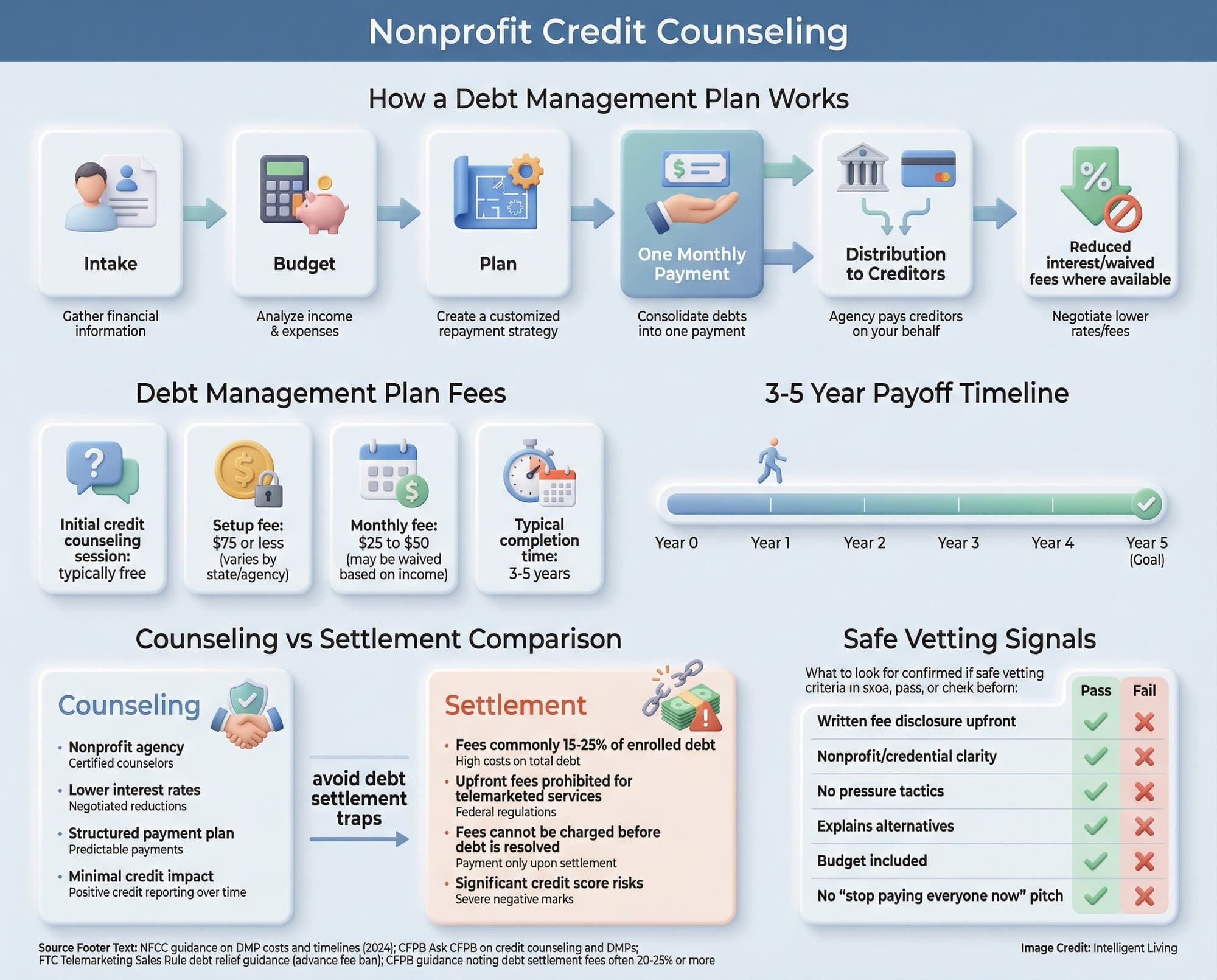
Reputable counseling programs using credit counseling and debt management plans provide budgeting assistance distinct from settlement, consolidation, or credit repair services. Evaluating relief options through credit counseling versus debt settlement and consolidation ensures you understand these critical differences.
How to Vet Counselors
Verify certification and fee transparency to ensure agency legitimacy. FTC checklists identify critical red flags when selecting a counselor:
- High-pressure tactics to enroll in specific plans.
- Hidden fees undisclosed prior to official onboarding.
- Refusal to provide clear, written fee schedules.
Using the NFCC nonprofit counselor directory or FCAA credit counselor finder ensures you avoid predatory providers.
Avoiding Debt Relief and Settlement Traps
Debt settlement and relief programs carry substantial risks:
- Escalating fees and credit damage occur during extended negotiation periods.
- Rigorous vetting of debt relief services via debt relief programs prevents exposure to harmful programs.
- Prepaid service fee prohibitions through advance fees before results protect consumers.
Anecdote: Selecting a certified nonprofit agency ensured access to transparent fee schedules and viable alternatives. This path successfully avoided high-cost predatory settlement pitches.

The 14-Day Debt Reset: Turn the Plan into a Repeatable System
Days 1–3: Debt Map Construction
Log all accounts using the five core fields and calculate total minimum obligations. Visibility of the debt map ensures consistent updates when paired with automated review reminders.
Days 4–7: Triage and Outreach – Execute Consequence-Based Prioritization
- Contact creditors individually to negotiate temporary options.
- Immediate debt communication via acting fast if you can’t pay your credit cards ensures productive conversations; secure all agreements in writing.
Days 8–14: Lock in the Engine and Trap-Proof
Decide on snowball, avalanche, or a hybrid strategy. Run loan math against the triage plan before considering short-term lending. Applying key facts for saving money frees capital for principal reduction without requiring a total lifestyle overhaul.
Anecdote: Strict adherence to the 14-day schedule allowed one household to bypass high-fee loans in week two. The resulting savings were applied directly to a small balance payoff.

Sustainable Systems for Long-Term High-Interest Debt Relief
Repeatable systems minimize interest and block high-fee debt loops. Integrating a debt map, budget stabilization, and a habit-aligned payoff engine reduces the stress of rising rates while preventing emergency borrowing.
Financial automation routines safeguard long-term progress against unexpected financial resets. rebuilding credit and routines after bankruptcy proves that rigorous structure consistently outperforms panic during crisis. Commit to the process today to see your principal balance reduction accelerate every month.
FAQ: Expert Answers on Debt Payoff and Interest Management
Optimal Debt Ordering Strategies for Similar Interest Rates:
- Balance-Based Ordering: Target the smallest balances first to secure psychological momentum and visible wins.
- Stress-Based Ordering: Prioritize the most mentally taxing accounts to eliminate decision fatigue and sustain focus.
Will calling a creditor hurt chances of getting a lower rate?
Proactive outreach rarely impacts eligibility for improved terms. Factual discussions of hardship frequently secure fee waivers or APR reductions if initiated prior to a missed payment.
Is a debt management plan the same as debt settlement?
Debt management plans utilize nonprofit counselors to distribute monthly payments and lower interest rates. Settlement programs negotiate lower total balances but often impose significant credit score risks.
What if a debt collector or creditor sues?
Preparation for legal action involves specific steps:
- Identify deadlines by reviewing the legal stages of debt collection via what typically triggers a credit card lawsuit timeline.
- File a formal defense or negotiate a settlement prior to scheduled court dates.
How to get free copies of credit reports and dispute errors?
obtaining free credit reports via how to get a free copy of your credit reports is possible through federally authorized channels. correcting reporting inaccuracies via disputing credit report errors ensures your credit profile remains accurate.


