
Modern scientific computing faces a fundamental structural bottleneck: physical simulations demand massive double-precision math across tightly coupled processors, while artificial intelligence models consume vast streams of lower-precision data that choke conventional storage and memory buses. Building separate machines for each workload wastes power, floor space, and research time. With the launch of the Horizon supercomputer at the Texas Advanced Computing Center (TACC) at The University of Texas at Austin, engineers have wired high-density simulation and large-scale AI training into a single liquid-cooled architecture.
On November 17, 2026, TACC opened the Horizon system to early users, marking the operational debut of the most powerful academic supercomputer in the United States. Even in its initial deployment phase, the machine ranks among the top systems globally while giving university researchers an immediate 10-fold leap in simulation capability over its predecessor, Frontera. Understanding how Horizon achieves those numbers requires separating the hardware running today in Phase One from the full system expansion scheduled for early 2027.
Horizon Is Open: Early Access Versus the Full System
Supercomputers of this scale rarely flip on all at once. TACC is bringing the Horizon supercomputer online in two distinct hardware phases so researchers can begin running code on the graphical processing units (GPUs) immediately while engineers prepare the second-stage central processing unit (CPU) expansion.
What went live on November 17, 2026, is Phase One: a 4,000-GPU partition built on the NVIDIA Grace Blackwell platform inside Dell PowerEdge XE8712 servers. That single deployment far exceeds the GPU capacity of any previous TACC machine. Combined with existing systems on campus, Horizon pushes TACC’s active fleet to nearly 5,500 GPUs, representing the highest concentration of academic GPU computing at any university in the United States.
Horizon serves as the flagship hardware for the National Science Foundation Leadership-Class Computing Facility (NSF LCCF), backed by NSF Award #2323116. For the federal agency, the rollout marks a historic milestone in open-science infrastructure.
“With Horizon, NSF is making its biggest-ever investment in computing infrastructure, and we cannot wait to see the discoveries it makes possible,” said Katie Antypas, senior advisor for the NSF Directorate for Computer and Information Science and Engineering. “After years of planning and building, it is exciting to finally put this system into the hands of researchers.”
During this early-access window, research teams are stress-testing the 4,000-GPU fabric, scaling scientific codes, and validating data pipelines. Phase Two arrives in early 2027, when TACC will install dedicated servers powered by NVIDIA Vera CPUs. Once those CPU racks are integrated into the high-speed network, total sustained system performance will climb further, completing the balanced architecture designed for the full NSF LCCF production lifecycle.
By the Numbers: What 132 Petaflops Actually Means
When evaluating characteristics of supercomputers, headlines often blur three different measurements: sustained benchmark speed, theoretical peak hardware speed, and projected multi-phase targets. Horizon’s initial entry on the November 2026 TOP500 rankings makes the distinction between live performance and future capacity clear.
On the High-Performance Linpack (HPL) benchmark, which tests how fast a system solves dense linear equations using 64-bit floating-point arithmetic, Horizon’s live GPU partition recorded a sustained speed (Rmax) of 132.00 petaflops, or 132 quadrillion calculations per second. According to its official TOP500 system profile, that measured output earned Horizon the No. 24 spot globally and made it the fastest academic supercomputer in America.
That 132-petaflop figure reflects real-world execution across 144,000 total cores running Rocky Linux 10.2, combining 72-core Grace processors clocked at 3.1 GHz with Blackwell accelerators in a GB200 NVL4 configuration. By contrast, the machine’s theoretical peak performance (Rpeak) on the TOP500 test sits at 167.14 petaflops, while TACC’s Horizon system specifications list general GPU peak guidance at 140 petaflops and project a combined 180 petaflops once the Phase Two Vera CPU servers are added in early 2027.
| System | GPU / CPU Base | Key Performance | Status |
|---|---|---|---|
| Horizon Phase One (live Nov 2026) | 4,000 NVIDIA Grace Blackwell GPUs, Dell PowerEdge XE8712 GB200 NVL4 | 132 HPL petaflops measured, Rpeak 167.14, No. 24 TOP500 Nov 2026 | Early access |
| Horizon Full (projected early 2027+) | Adds NVIDIA Vera CPUs | 140 GPU peak petaFLOPS, 180 combined projected | Phase Two pending |
| Vista (prototype) | 600 NVIDIA Grace Hopper Superchips | First non-x86 TACC system in nearly 20 years | Production, proving ground |
| Frontera (retired) | Former No. 1 academic US supercomputer | Baseline reference system | Retired Oct 2026 after 8M+ jobs; Horizon offers 10x simulation |
Built for AI and Simulation Together
Traditional physical simulations rely on 64-bit precision so rounding errors do not distort climate models, seismic waves, or subatomic particle interactions over millions of time steps. Modern artificial intelligence works differently. Training neural networks and running inference can use smaller 16-bit or 4-bit numbers without losing accuracy, allowing specialized tensor cores to process vastly more operations per watt.
While some national computing programs have explored CPU-only exascale designs to prioritize general-purpose code sovereignty, TACC engineered the Horizon HPC platform around tightly coupled Grace Blackwell hybrid nodes. In lower-precision workloads, Horizon delivers 20 exaFLOPS of BF16/FP16 artificial intelligence compute and 80 exaFLOPS of FP4 AI performance. That represents more than a 100-fold improvement in AI throughput over TACC’s previous flagship generation.
“We have built an engine for discovery, a balanced system for both AI and simulation, which will unlock entirely new approaches to scientific problems and fundamentally change the pace and scale at which science is done,” said Dan Stanzione, executive director of TACC.
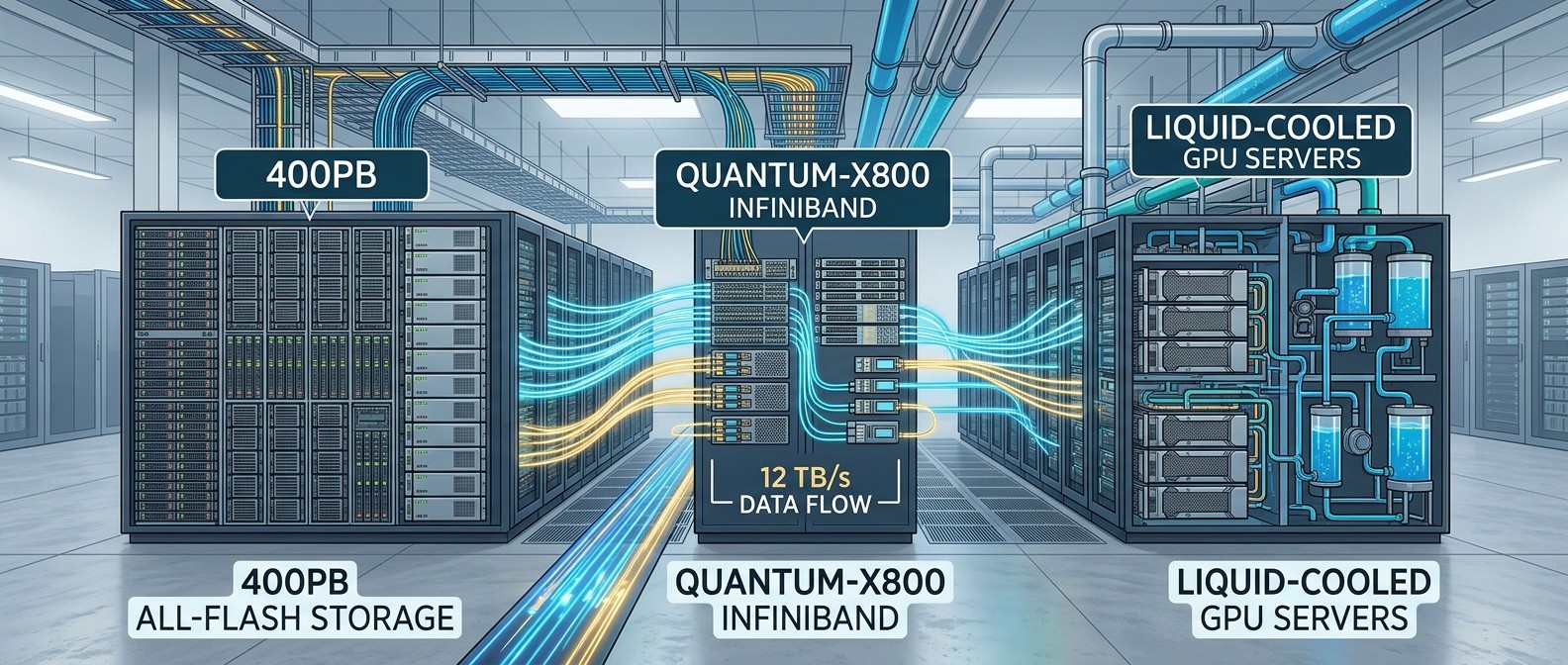
Keeping 4,000 GPUs fed with data requires eliminating storage and networking bottlenecks that normally throttle large runs. If processors have to wait milliseconds for data to arrive from spinning hard drives, most of those exaFLOPS sit idle. Horizon solves this input-output constraint through four interlocking subsystems built in partnership with Dell Technologies, NVIDIA, VAST Data, Spectra Logic, Versity, and Sabey Data Centers:
- In-network computing fabric: Nodes communicate across an NVIDIA Quantum-X800 InfiniBand interconnect that performs data aggregation inside the network switches themselves, cutting latency during massive parallel runs.
- All-flash local storage: A 400-petabyte all-solid-state storage layer built on the VAST AI Operating System sustains read speeds well above 12 terabytes per second, backed by multi-tenancy and quality-of-service (QoS) controls so one massive AI training job cannot starve smaller simulation runs.
- Energy efficiency gains: Architectural leaps in the Grace Blackwell platform make the system up to 6 times more energy efficient than prior-generation hardware per unit of compute.
- Liquid-cooled facility footprint: Horizon operates inside a 20-megawatt Sabey data center in Round Rock, Texas, using direct liquid cooling and low-cost renewable power to reject heat far more effectively than chilled-air server rooms.
“Bringing accelerated computing and simulation together at this transformative scale lets scientists explore more ideas and tackle problems that were once beyond their reach,” said Ian Buck, vice president of hyperscale and high-performance computing at NVIDIA.
Vista Was the Dress Rehearsal
Jumping straight from legacy CPU clusters to a 4,000-GPU Grace Blackwell machine would have stalled hundreds of active university research groups. For nearly two decades, TACC’s primary supercomputers ran on x86 processor architectures. Horizon breaks from that lineage by adopting Arm-based NVIDIA Grace CPUs paired directly with Blackwell GPUs over high-bandwidth chip-to-chip links.
To prevent a software bottleneck on day one, TACC first deployed the Vista prototype system. Equipped with 600 NVIDIA Grace Hopper Superchips, Vista acted as a live engineering proving ground where TACC staff and academic teams ported legacy simulation codes to Arm, tuned tighter CPU-GPU memory sharing, tested storage workflows, and refined large-scale AI training and inference routines before Horizon’s racks arrived.
That preparation was critical because Horizon replaces a workhorse of American academic science. In October 2026, TACC retired Frontera after more than seven years of service. Having entered production in June 2019 as the first phase of the LCCF initiative, Frontera became TACC’s longest-running system and executed more than 8 million computational jobs over its lifespan. With Frontera offline, Horizon joins TACC’s active computing and storage fleet alongside Vista, Lonestar6, Stampede3, Jetstream2, Ranch, and Corral, stepping in with 10 times the simulation capability of the retired flagship.
“Horizon is the centerpiece of the NSF LCCF, and it is only part of the story,” said John West, deputy director of the NSF LCCF. “Alongside it, we are building the software, storage, user support, training, and partnerships across the country that will help researchers turn its power into discovery.”
What Scientists Will Actually Do With It
Raw petaflops and exaFLOPS only matter when they compress the time it takes to solve complex physical problems. When supercomputer hours are scarce, scientists must simplify their models by using coarser spatial grids, shorter time horizons, or smaller molecular samples. Expanding both memory bandwidth and compute density allows researchers to simulate complete physical systems at full resolution.
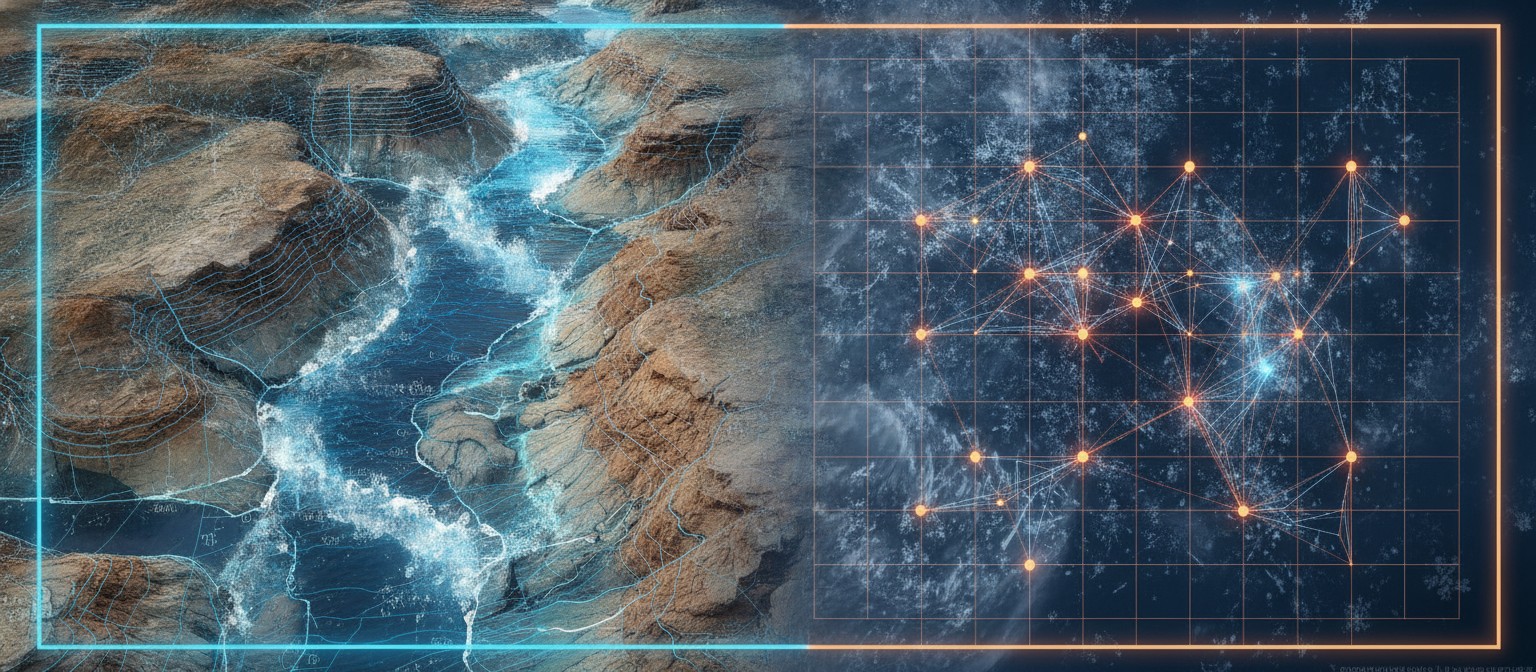
Fernanda Leite, vice president for research at UT Austin, highlighted three immediate areas where the university and national research community will apply the system:
- Flash flood forecasting: Tracing how extreme rainfall moves through every creek and tributary of the Texas Hill Country watershed to improve warning lead times.
- Power grid resilience: Running high-resolution stress tests on the Texas electrical grid to identify failure points before the next severe winter storm hits.
- Disease treatment timelines: Analyzing massive biological datasets to accelerate how quickly researchers identify and validate new medical treatments.
Biomedical researchers already have a clear precedent for how leadership-class machines compress discovery schedules, much like earlier supercomputers screening drug compounds narrowed thousands of molecular possibilities down to viable candidates in days rather than months. By merging physical molecular dynamics with generative AI models on the same nodes, Horizon lets biophysicists simulate how candidate proteins fold and bind in a single continuous workflow.
Beyond those immediate projects, early-access and production allocations on Horizon will span earthquake science, quantum materials, lattice quantum chromodynamics (QCD), medicine, biophysics, and observational astronomy. Across previous hardware generations, TACC systems have supported more than 130,000 students and researchers nationwide. Those allocations have underpinned results ranging from stronger hurricane building codes to fundamental astrophysics, including computational support for the IceCube Neutrino Observatory work on high-energy cosmic neutrinos that earned physicist Francis Halzen a share of the 2026 Nobel Prize in Physics.
Frequently Asked Questions
Is Horizon the fastest supercomputer in the world?
No. On the November 2026 TOP500 list, the Horizon supercomputer ranks No. 24 in the world with a measured High-Performance Linpack speed of 132 petaflops. However, it is the most powerful academic (university-operated) supercomputer in the United States, ahead of any other US campus system.
When will the full Horizon system be ready?
Horizon opened its Phase One 4,000-GPU partition to early users on November 17, 2026. Phase Two is scheduled for early 2027, when TACC will add servers powered by NVIDIA Vera CPUs, pushing the machine toward its projected 180-petaflop combined GPU and CPU performance target.
Who gets to use Horizon and who paid for it?
Horizon is funded by the National Science Foundation under NSF Award #2323116 as the centerpiece of the NSF Leadership-Class Computing Facility (LCCF), representing the agency’s largest-ever computing infrastructure investment. It serves academic and open-science researchers across the United States, building on a TACC user community of more than 130,000 researchers and students.
How does Horizon compare to Frontera and Vista?
Frontera was TACC’s previous flagship supercomputer, retiring in October 2026 after more than seven years and 8 million jobs; Horizon delivers 10 times Frontera’s simulation performance and over 100 times its AI performance. Vista is a 600-chip NVIDIA Grace Hopper system that served as the non-x86 software and architecture proving ground for Horizon.


