
For decades, psychiatrists and neuroscientists have faced a frustrating physical trade-off when trying to electrically tune the brain’s mood circuits. Coils and electrodes placed on the outside of the head can easily reach the outer bark of the brain, but their signals fade or scatter before reaching the deeper emotional and reward centers buried beneath. Reaching those inner structures directly has traditionally required surgical deep brain stimulation, an invasive procedure that threads wires through the skull. Now, researchers in China have demonstrated that a technique using overlapping high-frequency electrical currents delivered entirely through scalp electrodes can reach a deep reward hub, improve how people learn from positive feedback, and modestly reduce depressive symptoms in adults with subclinical depression.
Published on November 18, 2026, in Science Translational Medicine, the human study tested transcranial temporal interference stimulation (tTIS) across 145 participants in two randomized, sham-controlled experiments. By tuning the overlapping currents to create a gentle 10-hertz rhythm deep inside the ventromedial prefrontal cortex, the team nudged a sluggish reward circuit back toward responsiveness after just three 20-minute sessions, with symptom improvements holding at a seven-day check-in. The trial deliberately enrolled people with mild-to-moderate, subclinical depressive symptoms rather than diagnosed major depressive disorder, making the work an early human proof of concept rather than a ready-to-prescribe clinic treatment.
What the Chinese Team Actually Did
The investigation was led by Professor Tu Yiheng at the Institute of Psychology of the Chinese Academy of Sciences, in collaboration with Professor Peng Weiwei at Shenzhen University, with Wang Feixue serving as first author. According to the Chinese Academy of Sciences announcement and the PubMed study record, the authors set out to solve two linked problems in non-invasive brain stimulation for depression: identifying the exact electrical language the brain uses when updating positive expectations, and testing whether delivering that exact rhythm to a deep target could shift both behavior and mood.
Rather than jumping straight into a clinical trial with an arbitrary electrical setting, the team structured the study in three deliberate stages:
- Circuit mapping: Combining functional magnetic resonance imaging (fMRI), electroencephalography (EEG), and computational modeling to watch how deep brain regions communicate while volunteers learn from monetary rewards and losses.
- Healthy behavioral and scanner testing: A randomized, single-blind, sham-controlled experiment in 76 healthy adults comparing 10-hertz stimulation, 5-hertz stimulation, and sham stimulation during a decision-making task, alongside simultaneous tTIS and fMRI scans in a subset of 37 participants to verify the circuit changes inside the scanner.
- Subclinical depression trial: A randomized, double-blind, sham-controlled trial in 69 adults with subclinical depression (entering with an average Beck Depression Inventory score around 16) who received 20 minutes of stimulation per day for three consecutive days, followed by assessments immediately after the final session and seven days later.
How Temporal Interference Reaches Deep Without Surgery
Standard electrical currents applied to the scalp face a basic physics hurdle. Low-frequency currents, the kind that match the brain’s natural 1-to-30-hertz rhythms, stimulate the superficial cortex right under the skull long before they can penetrate deeper tissues. Turning up the power only activates pain nerves in the scalp and fires off surface neurons indiscriminately. Because of this barrier, interest in non-invasive deep brain stimulation for depression and non-invasive deep brain stimulation for Parkinson’s and other circuit disorders has increasingly focused on ways to slip energy past the outer cortex without triggering it.
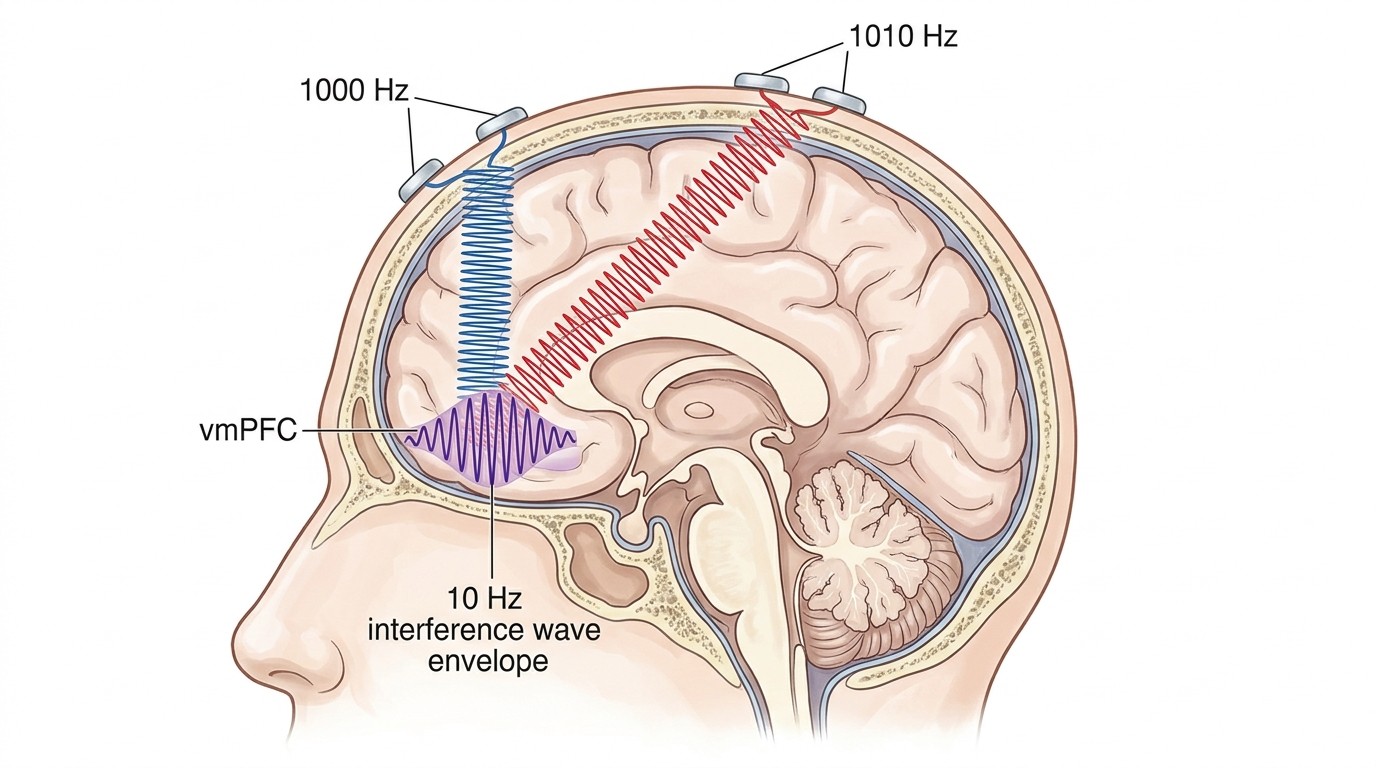
Temporal interference stimulation works around the surface barrier by exploiting how neurons respond to speed. Neurons essentially ignore electrical currents oscillating in the kilohertz range (thousands of cycles per second) because their membranes cannot fire fast enough to keep up. In tTIS, researchers place pairs of electrodes on the scalp and send two slightly different kilohertz currents into the head at the same time. In this study the team used 2,000 hertz from one pair and either 2,010 hertz for 10-hertz envelope stimulation or 2,005 hertz for 5-hertz envelope stimulation, delivered through a Soterix interferential system at 0.85 mA and 1.15 mA through small ring electrodes at Fp1-F5 and Fp2-AF8.
As those two fast, silent waves pass through the outer cortex, surface neurons remain undisturbed. Deep in the brain where the two beams cross, however, the waves interfere with one another and create an amplitude envelope, a slow, pulsing beat equal to the difference between the two frequencies, which in this study was 10 hertz or 5 hertz depending on the arm. By using individualized electric-field modeling, Tu’s team aimed that 10-hertz intersection zone directly at the ventromedial prefrontal cortex (vmPFC), a deep midline hub tucked behind and slightly above the eyes.
Why Reward Learning Matters in Depression
Many people associate depression primarily with sadness, yet one of its most stubborn features is anhedonia, a blunted ability to feel pleasure or adjust expectations when something good actually happens. In everyday life, the brain constantly calculates what neuroscientists call a reward prediction error: the gap between what you expected to happen and what actually occurred. When an outcome is better than expected, a healthy reward circuit fires a strong update signal that encourages you to seek that rewarding activity again.
Using multimodal fMRI, EEG, and computational modeling before applying any stimulation, the researchers tracked how the brain processes these updates during a reinforcement-learning task involving monetary gains and losses. They mapped a two-way excitatory-inhibitory loop between the ventromedial prefrontal cortex and the ventral striatum, a deep structure central to motivation and reward. Within this loop, the two regions continuously balance one another while encoding reward prediction errors, and the strength of their communication scales directly with how quickly a person learns from positive feedback.
Crucially, the EEG recordings showed that oscillatory brain waves in the vmPFC within two specific frequency bands, alpha (around 10 hertz) and theta (around 5 hertz), tracked reward prediction errors when participants won money. No comparable rhythm pattern appeared when participants were learning to avoid punishment or monetary losses. That biological specificity gave the team two clear candidate frequencies, 10 hertz and 5 hertz, to test with temporal interference stimulation.
What Improved and What Did Not
When the researchers tested those two rhythms in the 76 healthy volunteers using a randomized, single-blind, sham-controlled design, only one frequency moved the needle. Delivering 10-hertz temporal interference stimulation to the vmPFC significantly improved reward learning performance and raised participants’ learning rates for positive outcomes compared with sham stimulation (learning-rate estimate +0.046 versus sham, P = 0.006; optimal-choice estimate +0.238 versus sham, P = 0.017). As summarized in Psychiatric News Alert’s coverage of the study, the 5-hertz theta stimulation produced no behavioral advantage over sham, and neither frequency altered how participants learned from punishment.
To see why the 10-hertz rhythm worked while 5 hertz did not, the team examined the 37 participants who underwent simultaneous tTIS and fMRI scanning. Normally, the ventral striatum exerts an inhibitory brake on the vmPFC inside their shared feedback loop. The scanner data revealed that 10-hertz stimulation specifically weakened the ventral striatum’s inhibitory influence on the vmPFC, freeing the deep prefrontal hub to respond more vigorously to positive outcomes.
That mechanistic distinction carried straight over into the clinical phase. In the 69 adults with subclinical depression (final analyzed sample: 22 in the 10-hertz arm, 23 in the 5-hertz arm, and 24 in sham, after 21 of 90 enrolled were excluded for dropouts, extreme life events, or atypical anxiety), participants were randomly assigned under double-blind conditions to the same three arms for 20 minutes a day over three consecutive days. At the seven-day follow-up, the 10-hertz group showed a significantly greater drop in depressive symptoms than the sham group, a 2.81-point greater BDI reduction (95% CI -5.51 to -0.11, P = 0.039, Cohen’s d = -1.03), with no significant difference immediately after stimulation and no significant benefit for 5 hertz at either time point.
Where This Sits: DBS vs TMS vs Ultrasound vs tTIS
For readers trying to sort out where temporal interference fits among modern brain-tuning tools, it helps to compare how different technologies trade off depth, precision, and invasiveness. Standard clinic-based transcranial magnetic stimulation uses magnetic pulses to induce electrical currents in the outer prefrontal cortex and is already widely cleared for clinical depression.
| Technology | Invasiveness and Hardware | Primary Brain Target Depth | Typical Treatment Schedule | Current Clinical Status in Depression |
|---|---|---|---|---|
| Deep Brain Stimulation (DBS) | Invasive neurosurgery with implanted electrodes and chest pulse generator | Deep subcortical circuits (such as the subcallosal cingulate) | Continuous chronic stimulation over months to years | Investigational for severe treatment-resistant depression |
| Transcranial Magnetic Stimulation (TMS) | Non-invasive electromagnetic coil held against the scalp | Shallow outer cortex (primarily dorsolateral prefrontal cortex) | Daily clinic sessions over several weeks (accelerated protocols also used) | Cleared and established in routine psychiatric care |
| Transcranial Focused Ultrasound (tFUS) | Non-invasive acoustic transducer coupled to the head | Deep focal brain structures reached via converged sound waves | Short experimental sessions over days in research protocols | Investigational across early human mood and circuit trials |
| Transcranial Temporal Interference (tTIS) | Non-invasive scalp electrodes delivering overlapping kilohertz currents | Deep midline hubs (vmPFC-ventral striatum loop via 10 Hz envelope) | 3 consecutive daily sessions of 20 minutes in the 2026 CAS study | Investigational proof of concept (tested in n = 69 subclinical depression, 7-day follow-up) |
What This Does Not Prove Yet
While the ability to dial down an inhibitory deep-brain connection without an operating room is a meaningful technical step for non-invasive brain stimulation in depression research, both the study authors and outside reports highlight several limits that keep this protocol firmly in the experimental column.
First, the 69 participants in the clinical arm had subclinical depression with an average starting Beck Depression Inventory score around 16, not diagnosed major depressive disorder. A 2.8-point advantage over sham on the Beck scale over seven days demonstrates that the target circuit is engaging and shifting mood metrics in the expected direction, but it does not tell doctors whether the effect would be large enough or durable enough to lift someone out of a major depressive episode.
Second, the dosing window and follow-up were intentionally brief, and adverse effects did not differ meaningfully between groups: chi-square tests across headache, neck pain, scalp pain, tingling, itching, burning, redness, sleepiness, trouble concentrating, mood change, and phosphenes all returned non-significant P values. Participants received just three 20-minute sessions across three consecutive days, and formal symptom tracking ended at the seven-day mark. Nobody yet knows whether a 10-hertz tTIS benefit fades in week two, or whether extending treatment to two or four weeks, closer to standard magnetic stimulation schedules, would produce larger and longer-lasting symptom relief.
Finally, as noted in the Psychiatric News Alert report, the researchers selected a stimulation intensity that carefully balanced participant safety, efficacy, and sham blinding (making sure volunteers could not easily guess whether they were getting real or fake current from scalp tingling), meaning the dose used in this study may not yet be optimal for clinical therapy. The protocol also delivered fixed 10-hertz stimulation rather than adjusting in real time as a closed-loop brain-computer interface. As the Chinese Academy of Sciences team emphasized, well-controlled clinical trials in patients diagnosed with major depressive disorder, featuring larger sample sizes and longer follow-up periods, will be essential before temporal interference stimulation can move from a research laboratory tool toward everyday psychiatric care.


