
When the Anthropic IPO priced at $83.00 per share and debuted on the Nasdaq Global Select Market under the ticker ANT, the listing became the largest initial public offering on record. Raising $81.3 billion in the public offering alongside a $26 billion concurrent private placement valued the AI lab at roughly $1.5 trillion. Alongside that historic scale sits a structural question: the tech giants buying billions in equity are also the infrastructure vendors collecting hundreds of billions in future cloud and chip payments from the company.
That overlap prompted TechCrunch reporter Rebecca Bellan to ask on November 19, 2026 whether the public offering puts the artificial intelligence industry’s circular financing boom to a real-world test. Examining what an S-1 registration statement must disclose shows how capital flows between model builders and hardware suppliers, why the structure is legal and common in capital-intensive industries, and what $900.9 billion in multi-year infrastructure commitments means for enterprise software buyers and electric grids.
What TechCrunch Asked on Anthropic IPO Day
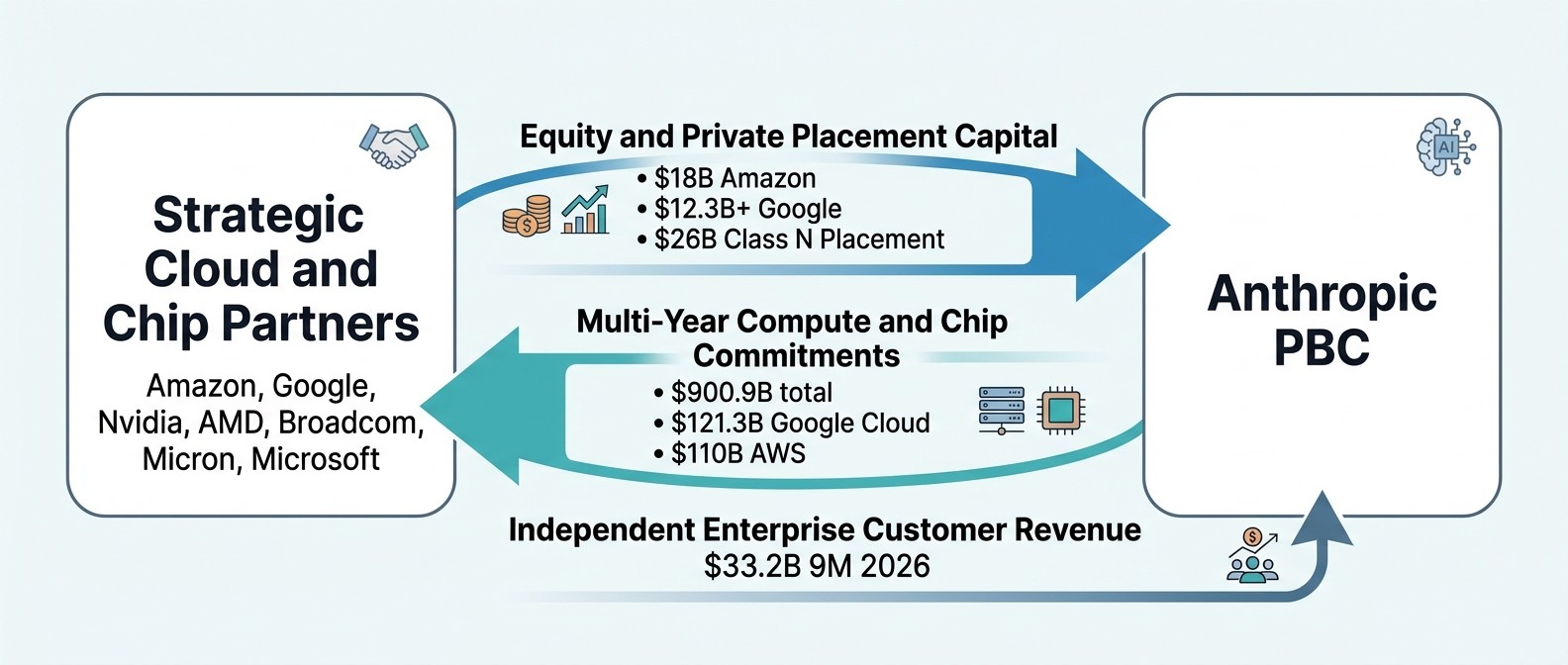
In a November 19, 2026 analysis examining how the Anthropic IPO tests circular financing, TechCrunch reporter Rebecca Bellan highlighted a central tension in modern artificial intelligence funding. The largest financial backers of frontier AI labs also serve as their primary commercial landlords. When a cloud hyperscaler or chipmaker invests billions of dollars into an AI developer, and that developer commits to spend tens or hundreds of billions of dollars buying compute and semiconductors from those same backers, money appears to move from one pocket to another within a closed loop.
The numbers surrounding the Anthropic IPO explain why the question moved from private venture circles into public market scrutiny. According to the SEC Form S-8 registration filing, the company’s S-1 registration statement (File No. 333-299633) was declared effective on November 18, 2026, pricing Class A shares at $83.00. Trading opened the following day at $111 per share, a 33% jump above the offering price. Including the $26 billion private placement of non-voting Class N shares sold to strategic hardware and cloud partners at the IPO price, total capital raised in the transaction reached $107.3 billion.
Yet the company’s balance sheet obligations are even larger than its record capital raise. The preliminary S-1 prospectus discloses approximately $900.9 billion in aggregate purchase commitments as of and subsequent to September 30, 2026, with substantially all of that total dedicated to cloud compute and physical infrastructure. Of that obligation, roughly $70.7 billion is due within the 12 months following September 30, 2026. TechCrunch framed the public listing as the pivotal moment when that loop either proves self-sustaining through independent enterprise revenue, public equity, and corporate debt, or exposes how heavily AI growth still leans on vendor-supplied capital.
Mapping the Supplier-Investor Circle in Plain English
Understanding the Anthropic circular financing debate starts with tracing the two-way movement of capital and compute. In a traditional software company, venture capitalists provide cash, and the startup spends that cash largely on engineering salaries and sales teams. In frontier AI, training and running large language models requires massive clusters of specialized accelerators, high-bandwidth memory, and purpose-built data centers that only a handful of global corporations control.
As a result, the funding loop operates across two distinct channels:
- Capital flowing into the AI lab: Cloud providers and semiconductor companies purchase equity stakes, convertible promissory notes, or non-voting shares in the AI company. This inflow gives the lab cash and balance-sheet strength.
- Compute purchases flowing back to suppliers: The AI lab signs binding multi-year contracts to rent server capacity and buy specialized processors from those same corporate investors. This outflow becomes recognized cloud and hardware revenue for the suppliers.
Analysts and financial reporters distinguish between three tools often lumped together in casual discussion: cloud credits, cash equity investments, and binding purchase commitments. In early startup rounds, cloud providers sometimes issue promotional cloud credits, which function like gift cards for server time rather than unrestricted cash. At the scale disclosed in the Anthropic IPO prospectus, however, the relationships involve hard cash equity investments paired with massive long-term commercial supply contracts that far exceed the initial equity checks.
As major cloud providers and chipmakers structure custom chip manufacturing partnerships and multi-year capacity agreements across rival labs, every participant locks in a strategic advantage. The AI developer secures guaranteed access to scarce power and silicon. Meanwhile, the supplier locks in a marquee anchor tenant to justify building billions of dollars of new data centers, while also owning an equity stake that appreciates if the lab succeeds.
| Strategic Partner | Role as Investor (Disclosed Stake and Capital In) | Role as Supplier (Disclosed Anthropic Commitments Out) |
|---|---|---|
| Amazon | Approximately 14.6% to 14.7% stake (valued near $159B at $83 IPO price) after investing $18B and converting a portion of promissory notes | At least $110B in committed Amazon Web Services spend through April 2036 (subject to contractual exceptions) |
| Alphabet (Google) | Approximately 13.4% to 13.7% stake (valued near $149B at $83 IPO price) on $12.3B invested since 2023, up to $30B conditional on milestones, plus $10B in Class N IPO placement | At least $121.3B in committed Google Cloud spend through mid-2033 (subject to contractual exceptions) |
| Nvidia | $10B participation in the $26B Class N non-voting private placement at the $83 IPO price | Multibillion-dollar strategic chip partnership covering GPU and hardware purchases by Anthropic |
| AMD, Broadcom, Micron, Microsoft | Shared remainder of the $26B Class N private placement alongside TSMC | Multibillion-dollar strategic partnerships covering compute, networking, memory, and cloud purchases |
| TSMC | Participant in the remainder of the $26B Class N private placement | No direct purchase partnership announced with Anthropic (manufactures wafers for chip vendors) |
As detailed in an analysis of the Amazon and Google cloud agreements, the combined minimum spend with Google Cloud ($121.3 billion through 2033) and AWS ($110 billion through 2036) reaches roughly $231 billion before counting deals with chipmakers and other infrastructure providers. At the $83 offering price, Amazon and Google together held roughly 28% of the company, a combined stake worth approximately $307.9 billion.
What an S-1 Prospectus Must Disclose About Supplier Ties
Calling a financing arrangement “circular” in technology journalism does not imply accounting impropriety or illegal behavior. In public securities law, overlapping investor and vendor relationships are fully permissible provided they are transparently recorded and disclosed so public shareholders can evaluate them. When a private company files a Form S-1 registration statement to go public, securities regulations require specific disclosures that strip away private-market ambiguity.
Readers examining the Anthropic IPO S-1 prospectus can trace these relationships across four standard filing sections:
- 1. Principal and Selling Stockholders (Beneficial Ownership): The filing must list any entity holding more than 5% of a class of voting shares, along with exact share counts, voting power percentages, and conversion terms for non-voting shares or promissory notes. This section reveals how much ownership concentration remains with commercial partners like Amazon and Alphabet after the public float.
- 2. Certain Relationships and Related-Party Transactions: Whenever a major shareholder (typically a 5% or greater owner) also conducts material commercial business with the issuer, the company must summarize the terms of those commercial contracts. This requirement ensures investors can see whether cloud and hardware agreements with major shareholders were negotiated alongside equity financings.
- 3. Contractual Obligations and Commitments: In the management discussion and financial footnotes, the prospectus must tabulate binding multi-year purchase obligations by time horizon. This disclosure is where the $900.9 billion total commitment and the $70.7 billion due within 12 months appear, separating near-term cash demands from decade-long targets.
- 4. Risk Factors: The company’s legal and financial teams must explicitly warn prospective buyers about what happens if revenue growth slows while contractual compute bills come due, or if suppliers fail to deliver contracted data center capacity.
The prospectus also notes that Anthropic retains the ability to pay certain future commercial commitments in stock rather than cash, and that the company’s seven co-founders cashed out roughly $1.95 billion to $2 billion combined during the offering. Full disclosure in an S-1 shifts the burden of analysis to the market: once the obligations and related-party ties are itemized in plain sight, investors and enterprise customers can measure them against actual operating cash flow.
The Numbers Behind the Test: Revenue vs. Compute Commitments
Testing whether the loop can sustain itself requires comparing the company’s external customer revenue against its infrastructure bills. If an AI lab only generated negligible revenue while recycling investor cash back to cloud hosts, the circle would quickly stall once equity raises stopped. The financial metrics disclosed around the Anthropic IPO show a much more rapid commercial ramp alongside massive capital intensity.
According to a Reuters report via Euronext on the IPO pricing and preliminary filing figures, Anthropic generated $33.2 billion in revenue during the first nine months of 2026, representing year-over-year growth exceeding 1,100%. Third-quarter 2026 revenue reached $17 billion, equivalent to a $68 billion annualized rate. By October 31, 2026, annualized run-rate revenue reached approximately $81 billion, climbing $10 billion in a single month from September 30.
| Financial and Operational Metric | Disclosed Figure | Reporting Period / Horizon |
|---|---|---|
| IPO Share Price and Valuation | $83.00 per share / ~1.5 trillion valuation | November 18-19, 2026 debut (Ticker: ANT) |
| Total Deal Capital Raised | $107.3 billion ($81.3B public IPO + $26B private placement) | November 2026 offering close |
| Post-Debut Cash and Short-Term Investments | ~220 billion war chest | Post-IPO including private placement and prior raises |
| Recognized Revenue (9M 2026) | $33.2 billion (up >1,100% YoY) | Nine months ended September 30, 2026 |
| Third-Quarter 2026 Revenue | $17.0 billion (~68B annualized rate) | Three months ended September 30, 2026 |
| Annualized Revenue Run-Rate | ~81.0 billion | As of October 31, 2026 |
| Compute and Infrastructure Expense (9M 2026) | $18.8 billion (up ~300%-382% YoY) | Nine months ended September 30, 2026 |
| Near-Term Purchase Commitments Due | ~70.7 billion | 12 months following September 30, 2026 |
| Total Multi-Year Purchase Commitments | ~900.9 billion | Aggregate commitments through 2033-2036 |
The unit economics of that compute spend are also shifting as enterprise adoption grows. An analysis by Morningstar on where Anthropic’s revenue goes alongside filing data shows that during the first half of 2026, compute spending totaled roughly $8.9 billion. Of that $8.9 billion, only $2.4 billion supported revenue-generating customer inference, while $6.5 billion went toward frontier model training, research, and free-tier usage. Over the full nine months ended September 30, 2026, compute and infrastructure expenses reached $18.8 billion. Crucially, however, total compute expenditure per dollar of revenue fell from between $2.01 and $2.51 earlier in its ramp down to roughly $0.48 to $0.58 by the third quarter of 2026.
Wall Street and semiconductor analysts quoted in TechCrunch’s report offered measured assessments of how those figures balance out. Joey Brookhart, Tokenomics lead at SemiAnalysis, estimated that Anthropic will need roughly $280 billion in cumulative revenue over the next four years to cover its upcoming compute bill, a target he noted appears achievable if its current trajectory holds. Brookhart added that supplier ownership remains worthwhile because the company’s revenue increasingly comes from outside customers, and a public listing makes it easier to issue corporate debt and access broader capital markets.
Gil Luria, head of technology research at D.A. Davidson, pointed out that the offering leaves Anthropic with a roughly $220 billion cash and short-term investment reserve, the largest cash war chest of its kind, including roughly $141 billion in cumulative capital raised prior to and during the debut ($91.7 billion in net IPO proceeds at $83). Luria distinguished Anthropic’s position from specialized “neocloud” debt-financed server hosts such as CoreWeave, noting that Anthropic’s primary risk is losing the technological race for frontier model leadership. Even if model leadership shifts among competing labs, Luria noted, cloud and silicon suppliers still benefit from aggregate industry demand for AI infrastructure.
What $900.9 Billion in Commitments Means for Enterprises and Electric Grids
Beyond public stock buyers, the risk factors inside the Anthropic IPO prospectus carry direct operational lessons for two groups: enterprise chief information officers buying AI software, and regional utility planners managing electricity and water infrastructure.
Enterprise Buyer Lock-In and Pricing Mechanics
For corporate IT buyers integrating Claude into software engineering, customer operations, or an enterprise agentic platform, a $900.9 billion infrastructure commitment cuts both ways. On the positive side, multi-year capacity locked in with two major cloud providers gives enterprise workloads running on those clouds dedicated silicon supply and multi-cloud redundancy.
On the risk side, the S-1 prospectus warns that many of these infrastructure agreements include binding “take-or-pay” or minimum spend provisions. If customer demand grows more slowly than projected, or if algorithmic breakthroughs allow models to run on far less hardware, the lab could be left paying for excess, underutilized data center capacity. Conversely, the filing warns that compute providers themselves rely on third-party financing and credit markets to build new server clusters. If credit tightens or construction stalls, contracted capacity could be delayed, repriced, reduced, or undelivered, directly affecting enterprise service costs and availability.

Electricity, Water, and Grid Curtailment Realities
A $900.9 billion compute commitment is not just an accounting entry; it represents a massive claim on physical electricity, transformers, transmission lines, and cooling water over the next decade. The preliminary prospectus explicitly flags physical utility bottlenecks as a material business risk.
Specifically, the filing warns that data center rollouts face potential delays in securing high-voltage electricity, cooling water, and regional grid interconnection services. To win local permits and prevent residential electricity bills from spiking, the prospectus notes that Anthropic and its infrastructure partners have made voluntary commitments to offset community and ratepayer impacts. Those physical grid commitments include:
- Grid-upgrade cost coverage: Paying directly for utility transmission and substation upgrades required to connect massive AI training clusters.
- New power generation procurement: Contracting for new clean and firm power generation capacity rather than simply drawing down existing regional grid reserves.
- Load curtailment systems: Installing automated demand-response and curtailment systems that allow data centers to dial back non-essential training workloads during peak winter freezes or summer heat waves when local power grids are strained.
For sustainability officers and energy analysts, these S-1 disclosures confirm that frontier AI growth is now physically tethered to utility construction timelines. Even when an AI developer has $220 billion in liquid reserves to pay for server racks, those servers cannot turn on faster than regional utilities can permit and energize new gigawatts of generation.
What Deeper Filing Dives Add: Five Footnotes to the Circle Test
News summaries capture the outline of the Anthropic IPO. Analyses that work directly from the final prospectus add five details worth knowing, each reported here as disclosed, without any view on what to buy or sell.
1. The rest of the $900.9 billion bill has names. Beyond Google and Amazon, a filing-level analysis of the final prospectus (Form 424B4) breaks out additional counterparties: Broadcom equipment-lease rent of about $161.2 billion, SpaceXAI compute of up to $120.5 billion, Microsoft cloud of at least $47.2 billion, Nscale of up to about $44.6 billion, and Lambda of about $41.3 billion, of which about $34.9 billion was then terminable. The same analysis puts $451.6 billion of the total due before the end of 2030 and $186.2 billion subject to termination rights or contingent conditions. It also details the $26 billion Class N split: Google and Nvidia $10 billion each, AMD $2.5 billion, Broadcom, Micron and Microsoft $1 billion each, and TSMC $0.5 billion, with pro forma cash and short-term investments of $232.4 billion. (SEC filing analysis of the 424B4)
2. Day one closed well below its open. ANT opened at $111.50, up 34.3% from the $83 offer price, but closed the first session at $97.17, up 17.1% on the day and about 13% below the opening print, on a day the Nasdaq Composite fell 2.25%. (Admiral Markets day-by-day AI market timeline) The full first-day range sat between a $115.10 high and a $101.36 last trade at 12:31 ET in intraday filing analysis. (SEC filing analysis of the 424B4)
3. Most of the headline net loss was a paper charge. For the third quarter, Anthropic reported revenue of $16.96 billion, up 47% from the second quarter, with an operating loss of $567 million after operating income of $974 million the prior quarter, while the net loss narrowed to $23.3 billion from $66.3 billion. (Reuters on the IPO results) Axios noted roughly $22 billion of that quarterly loss was a non-cash accounting charge, with the operating result still showing a loss above half a billion dollars. (Axios on the post-listing results) That distinction matters because filing analyses also show compute at 58% of third-quarter revenue, up from 48% in the second quarter.
4. Revenue is concentrated and largely pay-per-use. The filing analysis puts the top five customers at about 25% of nine-month 2026 revenue, with about 44% of that revenue flowing through the cloud marketplaces of Amazon, Google and Microsoft, and recorded revenue backlog (RPO) of $13.8 billion. (SEC filing analysis of the 424B4) Consumption-based fees were about 79% of nine-month revenue, which is why analysts watch whether usage growth outlasts price cuts on new model versions.
5. Watchdogs gave the circle a macro name. The International Monetary Fund’s October 2026 Global Financial Stability Report describes 14 publicly disclosed AI transactions since 2023 totaling about $300 billion in equity, $650 billion in debt, and $1.4 trillion in future revenue commitments, warning of wrong-way risk where investments lose value at the same moment tied revenue streams weaken. (IMF October 2026 GFSR Chapter 1) The European Central Bank’s November 2026 review echoes the point, flagging opaque off-balance-sheet and circular links between cloud providers, labs and chipmakers. (ECB Financial Stability Review box) Neither body accuses any company of wrongdoing. They describe a structure public shareholders must now price.
Frequently Asked Questions
What was the Anthropic IPO price and valuation?
Anthropic priced its initial public offering at $83.00 per Class A share under the Nasdaq ticker ANT on November 18, 2026, valuing the company at approximately $1.5 trillion. The public offering raised $81.3 billion, and together with a concurrent $26 billion private placement of non-voting Class N shares to strategic partners, total capital raised reached $107.3 billion. Shares opened for trading on November 19, 2026 at $111, up 33% from the IPO price.
What is circular financing in AI?
In the AI industry, circular financing refers to arrangements where cloud providers and chipmakers invest billions of dollars into an AI developer, and that developer simultaneously commits to spend billions of dollars buying cloud server capacity and semiconductors from those same investors. Observers track whether the AI lab generates enough independent outside customer revenue to pay those infrastructure bills without relying on continuous equity injections from its suppliers.
What does the Anthropic S-1 disclose about supplier-investors?
The S-1 registration statement details beneficial ownership stakes, related-party commercial contracts, multi-year purchase obligations, and infrastructure risk factors. It shows that Amazon (about 14.6% stake) and Google (about 13.4% stake) are both major shareholders and primary cloud vendors, alongside $26 billion in private placement shares purchased by Nvidia, Google, AMD, Broadcom, Micron, Microsoft, and TSMC, paired with roughly $900.9 billion in total compute commitments ($70.7 billion due within 12 months of September 30, 2026).
Does circular financing in an IPO filing mean something improper?
No. Having major customers or suppliers also hold equity stakes is legal and common in capital-intensive sectors such as aviation, telecommunications, energy, and cloud computing, provided all material terms and related-party ties are accurately disclosed in SEC filings. An S-1 disclosure gives public market participants the audited revenue and commitment data needed to evaluate the business on its own merits.
A Public Balance Sheet Test for the AI Infrastructure Buildout
The Anthropic IPO moves the debate over AI infrastructure economics out of private venture estimates and into audited public filings. With $33.2 billion in nine-month revenue, an $81 billion annualized run-rate as of October 2026, and roughly $220 billion in cash reserves, the company enters the public markets with substantial external customer demand and near-term liquidity to cover its $70.7 billion 12-month compute bill. Over the coming decade, the true test of that $900.9 billion commitment will depend not only on enterprise software adoption, but on whether cloud suppliers and regional electric grids can finance, permit, and power the physical data centers promised on paper.


