
If you’re still filling cartridges with a syringe or a repeater, you already know the pain. Fills drift, hands cramp, oil cools and thickens halfway through a batch, and a single bad afternoon can cost you hundreds of dollars in wasted extract. Eventually, every growing operation asks the same question: should you move to a semi-automatic filler or go straight to a fully automatic machine?
The honest answer is that it depends on your volume, your team and your growth plans. In this guide, we’re comparing both options on speed, accuracy, capacity, labor, operating costs, maintenance and scalability, so you can decide which one fits your operation. Several equipment makers, including Vape-Jet, build both styles of machine, which makes the two categories easy to compare side by side.
Before walking through the comparison, it helps to know the shape of the decision. Volume, labor and compliance exposure do most of the work in deciding between the two machine types, and the sections below move through each of those in turn.
How Semi-Automatic Filling Machines Work
A semi-automatic filler handles the hard part of dosing while you handle positioning. You place a cartridge under the dispensing needle, then trigger each fill with a button or foot pedal. The machine controls oil temperature and dispense volume, so every pull delivers the same amount without you eyeballing a syringe.
Most semi-automatic machines include a heated reservoir, a heated needle and a pump that measures each dose. Better models use multiple heat zones to keep oil at a stable temperature from reservoir to tip, and some use nitrogen pressure to push thick oils without relying on high heat. That combination helps you protect terpenes while still moving viscous extracts like live resin and rosin.
How Fully Automatic Filling Machines Work
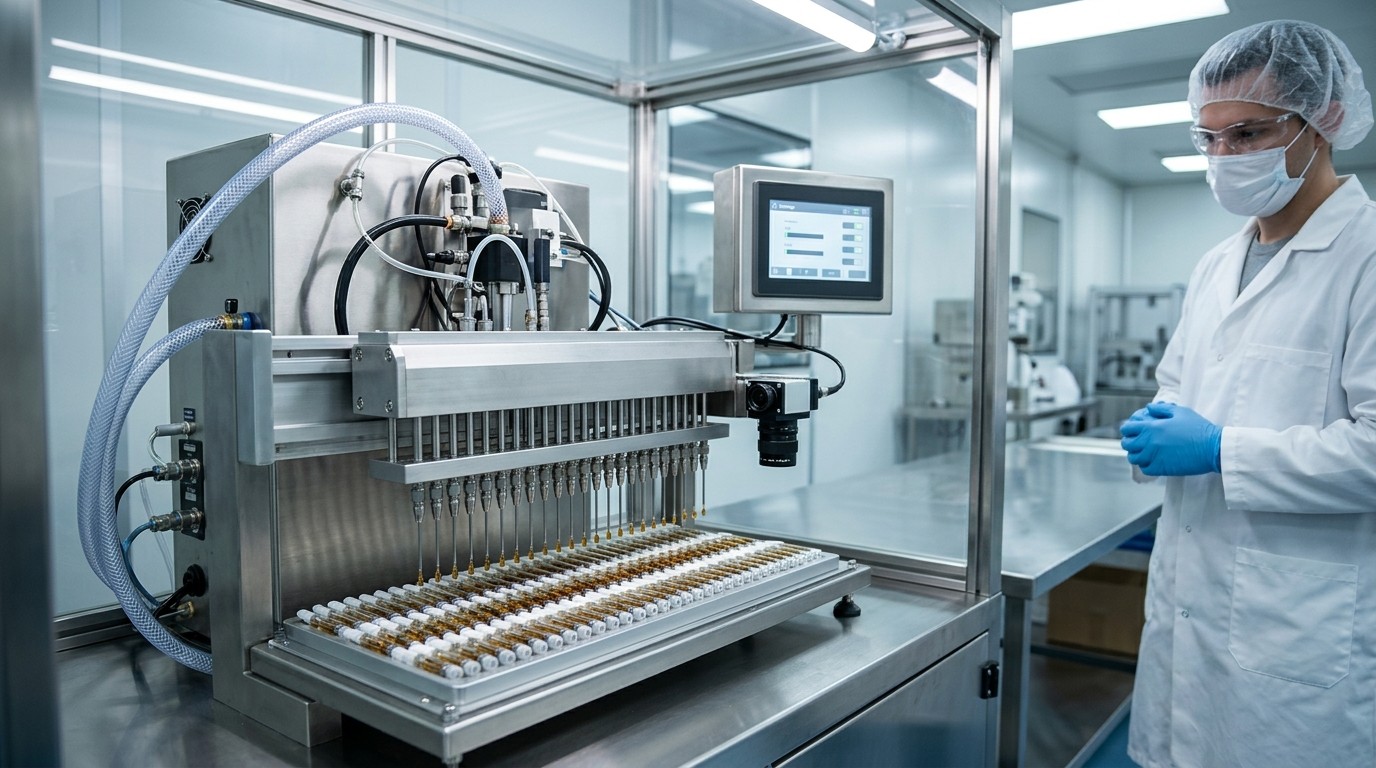
A fully automatic machine takes positioning off your plate, too. You load a tray, select a hardware profile, dial in your oil settings and start the cycle. The machine aligns the needle, fills every cartridge in the tray and moves on without you touching each unit.
Many automatic fillers require you to load hardware into a custom jig first. Newer designs skip that step with camera-based alignment. Vape-Jet’s fully automatic machine, for example, uses machine vision to detect alignment and bent center posts, then fills directly from the tray the hardware ships in. Removing jig loading saves you labor on every batch and makes it easier to switch between hardware styles.
Speed, Accuracy and Production Capacity
Both machine types beat hand filling on consistency, because both rely on a calibrated pump rather than your thumb. The difference shows up in how well that accuracy holds as volume grows.
With a semi-automatic machine, your output depends on how quickly your operator can place, fill and remove cartridges. A skilled operator can move quickly, but fatigue sets in over a long shift and throughput dips. With a fully automatic machine, cycle time stays steady because the machine handles placement. If you need to fill tens of thousands of carts a month, that steady pace matters more than peak speed.
Accuracy also holds up better with automation over long runs. When a person positions every cart, small misalignments add up. Automated alignment removes that variable.
Labor Requirements and Operating Costs
Labor is usually where the math tips. A semi-automatic machine needs a dedicated operator for every minute it runs, and if you want more output, you add more operators or more machines. A fully automatic machine frees your operator to cap, prep hardware or formulate while the machine fills, so you grow output without growing headcount at the same rate.
Operating costs go beyond wages, though. Factor in power, nitrogen supply, cleaning solvent, replacement parts and the oil you lose to purging and cleaning. Machines with clean-in-place systems cut both downtime and waste, because they flush the fluid path with solvent in an automated cycle instead of requiring you to disassemble and scrub parts by hand.
Maintenance and Scalability
Semi-automatic machines are mechanically simpler, so they’re easier to learn, quicker to set up and generally cheaper to keep running. That simplicity makes them a smart first machine for many labs.
Fully automatic machines ask more of your facility. Expect requirements like a clean lab environment, dedicated electrical service, a nitrogen supply, climate control and a network connection for software updates and remote support. In return, you get a machine built to scale. Because automatic fillers run on saved profiles, you can add SKUs, new oils or new hardware without rebuilding your workflow. The same principle drives most production equipment: repeatable, software-controlled processes scale more predictably than manual ones, as our look at automated packaging and filling machines explains.
Which Option Fits Your Business?
Here’s which type of vape cart filling machine is best, depending on your business:
- Small businesses and craft labs: A semi-automatic machine usually makes the most sense if you’re filling a few thousand carts a month. You’ll get precise, repeatable fills without overhauling your facility, and your team can learn it quickly.
- Growing brands: This is where the decision gets interesting. If your orders keep outpacing your operators and you’re paying overtime to keep up, you’re likely ready for automation. Some brands run both, using a fully automatic machine for high-volume SKUs and a semi-automatic machine for small batches and test runs.
- Large-scale manufacturers: At high volume, a fully automatic machine is hard to beat. One trained operator can often oversee more than one automatic machine, which multiplies your output without multiplying your payroll.
Key Factors to Consider Before You Buy
Here’s what to consider as you choose a machine:
Your Real Production Volume
Start with an honest look at how many carts you fill each week, because the right type of machine depends heavily on it.
Manual filling with a distillate gun or handheld tools generally tops out at a few hundred to about 1,000 carts per shift, and operator fatigue tends to slow output later in the day.
Semi-automated machines can fill several thousand carts in a single shift, which can let a small operation finish a week’s output in part of one day. For very small or single-SKU operations (a couple hundred carts a week with no plans to grow), manual filling can still make sense.
The crossover points are worth working out for your own operation, and they depend on labor cost more than on cart count alone. In broad terms, semi-automation starts to repay its cost once a couple of hundred carts a week are being filled by hand, and fully automated systems become worth evaluating as weekly volume climbs toward the low thousands.
Oil Viscosity and Heat Control
Thick extracts like live resin and rosin need precise heat control, and ideally nitrogen-assisted pressure, to flow consistently. Look for closed-loop temperature control, which keeps oil at a steady temperature instead of drifting and degrading terpenes. Ask each manufacturer how their machine handles your specific oil at the lowest workable temperature.
Fill Accuracy
Precision affects your margins more than many operators realize. Manual fills commonly vary by around 5%, which pushes teams to overfill on purpose to stay above label weight. That extra oil adds up quickly: at 2,000 carts a week, a 5% overfill can mean roughly 100 grams of oil lost weekly. Semi-automated machines typically hold variance to about 1% or less, and some manufacturers publish figures as tight as plus or minus 0.5%, so ask vendors for their accuracy specs under normal operating conditions.
Oil Waste and Yield
Overfill isn’t the only source of loss. Drips and stringing at the nozzle, carts that fail QA and need rework, and terpene degradation from inconsistent heat all chip away at your yield.
Manual workflows can lose an estimated 5 to 10% of oil to these issues, compared to under 2% with a semi-automated machine. If you make your own oil, protecting your most expensive input is a major reason to automate.
Cartridge Compatibility
Confirm that the machine supports your 510s, all-in-ones, pods, or disposables. Ask for a published compatibility list, and test your own hardware during a demo.
Batch Size and Changeovers
If you run many small SKUs, changeover speed matters as much as filling speed. Cleaning tools, resetting temperatures, and switching oils by hand can take 45 to 90 minutes each time.
Machines with clean-in-place cycles and saved SKU profiles can cut that to 5 to 15 minutes, which adds up to hours of recovered production each week. If you run a few high-volume SKUs, throughput comes first.
Compliance and QA Protection
In many states, underfilled carts on a retail shelf count as a labeling violation, which can lead to recalls, mandatory retesting, retailer chargebacks, and in repeated cases, license risk. A single compliance problem can cost more than the machine itself. The standards behind those rules come from weights and measures law rather than cannabis regulation specifically: the National Institute of Standards and Technology publishes the model packaging and labeling rules that states adopt, and its guidance on cannabis weights and measures explains how average net content and underfill enforcement apply to labeled products. Because those rules turn on the average net contents of a lot, not just on any single cart, tight and repeatable fills are what keep a batch inside tolerance.
Machines that fill consistently and keep audit-ready fill logs give you a layer of protection that manual filling can’t.
True Cost, Including Your Own Time
Don’t stop at the sticker price. Weigh setup requirements, training, warranty coverage, and support response times, since a cheaper machine that sits idle waiting for parts can cost more than a pricier one with strong support. When you calculate labor savings, include the owner’s time if you work the line yourself. That time is worth what you could earn spending it on sales, marketing, or growing the business, not just what you’d pay a filling tech.
Semi-automated machines for small operations generally run from about $25,000 to $45,000, and once labor, rework, oil waste, and compliance exposure are added up, the cost of staying manual can far exceed that.
Production Goals and Upgrade Path
Buy for where you expect to be in 12 to 18 months, and think about the next few years beyond that. Scaling manual filling past a few thousand carts a week typically means rebuilding your whole workflow.
A semi-automated machine from a vendor that also offers fully automated equipment gives you a smoother path, since your training, SOPs, and support relationship can carry over when you upgrade.
How to Calculate Your Return on Investment
You can estimate payback with a simple formula:
Payback period (months) = Machine cost ÷ Monthly savings
To find your monthly savings, add up three numbers. First, labor hours saved each month multiplied by your hourly labor cost. Second, oil saved from tighter fills and less waste, multiplied by your cost per milliliter. Third, extra revenue from orders you can now fill on time.
Here’s a hypothetical example. Say a machine saves you 120 labor hours a month at $25 an hour ($3,000), cuts oil waste enough to save $1,500 and helps you fill $2,000 in orders you’d otherwise miss. That’s $6,500 in monthly value, so a $50,000 machine would pay for itself in under eight months. Your numbers will depend on your volume, wages and oil costs, so run the calculation with your own figures before you talk to vendors.
Keeping Fill Volumes Consistent
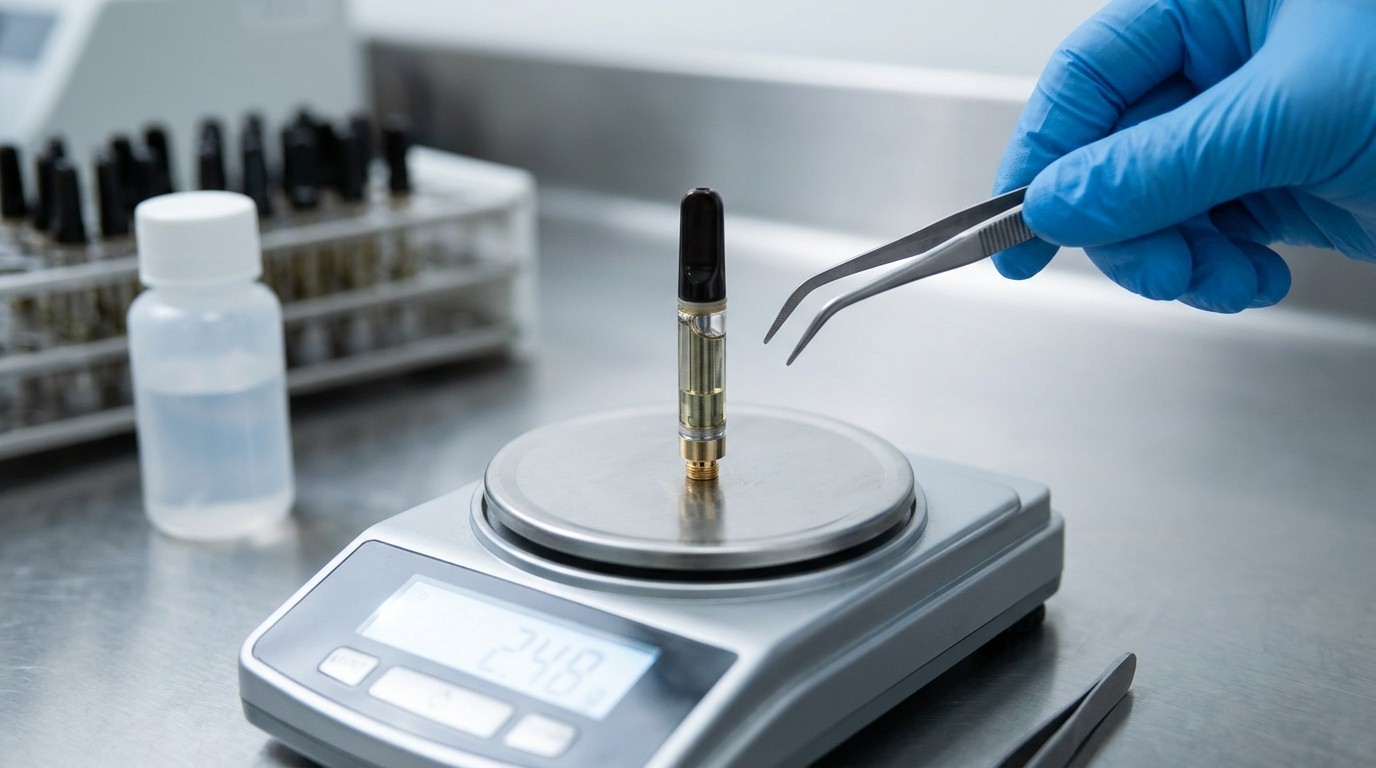
Consistency starts with temperature. Warm your oil just enough to flow smoothly, and keep it stable throughout the run, because viscosity changes as oil cools. Calibrate your fill volume at the start of each batch by weighing a sample of filled carts, and recheck whenever you switch oils or hardware. Tracking your fill data over time also helps you spot drift early, and machines that log temperature, fill time and waste rates make this much easier.
Avoiding Common Filling Issues
- Overfills and underfills: These usually trace back to poor calibration or temperature swings. Weigh samples often.
- Leaking cartridges: Overfilling, wrong needle depth or delays between filling and capping can all cause leaks. Cap promptly after filling.
- Air bubbles: Filling too fast or at the wrong temperature traps air. Slow the dispense rate or adjust the heat.
- Clogs: Oil that cools inside the fluid path will clog. Heated needles and reservoirs, plus a thorough clean between batches, prevent most blockages.
- Terpene loss and oxidation: Excessive heat and oxygen exposure degrade flavor. Use the lowest workable temperature and nitrogen-assisted filling where you can.
Comparison Table
| Factor | Semi-Automatic | Fully Automatic |
|---|---|---|
| How It Works | Operator positions carts and triggers each fill | Machine aligns and fills full trays automatically |
| Upfront Cost | Lower | Higher |
| Throughput | Limited by operator speed and fatigue | Steady cycle time across long shifts |
| Fill Consistency | Pump-controlled, but placement depends on the operator | Pump-controlled with automated alignment |
| Labor | One dedicated operator per machine | One operator can manage filling plus other tasks |
| Learning Curve | Short | Longer; requires training |
| Setup and Facility Needs | Minimal | Nitrogen, clean lab, network access, climate control |
| SKU Changeovers | Manual adjustments | Saved profiles for fast switching |
| Scalability | Add machines and operators | Add volume without adding much labor |
| Best For | Small labs, craft brands, test batches | Growing brands and high-volume manufacturers |
Recommendations for Different Production Needs
If you’re filling a few thousand carts a month or you’re just moving off hand filling, start with a semi-automatic machine. You’ll get consistent fills and a manageable learning curve.
If your orders regularly outpace your team and backlogs keep building, look closely at a fully automatic machine, or pair one with your existing semi-automatic setup.
If you’re producing at large scale, plan around fully automatic machines and think about how many units one operator can manage.
The Bottom Line
Neither machine type is better across the board.
A semi-automatic filler gives you precision and control at a lower barrier to entry, while a fully automatic machine gives you speed, consistency and labor savings that compound as you grow.
Match the machine to your current volume and your 12 to 18 month plan, run your own ROI numbers, and ask for a demo with your actual oil and hardware before you commit.
Frequently Asked Questions
Here are quick answers to the questions we hear most about choosing and running a vape cart filling machine.
How long does it take to set up a fully automatic filling machine?
Setup time depends on your facility, but plan for anywhere from several weeks to a few months once you factor in facility checks, configuration, installation and training. Semi-automatic machines usually take far less time to get running.
How do you clean a vape cart filling machine?
Most modern fillers use a clean-in-place process that flushes the fluid path with solvent, such as alcohol, between batches. Clean whenever you switch oils and at the end of each production day to prevent clogs and cross-contamination.
How much maintenance does a filling machine need?
Semi-automatic machines usually need only routine cleaning and periodic calibration checks. Fully automatic machines add more components to inspect, so look for a manufacturer that offers fast technical support and replacement parts under warranty.
Should I choose a semi-automatic or fully automatic machine?
Choose semi-automatic if you fill a few thousand carts a month or want a simple first upgrade from hand filling. Choose fully automatic if labor costs, backlogs or growth targets are holding your production back.


