
Generating electricity in the open ocean fails most often for one physical reason: saltwater and violent swells destroy submerged moving machinery. Standard ocean power concepts typically place gears, pistons, or hydraulic seals directly in the path of breaking waves, where corrosion and extreme forces quickly wear them down. Irish developer OceanEnergy designed its 826-ton OE35 wave energy device to bypass this bottleneck entirely by keeping every single moving part high above the waterline.
Measuring 125 by 59 feet (38.1 by 18 metres), the floating steel hull has now cleared independent European Union review and secured a critical Scottish Marine Licence in November 2026. These regulatory approvals clear the path for a two-year, grid-connected demonstration at the European Marine Energy Centre (EMEC) Billia Croo test site off the west coast of Orkney, Scotland. While the test will export electricity to the UK grid via EMEC’s subsea cables, the deployment is a rigorous engineering trial to prove reliability and cost reduction rather than a commercial power farm.
What WEDUSEA Actually Approved
The Orkney deployment is the central test of the WEDUSEA programme (Wave Energy Demonstration at Utility Scale to Enable Arrays), a EUR 19.6 million collaboration co-funded by the EU Horizon Europe programme and Innovate UK. Led by OceanEnergy, the consortium coordinates 14 industry and academic partners across Ireland, the UK, France, Germany, and Spain.
Rather than rushing hardware into the Atlantic, the programme structured the deployment around three gated stages:
- Phase 1 (Design and Go/No Go Review): Engineers adapted the buoy wave energy converter specifically for the wave climate at Billia Croo. In September 2024, the project passed an independent EU panel evaluation verifying its technical designs and financial planning.
- Phase 2 (Two-Year Atlantic Demonstration): The 1 MW rated device will operate over a two-year demonstration in open Atlantic conditions at EMEC, feeding electricity into the grid while undergoing structural, acoustic, and ecological monitoring.
- Phase 3 (Commercialisation and Standards): Data from the two-year trial will feed directly into international environmental databases and International Electrotechnical Commission (IEC) standards to lay the engineering foundation for multi-megawatt commercial arrays.
On 20 November 2026, EMEC confirmed that the Scottish Marine Directorate granted the Marine Licence on behalf of Scottish Ministers for Berth 5 at Billia Croo, following consultations with NatureScot and the Scottish Environment Protection Agency (SEPA).
“The WEDUSEA partnership has worked hard to ensure that all detailed designs and planning are robust, to prove that the project is viable and that the project will be delivered within budget. Now we have received the green light from the EU, it’s all systems go!” said Professor Lars Johanning of the University of Plymouth following the Phase 1 review.
How the OE35 Makes Power
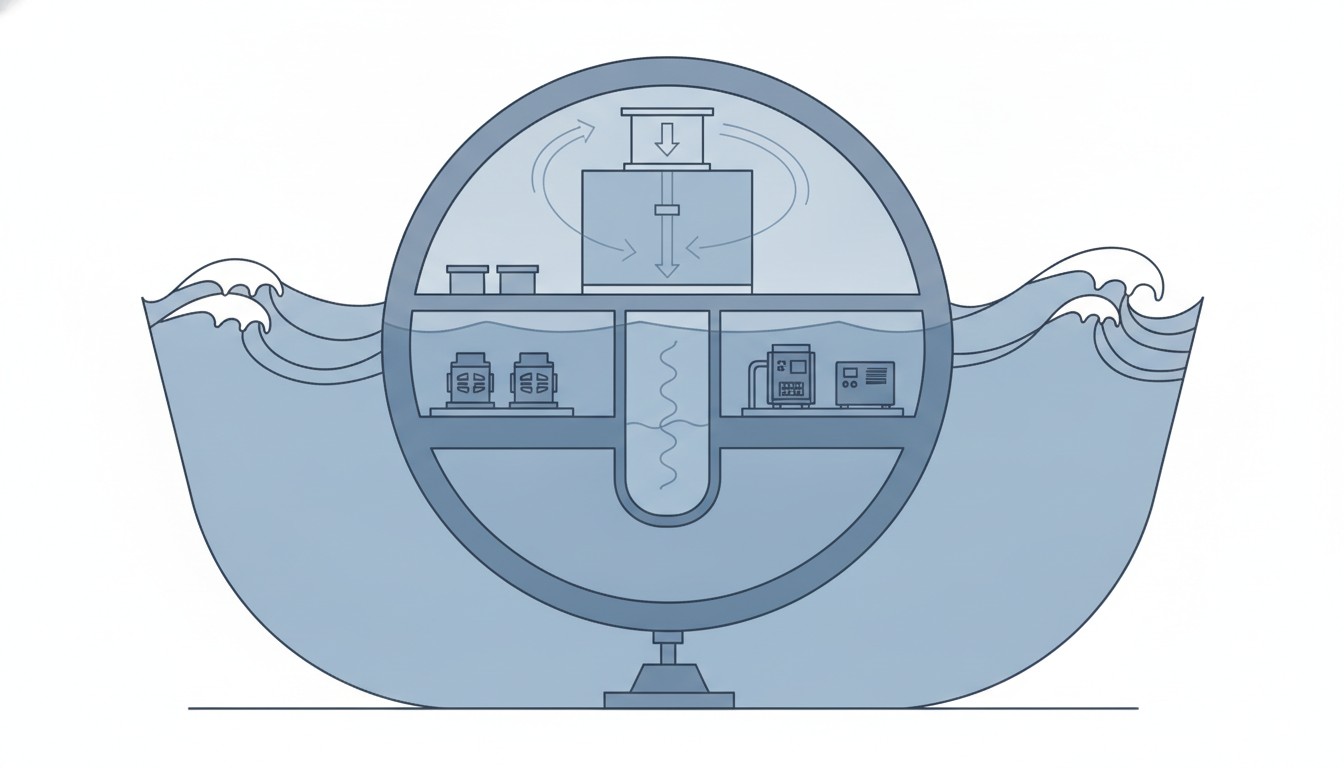
The OE35 Buoy operates as a floating oscillating water column (OWC). Instead of using floats or flaps that pivot in the surf, the hull acts as a massive, partially submerged steel lung that uses waves to pump trapped air.
The lower portion of the hull sits open to the sea below the surface, trapping a large pocket of air inside an internal chamber above the waterline. As incoming Atlantic waves pass beneath the moored vessel, changing water pressure at the submerged opening forces the internal water column to rise and fall like a piston. Rising water compresses the trapped air and pushes it upwards through an outlet duct at the top of the deck. When the wave trough passes, the internal water level drops, drawing outside air back down through the same opening.
To turn that back-and-forth airflow into steady electricity without valves or rectifiers, the ocean wave energy generator uses a Wells turbine. Invented in Belfast in the late 1970s, the Wells turbine features symmetrical aerofoil blades mounted radially around a central rotor. Because of the blade geometry, the rotor spins continuously in the same direction whether air is rushing upwards out of the chamber or being sucked back down into it.
This mechanical arrangement isolates the vulnerable components from the sea. The turbine rotor on the upper deck is the only moving part on the entire wave energy converter, sitting well above the waves, while the electrical equipment stays enclosed below in a sealed machine room.
How Big Is It
Surviving Atlantic storms while trapping enough air volume to drive a utility-scale generator requires battleship proportions. The OE35 hull is fabricated from steel using conventional shipyard techniques, an approach proven on a precedent hull built by Vigor in Oregon in 2018. Supported by a USD 12 million project backed by the US Department of Energy’s Water Power Program and the Sustainable Energy Authority of Ireland (SEAI), that earlier unit was towed from Honolulu and deployed in July 2024 at the US Navy Wave Energy Test Site (WETS) in Kaneohe Bay, Oahu, where it ran at 500 kW for testing.
For the Orkney demonstration, the device is moored to the seabed and connected via an underwater electrical umbilical to EMEC’s subsea cable network. Key physical and electrical specifications for the OE35 architecture include:
- Total weight: 826 tons
- Length and beam: 125 by 59 feet (38.1 by 18 metres)
- Operating draft: 31 feet (9.4 metres) submerged below the waterline
- EMEC demonstration rating: 1 MW
- Maximum hull capacity: Capable of up to 1.25 MW (tested at 500 kW in Hawaii)
- Control systems: Unmanned operation, extensively instrumented for autonomous generation control, navigational safety, and environmental monitoring
What Counts as Success
Wave energy has struggled for decades to cross the valley between functional prototypes and bankable utility arrays because single steel prototypes are expensive to build, moor, and maintain per megawatt-hour produced. The WEDUSEA programme sets concrete numerical benchmarks to measure whether the OE35 can close that economic gap by integrating improved moorings and power take-off systems while advancing reliability, scalability, sustainability, and circularity.
According to the UK Research and Innovation (UKRI) project dossier, the baseline device is expected to generate in excess of 1,650 MWh over its deployment. On the financial side, the engineering upgrades aim to cut the single-device Levelised Cost of Electricity (LCOE) by 32%, dropping from 361 EUR/MWh down to 245 EUR/MWh. When modelled across a 20 MW commercial array where fabricators and grid connections share fixed costs, the projected LCOE falls from 185 EUR/MWh to 127 EUR/MWh.
“The innovative actions taken in this programme aim to improve the efficiency, reliability, scalability and sustainability of wave energy technology, and reduce the Levelised Cost of Electricity of the technology by over 30%. This will help to de-risk investments in wave energy,” explained EMEC Project Manager Myles Heward.
In parallel with tracking megawatt-hours and maintenance costs, engineers will conduct a formal IEC technical inspection and performance assessment to verify the hull’s structural survivability and power curve in real ocean swells.
“Wave energy is the world’s most valuable renewable resource with around 30 TWh of potential annual production waiting to be harnessed. That’s almost ten times Europe’s annual electricity consumption. However, this potential has yet to be fully realised. The project will demonstrate that wave technology is on a cost reduction trajectory and will thus be a stepping stone to larger commercial array scale up and further industrialisation. We predict that the natural energy of the world’s oceans will one day supply much of the grid,” said Professor Tony Lewis, Chief Technology Officer at OceanEnergy.
Why Orkney Waters Are the Test
Testing in sheltered bays or wave tanks cannot replicate the multi-directional force of deep ocean storms. Located off the western shore of Mainland Orkney, the Billia Croo test site faces the open North Atlantic directly, exposing moored equipment to some of the highest-energy wave regimes in Europe.
Operating at an accredited test facility also solves the grid bottleneck that stalls many marine prototypes. At Berth 5, the OE35 plugs its underwater umbilical directly into EMEC’s pre-installed subsea cable, which runs ashore to an onshore substation connected to the UK national grid. That infrastructure allows engineers to test how autonomous generation controls handle real grid export standards while waves fluctuate from calm swells to winter gales.
What About Sea Life and Sound
Placing an 826-ton steel vessel that compresses air in coastal waters raises legitimate questions about underwater noise, seabed disruption, and wildlife behaviour. Under the marine licence requirements, EMEC has created an extensive environmental monitoring plan examining the habitat both above and below the water in the vicinity of the device before, during, and following deployment.
Before installation takes place, researchers establish a biological baseline of benthic (seabed) and pelagic (open water column) activity at Berth 5. Once the hull is moored and operating, field campaigns track four specific areas:
- Underwater and airborne acoustics: Measuring sound emissions from the oscillating water chamber and the above-deck Wells turbine to assess whether noise reaches levels that disturb marine mammals or coastal bird colonies.
- Biophysical wave dynamics: Analysing how the massive floating hull alters local wave movement and water mixing immediately behind the mooring site.
- Fish aggregation: Observing whether the submerged hull and mooring lines act as an artificial reef that attracts schooling fish.
- Seabird analysis: Monitoring how diving and surface-feeding seabirds interact with the unmanned deck structure above the water.
OWC vs Waveline vs Blowhole
Wave developers have tried radically different mechanical architectures to balance energy capture against ocean survivability. Comparing the OE35 against two other prominent designs highlights the core engineering trade-offs between rigid offshore chambers, flexible surface spines, and nearshore concrete structures.
| System Feature | OceanEnergy OE35 Buoy | SWEL Waveline Magnet | Wave Swell UniWave 200 |
|---|---|---|---|
| Primary Architecture | Floating steel oscillating water column (OWC) | Long modular chain of floating plastic platforms | Nearshore concrete artificial blowhole chamber |
| Power Take-Off | Bidirectional Wells air turbine on upper deck | Spine lever mechanical generators along floating line | One-way air turbine driven by upward air expulsion |
| Submerged Moving Parts | None (only internal seawater column rises and falls) | Articulated spine joints flex continuously with wave contour | Passive one-way valves release pressure on wave upstroke |
| Deployment Context | 1 MW rated deep-water unit cleared for 2-year Orkney grid demo | Wave-tank and open-sea concept testing phase | 200 kW King Island trial (45% to 50% wave-to-wire conversion) |
Where the OE35 relies on a rigid, 826-ton steel hull to house a zero-valve bidirectional air turbine, the flexible spine-like Waveline Magnet takes the opposite structural approach. Built from a long modular chain of plastic floats, it rides along the surface contour of the swell, using the flexing motion between platforms to drive lever generators along its central spine. That keeps structural weight low, though every flexing hinge must endure millions of mechanical cycles in seawater.
Closer to shore, Wave Swell Energy’s blowhole UniWave system shares the oscillating water column principle with the OE35 but modifies the airflow cycle. Tested at a 200 kW scale off King Island, its heavy concrete chamber vents air out during the wave crest through passive valves and draws air back through a one-way turbine only as the wave recedes, achieving 45% to 50% wave-to-electricity conversion in trials. The OE35 instead floats in deeper water and generates power on both the upward and downward stroke of the wave using its symmetrical Wells rotor.
Frequently Asked Questions
Is the OE35 already powering homes in Scotland?
No. While the OE35 received its EU Phase 1 green light in September 2024 and its Scottish Marine Licence for Berth 5 at Billia Croo in November 2026, with preparations progressing for its two-year demonstration, it is an experimental validation project rather than a commercial power station. During the trial, electricity generated by the 1 MW device will be exported to the UK grid via EMEC’s subsea cables and onshore substation, but the core purpose is gathering performance, cost, and environmental data.
How much power will the OE35 wave energy device make?
The EMEC demonstration unit is rated at 1 MW (with a hull architecture capable of up to 1.25 MW) and is expected to generate in excess of 1,650 MWh over its deployment. Rather than maximising immediate commercial revenue, that output target serves to validate a projected 32% drop in the Levelised Cost of Electricity from 361 EUR/MWh to 245 EUR/MWh.
How does an oscillating water column differ from other wave generators?
Most wave energy devices place hinges, hydraulic pistons, or buoys directly in the water to capture surface movement. An oscillating water column uses a hollow chamber that is open to the sea below the waterline. Waves push the water column up and down inside the hull like a liquid piston, forcing trapped air through an air turbine at the top of the deck so that no moving machinery ever touches the seawater.
What happens after the two-year Orkney demonstration finishes?
Following the two-year Phase 2 ocean trial at Billia Croo, the WEDUSEA consortium enters Phase 3, focusing on commercialisation, dissemination, and industry standards. Acoustic, biological, and structural inspection records from Orkney will be fed into environmental databases and IEC electrotechnical standards to support the engineering and financing of 20 MW commercial wave arrays.
Building the Evidence for Utility Arrays
Clearing both the European Union technical review and the Scottish Marine Directorate licensing process puts the OE35 wave energy converter in a position to answer the toughest questions facing marine power. As Matthijs Soede of the European Commission noted, “WEDUSEA is set to be a major catalyst for the wave energy industry, unlocking the full potential of this exciting renewable technology.” Over its two-year test at Billia Croo, the 826-ton buoy must now prove it can deliver reliable electricity, leave surrounding marine ecosystems intact, and push wave power costs down towards utility-scale reality.


