
Most plastic recycling stories focus on beverage bottles and food packaging that can be melted down and reshaped. Yet some of the toughest plastics in modern industry, found in boat hulls, car parts, and wind turbine blades, refuse to melt at all. Once cured into shape, these rigid polymers lock into a permanent chemical structure that resists both heat and biological breakdown.
Now, a research team led by the Spanish National Research Council (CSIC) and Madrid biotechnology firm EvoEnzyme has demonstrated a two-sided laboratory workaround for a recyclable thermoset plastic. In a 2026 Science Advances paper, lead author Mikel Dolz, corresponding author Miguel Alcalde, and French collaborators report the first documented enzymatic degradation of a complex polyester resin from thermoset composite materials. Because this is an early proof-of-concept study conducted at laboratory scale on a custom-modified resin, it does not recycle existing waste or provide a ready-made industrial process.
Why Thermosets Were Considered Unrecyclable
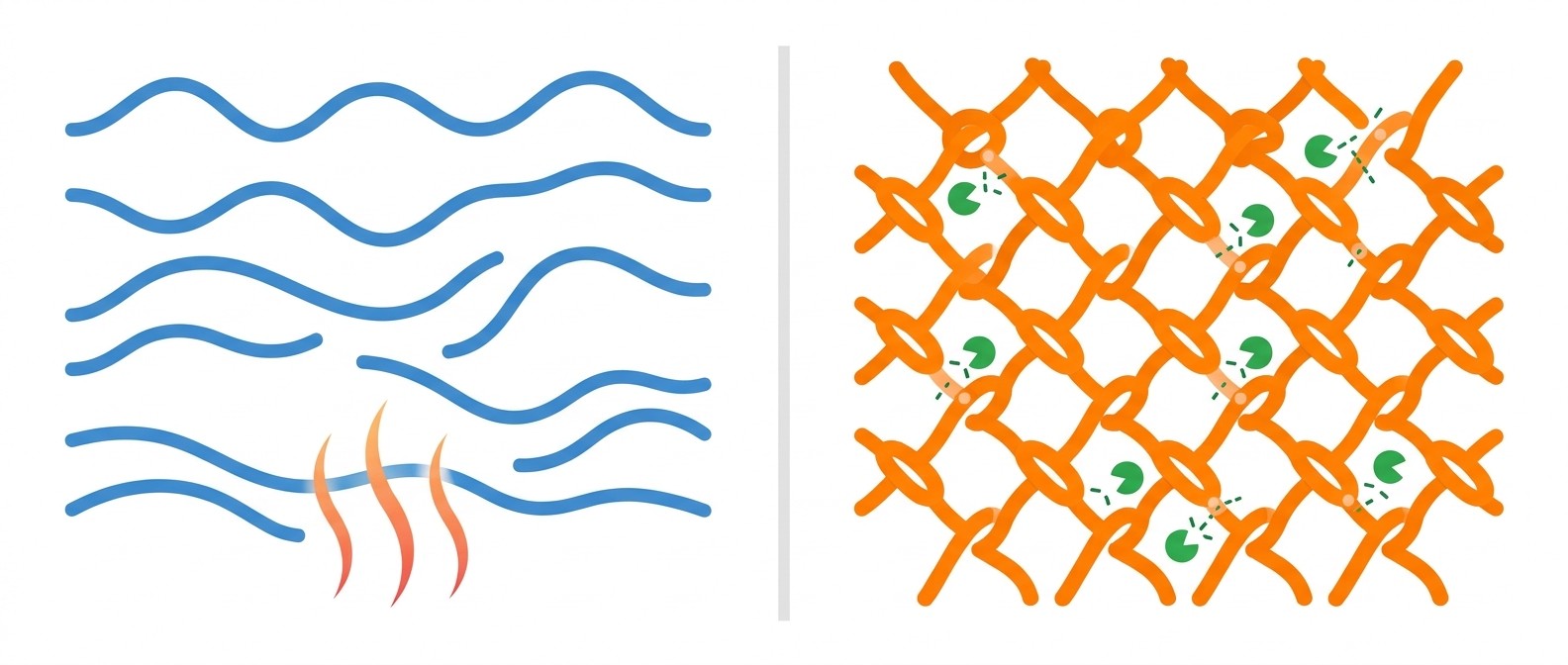
To see why this experiment matters, it helps to separate the plastic world into two basic families: recyclable thermoplastics and thermosets. Thermoplastics behave like candle wax. Their molecules form long, separate linear or branched chains that slide past one another when heated, allowing factories to melt and remold them into new items.
Thermosets behave more like a baked cake. During manufacturing, liquid resins undergo a chemical reaction that links their polymer chains together in every direction, creating a permanent three-dimensional crosslinked network. Once set, you cannot melt a thermoset back into a liquid any more than you can unbake a cake back into batter. Apply high heat, and the material simply chars and degrades.
| Feature | Thermoplastics | Thermosets |
|---|---|---|
| Molecular Structure | Linear or branched polymer chains that are not chemically locked together | Crosslinked three-dimensional polymer network with permanent chemical bonds |
| Response to Heat | Softens and remelts repeatedly when heated, like candle wax | Holds its rigid shape until it chars or chemically degrades, like a baked cake |
| Standard Recyclability | Mechanically recyclable by sorting and remelting, though often with downcycling | Cannot be remelted; conventionally considered unrecyclable by standard thermal methods |
| Common Examples | PET drink bottles, HDPE milk jugs, food containers | Polyester boat hulls, wind turbine blades, automotive parts, epoxy circuit boards |
| Typical End of Life | Mechanical recycling, incineration, or landfill | Landfill burial, incineration, or mechanical grinding into low-grade filler |
That structural stubbornness is exactly why engineers love thermosets for demanding jobs. When reinforced with glass or carbon fibers to form a thermoset composite, these resins stay strong under extreme weather, heat, and mechanical stress in airplanes, boats, cars, and wind blades. When those products reach the end of their service life, however, the locked polymer network leaves few options beyond landfill disposal, incineration, or grinding the scrap into cheap construction filler.
The Two-Sided Fix: Redesign the Plastic, Then Evolve the Eater
Rather than hunting for a miracle microbe that could chew through conventional hardware, the CSIC-led team and their partners approached the puzzle from both sides at once. Over the past decade, scientists have made rapid progress using enzymes to digest thermoplastics, particularly polyethylene terephthalate (PET) bottles. Throwing a natural enzyme at a commercial thermoset composite, however, usually fails because the dense crosslinked matrix blocks the protein from reaching and snipping the chemical bonds inside. The starting commercial resin R930A, widely known as a fire-protection coating in the automotive and aeronautic sectors, was a case in point: its network forms through curing with oligomeric poly(styrene-co-HEMA), introducing carbon-carbon linkages highly resistant to enzymatic cleavage.
- Step 1, redesign the resin: Chemists replaced the styrene-derived motifs with ester-containing links, building the second-generation resin R930A_DVE1 from the crosslinker 1,3-bis(2-ethenyloxy)ethyl(1,3-benzenedicarboxylate) (DVE1) plus 2-hydroxyethyl methacrylate (HEMA) and methyl methacrylate (MMA) in a 1:1:1 ratio. The new resin kept a comparable glass transition temperature (84°C versus 78°C for R930A) and similar density, with a more flexible, ductile network: 58 percent lower Young’s modulus but higher tensile strength (47 MPa versus 12 MPa).
- Step 2, evolve the enzyme: Protein engineers took the fungal cutinase FsC variant L182A, chosen after benchmarking six cutinases because it combined activity on both surrogates with strong expression at about 120 milligrams per liter in flask cultures, and reshaped it to recognize and cleave the ester bonds inside that newly accessible resin structure.
This co-design philosophy echoes wider chemical efforts to build plastics designed from the start to come apart cleanly when triggered, rather than trying to force legacy materials through recycling systems they were never built to survive. By placing enzyme-accessible weak points into the second-generation R930A polyester backbone, the researchers gave their biological catalyst a realistic foothold without sacrificing the resin’s core structural role.
How They Evolved a 22x Stronger Cutinase
For the biological half of the system, the team started with a cutinase from the fungus Fusarium solani. In nature, fungi use cutinases as molecular scissors to slice through cutin, the waxy polyester coating that protects plant leaves. Because cutin contains ester bonds similar to those in synthetic polyesters, cutinases have become prime candidates for plastic biocatalysis, including earlier breakthroughs using an engineered cutinase that breaks down PET bottles into fresh starting monomers.
Natural Fusarium solani cutinase is too sluggish and heat-sensitive to tackle a tough thermoset matrix efficiently. To upgrade it, the researchers combined computational protein design, including PROSS plus CNA, FireProt, ProtPoser and consensus analysis, with directed evolution, a laboratory process that mimics natural selection at high speed by repeatedly mutating a gene, testing thousands of enzyme variants, and breeding the best performers across multiple rounds. An early intermediate, clone 8F3, already gained 20.5-fold and 10.4-fold total improvement on the two surrogates but lost 6 to 8°C of stability, which the PROSS stabilization rounds then recovered and exceeded.
Testing thousands of mutant enzymes directly on solid chunks of cured plastic would be far too slow for high-throughput screening. Instead, the team synthesized two soluble surrogate motifs, p-nitrophenyl trimethylacetate (3MA) and p-nitrophenyl benzoate (p-NPBZ), small dissolved molecules that mimic the exact chemical architecture of the redesigned R930A_DVE1 resin. Using these soluble stand-ins to screen performance quickly, the researchers guided the enzyme through iterative improvements, ending with a final variant named RancoR:
- 19 targeted mutations: RancoR accumulated 19 amino acid changes compared with the starting FsC enzyme (D21N, I24A, A29S, A32P, N58A, R78T, G100R, Q103N, Q104A, A127T, S129A, T144V, T150Q, R156N, S181T, A185T, R196A, E205R and R208K).
- 22-fold higher activity: Purified RancoR showed 20-fold and 22-fold improvements in specific activity toward 3MA and p-NPBZ, respectively, over the parental enzyme. In microfermentation screening, which combines activity and expression, total improvement reached about 136-fold and 99-fold for the two surrogates.
- 11°C boost in heat tolerance: The mutations raised thermodynamic stability by 11°C to a melting temperature of 63°C, with kinetic stability up 10.7°C to a T50 of 71.2°C, helping the catalyst stay folded and active under warmer reaction conditions.
What the Engineered Enzyme Actually Did in the Lab
A stronger enzyme is only useful if it can be brewed in reasonable quantities and actually breaks down the target polymer. To test scalable enzyme manufacturing, the researchers moved production into the yeast Pichia pastoris (Komagataella phaffii) and grew it in a 5-liter fed-batch bioreactor. According to the indexed study findings, after about 70 hours of fermentation the yeast produced roughly 0.7 grams per liter of RancoR, about 10 times the flask-scale yield, with a 3-fold increase in secretion levels over the parental enzyme.
For the resin test itself, the team micronized the cured R930A_DVE1 resin to particles below 45 micrometers to increase surface area, then ran reactions in 100 mM potassium phosphate buffer at pH 8.0 with 200 milligrams of resin per milliliter and 0.5 milligrams of enzyme per milliliter at 40°C, refreshing the medium with fresh enzyme every 72 hours. Under these optimized conditions, the enzyme depolymerized the crosslinked material over 15 days to a total of 6 millimolar (6 mM) of monomethyl phthalate, roughly 1.08 grams per liter. That equals about 2 percent by weight of the unsaturated polyester in the formulation, or about 1 percent of the starting resin mass, which the authors note is comparable to early-stage results reported for other hard-to-degrade polymers such as polyamides.
Importantly, the original commercial R930A resin showed negligible degradation under the same enzymatic treatment, confirming that the redesign step was essential. The detection of released monomethyl phthalate, which arose exclusively from enzymatic cleavage of the polyester backbone with a clear enzyme-dependent and dose-responsive profile, confirmed genuine severing of bonds inside the complex resin rather than surface scrubbing. Because this test occurred under controlled laboratory conditions on a custom-formulated resin, it stands strictly as a biochemical proof of concept rather than a complete material recovery cycle.

Why This Is Lab Scale Only, Not Industrial Recycling Yet
Every time a plastic-eating enzyme appears in a scientific journal, headlines tend to jump straight to waste-free oceans and disappearing landfills. Reading the CSIC and EvoEnzyme results accurately requires separating what the experiment proved from what remains unsolved.
First, the authors explicitly frame their paper as a proof-of-concept study aimed at demonstrating the feasibility of enzymatic thermoset composite degradation. That result proves the biochemical mechanism works, but industrial chemical recycling demands orders of magnitude higher product concentrations, complete conversion metrics, and verified purification steps to turn recovered molecules back into fresh resin.
Second, the enzyme did not eat an off-the-shelf thermoset. It broke down a second-generation polyester resin specifically modified from R930A to let the enzyme in. That distinction means this method cannot be sprayed onto legacy boat hulls, epoxy circuit boards, or older wind turbine blades already sitting in scrapyards. Still, the research fits into a broader European effort, including EvoEnzyme’s ongoing work within the BLADE2CIRC wind blade recycling initiative, to combine reversible polymers and tailored enzymes for future composite hardware.
Finally, moving any biological recycling process out of the lab takes years of heavy chemical engineering. Even for much simpler PET bottle waste, building the industrial enzymatic PET plant capable of processing 50,000 tonnes per year has required more than a decade of optimization, permitting, and multi-year construction timelines. Turning this gram-per-liter proof of concept into a viable factory process will require solving bulk composite breakdown, fiber separation, reaction speed, and unit economics.
Frequently Asked Questions
Is Thermosetting Plastic Recyclable?
Conventional thermosetting plastic is not recyclable through standard melting and remolding because its polymer chains are locked in a permanent three-dimensional chemical network. The new CSIC-led study shows that a thermoset plastic recyclable by enzymes is possible in the laboratory, but only when chemists first redesign future polyester resins to include enzyme-accessible weak points. It does not make existing thermoset waste recyclable.
What Enzyme Can Break Down Plastic?
Several ester-cleaving enzymes, including PETase and leaf-branch compost cutinase (LCC), can break down polyester thermoplastics such as PET drink bottles. In the November 2026 study, researchers engineered a fungal cutinase from Fusarium solani with 19 mutations to depolymerize a redesigned polyester thermoset composite resin. These enzymes work only on specific ester bonds in polyesters and do not break down epoxy thermosets or polyolefins like polyethylene and polypropylene.
Why Does Lab Success Not Mean Industrial Recycling?
A laboratory study only needs to prove that a chemical reaction can happen, whereas an industrial plant must process thousands of tons quickly and profitably. In this experiment, the 22-fold specific-activity jump was measured on dissolved surrogate molecules, the solid-resin test peaked at 40°C and declined at higher temperatures as enzyme inactivation outweighed polymer mobility, and the 15-day run reached about 1.08 grams per liter (6 mM) of monomethyl phthalate, or roughly 1 percent of the starting resin mass. Scaling up would require much higher conversion rates on full fiber-reinforced hardware, cost-effective product purification, and proven energy and economic numbers.


