
The plastic recycling company Carbios has made a breakthrough discovery. Its team of scientists engineered an enzyme that can reduce Polyethylene terephthalate (PET) plastics to their basic chemical building blocks, which can then be used to make high-quality new items. The enzyme was initially discovered in 2012 in a compost heap of leaves, but even though it was able to break down plastics, it wasn’t able to do it efficiently. The newly developed version can.
The company plans to have an industrial-scale recycling facility built within five years. It has partnered with major companies, including L’Oreal and Pepsi, to get the plant running as soon as possible. The new enzyme is a significant advancement because most existing recycling technologies can only produce plastics right enough for carpets and clothing. Carbios’ enzyme can convert 90% of the same plastic back into its pristine starting material, while other methods can only convert about 30%, and it often ends up a lower strength version.
Carbios deputy chief executive, Martin Stephan, said:
We are the first company to bring this technology to the market. Our goal is to be up and running by 2024, 2025, at a large industrial scale.
A reduction in plastic use is one part of solving the waste problem. But we all know that plastic brings a lot of value to society, in food, medical care, transportation. The problem is plastic waste.
Around 70 million tons of PET is produced every year, making it one of the world’s most commonly used plastics. Of course, with so much of it in use, there are plenty of recycling companies trying to deal with all the waste produced. However, when a batch of multi-colored pieces of plastic comes in, it gets melted all together, and the result is an ugly gray-black plastic that few companies want to work with. Hence why the material ends up as carpets or other low-grade plastic fibers that subsequently end up in a landfill and don’t get recycled again.
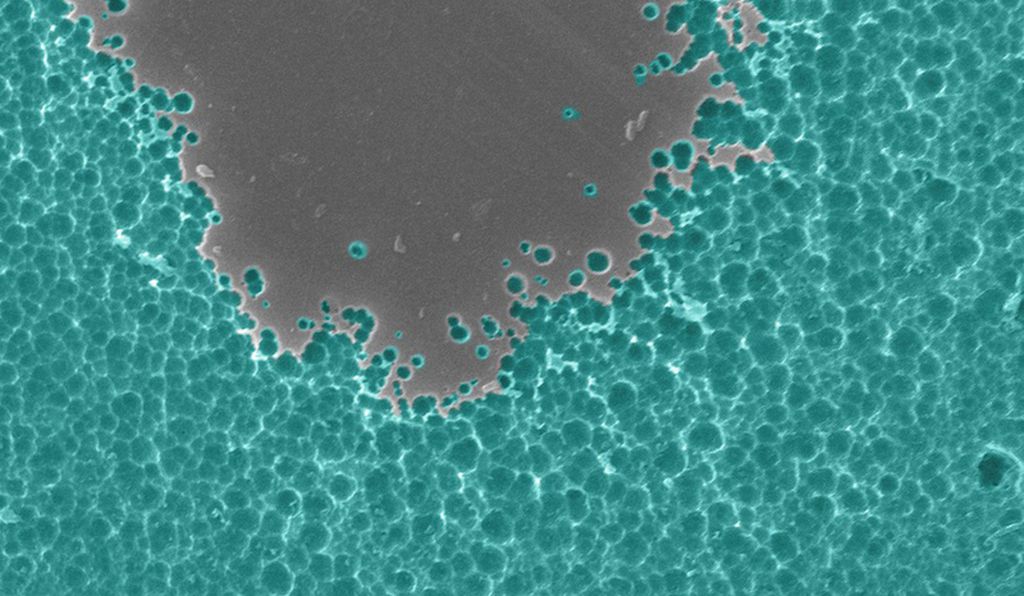
Researchers have long been looking for a solution to this problem. That’s how back in 2012, a team at Osaka University found the enzyme Carbios is working with today. The enzyme they found – called leaf-branch compost cutinase (LCC) – breaks the bonds between PET’s two building blocks: ethylene glycol and terephthalate. LCC, in its original state, had evolved to break down the waxy protective coating on many plants’ leaves. However, it turns out they can break down PET too, but rather slowly. Another issue was that when put into the environment necessary for plastic to be soft and easier to work with (temperatures at 65°C), the enzymes would fall apart after a few days.
Curious to see if the enzyme could be altered to employable standards, Alain Marty, the chief scientific officer at Carbios, teamed up with Isabelle Andre, an enzyme engineering expert at the University of Toulouse. Together they set out to re-engineer LCC.
They generated hundreds of mutant enzymes by changing amino acids in its crystalline structure at the binding site to make them more efficient. They also added in heat-stabilizing amino acids to make it able to withstand higher temperatures for longer. After testing all of them to find the most efficient PET breakers, they found the one best mutant enzyme. It’s 10,000 times more effective at PET bond-breaking than the native LCC. It can also work in temperatures at 72°C (which is around the temperature at which PET becomes molten) without breaking down. The research has been published in Nature.
Prof John McGeehan, the director of the University of Portsmouth’s Centre for Enzyme Innovation, said:
It makes the possibility of true industrial-scale biological recycling of PET a possibility. This is a very large advance in terms of speed, efficiency and heat tolerance. It represents a significant step forward for true circular recycling of PET and has the potential to reduce our reliance on oil, cut carbon emissions, and energy use, and incentivize the collection and recycling of waste plastic.
Seeing as plastic isn’t going to disappear, because realistically it is a reliable, lightweight, and useful material, perfecting the recycling method to make it so we can reuse the plastic infinitely is critical. Another team recently found a bacteria in a plastic landfill which breaks down and eats plastic all on it’s own! Carbios is in the process of getting a demonstration plant built that will recycle hundreds of tons of PET yearly. If successful, it will set up more facilities, very much helping society to deal with the challenging plastic crisis plaguing our planet today.


