
Every fall, the same ritual plays out across marinas from Maine to the Great Lakes. Boats come out of the water, cradles go up, and thousands of yards of plastic film get unrolled, heat-shrunk, and taped into place. By spring, most of that film is cut off, balled up, and hauled to a dumpster, where it will sit in a landfill for centuries, more or less unchanged.
For decades, this was simply the cost of doing business. Winterization protected the asset; what happened to the wrap afterward was someone else’s problem. That calculus is shifting. Marina operators are fielding more questions from boat owners about where the film goes, and yard managers are starting to look, carefully and with healthy skepticism, at what alternatives actually exist on the market. Some of that shift is customer-driven, some of it is coming from tighter local waste-handling expectations, and some of it is simply operators doing their own homework after years of treating shrink wrap as a disposable afterthought.
This article isn’t a sales pitch. It’s a practical look at what “biodegradable” actually means in the context of shrink wrap, what to ask before switching suppliers, and where the material trade-offs really sit for marina and boatyard operations, written for the people who have to make the wrap job hold up through a real winter, not just look good in a brochure.
The Waste Problem Nobody Talks About in the Fall
Boat winterization is one of the highest-volume single uses of plastic film in the marine industry in the United States. Across a full season, a marina wrapping its fleet moves a substantial amount of film through the yard, most of it destined for a landfill within months of being cut away in spring.
Conventional low-density polyethylene (LDPE) shrink wrap is engineered to be strong, UV-resistant for a season, and easy to shrink tight around irregular hull shapes. Those same properties are exactly what make it persistent once it’s discarded. It doesn’t break down in any meaningful timeframe under normal landfill conditions: a roll discarded today will still be sitting there in 500 years, gradually fragmenting into microplastics the entire time.
It’s also one of the more difficult plastics to recycle economically, since it’s thin and flexible. Most municipal recycling streams won’t take it at all, and the “recyclable” claims often printed on the packaging don’t hold up well once you look at what actually happens to the material after pickup. The BoatUS Foundation notes that shrink wrap is not biodegradable and can become a genuine disposal problem at landfills, which is why a growing number of marinas have started offering bulk collection programs of their own.
That’s the gap a newer category of film is trying to close, not by making winterization less effective, but by changing what happens to the film after it’s cut away.
What “Biodegradable” Should Actually Mean for a Boatyard
The word gets used loosely in marine retail, so it’s worth being precise. A biodegradable shrink film worth considering for commercial winterization work should meet a few specific conditions.
It Has to Perform Like a Premium Film, Not a Compromise
If a “green” wrap tears more easily, shrinks unevenly, or needs extra heat to seal, it doesn’t matter how eco-friendly the marketing is: it will cost a yard money in labor and callbacks. Any biodegradable film worth stocking needs to match or beat the tensile strength, UV stability, and weldability of the conventional film crews are already used to.
It Has to Be Tested to a Recognized Standard, Not Just Claimed
Look for third-party biodegradation testing under an established protocol. ASTM D5511 is the relevant one for anaerobic, landfill-representative conditions. A material with documented, ongoing test results is a meaningfully different proposition than a film that simply says “eco” on the roll.
It Should Not Shed Microplastics as It Breaks Down
This is the detail that separates genuinely biodegradable film from “degradable” or oxo-degradable plastics, which fragment into smaller and smaller plastic particles rather than breaking down at a molecular level. For a marina sitting on open water, that distinction matters enormously.
It Shouldn’t Have a Shelf-Life Problem
A film that starts degrading in storage before it’s ever used isn’t workable for a seasonal business. Biodegradation should be triggered by landfill conditions specifically, not by ambient humidity, sunlight, or time on a shelf.
Where This Actually Shows Up in the Real World
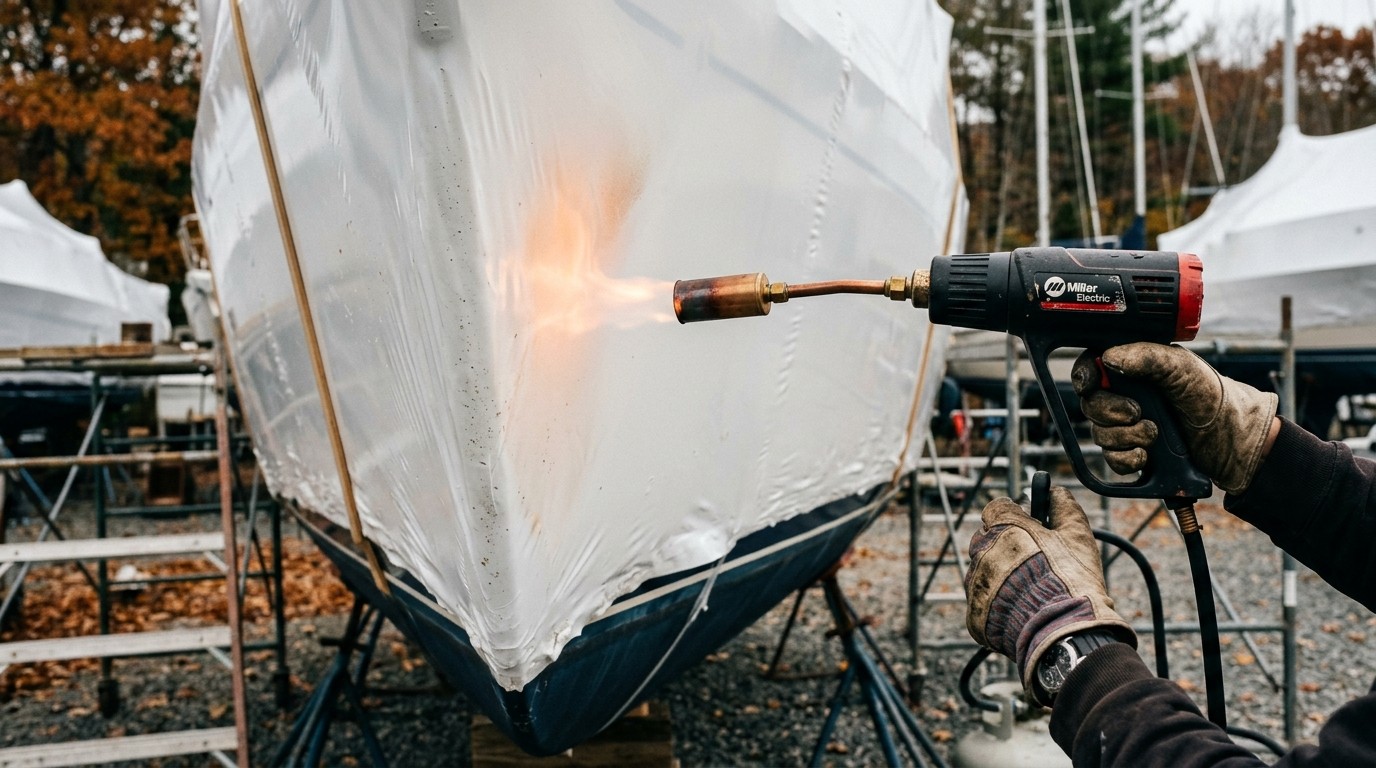
One of the more credible examples of a manufacturer building specifically around these constraints is bioaqualife®, a Narragansett, Rhode Island-based company founded in 2023 that has focused its shrink-wrap line on marine winterization, sandblasting containment, and OEM boat covers.
The company markets its film as breaking down under landfill conditions without leaving microplastic residue, backed by ongoing ASTM D5511 testing. The latest published reading, released in June 2026, put bioWRAP® at 93% biodegradation after 1,147 days in landfill conditions, up from an earlier milestone of 78.8% at 1,067 days. It’s worth noting that biodegradation testing is a multi-year process by design, so a manufacturer publishing interim, ongoing results is a different posture than one making a flat, unqualified claim.
| Spec | Detail |
|---|---|
| Gauge | 7, 7.5, 9, and 11 mil (11 mil equals 280 microns) |
| Roll width | 14 to 40 feet |
| Biodegradation testing | ASTM D5511: 93% at 1,147 days (testing ongoing) |
| Microplastics | None claimed: molecular breakdown, not fragmentation |
| Flame retardant (FR) certification | ASTM E84 Class A |
| Shelf life | No degradation until landfill conditions are reached |
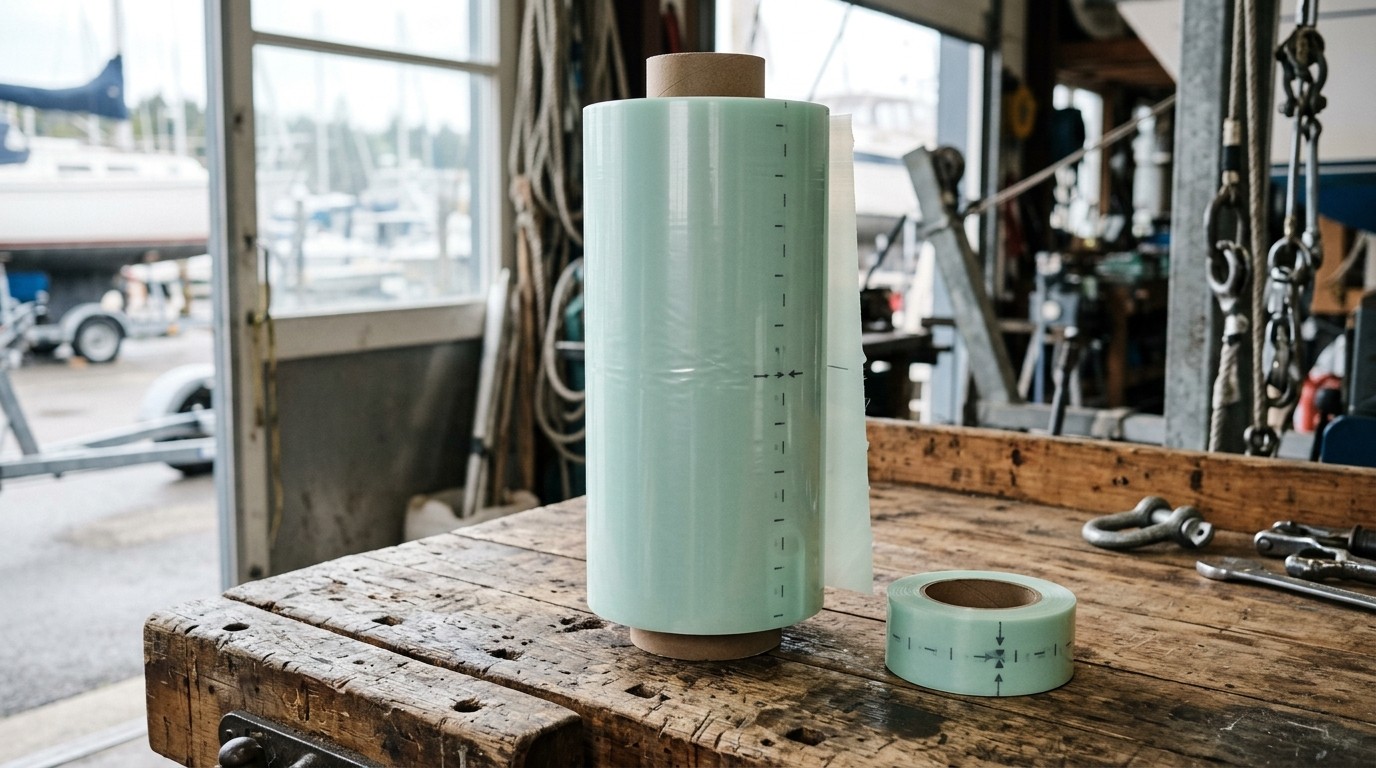
| Roll format | Center-fold, with printed alignment marks every 2 feet |
None of this is a reason to switch suppliers blindly. It’s a reason to ask the same questions of any biodegradable film being pitched to your yard: how does it perform against conventional wrap, what standard was it tested against, how far along is the testing, does it shed microplastics, and does it actually perform under real winter conditions, not just in a lab.
Reading Past the Marketing: A Short Primer on Standards
Marine retail is full of loosely used sustainability language, so it’s worth arming your purchasing team with a basic vocabulary before any supplier conversation.
Biodegradation Testing
“Biodegradable” on its own is not a regulated claim in most jurisdictions, which is why it gets applied so liberally. What actually matters is the test standard behind it. ASTM D5511 measures the percentage of a material’s carbon that converts to biogas under anaerobic, landfill-representative conditions over a defined test period. A film with a published D5511 result is making a fundamentally different claim than one that simply prints “biodegradable” on the roll. The same logic now underpins national rules such as Britain’s first biodegradable plastic standard, which requires 90% of a plastic’s organic carbon to convert to carbon dioxide within 730 days.
FR and Safety Certifications
ASTM E84 measures flame spread and smoke development, with Class A as the top rating. To earn it, a material must post a flame spread index of 25 or less and a smoke development index of 450 or less. EN 13501-1 is the equivalent European standard, relevant for marinas working with European-flagged vessels. Neither has anything to do with biodegradability, but both matter for insurance and code compliance, so it’s reasonable to ask any film supplier for current certification documentation rather than taking a claim at face value.
The Cost Conversation Yard Managers Actually Have
Price-per-roll is the number every yard manager starts with, and it’s rarely the number that ends up mattering most once a season is underway. A more useful comparison looks at total cost per boat wrapped, which is harder to pin down before a real trial, but far more relevant to the bottom line than the invoice for a single pallet of film.
| Cost category | What actually drives it |
|---|---|
| Material cost | Price per roll: the starting point, rarely the full picture |
| Labor time per boat | Shrink speed, seam welding quality, rework needed |
| Callback and rework | Wind damage or seam failure requiring mid-winter repair |
| Disposal | Municipal tonnage fees or waste-stream restrictions, where applicable |
Material cost is the easiest line item to compare and the least useful one on its own. Labor time is where a film that shrinks faster or welds more predictably can quietly offset a higher roll price across a busy season: the manufacturer of the film discussed above claims up to a 20% saving in install time, which would translate into less propane burned and less tape and labor per boat. That figure is a company claim, not an independent benchmark, which is exactly why the trial-before-you-commit approach matters. A trial is the only way to get a number specific to your crew and your typical boat mix rather than relying on a supplier’s general claims.
Callback and rework cost is harder to quantify but real: a wind-damaged wrap that needs mid-winter repair costs both material and labor, and it’s also a customer-relationship cost that doesn’t show up cleanly on a spreadsheet.
None of these numbers can be estimated accurately from a spec sheet. They only become clear once a yard runs its own trial and tracks the results across a representative set of boats.
A Practical Framework for Evaluating a Switch
If your marina is weighing whether to introduce a biodegradable film into next season’s winterization program, a few steps are worth working through with your team before committing to a full changeover.
Start with a limited trial, not a full conversion. Wrap a handful of boats, ideally a mix of hull shapes and sizes, before switching your whole inventory order. This gives your crew a chance to get a feel for shrink temperature, seam behavior, and tear resistance without risking a season’s worth of work on an unfamiliar product.
Talk to your installers directly, not just your supplier. The people running heat guns and tensioning film every day will notice differences in handling long before it shows up in a spec sheet. If your crew reports the material behaves differently under the gun, that’s worth factoring into your ordering decision regardless of what the marketing says.
Ask about total cost, not just roll price. A slightly higher per-roll cost can be offset, or not, by faster application time or fewer callbacks for wind damage. Get real numbers from your own yard’s trial before assuming either direction applies to your operation.
Confirm the disposal pathway with your hauler. A biodegradable film only delivers on its promise if it actually ends up somewhere it can biodegrade. Check with your waste hauler about how the material is handled, and don’t assume “biodegradable” and “compostable” are interchangeable. They usually aren’t, and the disposal instructions can differ meaningfully between the two.
Questions Worth Putting Directly to Any Supplier
Before a full order goes out, it’s worth having a short, direct conversation with any biodegradable film supplier, including one already under consideration:
- How does tensile strength compare with the film my crew already runs under the gun?
- How does it perform against the conventional wrap we already use?
- What is its UV stability rating, and how long does that protection last?
- Does it start breaking down during storage or while in use, or only once it reaches a landfill?
None of these questions have a universally “right” answer for every yard. But asking them consistently is what separates a real material upgrade from a marketing exercise.
Frequently Asked Questions
What Standard Should a Biodegradable Shrink Film Be Tested Against?
The relevant one is ASTM D5511, which measures the share of a material’s carbon converted to biogas under anaerobic, landfill-representative conditions. bioWRAP® film documents 93% biodegradation at 1,147 days under this standard, with testing ongoing.
Does Biodegradable Shrink Wrap Shed Microplastics as It Breaks Down?
Genuinely biodegradable film breaks down at the molecular level rather than fragmenting. That distinguishes it from oxo-degradable plastics, which just break into smaller and smaller plastic particles.
Does Biodegradable Film Have a Shelf Life for Off-Season Storage?
No. Biodegradation is triggered by landfill conditions specifically, not by ambient humidity, sunlight, or time on a shelf, so a trial roll in inventory behaves like any conventional wrap.
The Bottom Line for Marina Operators
Winterization isn’t going away, and neither is the volume of film that comes with it. The honest answer is that biodegradable shrink film isn’t a magic fix. It still needs proper landfill disposal to break down as intended, and it’s still a relatively young category compared to decades of conventional LDPE film.
Practical takeaway: before committing a season’s inventory to any biodegradable film, run a small trial on a handful of boats and let your own crew’s hands-on feedback, not the spec sheet, make the call.
For marinas looking for a starting point to build that trial around, manufacturers such as bioaqualife®, founded in 2023 and serving the marine segment alongside construction and industrial applications, are worth a look.


