
In a small, early-stage study, 10 people who were legally blind from advanced retinitis pigmentosa, a group of inherited eye conditions in which the retina’s light-sensing cells break down over time, received an optogenetic therapy. Optogenetics is a method that uses light to control cells that have been given a light-sensing protein. Seven became more sensitive to light, and a smaller number could again detect or locate simple objects while wearing special goggles. The result is partial, not full vision, but it held across several patients for the first time in a group.
What the 10-Person Study Found
The trial enrolled 10 adults with advanced retinitis pigmentosa, all of whom had little or no remaining vision and were legally blind as a result.
Each person received a single injection into the worse-seeing eye. The injection used an adeno-associated viral vector, a widely used carrier virus called AAV, to deliver instructions for making ChrimsonR. ChrimsonR is a light-sensing protein first found in algae. It responds best to amber-colored light. The team tested three dose levels, and responses appeared in all three groups, which matters because it suggests the signal was not tied to one dose.
The main goal was safety, which is normal for a first cohort at this stage. Secondary tests measured whether light sensitivity and everyday visual tasks improved when participants wore light-stimulating goggles. The other eye was patched during each test session so only the treated eye counted.
In this small, early-stage group, the team reported:
- 7 of 10 participants became more sensitive to light, with gains ranging from a factor of 2.0 to a factor of 62.3.
- 6 of 10 reached a preset bar for a clinically meaningful gain. That bar required a drop of at least 0.6 log units on a light sensitivity test, equal to seeing light about four times dimmer than before.
- 4 of 8 people who completed behavioral testing improved at detecting or locating objects.
- More participants improved at related tasks, such as finding a doorway or following a line while wearing the goggles.
- 4 participants showed steady gains across several real-world tasks over months to years of follow up.
The study was led by Jose-Alain Sahel of the University of Pittsburgh School of Medicine and Botond Roska of the Institute of Molecular and Clinical Ophthalmology Basel, known as IOB. It was supported by GenSight Biologics and run as part of the PIONEER trial, listed as NCT03326336 in the federal trial registry. The paper, titled Optogenetic Therapy for Restoring Aspects of Visual Function, appeared in volume 395, pages 1399 to 1408.
How Spare Retinal Cells Take Over When Photoreceptors Are Gone
A healthy retina works in layers. The photoreceptors, the light-sensing cells at the back, include rods for dim light and cones for sharp central and color vision. When light arrives, they convert it into electrical signals.
Those signals pass to middle cells, called bipolar cells, and then to ganglion cells. Ganglion cells are nerve cells whose long fibers form the optic nerve, the cable that carries visual information to the brain. In retinitis pigmentosa, photoreceptors die first. Ganglion cells often survive long after, but they have no light signal left to carry.
Optogenetics gives those surviving cells a new job. The AAV injection adds the ChrimsonR gene to ganglion cells in the treated eye. Weeks later, those cells make the light-sensing protein and sit ready. By itself, that is not enough, because ChrimsonR needs bright, specific light to switch on.
The goggles close the loop:
- A camera on the goggles captures the scene in front of the person.
- A portable processor turns that scene into patterns of amber light.
- A projector in the goggles sends those light patterns onto the retina.
- The treated ganglion cells respond to the patterns and send signals down the optic nerve.
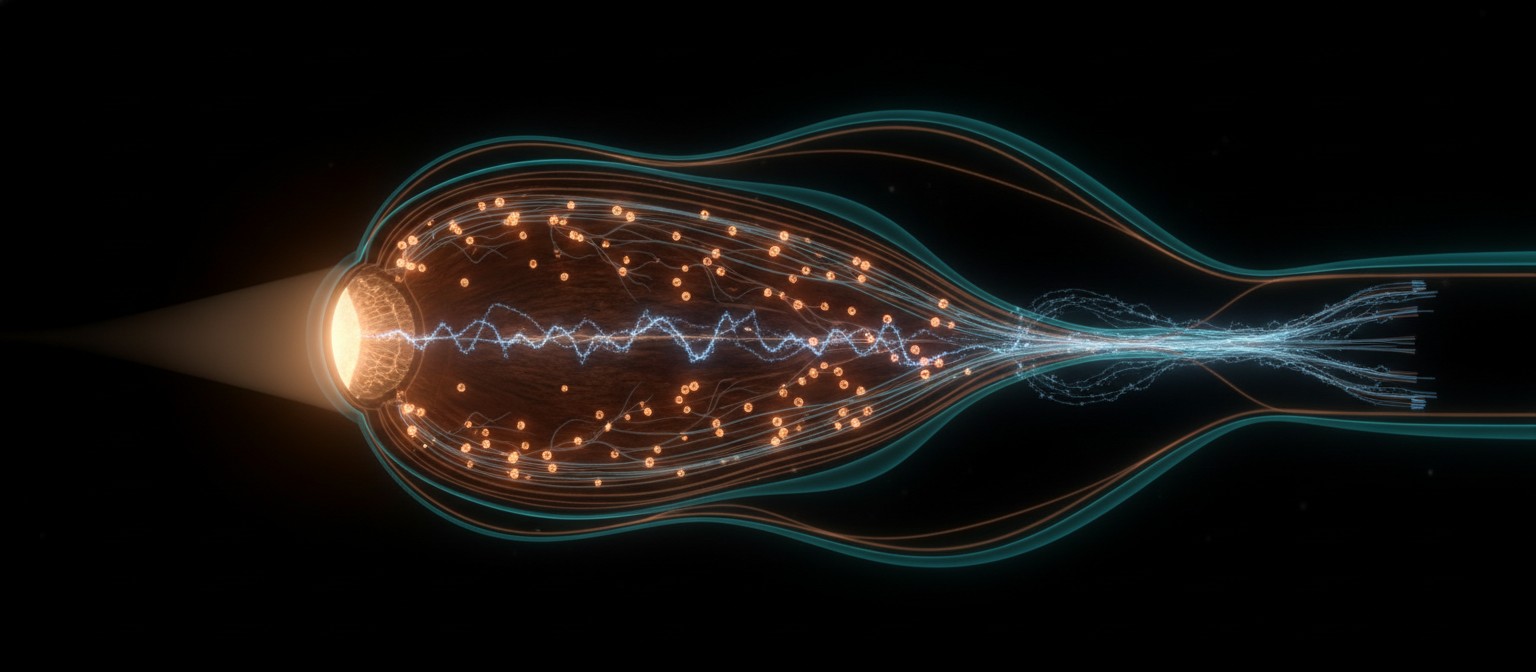
Brain recordings suggest the signal goes further than the eye. In this study, researchers led by Marlene Behrmann at Pittsburgh used electroencephalography, a method that records brain activity from sensors on the scalp, and found visual signals reaching and being processed in the visual cortex. The visual cortex is the part of the brain that interprets what the eyes send. People who trained more with the device also tended to do better on object detection, which fits with the idea that the adult brain must relearn how to read a new kind of input.
The U.S. National Eye Institute uses a sports analogy for this general idea. As its Reviving Vision primer explains, bipolar and ganglion cells can act like second-string players who step in when rods and cones can no longer play. The cells do not become true photoreceptors. They simply gain a light response that can pass useful information forward.
What Patients Could and Could Not See
It helps to translate test scores into everyday tasks. In this early cohort, gains were limited but practical for people starting from near-total blindness.
While wearing the goggles, some participants could:
- Notice when an object was present on a table.
- Tell roughly where that object was located.
- Reach toward it more accurately.
- Find a doorway or follow a high-contrast line more reliably.
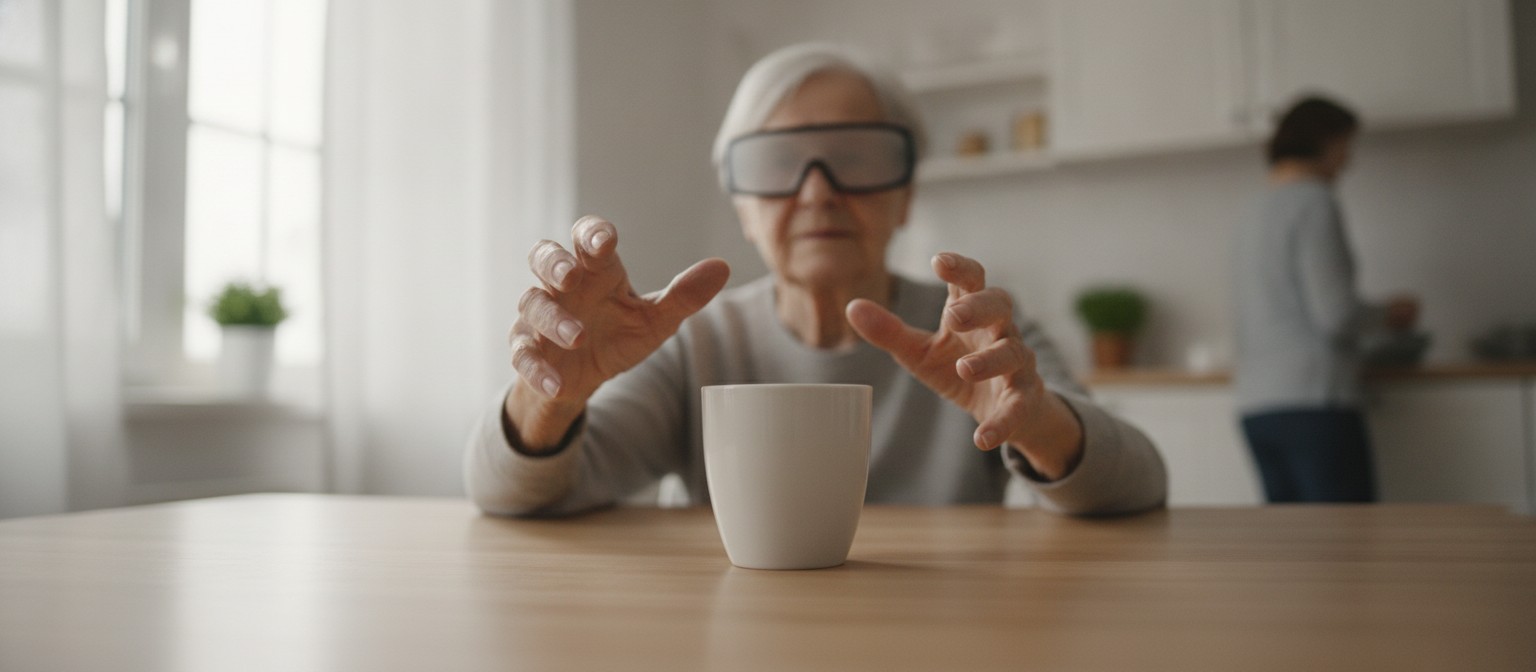
The treatment did not restore normal vision. Participants could not read with the treated eye. They did not regain full color vision or sharp detail. The effect also required the goggles. Without the camera and projector system, ordinary room light does not activate ChrimsonR strongly enough for useful sight.
That limit matters. Headlines that say blindness was cured overstate what the paper shows. A fairer summary, shared by both the University of Pittsburgh summary and the IOB media release, is that a degree of visual function returned at a very advanced stage of disease, in some but not all participants.
Safety Results From the Early Trial
Safety was the primary endpoint, meaning the first question was whether the injection and follow-up caused harm. Within the limits of a 10-person open-label study, the team described the treatment as tolerated. Open-label means both doctors and participants knew who received treatment, with no placebo group for comparison.
The paper records 34 eye-related adverse events in 9 of the 10 participants. Most were mild or moderate and included short-term inflammation inside the eye and brief rises in eye pressure. One severe event, a temporary blockage of blood flow in the retina right after injection, resolved within minutes after treatment, according to the University of Basel summary of the study.
Small size limits what safety data can prove. Rare or late problems would not show up in 10 people. Longer follow-up and larger controlled studies are needed before anyone can judge durability, repeat dosing, or use in other diseases where photoreceptors are lost but ganglion cells remain.
How This Approach Differs From Other Vision Restoration Strategies
Several fields aim to restore sight, but they work on different cells and at different stages. Confusing them is easy, so it helps to separate them clearly.
| Strategy | What It Acts On | Stage of Testing | Key Limit |
|---|---|---|---|
| Ganglion-cell optogenetics (this NEJM study) | Adds a light sensor to surviving ganglion cells; uses goggles to drive them | 10 legally blind adults; safety primary; partial gains in some | Requires goggles; low resolution; no reading or normal sight |
| Mutation-specific gene replacement | Fixes one faulty gene in an inherited retinal disease | Approved for one rare RPE65 defect; hard to scale across 100-plus RP genes | One treatment per gene; only helps people with that exact defect |
| Retinal implants such as PRIMA | Electronic chip plus camera glasses stimulate remaining retinal circuits | 38 people in a 12-month trial in advanced macular degeneration; some regained reading ability | Needs eye surgery and long rehabilitation; different disease and device path |
| Muller-glia regeneration in mice | Reprograms support cells called Muller glia to make new photoreceptors | Mostly fish and mouse work; not a human treatment | Mammalian retinas show very limited regrowth so far |
The Muller-glia distinction deserves care. In zebrafish, Muller glia act like repair crews that reenter a stem-like state and produce new neurons after injury. In mammals, that ability is sharply limited, and recent mouse work pushing Muller glia toward new photoreceptors remains laboratory research. It works by growing replacement light sensors, which is a different goal from this human study.
Other human approaches sit closer to the clinic. Mutation-specific gene therapy helps a narrow group, which is why Sahel has argued for a mutation-independent method that could work regardless of which of the more than 100 RP genes is involved. Electronic implants take a different route with hardware. Readers can compare this gene-plus-goggles result with Intelligent Living’s earlier reporting on the single patient who regained partial sight with optogenetics in 2021, the PRIMA retinal implant system for late-stage macular degeneration, and a first-in-human stem cell trial for dry macular degeneration that also reported early but limited gains. A separate viral gene therapy for choroideremia, one form of inherited blindness, shows what a single-gene fix can and cannot do.
The approach requires a working optic nerve to carry signals to the brain, as Science News reporting on the study notes. It relies on cells in the retina communicating to the brain, so it cannot restore vision when that connection is damaged. That is why candidacy centers on surviving ganglion cells plus an intact nerve, not on blindness from any cause.
Durability: the Open Question Rivals Skip
Almost every release-led account of this study leaves out the same point: whether the gains lasted. The paper reports that four participants showed steady gains across several real-world tasks over months to years of follow up, but most coverage, and the short summaries, do not say how long any individual gain persisted or whether repeated testing is still underway. Physics World is the exception in naming the limit directly, noting the small sample left the team unable to fully characterize treatment response. Treat durability as unproven until larger studies with prespecified long-term follow-up report it.
Why Results Varied and What Comes Next
Not everyone improved, and the paper points to reasons that future work must address. Only eight of the 10 participants completed behavioral testing. Responses differed, likely because of differences in surviving retinal structure, precision of gene delivery, time since vision loss, and how much each person practiced with the system. The link between more training and better detection suggests rehabilitation is part of the treatment, not an extra.
The step from one patient to 10 matters because single cases can mislead. The 2021 report showed that partial recovery was possible in one man, who learned to locate a crosswalk and count stripes after months of training. The new cohort shows the effect can repeat across several people, still partial, still early, but no longer a single example. That is the milestone to keep in view.
Next steps include larger and controlled studies, better light sensors that work in dimmer light, sharper ways to translate camera images into nerve signals the brain can use, and longer safety follow-up. Researchers also want to test whether the same idea could help other conditions where photoreceptors are lost but ganglion cells survive. None of that is clinic-ready. Anyone considering a trial should speak with an eye specialist and check official registries rather than relying on marketing claims.
Frequently Asked Questions
Does optogenetics cure blindness?
No. In this small, early-stage study, some legally blind participants gained limited light perception and object-related tasks while using goggles. Normal vision and reading did not return. It is best described as partial optogenetics vision restoration, not a cure.
How is this different from the 2021 single-patient result?
The biology is closely related. Both used an AAV to add ChrimsonR to surviving ganglion cells plus light-stimulating goggles. The 2021 Nature Medicine report covered one person. The 2026 NEJM paper covers the first treated cohort of 10, with safety as the primary endpoint and repeated behavioral and brain measures.
Why are goggles required?
Treated ganglion cells respond to bright, specific wavelengths, not normal indoor light. The goggles use a camera and processor to turn the scene into amber light patterns strong enough to activate ChrimsonR. Without them, the gene alone does not produce useful sight.
Will retinal implants or stem cells make optogenetics unnecessary?
They address different needs. Implants such as PRIMA use electronics to stimulate remaining circuits and have shown reading gains in macular degeneration, but they require surgery and extensive training. Stem cell transplants aim to rebuild support layers. Muller-glia regeneration aims to grow new photoreceptors but remains largely in animal work. These paths may complement each other rather than replace one another.
Who might qualify for future trials?
Only people with advanced retinitis pigmentosa in whom photoreceptors are lost but inner retinal cells survive. This is not a treatment for blindness in general. Because the signal must travel down the optic nerve, coauthor Jose-Alain Sahel notes it cannot help when that connection is damaged, and future trials will likely require surviving ganglion cells and an intact optic nerve. Exact criteria will depend on trial design, eye health, and safety screening. An ophthalmologist and official trial listings are the right sources for current options.
A Small Light, Honestly Measured
For people who have lived without sight for years, noticing an object on a table or finding a doorway is not small. It is a change in daily life. The honest frame from this early work is narrow: a single injection plus goggles was tolerated in 10 people, light sensitivity rose in most, and partial object-related vision returned in some. Larger and longer studies will decide whether that small light can grow brighter and last.


