
For years, the easiest way to make an appliance sound “smart” was to connect it to an app: add Wi-Fi, send a notification, put a dashboard on a phone. That definition is starting to feel outdated. Some of the most useful intelligence in modern home cleaning happens inside the machine, as sensors monitor conditions and control systems adjust performance in real time. The more useful question in 2026 isn’t whether an appliance is connected, but how many decisions and repetitive tasks it removes from the person using it.
From Remote Control to Context Awareness
Early smart-home products were largely command-driven: open an app, tap a button, tell a voice assistant what to do. More recent thinking moves toward context awareness, where systems detect changing conditions and respond without a new instruction each time. Floor care is a useful category to watch here, since cleaning involves constant small judgments: is this area dirtier, does the machine need more power, is the roller ready for next use? The more of those decisions a system handles in the background, the more useful its intelligence actually is.
Dirt Detection Only Matters If It Changes the Cleaning
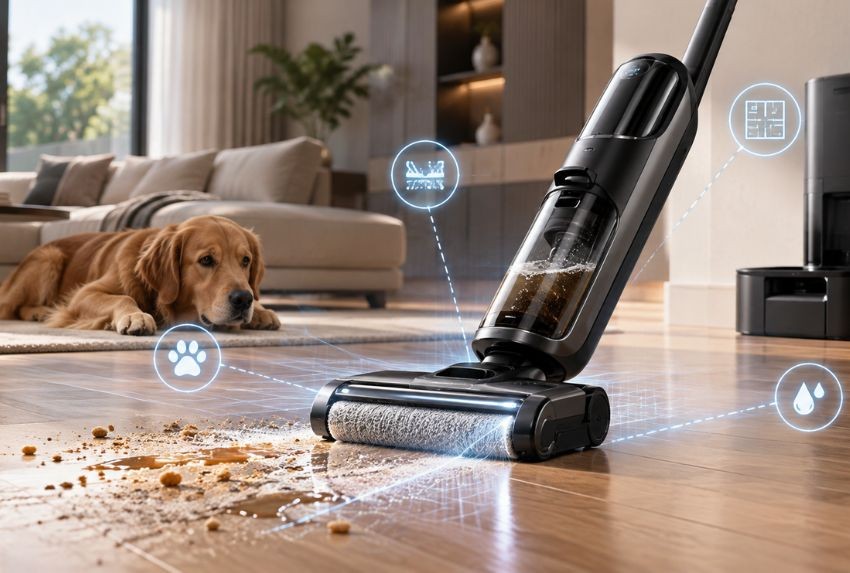
A sensor that just produces an animation on a screen has limited value. The useful part comes when sensing changes what the machine actually does. Tineco’s iLoop system, used across parts of its floor-care range, is built around real-time dirt detection, adjusting suction power and water flow automatically so the user has to switch operating levels less often when moving from a clean patch of floor to a messier one. That is a stronger form of “smart” than simply displaying more information.
The Most Important Automation May Happen After Cleaning
Wet-dry floor cleaning creates a second problem once the floor itself is clean: the machine now holds dirty water, a wet roller and residue inside the cleaning path. This is where self-cleaning systems earn their value, rinsing the roller, flushing the pathway and drying with heated air. That doesn’t make the appliance maintenance-free; tanks and filters still need checking. The more accurate framing is that automated maintenance reduces repetitive tasks, rather than replacing ownership altogether.
Steam Is a Good Example of Why More Intelligence Needs More Judgment
The Tineco FLOOR ONE S9 Boost Steam Wet Dry Vacuum Cleaner pairs wet-dry cleaning with targeted BoostSteam and ReverseScrub, in a body that reclines fully flat to reach under beds and sofas. Those functions genuinely help against dried food or greasy marks, but steam is also a reminder that the most advanced feature isn’t always the correct one. Different flooring materials react differently to heat and moisture, and the flooring manufacturer’s instructions should always override the appliance’s feature list.
Mechanical Design Is Still Part of Intelligence
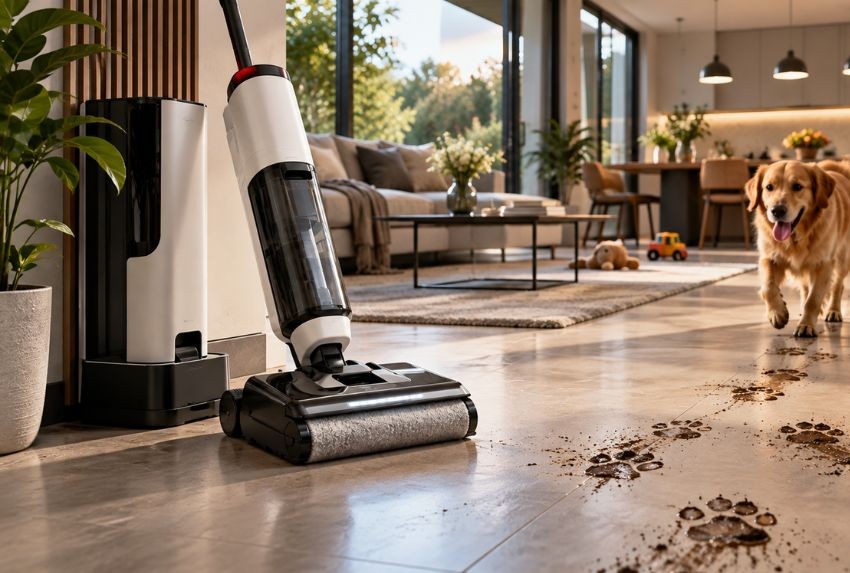
Smart-home discussions can become too focused on software, but every appliance still occupies physical space. A machine can have excellent sensing and still be unable to reach beneath a low sofa. The Tineco S7 Stretch Ultra Cordless Wet Dry Vacuum Cleaner uses a 180° Lay-Flat design that lets the body recline almost horizontally under low furniture, alongside FlashDry and DualBlock Anti-Tangle. That is mechanical problem solving rather than software intelligence, and a sensor can’t clean a space the appliance physically can’t reach.
More Capability Should Mean Fewer Decisions, Not More Modes
Picture two products: one offers ten modes the user must choose between constantly; the other detects conditions and handles most ordinary adjustments itself. The first may look more feature-rich, while the second delivers the more genuinely intelligent experience. That principle extends beyond floor care. A smart thermostat shouldn’t make heating more complicated, and a wet and dry vacuum cleaner shouldn’t make someone think more about cleaning than they did before, by combining dry pickup and floor washing into one pass rather than adding extra steps. Robot vacuum cleaners have followed the same path, handling most of those decisions without being asked.
Connectivity Still Has a Role, Just Not the Central One
Companion apps can offer maintenance reminders, diagnostics and firmware updates, but connectivity shouldn’t be treated as the definition of intelligence. A home-cleaning appliance that responds sensibly to conditions without needing a phone may provide more everyday value than one with an elaborate app controlling a manual workflow. Compatibility with Alexa, Google Home or Matter is worth treating separately from onboard intelligence: a device can be highly adaptive without belonging to a wider voice-assistant ecosystem.
FAQ
Is sensor-based cleaning the same as AI?
No. Many adaptive functions operate on sensors and predefined control logic without machine learning, which is why the NIST AI Risk Management Framework describes AI as an engineered or machine-based system that generates outputs such as predictions, recommendations or decisions.
Does a smart cleaner need Wi-Fi?
No. Onboard sensing and automatic control can provide meaningful intelligence without continuous connectivity.
Is Lay-Flat a smart feature?
Not in the software sense. It is intelligent mechanical design, since it removes a physical limitation that software cannot solve.
The Intelligent Home Should Ask Less of Us
The future of smart living may be quieter than early visions of the connected home suggested: fewer dashboards, fewer commands, fewer moments where technology demands attention just to prove it’s smart. The most useful systems will sense more, respond appropriately, and interrupt people less often. That’s what makes cleaning technology interesting within the wider intelligent-home conversation: the best appliances are starting to behave like good infrastructure, present when needed and easy to forget once the job is done.


