
One study of pharmaceutical shipments found that packages spent an average of 68.3% of transit time outside the recommended temperature range. Winter three-day shipments fared worse, sitting outside target for 80.1% of transit. Separately, more than one in four mail-order prescription deliveries in the United States was found likely to be exposed to excessive heat on the way to the consumer.
The industry numbers are correspondingly large. IQVIA puts annual pharmaceutical excursion losses at around 35 billion dollars. IATA estimates that close to 20% of temperature-sensitive shipments are compromised each year. And 44.6% of biopharma organisations report more than one temperature excursion annually.
Most patients receiving medication by post have never considered any of this, which is reasonable. It is also the reason the subject deserves attention, because the one point in the chain nobody monitors is the last few hours, and that is the part the patient controls.
What the Rules Require
Federal mail-order shipping regulations set out distinct requirements by product type. Non-cold-chain medications must be maintained between roughly fifteen and thirty degrees Celsius during shipping. Cold-chain products have a tighter and lower window, between zero and fifteen degrees.
Those windows are not arbitrary. They derive from stability testing establishing how long a product retains potency and remains free of degradation under defined conditions. Outside them, the manufacturer’s data no longer describes what is in the vial.
The industry has also moved past treating this as a simple two-to-eight-degree question. Cumulative exposure matters, not just whether a threshold was briefly crossed, and the monitoring market has grown accordingly, from under five billion dollars in 2021 toward a projected ten billion by 2026.
Why the Last Mile Is the Weak Point
Pharmaceutical logistics is competent at the parts it can see. Manufacturer to distributor to pharmacy runs in validated, temperature-controlled, monitored conditions.
The last mile is different in kind. A parcel in a delivery vehicle in July is in an uninsulated metal box that may reach well above ambient temperature. A parcel left on a doorstep is in direct sun for however long it takes the patient to come home. A parcel in an apartment lobby or a parcel locker may sit for a day.
None of that is monitored, and nobody is accountable for it in the way they are accountable for the warehouse. It is why the excursion figures look the way they do despite the upstream chain being well controlled.
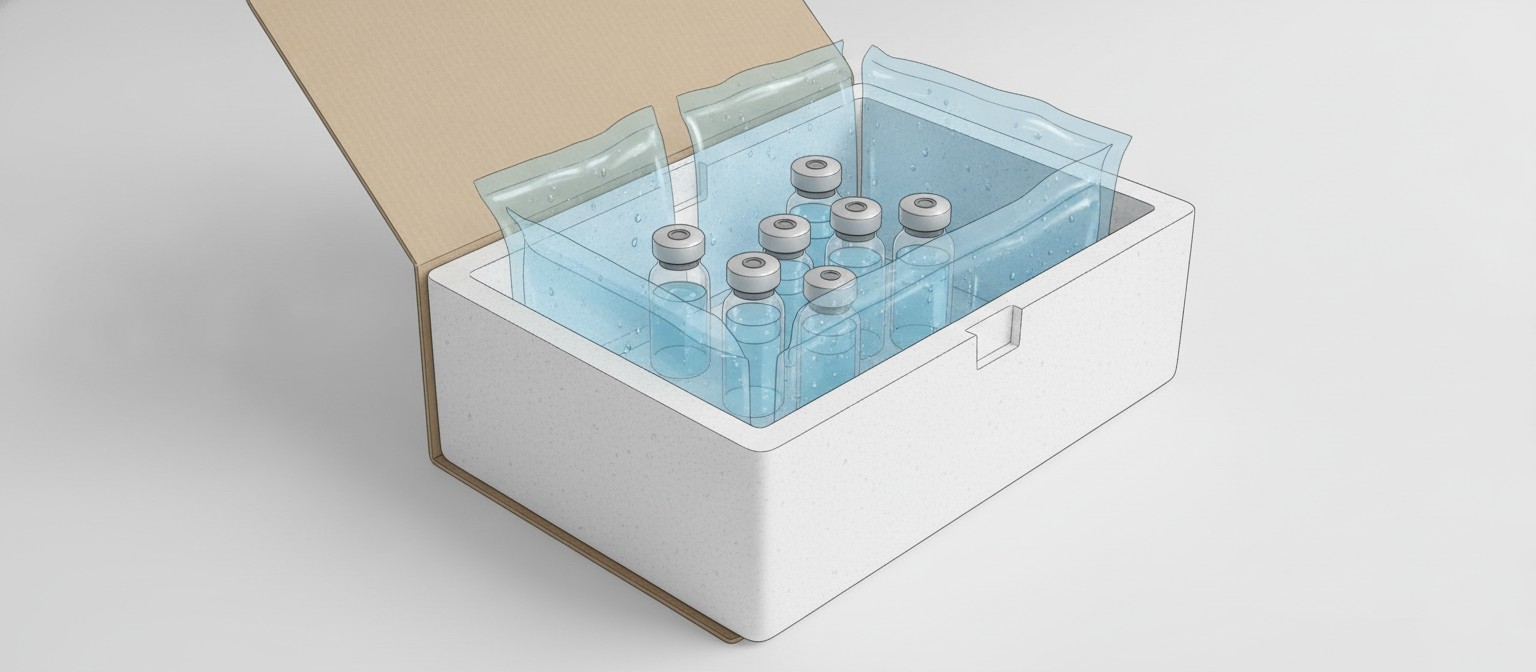
Insulated packaging and phase-change coolants are designed to carry the product through a predicted transit time. They are not designed to survive an extra day of a patient being at work, and the protection has a finite duration that is rarely communicated.
What a Patient Can Actually Tell
This is the uncomfortable part. A medication that has been through a temperature excursion frequently looks completely normal.
Visual inspection catches some problems. Discoloration, cloudiness or visible particles in a solution that should be clear are genuine signals, as is a product that has evidently been frozen. But loss of potency from cumulative heat exposure produces no visible change at all. The patient injects it, it appears to work, and it does not perform as it should.
That failure mode is particularly insidious because of how it gets interpreted. A patient whose results stall concludes the treatment is not working for them. The clinical conversation that follows is about the treatment rather than about the storage, because nobody in it knows the product spent a July afternoon in the sun.
The Questions Worth Asking Before the First Delivery
A few things are worth establishing in advance rather than after a problem.
How the product ships, and whether temperature-controlled packaging is used. What the expected transit time is, and how long the packaging protects beyond it. Whether delivery can be timed or redirected to somewhere attended. What the pharmacy’s policy is if a package arrives warm, has clearly been delayed, or has been sitting out. And who to contact about it.
That last point is the one that most often has no answer. A patient holding a parcel they are unsure about needs somebody to ask, and in a fragmented service there is frequently nobody whose job that is.
How This Works in Practice
The structural answer is an identifiable, licensed dispensing pharmacy with accountability for how the product reaches the patient, and a clinical relationship through which a problem can actually be raised. For patients weighing remote care options, understanding how digital healthcare platforms manage consultations and medication delivery can help set expectations before committing to a service.
TrimRx dispenses through named pharmacy partners rather than an anonymous fulfilment chain, with a licensed clinician attached to the patient throughout treatment. The practical consequence for a patient who receives a package they are unsure about is that there is a named pharmacy responsible for the dispense and a clinician to report it to, rather than a support form.
That matters more than it sounds. The difference between a product being replaced and a patient quietly injecting something they are uncertain about usually comes down to whether there was an obvious person to tell.
It is also the clearest practical distinction between a verifiable supply chain and an unverifiable one. Grey-market supply typically cannot account for storage conditions at all, which is one of the strongest arguments against it even when the product itself is genuine.
What Helps
Several things reduce exposure, and all are within a patient’s control.
Being present for delivery, or redirecting to a workplace or a neighbour, removes the doorstep interval entirely. Where a delivery window is offered, using it is worth the minor inconvenience.
Refrigerating promptly on arrival, rather than at the end of the day, limits cumulative exposure.
Photographing a package that arrives warm, damaged or obviously delayed before opening it creates the evidence any replacement conversation will need.
And raising a suspected excursion rather than hoping for the best is the decision that matters most, because the alternative is an unknowable product and a clinical picture that cannot be interpreted.

Where This Is Going
The direction is toward measurement. Real-time monitoring and high-fidelity data are being pushed further down the chain, and the logical endpoint is a temperature indicator inside the consumer parcel that tells the patient directly whether the product stayed in range.
That technology exists and is used in clinical and specialty logistics. Extending it to routine consumer delivery is a cost decision rather than a technical one, and the excursion figures make the case for it fairly convincingly.
Until it arrives, the last mile remains the unmonitored segment of an otherwise well-controlled chain, and the patient is the only person standing in it. Which makes the few practical habits above worth more than they appear: they are the only temperature monitoring most prescriptions will ever get.

