
Large systems software serves as the invisible backbone for daily essentials like mobile networks, routers, and public infrastructure. Failures in low-level operating system kernels trigger immediate, systemic outages across critical infrastructure. The Code Researcher agent introduces a paradigm shift in automated software repair for massive codebases by treating debugging as a rigorous investigation rather than a simple patching task.
This methodology aligns with the technological milestones driving agentic AI, which prioritizes tool use and multi-step reasoning over single-shot answers. It reflects a wider industry shift toward strategic AI applications in software development where every code change must be justified by empirical data. Code Researcher investigates multiple files and deep commit histories before proposing a repair. Reported results suggest this deeper context significantly improves repair outcomes.

Quick Context: Deep Research Coding Agents and Everyday Software Reliability
Key Facts: Deep Research Agents and Kernel Crash Benchmarks
- What It Is (reported): The preliminary findings for Code Researcher describe a deep research coding agent designed to fix crashes in large systems’ code by collecting evidence before editing.
- How It Works (reported): The agent executes a three-phase loop—Analysis, Synthesis, and Validation—using structured memory and git history debugging. The technical implementation and ablation results documenting the system’s effectiveness detail the implementation.
- Benchmark Setting: The evaluation is built around Linux kernel crashes from the kGym platform and kBench crash dataset, which emphasizes crash reproducers and validation loops.
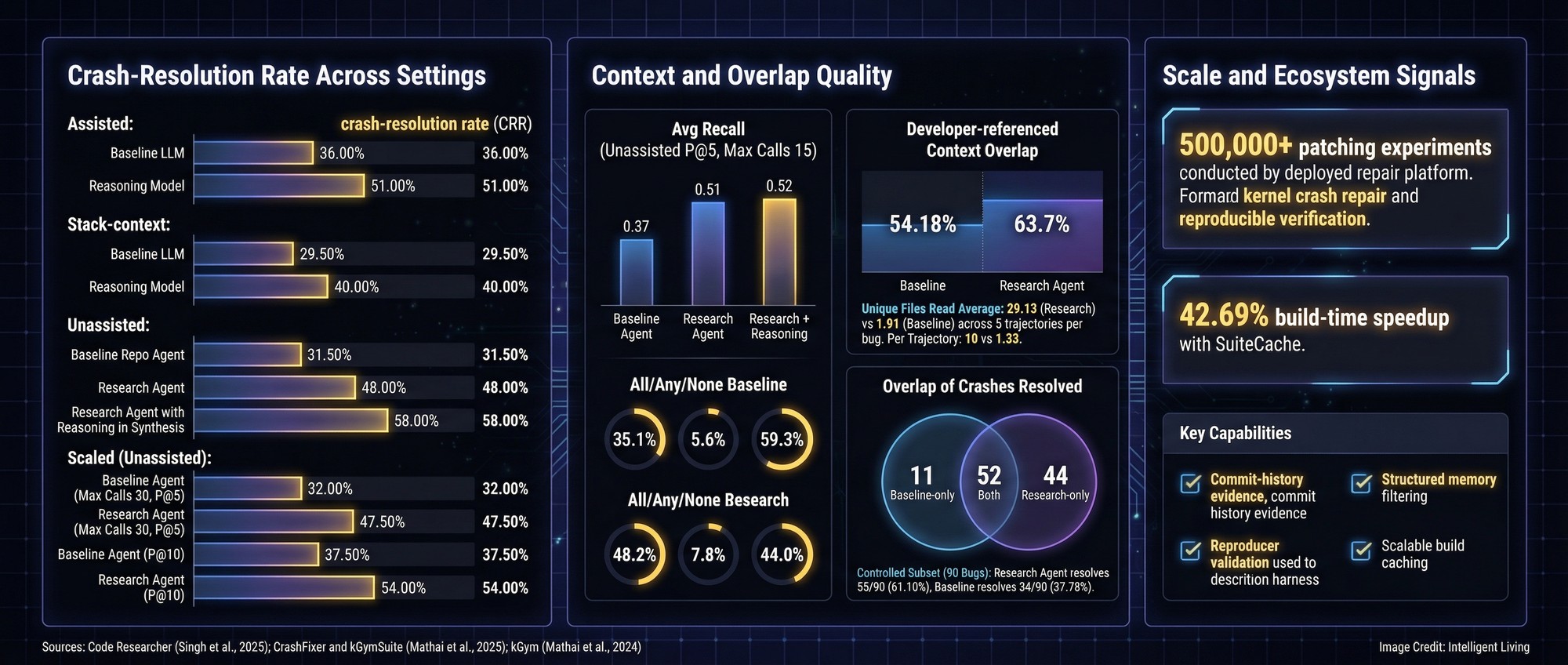
- Reported Results: The paper reports a 58% crash-resolution rate versus 37.5% for a baseline agent and an average of about 10 files explored per trajectory versus 1.33.
In the high-stakes environment of systems code, leveraging commit history and reproducible validation is the only way to ensure a fix addresses architectural root causes rather than merely masking symptoms.
Addressing Reliability Risks in Modern Software Stacks
Operating systems and libraries evolve over decades. Their commit histories preserve developer intent, temporary fixes, and critical design trade-offs. Standard crash reports lack context, typically offering only a stack trace and a noisy reproducer.
This investigative gap forces engineering teams to manually parse histories and search for related changes to guarantee patch integrity. Bridging this gap necessitates the same high-level automation mindset required for managing future-proof IT infrastructure effectively.
One way to picture it is to imagine a mechanic diagnosing a rare engine fault using only a bent, partially legible maintenance log and a stack of aftermarket parts. The log may contain the clue, but only after time-consuming cross-referencing. Similarly, Code Researcher treats the repository and its commit log as the maintenance record to be searched and interpreted before proposing a repair.

Code Researcher Basics: What It Does and Why Systems Code Breaks Simple Fixes
Functional Capabilities of the Code Researcher Agent
The Code Researcher agent prioritizes broad context exploration before initiating code edits. Alongside the preprint, a publicly accessible evaluation record captures the core claims and evaluation framing in a structured review format. Its publicly reported behavior includes the following:
- Three Phases: An analysis phase that performs focused searches and collects evidence, a Synthesis phase that compresses and filters the collected context into a candidate patch, and a Validation phase that applies and verifies the patch against crash reproducers. The project paper details this modular workflow.
- Search Actions: The Analysis phase supports domain-specific actions such as symbol-definition lookup, code grep, and, importantly, commit-message and diff search. This is not only text search but also a structured set of agent actions tuned for system-level code.
- Structured Memory and Filtering: Retrieved material is stored in a structured memory, and the agent filters that memory before expanding it into a patch to avoid noise and drift.
- Benchmark Performance: In the reported experiments using kBenchSyz, Code Researcher shows a materially higher crash-resolution rate than baseline systems.
Each of these claims is explicitly documented in the paper and supporting materials. The reported numbers should be treated as the outcomes of the described evaluation setup, not as unconditional guarantees for every codebase or production environment.
Architectural Challenges in Kernel-Scale Code Repair
Three properties make systems code especially challenging for small-repo-focused repair agents:
- Scale and Coupling: Massive kernel coupling means symptoms in one module often originate in distant hardware abstractions.
- Concurrency and Timing Sensitivity: Bugs in system code often surface under specific timing or load conditions, and the failure mode can be shaped by kernel locking rules and nesting constraints that are invisible in a narrow snapshot of a few files.
- Historic Design Choices: Commit history records why a change was made and sometimes shows a later reversion, a workaround, or a related optimization that affects behavior. Understanding those threads can convert a plausible patch into a safe one.
For example, a developer seeing a newly added pointer check might incorrectly assume it constitutes the final fix. Without the commit context, a repair agent could remove the symptom and create a regression elsewhere. Systems engineers often rely on those commit notes when they investigate, and adding explicit commit-aware reasoning into an agent closes an important gap.

Inside Code Researcher: The Research-First Workflow
Code Researcher operates through a sequence of modular investigative phases that emulate the meticulous habits of human systems engineers.
Investigative Analysis: Evidence Gathering and Search Actions
During the Analysis phase, the agent executes targeted search actions to map the codebase. The agent executes targeted investigative actions, including:
- Symbol-definition lookups to map function and type locations.
- Global code searches to identify related logic across the tree.
- Commit-history searches to extract developer intent from diffs and messages.
This pattern mirrors the local reasoning capabilities of advanced AI models that prioritize retrieval and verification over raw data dumping. A practical, relatable vignette: during a time-pressured incident, an engineer once found a tiny but revealing commit message that linked a regression to a hardware compatibility workaround. That single commit clarified why a later change caused the crash and saved hours of trial and error. The agent emulates this practice at scale.
Synthesis Phase: Memory Filtering and Candidate Patch Generation
Following evidence collection, the agent distills retrieved data into a focused memory subset. This filtering step eliminates noise and directs the candidate-generation process toward the most critical evidence.
Strategically focusing on high-signal artifacts—such as symbol definitions, recent diffs, and failing traces—prevents the noise and drift common when processing entire repositories in a single prompt. This phase converts vast observations into a compact, logical case for a specific code change. It resembles specialized prompt engineering for search-based AI that forces retrieval, filtering, and plain-language restatement before any final output is produced.
Validation Phase: Automated Verification and Fix Application
Automated software repair requires objective verification to ensure patch viability. Validation in this workflow applies the patch, runs the crash reproducer, and inspects whether the crash still occurs. The system marks fixes as successful only when the reproducer stops failing under the evaluation harness. This pragmatic bar separates a patch that compiles from a patch that actually addresses the reported failure.
Validation also reduces downstream cost. For operators, a patch that has been exercised in a reproducible environment is far less likely to introduce regression surprises in production, especially when validation is paired with automated software testing loops capable of running consistent checks across builds and configurations.

The Evidence Trail: Git History Debugging and Kernel-Scale Benchmarks
Causal Reasoning: Utilizing Git History as Debugging Evidence
The paper’s standout design choice involves treating commit history as a trail of causal breadcrumbs. Commit messages, diffs, and related commits often explain how a subsystem evolved, and an agent that can locate and interpret those artifacts can often understand a regression’s origin.
Analyzing Commit Evolution for Regression Identification
The authors provide ablation experiments showing that removing commit-history search reduces success rates on the reported benchmark. This finding proves that commit-aware search is a functional requirement rather than a stylistic choice. Modern teams already use automated regression searching via git bisect to localize failures; this agent scales that causal narrowing across much broader contexts.
Empirical Gains from Commit-Aware Search Actions
Effective debugging requires distinguishing between a static code snapshot and an annotated temporal timeline. The agent leverages both views to ensure patches address root causes rather than merely obscuring symptoms.
Comparing Static Snapshots to Temporal Commit Context
Static snapshots offer a single view, while annotated timelines explain how the current code structure evolved. The agent leverages both views to ensure patches address root causes rather than merely obscuring symptoms.
Evaluating Agents with the kGym and kBenchSyz Harness
Reproducer-Driven Testing in Isolated VM Environments
Benchmarks matter when judging claims about agent performance. The authors evaluated Code Researcher using the kBenchSyz subset of the kGym automated crash reproduction environment, designed to mimic the real-world complexity and reproducibility constraints of Linux kernel crashes. Unlike small-repo issue datasets that often focus on single-file edits and straightforward tests, kGym includes crash reproducers, VM-based test loops, and a validation pipeline that mirrors operational validation workflows. Many of those crash reproducers originate in fuzzing pipelines driven by tools like syzkaller, which can surface failures that do not come with a tidy human-written problem statement.
Benchmarking Beyond Standard Issue-Style Datasets
The evaluation harness builds and tests live kernel images, providing a rigorous validation signal that far exceeds a simple unit-test pass. This realistic approach compels agents to emulate human experts: reproducing failures in controlled settings and verifying that a proposed fix addresses the root symptom.
Performance Disparity Between Assisted and Unassisted Agents
The benchmark design also reports baseline performance in unassisted versus assisted settings, which helps explain why systems bug fixing often requires structured context gathering before a patch is even plausible.
What the Evidence Shows: Results, Limits, and the Agent Ecosystem
Key Findings and Performance Takeaways
Critical evaluation findings include:
- Context Depth Supports Better Patches: In the reported experiments, the agent explored more files and used commit evidence to increase successful fixes. Active searching of commits and high-signal artifacts directly correlates with the higher crash-resolution rates reported in the study.
- Reported Gains Are Benchmark-Specific: Results should be read as outcomes on a targeted benchmark. Real-world repositories vary in structure, test reproducibility, and available automation, which affects generalization.
However, these gains involve significant trade-offs. Deep research coding agents demand expansive computational resources and meticulous memory management to balance exploration costs against the likelihood of locating high-value clues.
Managing Risks in AI-Generated Code Repair
Rapid agentic AI development often outpaces verification, creating trust risks amidst the emerging risks of generative AI coding, where patches may appear correct initially.
The Roadmap for Automated Systems Reliability
A short anecdote makes the nuance clear: a team once rushed a narrowly scoped fix that passed unit tests but regressed a feature relied on by an adjacent service. The cost of that regression was higher than the original bug. That is why QA leadership and governance, including the transition to modern AI-led QA test governance, become essential as agent-generated patches become more common.
Situating Code Researcher in the Modern Agent Landscape
This is the place to sanity-check the evidence and situate Code Researcher inside the wider agent ecosystem before the conclusion.
Quantifying Agent Comprehension through Intermediate Metrics
Rather than relying on a binary pass-fail measure alone, the study reports intermediate metrics such as the number of files explored, overlap between retrieved context and ground-truth files referenced by human patches, and ablation results that measure how specific features, such as commit search, change outcomes. Those intermediate measures help interpret why a particular trajectory succeeded or failed.
Structural Advantages over SWE-agent and Static Tools
A lot of coding-agent progress has been shaped by issue-style benchmarks such as SWE-bench, where tasks often look like a bounded repository bug fix with a clear test signal. Baseline agents like SWE-agent often focus on quickly localizing an edit and generating a candidate patch. Research-oriented systems like Code Researcher instead emphasize iterative evidence gathering, memory filtering, and commit-aware searches as a precursor to writing code. Other approaches, including structure-aware localization such as AutoCodeRover, highlight how search and program analysis can narrow patch locations, but systems-code crash work still tends to demand broader context and more rigorous validation.
Integrating Research Agents into Automated QA Pipelines
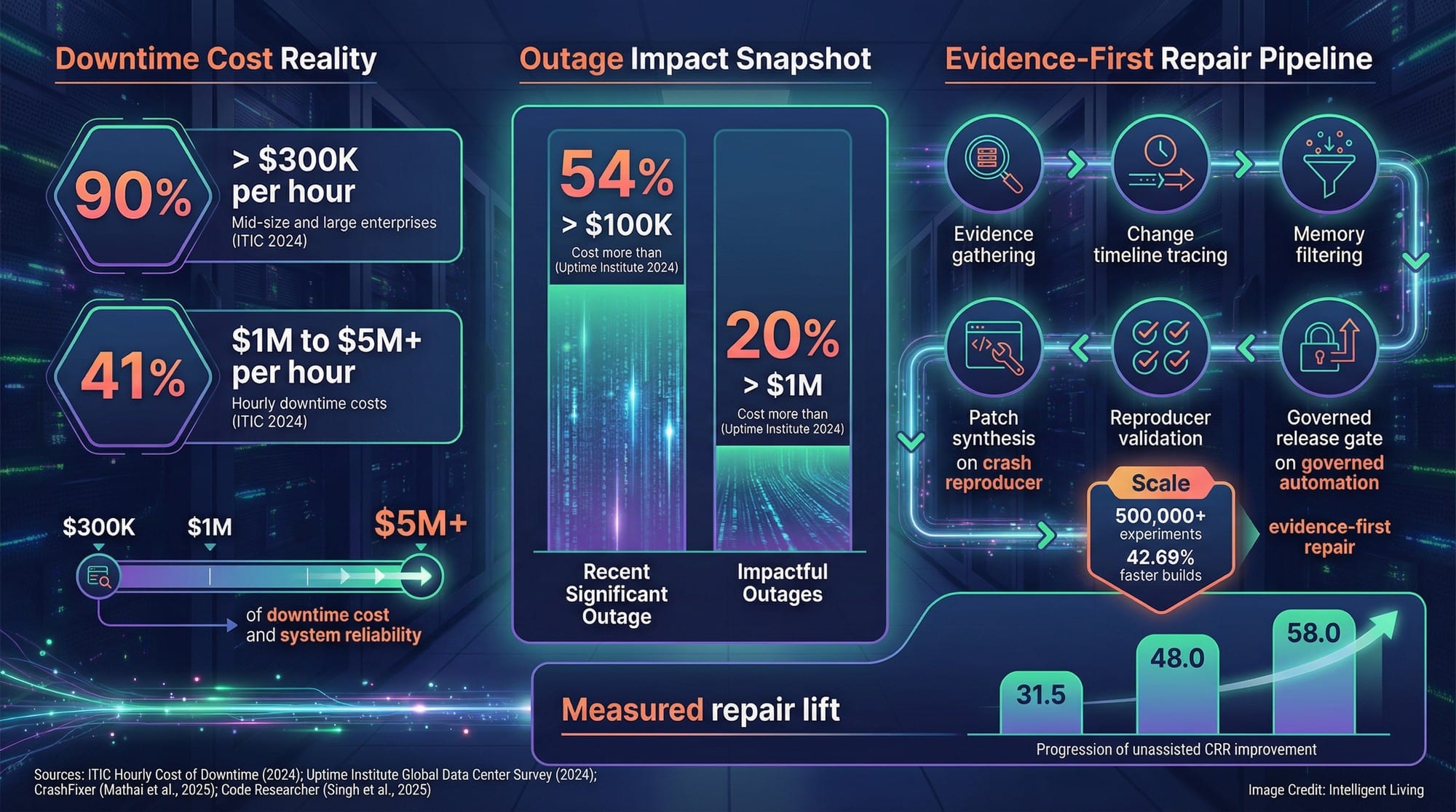
Kernel-scale repair is trending toward a pipeline: gather evidence, form a hypothesis, propose a patch, and then validate it under controlled conditions. That is why work like CrashFixer emphasizes workflow-inspired repair and the practical frictions of running experiments at the Linux kernel scale. On the platform side, kGymSuite shows how teams can automate kernel builds, patch application, and crash reproduction across isolated VM environments. In parallel, broader engineering domains are formalizing governed agent workflows, echoed in GPU-accelerated agentic workflows for engineering that treat validation as a first-class product requirement.
The Future of Automated Kernel Repair and Systemic Reliability
Meaningful progress in automated software repair for critical systems depends on mirroring the nuanced workflows of human engineers. Rather than rushing toward a patch, the next generation of tools must prioritize hypothesis testing and evidence gathering. Code Researcher represents an early, documented milestone in this research-first pipeline, proving that deeper context directly correlates with safer, more effective fixes in complex environments. This evidence-first philosophy extends to code review itself, where adversarial review protocols with structured disagreement are proving that multiple AI agents checking each other’s work catches bugs that single-agent approaches miss.
Organizations managing critical infrastructure must adopt this validation-heavy model to ensure long-term stability. The future landscape will likely feature a collaborative stack of specialized agents and VM-based validation harnesses rather than a single monolithic assistant. In these deployments, the system benefits from specialized execution interfaces for agentic AI that provide necessary governance, ensuring that every AI-generated repair is verified against real-world crash reproducers before deployment.
Strategies for Implementing Research-First Workflows
Organizations can improve their software reliability today by adopting several core research-first principles:
- Treat commit history as a primary evidence source during incident triage.
- Prioritize reproducibility by investing in crash reproducers and isolated VM test loops.
- Integrate structured memory into automation pipelines to filter retrieved data before synthesis.
Emerging Research Questions in AI Software Repair
- How well do commit-aware research agents generalize to diverse repositories beyond kernel-style projects?
- How can memory filtering be optimized to keep costs manageable?
- What tooling patterns reduce the risk of regression when an agent proposes a patch?

FAQ: Optimizing Kernel Crash Repair with Code Researcher
What is a deep research coding agent?
A deep research coding agent is an AI tool that prioritizes investigative data gathering—such as symbol lookups and commit-history searches—to fix complex software bugs.
How does git history debugging improve code repair?
Git history debugging allows agents to trace a regression’s origin through commit messages and diffs, ensuring the fix respects original developer intent.
Why is the kGym benchmark significant for systems code?
The kGym benchmark provides a realistic environment for Linux kernel crash repair, utilizing VM-based loops to validate that AI patches actually work.
Can Code Researcher fix concurrency-related bugs?
Yes, the agent’s ability to analyze broad context helps identify timing-sensitive failures often missed by tools that only look at a single file.
How is an AI-generated patch validated safely?
Patches are tested in isolated VM environments against crash reproducers, ensuring the failure is resolved without introducing new regressions. Practical workflows often start with Git repository searching techniques that connect messages, diffs, and symbols into a single trail of evidence.


