
A massive shift in cybersecurity occurred with the release of Anthropic’s Claude Opus 4.6, which successfully validated over 500 high-severity vulnerabilities hidden within the world’s most critical open-source libraries. Transitioning from a theoretical risk to a practical defensive asset, AI now plays a central role in validating critical code through Claude’s recent discovery. Global digital ecosystems rely on shared code; consequently, these findings serve as an essential safeguard for browsers, payment gateways, and healthcare systems.
Chronic underfunding and oversight plague the foundational infrastructure that serves as technology’s bedrock. Open-source code preservation initiatives highlight how the global stack depends on shared building blocks that rarely get the budget they deserve. Claude’s ability to pinpoint these flaws suggests that the race between attackers and defenders is entering a new, automated era. Prioritizing reproducible validation over industry hype allows this breakthrough to offer a glimpse into a future where software supply chains are continuously hardened against zero-day threats.
Executing proactive strategies does more than enhance security metrics—it cultivates authentic digital resilience amidst a volatile global landscape. Instead of waiting for a breach, organizations can now leverage these code-reasoning models to preemptively identify gaps that randomized testing often misses.

Validating 0-Day Vulnerabilities: Claude Opus 4.6 Testing and Reality Checks
Key Insights: Anthropic Frontier Red Team and Open-Source Security Data
- Sandboxed environments facilitated the Red Team evaluation of LLM-discovered zero-days, prioritizing reproducible validation over speculative claims.
- Findings often translate into patch releases for Firefox, as model-assisted data helps developers ship fixes for critical browser infrastructure.
- Public disclosure relies on a coordinated ecosystem where CVE Numbering Authorities assign standardized vulnerability IDs to help defenders track fixes across diverse vendors and dependencies.
- Maintainers grapple with automation overload, particularly when bug bounty volume overwhelms triage and forces teams to reconsider their reporting models.
Testing Setup and Scope: Claude Opus 4.6 Sandboxed Evaluation
Sandboxed virtual machines containing standard developer utilities served as the primary testing ground, allowing Anthropic to measure performance without custom harnesses or specialized prompt choreography. High-signal technical analysis relied on reproducibility and coordination as primary constraints.
A familiar moment helps explain the point. A maintainer who has spent a late night chasing a vague crash knows that a “maybe” is expensive, while a repeatable failure can be fixed.
Human-in-the-Loop Verification: Validating Automated Vulnerability Findings
A two-stage process defines the discovery workflow: the model surfaces reproducible candidate issues before humans validate and coordinate disclosure with maintainers.
Memory corruption generally facilitates easier verification than logic flaws, as these errors manifest as visible crashes during testing. Utilizing AddressSanitizer to detect out-of-bounds errors provides the instrumentation needed to separate high-signal reports from background noise.
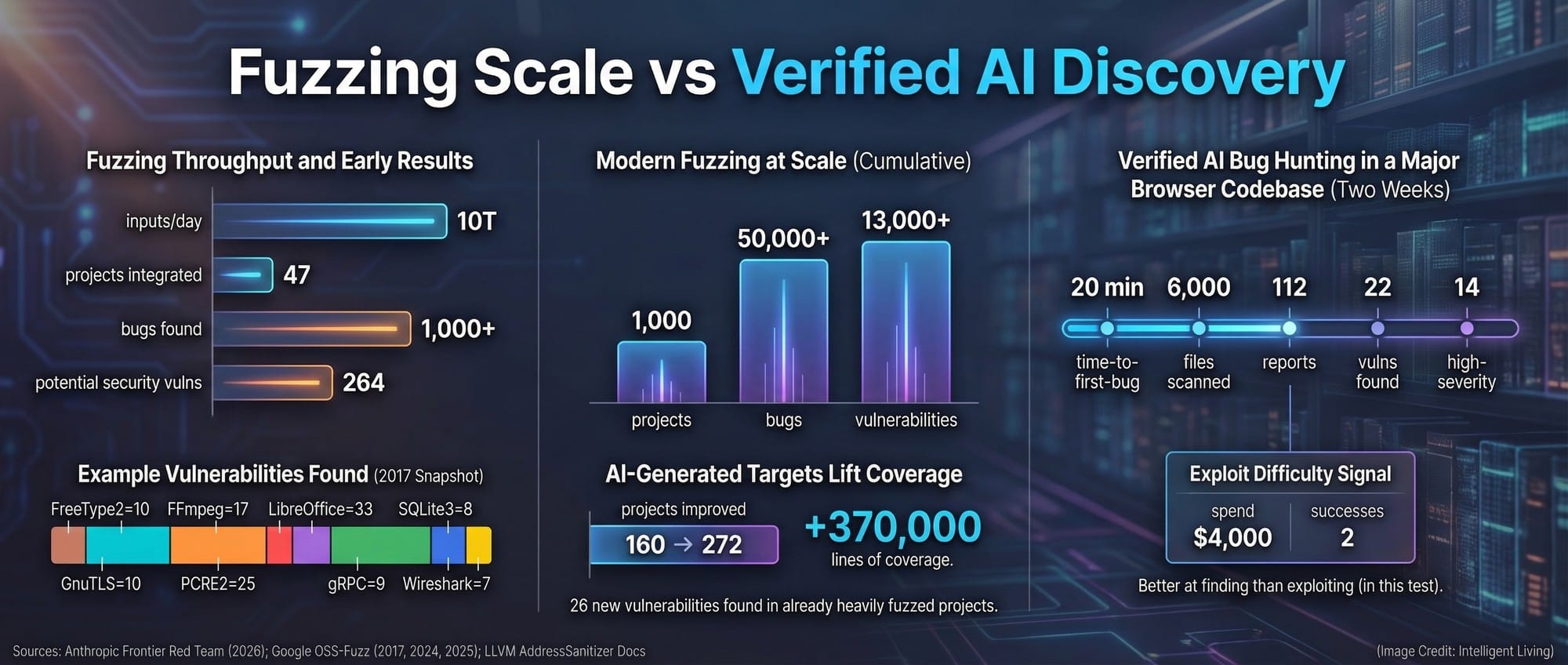
How AI Code Reasoning Outperforms Traditional Fuzzing for Open-Source Security
LLM Contextual Reasoning: Identifying Complex Logic Flaws and Edge Cases
Conceptual Reasoning Versus Randomized Testing
Fuzzing remains a powerful method for identifying crashes through randomized inputs. However, certain vulnerabilities require specific precondition chains or uncommon call paths that traditional tools miss.
LLMs enhance security by analyzing factors that fuzzers do not traditionally understand:
- Cross-project function usage patterns
- Behavioral shifts in code over time
- Hidden risks within complex algorithmic structures
Synthesizing these diverse context types allows models to bridge significant gaps in defensive discovery. Visualize the process through a simple metaphor: fuzzing stress-tests a lock by attempting millions of keys, whereas reasoning detects mechanical flaws in a recent rebuild.
Why this Matters Outside Big Security Teams
Evolving beyond elite security labs, AI-driven cybersecurity tools for small businesses now face the practical challenge of providing verifiable output that improves security without overwhelming limited staff.
Real-World Impact: Mozilla Firefox Patches and AI-Driven Remediation
Recent updates documented in Mozilla’s Firefox 148 security advisory signal clear public progress in model-assisted remediation. Common user experiences highlight a pattern where security only gains visibility when browser updates interrupt daily routines, even though those interruptions represent dozens of quiet fixes.
Discovery Versus Exploitation
Evaluations confirm that the model prioritizes identification over weaponization, reframing vulnerability risks as a race between verification, patching, and active adversaries.

The Patch Pipeline Pressure: Triage, Disclosure, and Supply-Chain Guardrails
Scalability Challenges: Addressing Open-Source Maintainer Triage Gaps
Maintainer Overload from Low-Quality Reports
The defensive upside breaks down if maintainers drown in low-quality submissions. Volume can crush the signal-to-noise ratio, turning “help” into unpaid triage work. A volunteer might spend hours reproducing technical reports only to find no underlying vulnerability.
Investment, Tooling, and the Fix Pipeline
Protocols for modernizing triage and remediation ensure that vulnerability discovery remains a productive force.
Effective scaling requires several key improvements:
- Enhanced automated validation systems
- Refined disclosure workflows
- Consistent funding for critical infrastructure
Fusing automation with human triage, the Alpha-Omega project for supply chain security systematically improves supply chain security for 10,000 widely deployed repositories.
Corporate investment directly determines defensive resilience. This funding specifically supports the discovery and remediation of vulnerabilities, preventing the verification burden from collapsing onto unpaid maintainers. At the organizational level, basic operational discipline still wins. Many breaches begin with routine data breach mistakes, not exotic zero-days, and failure points in vulnerability management often occur even when the technical findings are accurate.
Governed Acceleration: Guardrails for Zero-Trust Supply Chain Hygiene
Coordinated Disclosure that Matches the New Scale
Severe physical risks emerge in operational environments when security protocols lag behind automated discovery speeds.
Maintaining global stability requires:
- Precise flaw identification
- Adequate time for patch distribution
- Coordinated remediation across users and maintainers
Synchronizing these ecosystem responses provides a baseline for balancing discovery urgency with system safety.
Practical Security Controls that Scale
Continuously verifying access with zero-trust identity scales alongside patch discipline and blast-radius segmentation to secure an accelerating software ecosystem. Vulnerabilities in operational technology can immobilize critical infrastructure and magnify real-world consequences, making it imperative that security controls scale alongside automated discovery.

Reducing Systemic Risk: The Future of Proactive AI Vulnerability Triage
The emergence of Claude Opus 4.6 as a defensive powerhouse signals a transformative era for open-source maintenance and global software hygiene. Success in this new landscape depends entirely on the ability to scale human triage alongside automated discovery. While AI can surface hundreds of critical vulnerabilities, the ultimate strength of our digital ecosystem rests on the speed and precision of the patch pipeline.
Empowering maintainers and fusing advanced reasoning tools with coordinated disclosure protocols significantly mitigates systemic risk while halting routine data breach triggers. Software safety in critical services remains a primary concern, making the future of defensive AI about creating a sustainable, verifiable path to a more secure digital world.
FAQ: Navigating Defensive AI and Modern Open-Source Patch Reality
Mechanism: How Does Claude 4.6 Achieve Advanced 0-Day Discovery?
The model utilizes advanced code reasoning to analyze complex precondition chains and logic flows that traditional randomized fuzzing tools typically overlook.
Remediation: Are AI-Identified Vulnerabilities Being Patched in Libraries?
Yes, Mozilla has already integrated several findings into recent Firefox security updates, demonstrating a successful transition from automated discovery to real-world patches.
Sustainability: Why Does Triage Overload Threaten Open-Source Security?
Low-quality or unverified reports create triage bottlenecks that overwhelm volunteer maintainers responsible for functional open-source libraries.
Accessibility: Can Small Businesses Implement AI Cybersecurity Solutions?
Accessible security platforms now integrate these technologies, enabling smaller organizations to leverage enterprise-grade vulnerability detection.
What is the Alpha-Omega initiative in software security?
Over 10,000 widely deployed open-source software projects benefit from systematically improved security through corporate funding and automated validation.


