
A safe plunge into an urban river validates the integrity of a city’s invisible systems. Residents swimming through dense urban corridors signals that sewage containment and stormwater management have transitioned from neglected utilities to public health priorities. Global momentum is building as Swimmable Cities coalition initiatives treat urban swimming as a public-health standard rather than a novelty.
Reclaiming urban waterways requires a precise blend of laboratory standards, massive engineering, and real-time public communication. Success reclaims water as a shared asset, catalyzing improvements in green infrastructure and public standards.
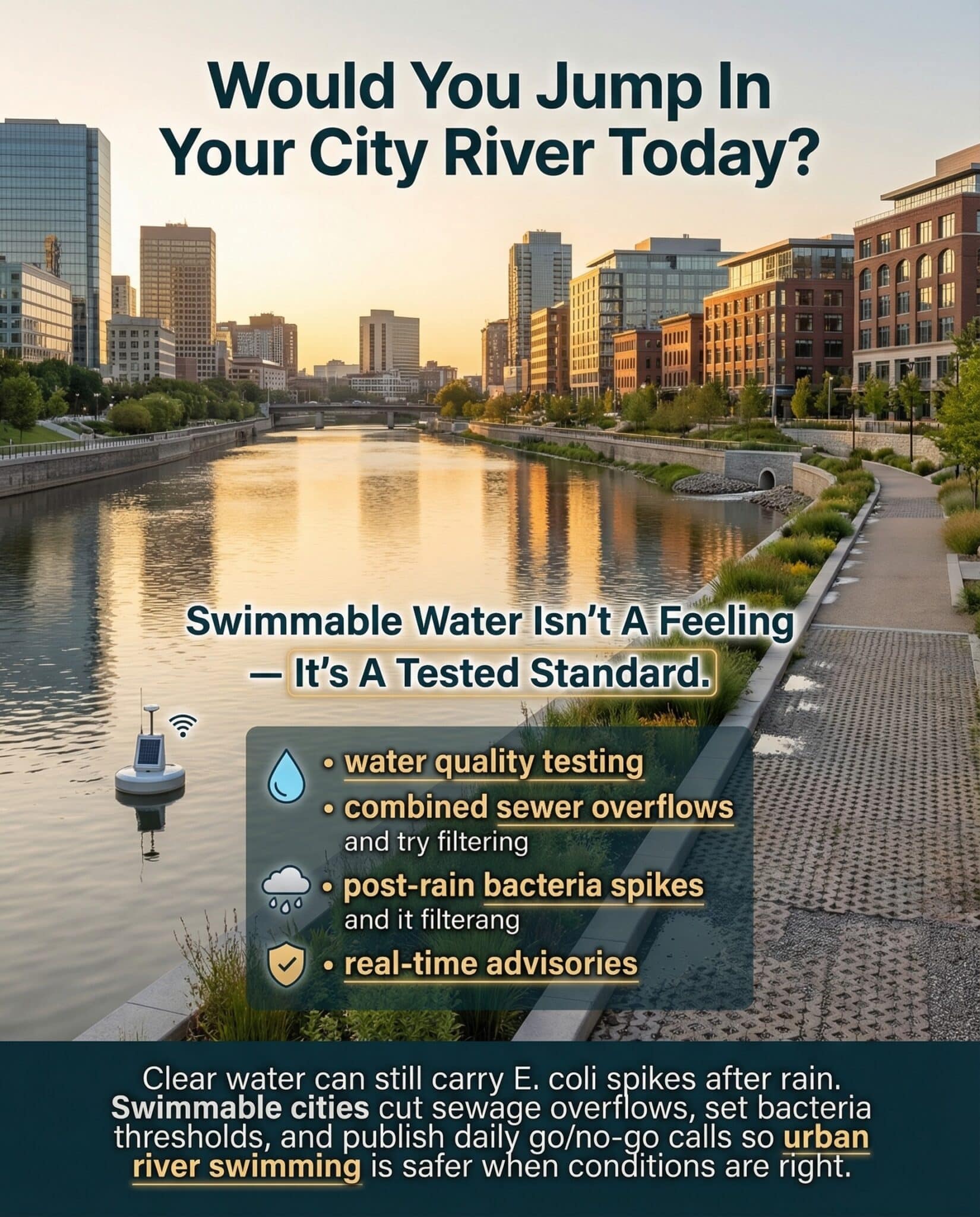
Swimmable City Standards: Water Quality Benchmarks for Safe Recreational River Access
Key Facts: Global Water Quality Standards for Swimmable Urban Rivers
- European regulators apply the 2006 bathing water directive to define swimmability as a measurable civic status based on Excellent or Poor ratings.
- Stateside, EPA’s 2012 recreational water quality criteria rely on fecal indicator bacteria like E. coli to estimate health risks for swimmers.
- International standards for recreational water safety emphasize preventive risk management, showing how programs reduce illness even when quality fluctuates.
- Rivers often turn unsafe after storms because aging pipes mix raw sewage with rain runoff. This combination leads to wet-weather discharges, known as combined sewer overflows, during high-flow events.
- Long-term monitoring demonstrates what European bathing water quality standards can achieve across thousands of verified sites.
- Package deals for swimmability combine standards, infrastructure, and amenities, aligned with the European Commission framing of swimmable cities as liveable cities in practical policy terms.

Defining Swimmable Status: Public Health Thresholds and Operational Safety Limits
When water consistently meets health thresholds, cities gain the ability to manage safety as weather shifts. This status is a working agreement between laboratory precision and the public’s right to safe water.
Measured Safety Versus Perception
Visual appearance often dictates how people judge water, with clarity mistakenly equated to cleanliness. Microbial risk defies this visual logic, requiring bacterial warning lights like enterococci to flag hidden contamination. Enterococci bacteria signals in recreational waters provide a vital proxy for health agencies when direct pathogen testing is impractical.
Real safety hinges on a city’s ability to catch risk spikes and warn the public instantly. This operational success requires:
- Defined health thresholds and rigorous sampling rules.
- Transparent response actions and closure protocols.
- Standardized recreational water sampling methods.
Standardized requirements ensure closure decisions remain tied to measurable risk rather than guesswork.
Swimmable Does Not Automatically Mean Chemically Clean
A river can meet microbial thresholds and still carry pollutants that are harder to detect without specialized monitoring. Persistent chemicals such as PFAS and long-lived microplastics are managed through different testing programs and regulatory tools than recreational bacteria thresholds. ‘Forever chemicals’ like PFAS linger in fish and sediment long after water appears clear; this contrast underscores the gap between microbial safety and chemical purity, especially when PFAS contamination risks are part of a watershed’s industrial legacy.
Neighborhoods witness this change firsthand. Families wade at sanctioned river edges while green flags fly on hot weeks, only to find a closure notice after a sudden downpour shifts the risk profile.
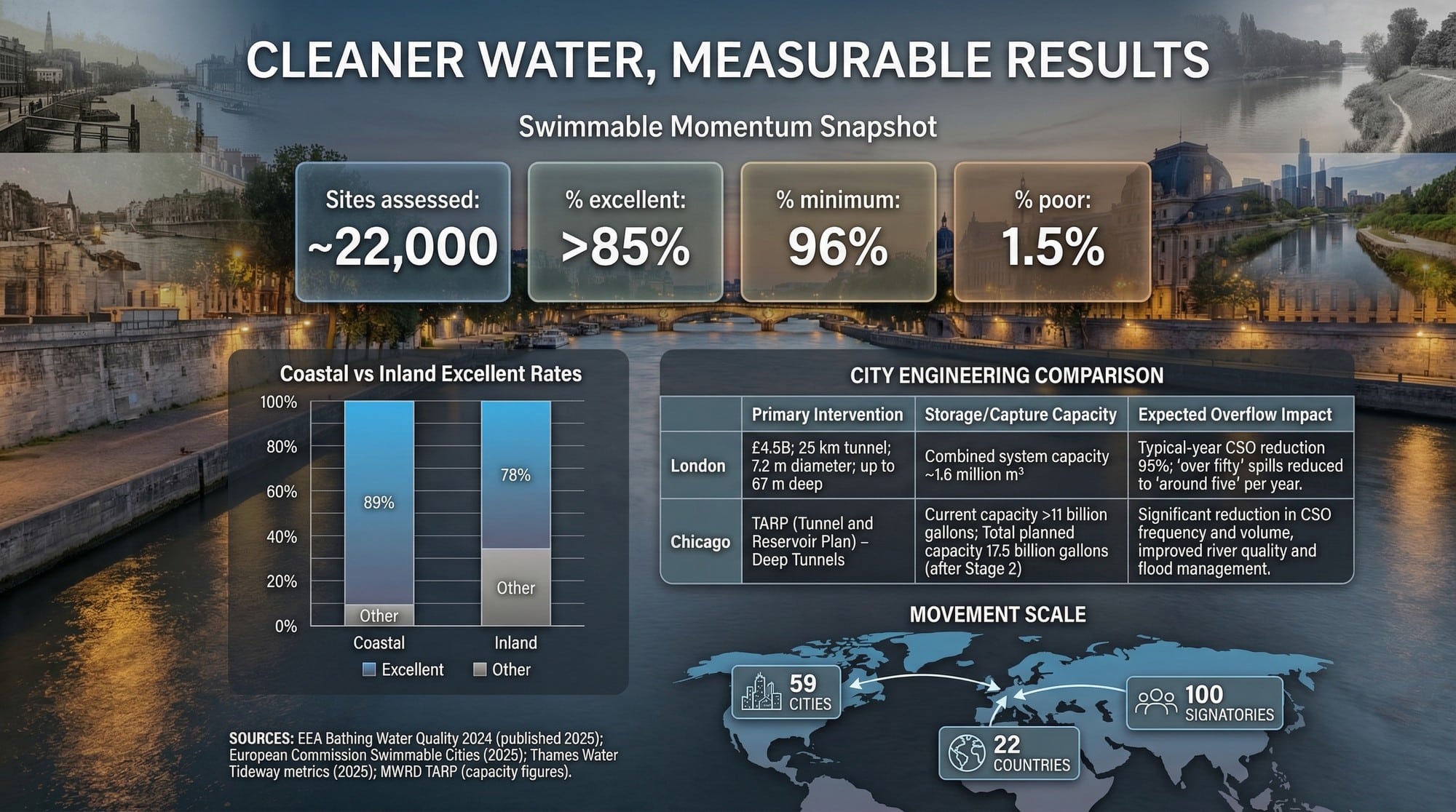
Urban Waterway Restoration: Global Success Stories in Reclaiming Swimmable Rivers
The concept of swimmability becomes real once a city commits to public rules and transparent testing. Success stories demonstrate the concrete steps required to reopen water.
Paris Waterway Recovery: Reopening the Seine for Public Swimming
Paris now opens swim zones on the Seine, relying on daily water-quality checks and weather-dependent safety protocols. Details about schedules, safety conditions, and daily analysis sit inside the city’s public framework for authorized swimming on the Seine, which treats the river as an actively managed site rather than an informal free-for-all.
London River Restoration: Civic Accountability and Infrastructure Performance Targets
In London, swimmability has become a measurable civic goal tied to accountability for sewage discharges and infrastructure performance. A public push for making London’s waterways swimmable has put timelines, discharge hours, and enforcement into everyday civic conversation.
Chicago River Swimming: Water Quality Compliance and Public Safety Rituals
Chicago shows what happens when water-quality compliance turns into a public ritual. Organized swims rely on clear course rules, transparent testing, and operational planning built around a water quality plan for the Chicago River Swim, so participation is tied to real measurements rather than bravado.
Stockholm’s Long Arc: A Global Model for Swimmable Waterways
Slow and unglamorous evidence often provides the most convincing proof of recovery. Stockholm’s water history reminds readers that urban waterways can recover their civic role through multi-decade investment and consistent monitoring, and the Stockholm International Water Institute history timeline captures that long arc in plain terms.
This invisible maintenance finally becomes visible on the first sanctioned swim day, proving to residents that decades of investment have paid off.

Infrastructure for Swimmable Cities: How Sewer Upgrades and Stormwater Management Control Water Quality
Sewers and stormwater act as the real control knobs for cities chasing a swimmable future. Most contamination spikes aren’t mysterious; they are the predictable results of aging pipes and overflow volume.
Managing Combined Sewer Overflows: Reducing Sewage Discharge During Heavy Rain
Older municipalities often rely on combined sewer systems that channel waste and rainwater through the same network. Heavy rain can overwhelm these pipes, sending contaminated discharge straight into local rivers. Domestically, a broad American Rivers sewage pollution overview emphasizes how infrastructure age and wet-weather stress drive recurring contamination events.
Municipal fixes include sealing leaks, expanding treatment capacity, and separating storm drains from sanitary sewers. The most effective programs typically combine these multiple engineering approaches for long-term reliability.
Engineering Solutions for Clean Rivers: Capture Tunnels and Deep Reservoir Storage
Metropolitan areas are investing in massive capture-and-storage systems to hold polluted overflow until treatment plants can handle the volume. London’s Tideway project uses a deep storage tunnel to intercept wet-weather sewage discharges into the Thames, and the engineering logic shows up in how the tunnel works as a system designed around surge capacity rather than perfect-weather averages.
Chicago’s Deep Tunnel acts as a TARP as a sewer overflow control system, storing combined flows during storms to reduce flooding and pollution.
Nature-Based Stormwater Solutions: Lowering Runoff Volume Through Green Infrastructure
Hard infrastructure often needs help from the surface. Nature-based stormwater systems absorb rainfall at the source, preventing surges from reaching aging pipe networks. controlling sewer overflows with green infrastructure lowers runoff volume by diverting water away from aging pipes.
Stormwater reduction utilizes neighborhood-scale nature designs to manage intense rain. These everyday drainage solutions include:
- Street trees and permeable paving that allow water to soak into the ground.
- Bioswales and wetlands functioning as working infrastructure.
- Green roof systems that intercept runoff before it reaches the street.
- Street-level retrofits that significantly reduce pipe stress during heavy downpours.
Residents often notice the difference immediately when newly planted swales prevent the curbside “brown rivers” that once followed every storm.
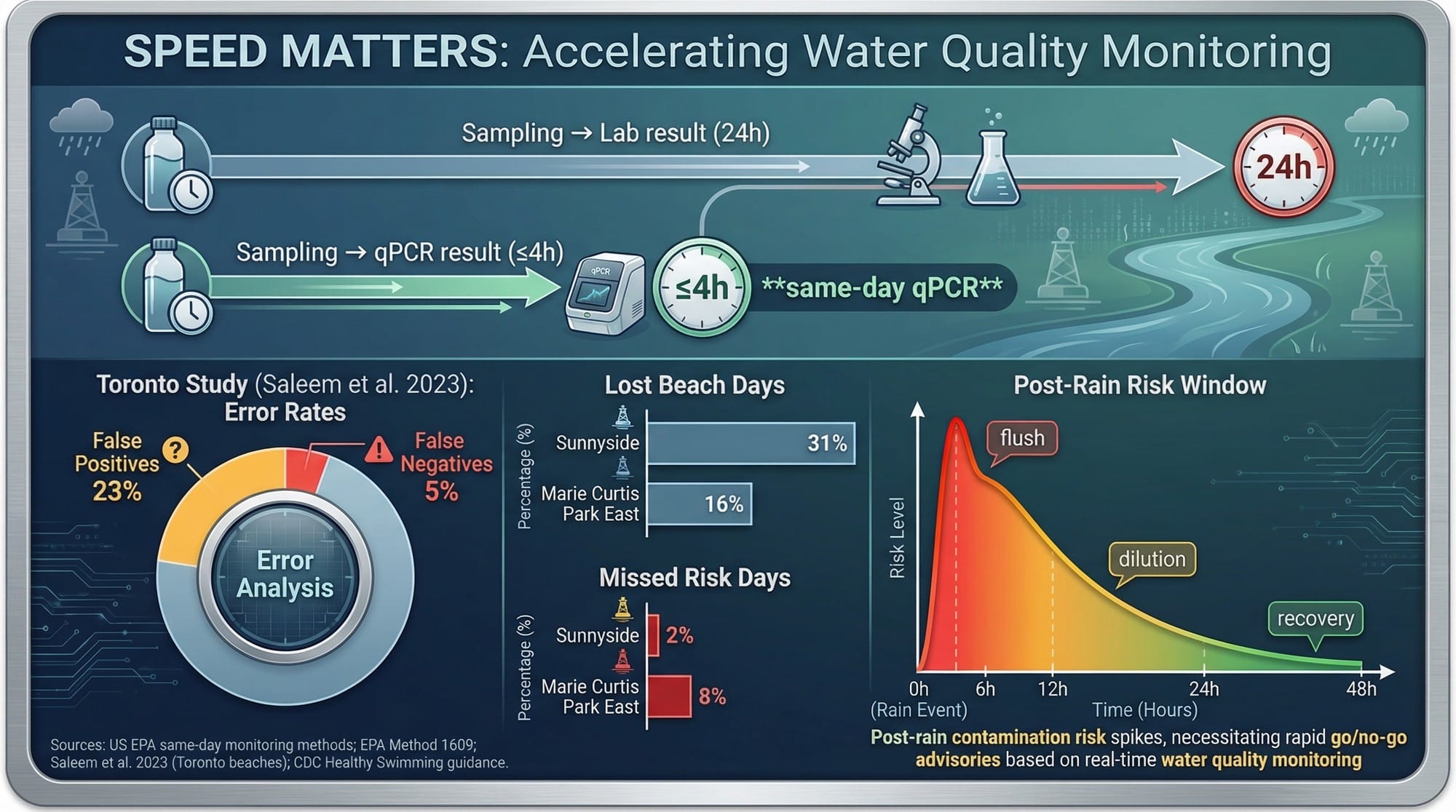
Real-Time River Swimming Safety: Monitoring Methods, Forecasting, and Post-Rain Contamination Risk
Water Quality Intelligence: Data-Driven Methods for Daily Swimming Safety Decisions
Even with upgraded infrastructure, rivers still change quickly. Real safety hinges on a city’s ability to catch risk spikes and warn the public instantly.
Monitoring Methods and Cadence
Standard culture-based lab tests are reliable but carry an inherent two-day delay. Modern hubs are pivoting toward water safety technology that blends sensors and filtration to warn swimmers in real time.
Forecasting Models and Predictive Tools
Some cities combine lab data with rainfall forecasts and hydraulic models to predict bacterial spikes before samples are processed. Copenhagen’s program is often cited as a mature example of this approach, using modeling and operational dashboards that support safe bathing water forecasting in Copenhagen Harbour across busy urban waterfronts.
Public Dashboards and Clear Communication
Public safety relies on clear signals when lab results are delayed. Swimmable cities typically provide:
- Digital dashboards showing open or closed status.
- Color-coded flags at entry points for instant visual checks.
- Simple guidance regarding post-rain safety windows.
The Post-Rain Risk Framework: Managing Bacterial Spikes and Volatile River Conditions
A swimmable river isn’t safe every single day. It requires a framework that keeps the water open when possible but triggers immediate closures when conditions shift.
Storm intensity dictates risk levels. Heavy downpours often result in:
- Fecal bacteria and street grime flushing directly into waterways.
- Combined sewer networks reaching capacity and discharging untreated waste.
- Volatile water conditions that turn safe sites into hazards overnight.
Health officials for visiting oceans, lakes, and rivers emphasize post-rain caution and paying attention to signage near drains and outfalls.
Planning for volatility is essential as intense rainfall events become more common. The EPA documents how extreme precipitation has changed in the United States, turning safe sites into closures in hours. Practical responses include neighborhood-scale runoff reduction using rain gardens that reduce stormwater runoff to filter pavement drainage.
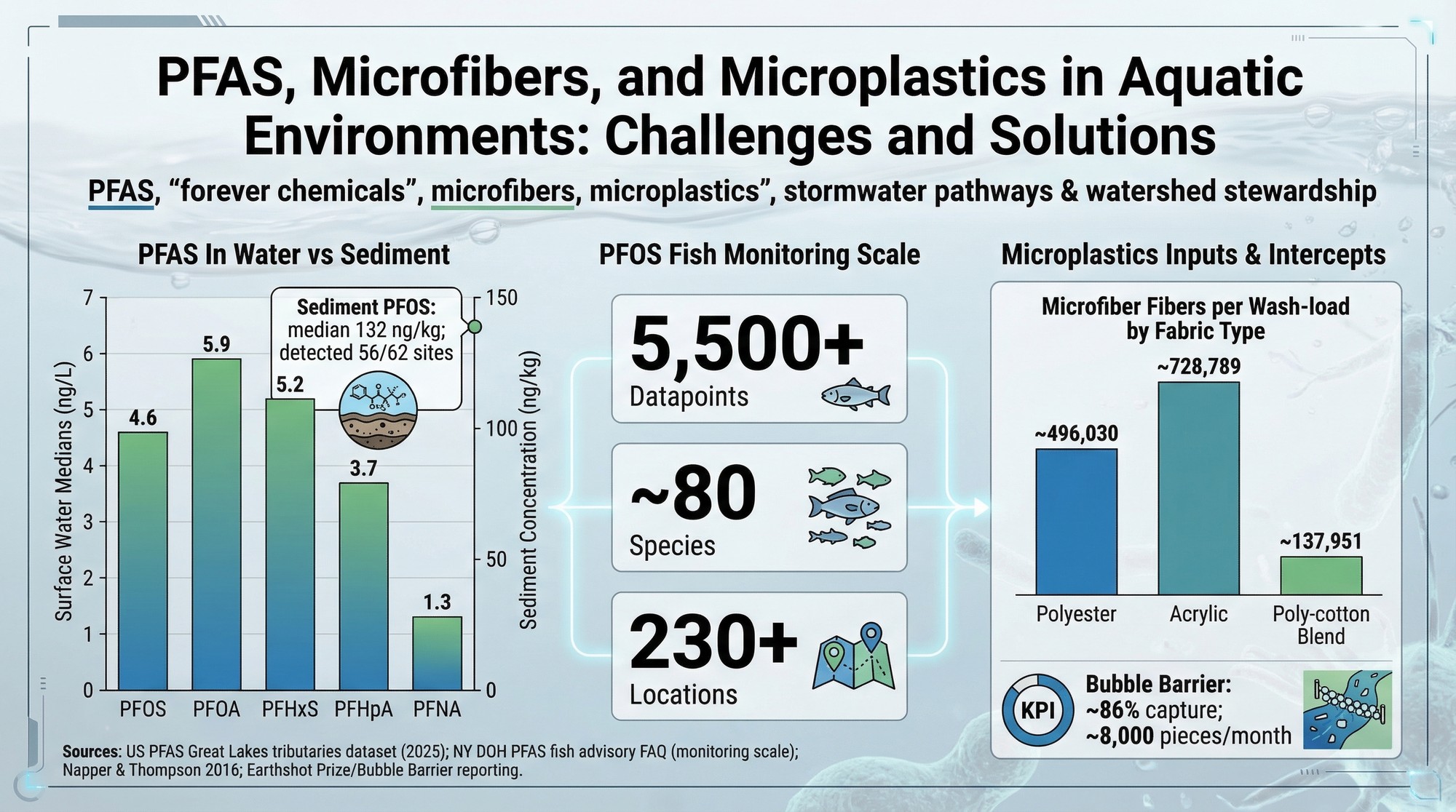
Persistent River Contaminants: Addressing Chemical Pollution, Equitable Access, and Watershed Stewardship
Evaluating Water Safety Beyond Bacteria: Addressing Persistent Chemical Contaminants
Microbial safety is the most immediate concern for swimmers, but it is not the only concern for a river.
Persistent Contaminants and Food Webs
‘Forever chemicals’ like PFAS linger in fish and sediment long after water appears clear; this contrast underscores the gap between microbial safety and chemical purity. Recreational safety rules and fish consumption advisories are not interchangeable; swimmability addresses short-term illness risk, while persistent contaminants involve long-term cumulative exposure.
Responses often fall under hazardous waste and environmental management systems that track pollutants beyond standard swim testing. Cleanup approaches focus on PFAS-free chemistry and cleanup advances targeting persistent compounds.
Microplastics and Microfibers
Microfibers from textiles migrate through wastewater systems into rivers, introducing a subtle pollutant that bacteria metrics often miss. Policy discussions increasingly treat source control as a realistic lever, utilizing microfiber filter policy momentum to reduce shedding before it reaches waterways.
Capture devices help intercept larger fragments. Amsterdam’s bubble barrier approach in canals uses air bubbles to guide floating plastic toward collection points before it breaks down.
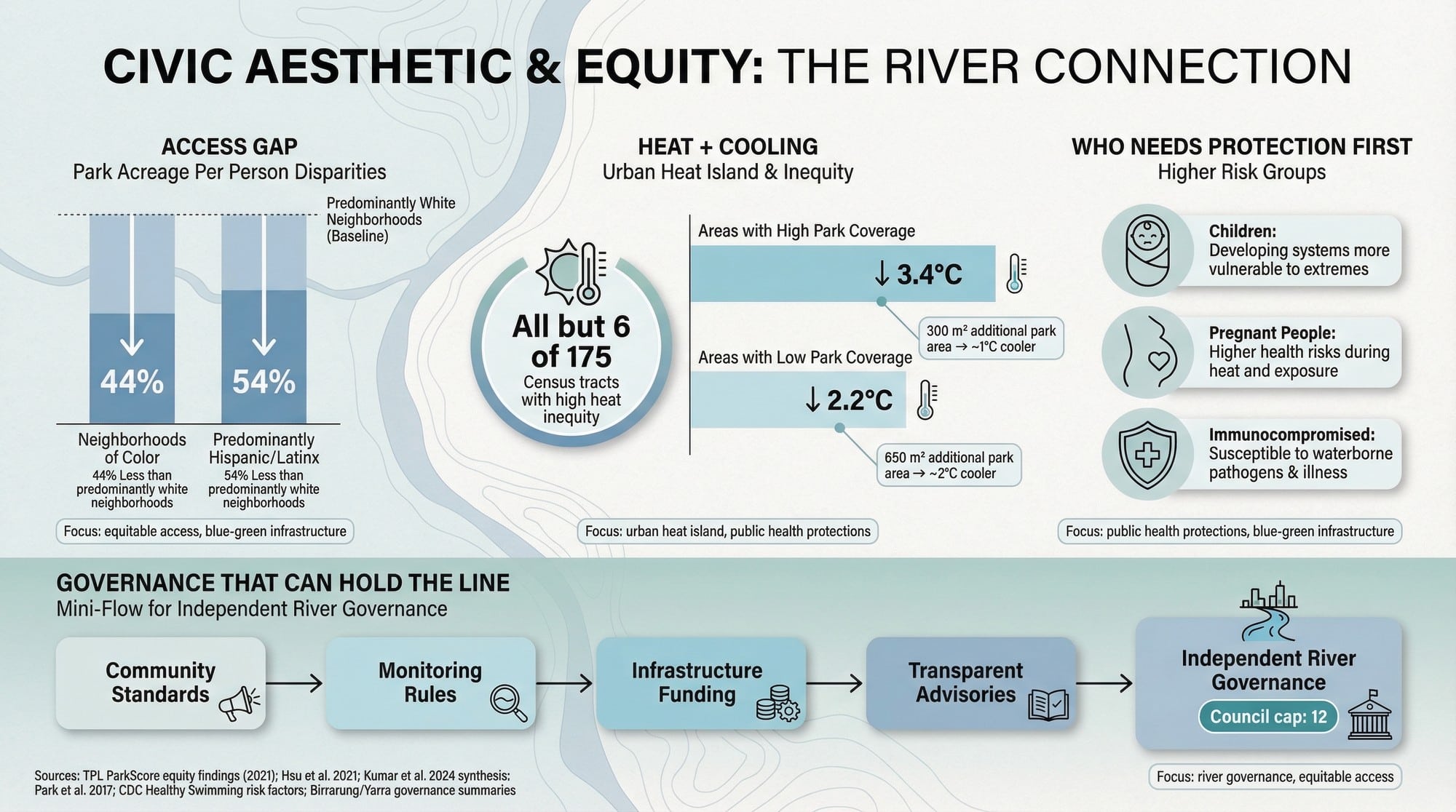
Equitable Water Access: Health Protections and Integrated River Governance Models
Fairness in water access involves more than an unlocked gate; it demands clear advisories, safe entry points, and enough staffing to keep sites functional for everyone. This is critical because common swimming-related illnesses often cluster in areas with higher exposure to contaminated water.
True access goes beyond an open gate; it requires clear advisories, safe entry points, and dedicated staffing to maintain site safety.
Living Rivers and Governance Models
Integrated jurisdictions treat rivers as living systems, pairing ecological goals with governance structures. Victoria’s legislation for the Yarra River formalizes oversight through integrated river protection and council structures, establishing a model for long-term stewardship.
Developing Swimmable Cities: Practical Community Actions and the Benefits of Urban Resilience
What Readers Can Do Next
- Check local advisories and avoid swimming for 24 to 48 hours after heavy rain, especially near storm drains and outfalls.
- Support runoff-reducing street upgrades like tree pit designs that manage stormwater in dense streets to store water and reduce flooding.
- Ask city leaders and utilities for projects that manage sewage with less disruption, including pipe repairs and nature-based systems.
- Reduce microfiber pollution at home by adopting everyday actions that cut microfiber shedding before fibers enter wastewater streams.
- Treat swimming safety and chemical exposure as separate conversations, as pollutants can concentrate in seafood through seafood exposure risks from water pollution.
Why Swimmable Cities Matter for Health and Urban Life
Restored urban waterways serve as tangible trust signals for modern municipalities. Success proves a city can manage waste, warn residents accurately, and invest in resilient public space. The ecosystem benefits ensure urban resilience is as much about ecology as it is about engineering.
Achieving swimmable status reclaims water as a shared asset, catalyzing improvements in green infrastructure and public standards. Neighborhoods embracing these restored rivers gain a natural defense against the urban heat island effect and a renewed sense of environmental stewardship.

Essential Guide to Urban River Swimming Safety
What defines a swimmable urban river?
Status is confirmed when routine lab tests show bacteria like E. coli remain within safe public health thresholds for recreation.
Why do cities close rivers after heavy rain?
Rain flushes street grime and sewage into waterways, causing temporary risk spikes managed through rainfall triggers and real-time monitoring.
How does green infrastructure improve water quality?
Permeable paths and rain gardens absorb stormwater, preventing aging sewer systems from overflowing untreated waste into rivers.
Is microbial safety different from chemical cleanliness?
Yes. Swimming standards focus on bacteria, while chemical testing tracks long-term contaminants like PFAS in sediment and fish.
Where can I find daily river safety updates?
Swimmable cities provide digital dashboards and color-coded flags at entry points to communicate water quality forecasts instantly.


