
Zogoflex is a proprietary thermoplastic elastomer material developed by West Paw for its line of durable dog toys. Unlike conventional vinyl or latex toys that quickly break down and end up in landfills, Zogoflex was designed to be non-toxic, highly durable, and recyclable through a closed-loop system. This guide explains what Zogoflex is made of, what its safety certifications actually mean, how sustainable it really is, and where its limitations lie.
What Is Zogoflex?
Zogoflex is the brand name for a family of dog toys and the proprietary material they are made from, both created by West Paw, a Bozeman, Montana-based manufacturer founded in 1996. The material was developed to solve three common problems with conventional dog toys: chemical safety concerns, poor durability, and lack of end-of-life options.
West Paw describes Zogoflex as a single-material, zero-waste product made in the USA. All Zogoflex toys are injection-molded in the company’s own factory, which allows the manufacturer to control inputs and reclaim production scrap. Key physical properties promoted by the company include:
- Buoyant and pliable, yet tough enough for aggressive chewers
- Elastic, able to stretch significantly and return to shape
- Dishwasher safe for cleaning
- Available in a range of hardnesses depending on the toy design
- Backed by a one-time manufacturer guarantee against damage
The Zogoflex line includes well-known designs such as the Toppl, Tux, Hurley, Jive ball, Qwizl and Bumi, all made from the same base material but molded into different shapes and hardnesses for different play styles.
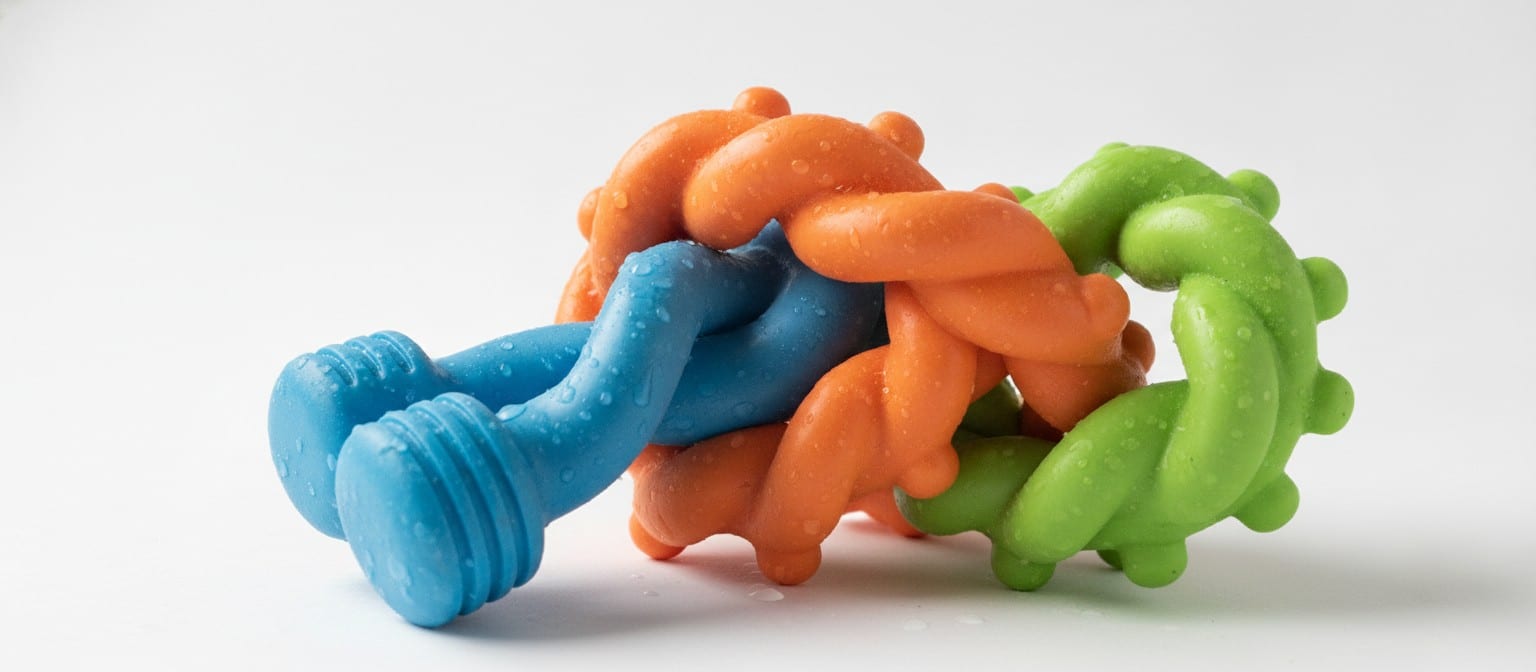
What Is Zogoflex Made Of? TPE Explained
Zogoflex is made from a thermoplastic elastomer, commonly abbreviated as TPE. Understanding this material class is essential to evaluating its performance and environmental profile.
The Basics of Thermoplastic Elastomers
TPEs are a hybrid class of polymers that combine the properties of thermoplastics and elastomeric rubbers. Thermoplastics soften when heated and harden when cooled, which makes them moldable and re-meltable. Elastomers provide rubber-like elasticity, stretch, and resilience. Together, they create a material that can be injection-molded like plastic but feels soft and flexible like rubber.
Unlike thermoset rubber, which undergoes an irreversible chemical cross-linking process during manufacturing, TPE does not form permanent cross-links. This structural difference is why TPE can be melted, ground, and remolded multiple times without major degradation in performance, a property that underpins its recyclability.
What Is in Zogoflex Specifically?
West Paw does not publish its full proprietary formulation, but the company states that Zogoflex is a 100% virgin thermoplastic elastomer sourced in the United States. According to West Paw’s published safety standards, the Zogoflex formulation is made with FDA-compliant ingredients and is:
- Free of BPA, phthalates, latex and natural rubber
- Free of lead, cadmium, mercury and hexavalent chromium
- Free of formaldehyde, polyvinyl chloride (PVC), hormones and asbestos
- Free of azo dyes and ozone-depleting substances
Industry TPE grades used for pet products, such as those produced by compounders like Hexpol TPE, are similarly formulated with only FDA-listed ingredients and are classified as suitable for children’s toys under standards like CPSIA, EN 71 and ASTM F963. This parallel helps illustrate the type of regulatory framework Zogoflex operates within.
It is important to note that TPE is not a single chemical formula. The term covers a broad family of blends, often mixing polyolefins or styrenic block copolymers with rubber and additives. Because the specific blend varies by manufacturer, two products labeled TPE can have different properties and additives.
Is Zogoflex Safe and Non-Toxic? Certifications Explained
Safety is central to how West Paw positions Zogoflex. The brand says its materials are among the strictest in the pet industry. Here is what those claims mean in practice.
FDA Compliant
West Paw states that Zogoflex is FDA compliant, meaning it is made from ingredients that meet the U.S. Food and Drug Administration’s requirements for food contact. In practical terms, the company describes this as safe to eat off of. FDA compliance does not mean the toy is edible, but that the material will not leach harmful substances under normal food-contact conditions. This is a stricter bar than many conventional dog toys, which have no food-contact standard at all.
BPA and Phthalate-Free
Bisphenol A (BPA) and phthalates are plasticizers and additives associated with endocrine disruption. West Paw confirms Zogoflex contains neither. Many low-cost vinyl dog toys still use phthalates to soften PVC, a concern also seen in broader microplastic exposure research, so a phthalate-free TPE represents a meaningful safety distinction, particularly for a product meant to be mouthed and chewed.
Latex-Free and Non-Toxic
Zogoflex is latex-free, which reduces allergy risk. The company also lists a lengthy exclusion list, including heavy metals, hormones, polychlorinated biphenyls, and brominated flame retardants, which signals careful ingredient sourcing rather than a formal third-party certification for each substance.
CE Marked
Seaflex and Zogoflex toys carry CE marking, which indicates the manufacturer has assessed the product as meeting EU safety, health, and environmental protection requirements. CE marking is a self-declaration for products sold in the European Economic Area and is required for many consumer goods entering that market, including toys.
Manufacturing and Corporate Certifications
Beyond material safety, West Paw itself carries broader sustainability credentials:
- Certified B Corporation since 2013, the first in the pet products industry
- Montana’s first Benefit Corporation, established in 2015
- Founding member of the Pet Sustainability Coalition (PSC)
- 100% designed and manufactured in Bozeman, Montana, with toys made in a zero-waste facility
These do not certify the Zogoflex material itself, but they audit the company’s overall social, environmental, and governance performance, including responsible manufacturing and worker standards.
How Sustainable Is Zogoflex? Recyclability and Join the Loop
Recyclability is Zogoflex’s most distinctive sustainability feature, but it requires careful explanation to avoid greenwashing.
Infinitely Recyclable in Theory, Closed-Loop in Practice
TPE’s thermoplastic nature allows it to be ground, melted, and remolded repeatedly without compromising integrity. West Paw states that Zogoflex can be infinitely recycled this way, and unlike mixed-plastic dog toys, Zogoflex toys are intentionally made from a single material to make reprocessing feasible.
However, this recyclability is not compatible with standard municipal curbside recycling. Most curbside programs are not equipped to handle bulky, durable TPE goods, and TPE is often classified as a #7 resin or left uncoded, which material recovery facilities generally reject. In practice, a Zogoflex toy placed in a curbside bin will likely end up in landfill.
The Join the Loop Program
To bridge this infrastructure gap, West Paw operates a take-back program called Join the Loop. Customers can return worn or damaged Zogoflex toys directly to West Paw or through participating retailers. The company then cleans the toys, grinds them into pellets, blends them with virgin TPE and colorant, and injection-molds them into new toys.
West Paw reports that this system diverts significant material. In 2020 alone, the company said it recycled 139,953 pounds of Zogoflex material, consisting of 139,528 pounds of post-manufacturing scrap (sprues and excess from molding) and 525 pounds of post-consumer returns. The company also estimates it diverts about 100,000 pounds annually through the program and that roughly 19% of each new Zogoflex toy contains recycled content from these streams.
The key nuance is the ratio: the vast majority of recycled content comes from factory scrap, not from toys returned by consumers after use. The post-consumer portion remains small, which reflects both the durability of the toys (they last a long time before needing return) and the challenge of motivating returns. West Paw acknowledges that participation, retail collection infrastructure, and logistics partnerships are ongoing hurdles.
Zero-Waste Manufacturing
Within its Bozeman factory, West Paw says Zogoflex production operates as a zero-waste molding process, where all sprue and trim is reground and blended back into new toys. This reduces manufacturing waste but does not eliminate the upstream environmental impact of producing virgin TPE from fossil feedstocks.
Zogoflex vs Seaflex vs Zogoflex Echo: What Is the Difference?
West Paw now offers three related material lines. While they share a base, they differ in recycled content and sourcing.
| Material Line | Base Composition | Recycled Content | Key Characteristics |
|---|---|---|---|
| Zogoflex (Original) | 100% virgin TPE | Approximately 19% recycled content via reclaimed factory scrap and consumer returns, blended into new toys | Most durable, widest color range, recyclable through Join the Loop, buoyant, and dishwasher safe |
| Seaflex | Approximately 88% Zogoflex (TPE) blended with 12.5% ocean-bound recycled HDPE | 12.5% ocean-bound plastic from shoreline communities | Made with plastic collected within 50 km of shorelines in communities without formal waste management, slightly stiffer feel, and recyclable through Join the Loop |
| Zogoflex Echo | TPE derived from recycled Zogoflex material | Higher recycled Zogoflex content, muted earth-tone colors | Same safety and recyclability as original Zogoflex, positioned as a more circular option |
The term “ocean-bound” is important for Seaflex. It does not mean plastic pulled from the ocean itself, but rather plastic waste collected on land within about 31 miles of a coastline before it can enter marine environments. West Paw says its ocean-bound HDPE is sourced from coastal communities in Central America, cleaned and blended with virgin Zogoflex. This provides a traceable second life for high-density polyethylene that might otherwise become marine debris.

Limitations and Environmental Criticisms of Zogoflex
An educational assessment should weigh both advantages and drawbacks. Despite its strengths relative to conventional pet toys, Zogoflex has several sustainability and systemic limitations worth noting.
1. Virgin Fossil-Based Feedstock
Standard Zogoflex is made from 100% virgin TPE sourced from petrochemical feedstocks. Even though it is recyclable and factory waste is reclaimed, its primary raw material still depends on fossil fuels. Unlike bio-based TPE blends that use plant-derived components to lower carbon intensity, virgin TPE carries the full embodied carbon of extraction, refining, and polymerization. West Paw has set a goal to double the total amount of recycled content in its enrichment, active play, and chew toys by 2027, which acknowledges this dependence on virgin material.
2. Not Biodegradable or Compostable
TPE is not biodegradable. Like most synthetic elastomers, it will not break down in a composting environment and can persist in landfill for many years if discarded. Its environmental benefit comes from durability and recyclability, not from decomposition. Durability itself is beneficial because a toy that lasts years replaces multiple short-lived toys, but at end-of-life the material still requires an active recovery pathway.
3. Not Curbside Recyclable
As noted, Zogoflex cannot be recycled through typical municipal recycling streams. The promise of recyclability is only realized if the owner participates in Join the Loop and returns the toy. Low consumer participation is a common weakness of take-back programs across industries, and West Paw’s own data showing only 525 pounds of post-consumer returns in a full year illustrates how small that stream remains compared to factory scrap. Without return, the toy follows the same landfill path as any other plastic toy.
4. Energy Intensity of Thermoplastic Processing
Injection molding TPE requires high heat and pressure, and the regrinding and remolding steps add additional energy demand. While this is likely less intensive than producing thermoset rubber toys that cannot be reprocessed at all, it is still an energy-consuming process. West Paw does not publish a life-cycle assessment for Zogoflex, so a full cradle-to-grave carbon comparison to alternatives is not publicly available.
5. Proprietary Formulation Limits Transparency
Because TPE is a broad family with undisclosed formulations, outside researchers cannot independently verify the complete lifecycle impact of Zogoflex without access to the specific blend. West Paw publishes its exclusion list and FDA compliance, but third-party eco-labels specific to the material, such as independent recyclability or compostability certifications, are not cited.
None of these points negate the material’s advantages over latex, vinyl, or nylon, but they contextualize claims like “infinitely recyclable” and “eco-friendly.” The most accurate framing is that Zogoflex is a more durable and more responsibly managed synthetic elastomer than typical alternatives, with a functional but participation-dependent closed loop, rather than a fully circular or low-carbon material.
How Zogoflex Compares to Other Dog Toy Materials
Choosing a dog toy material involves trade-offs among safety, durability, recyclability, and cost. The table below compares Zogoflex to common alternatives.
| Material | Typical Safety Profile | Durability for Chewers | Recyclability / End of Life | Common Issues |
|---|---|---|---|---|
| Zogoflex (TPE) | BPA, phthalate, latex-free; FDA compliant; heavy metal-free | High; flexible, resilient, stretchable | Recyclable only via manufacturer take-back; not curbside recyclable; not biodegradable | Virgin fossil feedstock; requires active return to realize recyclability |
| Natural Rubber | Generally low toxicity, but may contain latex allergens | High for moderate chewers; less consistent than TPE | Not curbside recyclable; biodegradable only under specific conditions and slowly | Allergy risk; sourcing impacts of rubber plantations; variable durability |
| Vinyl / PVC | Often contains phthalates, BPA, lead; frequent contamination concerns in low-cost toys | Low to moderate; tears easily | Rarely recyclable; difficult to reprocess; landfill | Chemical leaching risk; short lifespan creates more waste |
| Nylon / Hard Plastic | Generally inert, but can splinter or fracture into sharp pieces | Very high hardness, low flexibility | Not curbside recyclable as toy; landfill | Risk of tooth fracture and ingestion of hard fragments; not pliable |
| Plush / Fabric with Fill | Low chemical risk, but seams and squeakers ingestion hazard | Low; easily destroyed by chewers | Textile waste; polyethylene fill may be made from recycled bottles in some brands, but not recyclable as toy | Very short lifespan; creates frequent waste despite lower toxicity |
The advantages of TPE systems relate to both material science and system design. For example, PLUSfoam as a recyclable alternative to rubber and foam demonstrates similar principles, where closed-loop reprocessing outperforms single-use synthetics even when the base polymer remains fossil-derived.
Frequently Asked Questions
What is Zogoflex made of?
Zogoflex is made from a proprietary thermoplastic elastomer (TPE), a polymer that blends thermoplastic moldability with rubber-like elasticity. Standard Zogoflex is 100% virgin TPE sourced in the USA, formulated to be BPA, phthalate, latex and PVC free with FDA-compliant ingredients. It is a single-material construction, which allows factory scrap and returned toys to be ground and remolded into new toys.
What is the hardest dog toy to destroy?
No dog toy is indestructible, and West Paw notes its guarantee does not cover damage from sharp or aggressive chewing that creates separation. Among durable options, Zogoflex ranks highly for its combination of tear strength and flexibility, allowing it to stretch and rebound rather than crack. However, very strong chewers can still damage any flexible toy, and owners should supervise play and inspect toys for wear.
What is the healthiest dog chew toy?
The healthiest chew toy is one that is non-toxic, free of known harmful additives, appropriately sized, and durable enough not to shed ingestible fragments. Materials that are BPA, phthalate, latex and heavy-metal free, with FDA-compliant or food-contact-grade ingredients, such as Zogoflex, meet a stricter safety threshold than vinyl or poorly regulated rubber toys. No chew toy is calorie-free or fully digestible, so supervision and size-appropriate selection remain essential regardless of material.
How does the West Paw Toppl work?
The West Paw Toppl, made from Zogoflex, is a treat-dispensing puzzle toy with a bulbous shape and an inner cavity. Owners can fill it with kibble, peanut butter, or other foods and even freeze it to extend engagement time. Dogs then lick, nudge, and toss the Toppl to extract the contents, providing mental enrichment. Like other Zogoflex toys, the Toppl is dishwasher safe and recyclable through Join the Loop.
Conclusion
Zogoflex represents a deliberate attempt to improve on conventional dog toy materials by addressing toxicity, durability, and end-of-life design together. As a BPA, phthalate and latex-free, FDA-compliant TPE made in a zero-waste facility and backed by a take-back program that actually grinds and remolds returned toys on site, it sets a higher bar than vinyl, latex or mixed-plastic toys that have no recovery pathway at all.
At the same time, Zogoflex remains a virgin, fossil-based synthetic elastomer that is not biodegradable and not curbside recyclable. Its sustainability depends heavily on two factors that are easy to overstate: the longevity of each toy in use, which reduces replacement frequency, and the willingness of owners to return toys through Join the Loop at end of life. The post-consumer return volume to date remains a small fraction of total recycled throughput, which highlights a familiar challenge for closed-loop systems.
For consumers evaluating the material in educational terms, the most balanced summary is that Zogoflex is a safer and more circular option than most alternatives in the pet toy category, with meaningful but participation-dependent environmental benefits, and with the same fundamental limitation of any durable plastic: it lasts a long time, whether in a dog’s mouth, in a factory’s grinder, or, if not returned, in a landfill.


