
On July 21, 2026, the University of California San Diego announced it is joining the Innovative Genomics Institute as its fourth University of California partner campus to develop the next generation of genome editing tools. Founded by Nobel laureate Jennifer Doudna, the IGI has expanded from its original Berkeley-UCSF focus on human health to include sustainable agriculture and climate solutions, and UC San Diego now brings something none of the other campuses could: world-class ocean and marine science. Together, the partners aim to move genome editing from the lab into scalable solutions for health and the environment. This article explains what genome editing is, how next-generation tools go beyond CRISPR-Cas9, what the partnership will build, and what the technology means for cost, legality, and ethics.
UC San Diego Joins the Innovative Genomics Institute: What Just Happened
The Innovative Genomics Institute was founded in 2015 by Jennifer Doudna and Emmanuelle Charpentier’s CRISPR discovery to translate gene editing into practical solutions for society. It began as a partnership between UC Berkeley and UC San Francisco focused on human health, later adding UC Davis to expand into agriculture and climate applications.
UC San Diego becomes the fourth partner, combining strengths in environmental and marine science, engineering and computer science, and biomedical and life sciences. Dean of Biological Sciences Kit Pogliano will lead the collaboration for UC San Diego, while IGI Executive Director Brad Ringeisen cited engineering, medical devices, environmental research, and microbiome science as the complementary capabilities that motivated the expansion.
The collaboration is not starting from zero. The teams have worked together since 2018 on crop pest management, mosquito population control, and environmental application protocols. Two concrete funding milestones anchor the relationship:
- $10 million Howard Hughes Medical Institute award in 2023 to UC San Diego researchers to explore jumbo phage as therapeutic agents against antibiotic-resistant infections.
- $70 million Audacious Project gift in 2023 to the IGI to build microbiome-editing tools targeting livestock methane emissions and inflammatory diseases such as asthma, the largest Audacious Project science gift to date.
Why ocean science matters is the originality of this partnership. UC San Diego’s Scripps Institution of Oceanography and marine microbiome expertise open a credible path for environmental genome editing at scale, from engineering resilient marine microbes to addressing soil health and coastal ecosystem challenges. As Ringeisen noted, the mission is to develop solutions that can scale to meet the biggest challenges in health and climate and remain accessible to those who need them most.
What Is Genome Editing, and How Does It Work?
Genome editing is a group of technologies that give scientists the ability to change an organism’s DNA with precision. That can mean adding, removing, or replacing a specific sequence of letters in the genome. When that change is made in a precise location, it can correct a disease-causing mutation, introduce a beneficial trait in a crop, or disable a gene in a microbe.
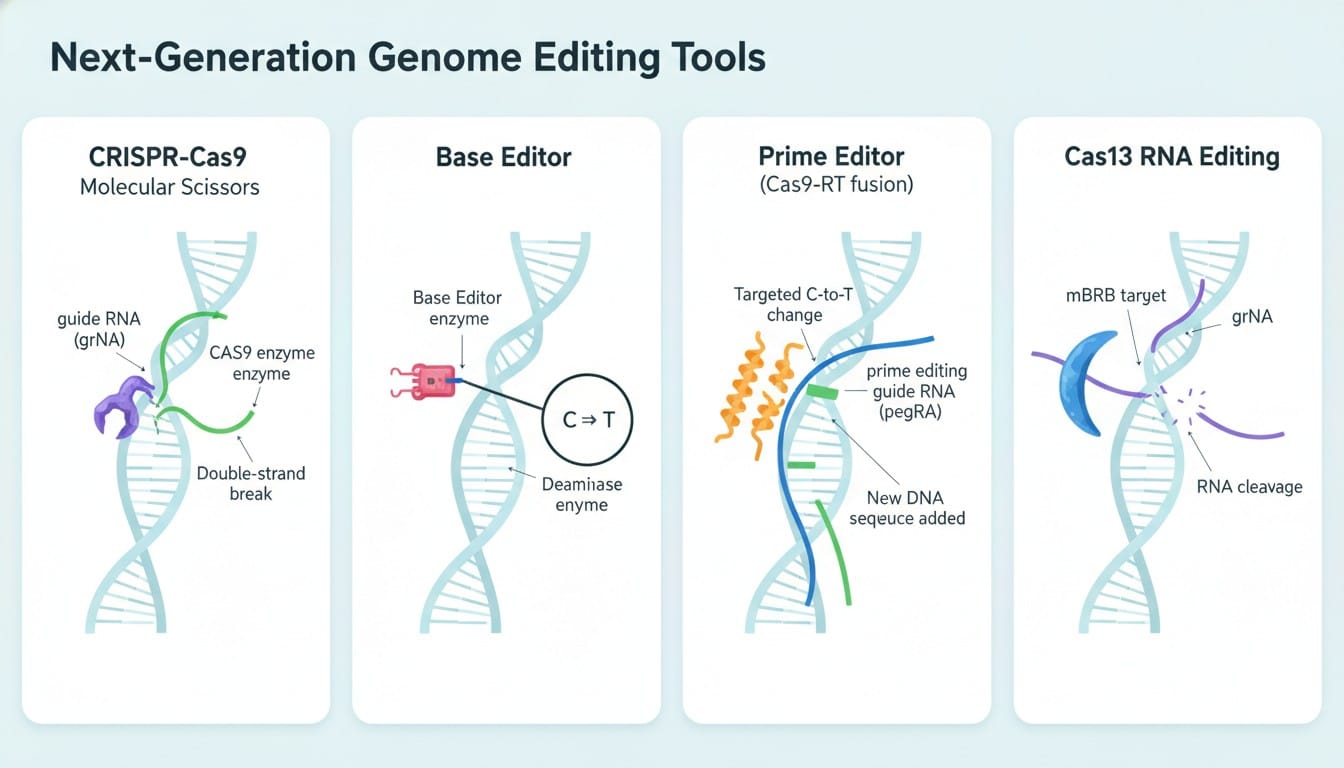
The National Human Genome Research Institute describes genome editing as building on earlier tools like zinc-finger nucleases and TALENs, but with CRISPR making the process far faster, cheaper, and more accessible. The core mechanism most people know is CRISPR-Cas9, often called molecular scissors:
- 1. Examine: Scientists identify the DNA sequence to target.
- 2. Design: They create a guide RNA that matches that sequence.
- 3. Insert: The guide RNA and Cas9 protein are delivered into the cell.
- 4. Cut and repair: Cas9 cuts both strands of DNA at the target. The cell then repairs the break, either by non-homologous end joining which can disable a gene, or by homology-directed repair, which can insert a correct sequence if a donor template is provided.
This cut-and-repair approach is powerful, but double-strand breaks can cause off-target effects and require the cell to do the repair work. That limitation is exactly why next-generation tools were developed.
Is Genome Editing the Same as CRISPR?
Genome editing is the umbrella term. CRISPR is the most famous tool under that umbrella, but it is not the only one. Think of genome editing as the field, and CRISPR-Cas9 as the first widely adopted instrument that defined the field.
Next-generation genome editing tools move beyond cutting both strands of DNA. According to a 2025 review of emerging prime editing trends in Nature and a 2026 methods review in PubMed, the major advances include:
- CRISPR-Cas12a: A more compact nuclease that recognizes different PAM sequences, expanding the range of targetable sites and often producing staggered cuts that can improve insertion efficiency.
- Base editors: Fusions of a disabled Cas9 nickase with a chemical-modifying enzyme that change a single letter without cutting both strands. Cytosine base editors change C to T, and adenosine base editors change A to G. Researchers at UC San Diego also developed multiplexed orthogonal base editors called MOBEs that use RNA aptamers to recruit both types at once, enabling multiple point mutations in parallel with reduced crosstalk.
- Prime editors: Described as search-and-replace editors, they fuse a Cas9 nickase to a reverse transcriptase and use a prime editing guide RNA to write new genetic information directly, without double-strand breaks or donor templates. This enables precise insertions, deletions, and all 12 possible base substitutions.
- CRISPR-associated transposases and recombinase fusions: Systems that insert large cargoes, entire genes, without relying on the cell’s repair machinery, critical for therapies that require more than a single-letter fix.
- RNA-targeting Cas13: Edits RNA rather than DNA, offering transient effects that fade as RNA turns over. This can be safer for temporary silencing of a gene without permanent genome changes.
- Epigenome editing: Uses disabled Cas proteins fused to epigenetic modifiers to turn genes on or off without changing the underlying DNA sequence.
In short, CRISPR opened the door, and these next-generation tools are refining the precision, payload size, and safety profile needed for real-world deployment.
What Can Next-Gen Genome Editing Actually Do?
The IGI partnership explicitly targets two large domains: health and environment. Here is what each looks like in practice.
1. Human health
Approved CRISPR therapies have already reached patients. The first CRISPR-based medicine for sickle cell disease was approved in late 2023, and multiple trials for beta-thalassemia, blindness, and cancer are ongoing. Next-generation editors aim to improve safety by avoiding double-strand breaks, to edit previously untreatable mutations via prime editing, and to enable multiplex editing for complex diseases where several genes must be corrected at once. Delivery remains the bottleneck, with viral vectors such as AAV and lentivirus and non-viral carriers like lipid nanoparticles both under active development.
2. Agriculture and climate
UC Davis brought agricultural expertise to the IGI, with applications including disease-resistant crops, resilient food systems as explored in our look at how 2025 agriculture breakthroughs build food security for 2026, and reduced fertilizer needs, and improved photosynthesis. UC San Diego adds marine and environmental science, which matters for ocean microbiomes, soil resilience, and coastal ecosystems. One flagship Audacious Project effort is engineering microbiomes with CRISPR to reduce livestock methane emissions, a major climate driver, and to address inflammatory diseases linked to microbial communities.
3. Environmental and antimicrobial applications
The $10 million jumbo phage program is a concrete example of an IGI-UC San Diego overlap. Jumbo phages are large bacterial viruses that can kill antibiotic-resistant bacteria. Genome editing tools can engineer phages for greater specificity and potency, offering an alternative where antibiotics fail. Similar approaches are being explored for mosquito population control to reduce malaria transmission without chemical insecticides.
Together, these tracks illustrate why the partnership frames genome editing as infrastructure for sustainability, not just medicine.
Genome Editing Tools Compared: From Cas9 to Prime Editors
Understanding the differences helps explain why the IGI is investing in a toolkit rather than a single technology.
| Tool | How It Edits | Double-Strand Break? | Best For | Limitation |
|---|---|---|---|---|
| CRISPR-Cas9 | Cuts both DNA strands; cell repairs the break | Yes | Gene knockouts, simple insertions | Off-target cuts, reliance on cell repair |
| CRISPR-Cas12a | Cuts with staggered ends at different PAM sites | Yes | Expanding target range, multiplexing | Still requires double-strand break |
| Base Editors (CBE/ABE) | Chemically converts one base to another | No (nick only) | Single-letter corrections | Cannot do insertions/deletions |
| Prime Editors | Nicks and reverse-transcribes new sequence | No | Precise insertions, deletions, all base swaps | Larger components, delivery challenge |
| MOBEs (UC San Diego) | Aptamer-recruited base editors at multiple sites | No | Simultaneous multi-gene editing | Complex guide design |
| CAST Transposases | Paste large DNA cargoes via transposition | No | Adding whole genes | Payload and specificity tuning needed |
| Cas13 (RNA editing) | Targets and edits RNA | No (RNA only) | Transient, reversible silencing | Not permanent; requires re-dosing |
This diversity is why a campus network matters. No single lab masters every modality, and scalable deployment requires parallel expertise in protein engineering, delivery, computational design, and field-specific biology.
Is Genome Editing Legal and Ethical?
Legality and ethics depend on what is being edited, where, and for what purpose. Three distinctions are critical:
- Somatic vs. germline editing: Somatic editing changes DNA in a patient’s body cells and is not inherited. Germline or heritable editing changes DNA in embryos, sperm, or eggs and would be passed to future generations. Virtually all countries treat these differently.
- Is genome editing legal in the US? Somatic genome editing for research and clinical trials is legal under FDA oversight, with trials requiring Investigational New Drug authorization. The FDA regulates genome editing in agricultural biotechnology through its existing biotechnology framework. However, federal funds cannot be used for research that edits human embryos, and the FDA is prohibited from considering applications for heritable embryo editing.
- What countries allow human gene editing? The World Health Organization has called for governance frameworks rather than a single global law. The UK allows licensed research on human embryos up to 14 days with strict oversight but not implantation of edited embryos. China permits somatic clinical trials under regulation, but germline implantation remains prohibited after the widely condemned 2018 He Jiankui case. Many European nations prohibit heritable editing under the Oviedo Convention, while allowing somatic research.
Ethical questions from the NIH and WHO guidance center on equity, informed consent, off-target safety, and whether to enhance traits beyond treating disease. The IGI has an explicit bioethics program and has stated that accessibility for those who need solutions most is part of its mission, a principle UC San Diego leaders echoed when announcing that solutions must scale equitably.
Is CRISPR Still Used Today, and How Much Does It Cost?
Yes, CRISPR is not only still used but is more widely used than ever. Beyond the clinic, CRISPR remains the workhorse for basic research in zebrafish, mice, and crops because it is fast and inexpensive. For example, the raw molecules for a lab experiment can cost under $100, though clinical applications involve far greater regulatory and manufacturing costs.
How much does CRISPR DNA editing cost in practice? There are three different cost layers:
- Research-grade reagents: $50 to $500 per experiment for plasmids, guide RNAs, and enzymes, often available through repositories like Addgene, including the UC San Diego MOBE plasmids now being deposited.
- Agricultural and industrial use: Costs vary by organism and scale but remain low enough that seed companies and startups routinely adopt CRISPR for crop trait development.
- Human therapeutics: The price reflects manufacturing, delivery, and regulatory oversight, not just the editor. The first approved CRISPR therapy for sickle cell disease was priced at $2.2 million per patient in the US, while trial-stage academic protocols may cost hundreds of thousands of dollars per participant. Next-generation editors aim to lower these barriers over time through improved manufacturing, including lipid nanoparticle delivery developed during the mRNA vaccine era.
Has anyone been cured by CRISPR? Several patients with sickle cell disease and beta-thalassemia have achieved transfusion independence and freedom from severe pain crises after CRISPR therapy, outcomes the FDA described as functional cures in approval documents. Research trials continue for inherited blindness, high cholesterol, and certain cancers, though most investigators describe results as durable treatments rather than universal cures until longer follow-up is available.
For broader context on how CRISPR has evolved from lab tool to medicine, see our coverage of next-gen CRISPR systems enabling precision editing and the first US human safety trial of CRISPR gene editing.
Frequently Asked Questions
What is meant by genome editing?
Genome editing means making precise changes to the DNA of a living organism, including adding, deleting, or replacing a specific sequence. It differs from traditional breeding or random mutagenesis because the change is targeted to a known location in the genome using programmable tools like CRISPR.
Is genome editing the same as CRISPR?
No. Genome editing is the field, and CRISPR is one set of tools within it. Other genome editing approaches include TALENs, zinc-finger nucleases, base editors, prime editors, and RNA editors like Cas13. CRISPR-Cas9 is simply the most widely used because it is efficient and easy to program.
Is genome editing legal in the US?
Somatic editing in approved research and clinical trials is legal with FDA oversight. Agricultural genome editing is regulated by the FDA, USDA, and EPA depending on the application. Federal funding cannot support editing of human embryos, and implantation of heritably edited embryos is not permitted.
What countries allow human gene editing?
Most countries allow regulated somatic gene editing for disease treatment under clinical trial oversight. Heritable germline editing that leads to pregnancy is prohibited or heavily restricted in the US, UK, EU, China, and many other nations, though research on embryos in vitro under license is permitted in some jurisdictions with a 14-day limit.
Is genome editing ethical?
Ethicists distinguish between treating serious disease, which has broad support when safety and equity are addressed, and enhancement or germline changes, which raise concerns about consent for future generations, access disparities, and unintended ecological consequences. Institutions like the IGI and WHO emphasize transparent governance and equitable access as ethical prerequisites.
Are we doing gene editing in humans?
Yes. Multiple somatic CRISPR trials are underway, and one CRISPR therapy for sickle cell disease has received regulatory approval. These edit blood stem cells outside the body or target the liver in vivo, not embryos, and are conducted under strict regulatory review.
Why This Partnership Signals the Future of Genome Editing
The UC San Diego-IGI partnership matters for three reasons that competitors covering CRISPR definitions have not yet captured.
First, it institutionalizes environmental genome editing beyond agriculture. Adding ocean science to the IGI network means microbiome editing, phage engineering, and marine ecosystem resilience move from speculative proposals to funded, cross-campus programs.
Second, it reflects a tool diversification strategy. Rather than betting on Cas9 alone, the consortium is building orthogonal base editors, prime editors, transposases, and RNA editors side by side, with computation and engineering closing the delivery gap.
Third, it anchors that science in scale and access. The pairing of a $70 million climate-health microbiome initiative with a $10 million antimicrobial phage program shows a deliberate portfolio approach: tackle climate and health simultaneously, and design tools that can be manufactured and deployed affordably.
If you want to track where genome editing goes next, watch delivery advances, the first field deployments of microbiome editors, and the policy decisions that determine whether new environmental tools reach the communities that need them.


