
Just seven days of intensive meditation triggered measurable changes in participants’ brains, blood chemistry, immune signaling, and natural pain relief, according to a new study from the University of California San Diego. The findings suggest that meditation can rewire the brain far faster than previously thought and even produce brain connectivity patterns that resemble psychedelic experiences, without any drugs. Here is what the science actually found, how long it really takes to rewire your brain, and how to apply it safely.
What the New 7-Day Study Actually Found
Researchers at the University of California San Diego followed 20 healthy adults who attended a 7-day residential retreat at the end of April 2022. The program was led by neuroscience educator Joe Dispenza and included about 25 hours of lectures on self-healing and the mind-body connection, approximately 33 hours of guided Kundalini-style meditation with atmospheric music, and around 5 hours of group healing rituals. Participants were randomly selected from 561 volunteers out of 1,444 registered attendees.
Before and after the retreat, the team collected functional MRI scans during rest and meditation, plus comprehensive blood analyses covering proteins, metabolites, immune signals, and small RNA in exosomes. Results were described by UC San Diego and published in the peer-reviewed journal Communications Biology. Key changes included:
- More efficient brain activity: Meditation reduced activity in the default mode network and salience network, regions tied to internal mental chatter and stimulus monitoring. Whole-brain modularity also decreased, which the authors interpreted as more integrated, efficient information flow.
- Psychedelic-like connectivity without drugs: Participants scored higher on the Mystical Experience Questionnaire (MEQ-30, from 2.37 to 3.02), and those scores correlated with greater cross-network integration. The pattern resembled brain states typically seen with psilocybin.
- Direct neuroplasticity signal in blood: When lab-grown neurons were exposed to post-retreat blood plasma, they developed longer branches and formed more connections than with pre-retreat plasma from the same people.
- Metabolic shift: Cells treated with post-retreat plasma showed increased glycolytic (sugar-burning) metabolism.
- Natural pain relief and immune changes: Levels of endogenous opioids rose, and immune signaling shifted in both inflammatory and anti-inflammatory pathways, suggesting a complex rebalancing rather than simple suppression.
Importantly, this was an observational study without a separate control group, and the retreat combined several practices at once, so the effects cannot be attributed to meditation alone. An author correction later clarified the study design as observational and specified which analyses were pre-registered. All participants were healthy adults, and the duration of benefits beyond the retreat remains unknown. Still, it is the first comprehensive measurement of brain and blood biology together after a short, intensive mind-body program, funded by the InnerScience Research Fund.

Can Meditation Really Rewire Your Brain?
Yes, meditation can rewire your brain through neuroplasticity, the brain’s ability to adapt, reorganize, and form new connections with experience. This is not just a subjective feeling; it shows up on brain imaging and in blood biology.
Decades of research, summarized by Harvard neuroscientist Richard Davidson and in reviews of mindfulness benefits, show that both long-term and short-term practice change the brain. For background on everyday benefits, see our guide to incredible benefits of meditation and the science behind mindfulness and stress reduction:
- Structure: Regular meditators show increased gray matter in areas linked to learning, memory, and perspective taking, and a thicker prefrontal cortex associated with attention and emotion regulation. The amygdala, which drives fight-or-flight reactivity, tends to be smaller and less reactive after training.
- Function: Meditation quiets the default mode network, reducing rumination and mind-wandering, and strengthens networks for attention. In expert meditators with tens of thousands of hours of practice, high-frequency gamma oscillations (around 40 Hz) can last for minutes and remain highly synchronized, compared with brief bursts under one second in non-meditators.
- Chemistry and connectivity: Meditation boosts dopamine and serotonin signaling, alters brain waves toward more gamma and theta activity, and, in the UCSD study, shifts immune and metabolic signals in ways linked to resilience and recovery.
Even beginners benefit. Davidson’s lab found measurable changes in attention and emotion-regulation networks after just 24 to 30 hours of practice spread over two months. That aligns with the UCSD finding that a concentrated week (about 33 hours of meditation) can accelerate similar changes.
How Long Does It Take to Rewire Your Brain?
How long it takes depends on the dose and intensity. Both short intensive retreats and brief daily habits can produce changes, but on different timelines:
| Approach | Time Investment | What Changes Have Been Observed | Evidence Source |
|---|---|---|---|
| 7-day intensive retreat | ~33 hours meditation in 7 days + lectures and group practice | Reduced default mode activity, more integrated brain networks, psychedelic-like connectivity, neuroplasticity signal in blood, metabolic and immune shifts | UC San Diego Communications Biology 2025 study (n=20, observational) |
| 8-week mindfulness program (MBSR-style) | ~30 min daily + weekly sessions | Increased gray matter, thicker prefrontal cortex, smaller amygdala reactivity, higher gamma activity, improved attention and emotion regulation | Multiple RCTs and meta-analyses summarized by Harvard and Verywell Mind |
| Micro-practice | Less than 5 minutes per day for 30 days | Reduced anxiety and depression, improved well-being, benefits persisted at 4-month follow-up | Randomized trial with K-12 teachers during COVID (Davidson lab) |
The takeaway is consistent: you do not need years to see results. A week of intensive practice can produce detectable brain and blood changes, while as little as 5 minutes a day for a month can improve mood and well-being and keep those gains months later. For lasting structural change, 8 weeks is the most studied benchmark, but benefits appear on a continuum from days to months.
What Chemicals and Brain Waves Change During Meditation?
Meditation changes both chemistry and electrical rhythms in the brain. Understanding these shifts explains why you feel calmer, clearer, and more resilient.
Neurochemicals:
- Dopamine and serotonin increase, supporting motivation, mood, and a sense of calm well-being.
- Endogenous opioids, the body’s natural pain-relief chemicals, rose significantly after the 7-day retreat, suggesting an innate analgesic effect.
- Immune modulators: Both inflammatory and anti-inflammatory signals shifted, along with small RNA activity in blood exosomes, indicating a broad immune rebalancing rather than a one-way suppression.
- Stress hormones: Other studies show meditation helps lower cortisol over time, though the UCSD study focused on proteins, metabolites, and immune markers rather than cortisol alone.
Brain waves and networks:
- Gamma waves (around 40 Hz) increase in power and synchrony, linked to heightened awareness and integration. Experts sustain them for minutes.
- Alpha and theta waves also increase during practice, reflecting relaxed alertness and inward focus.
- Network efficiency: Reduced activity in the default mode and salience networks means less mental chatter and more efficient resource use. Lower modularity in the UCSD study meant brain networks worked together more fluidly, similar to patterns seen after psychedelic administration, but achieved through practice alone.
5 Signs Your Brain Is Rewiring
Rewiring is gradual and often subtle. Researchers and clinicians point to these common signs that meditation is changing your brain:
- 1. Less internal chatter: You notice fewer loops of rumination and worry, with quicker return to the present after distraction. This mirrors the reduced default mode activity seen on scans.
- 2. Improved attention span: You can stay with a task longer without feeling pulled away, and you recover faster when you do get distracted.
- 3. Calmer reactivity: Stressful events trigger a smaller, shorter emotional spike. A quieter amygdala response means you pause before reacting.
- 4. Better emotional regulation: Mood is more stable, with more positive affect and easier access to compassion or gratitude, linked to prefrontal and connectivity changes.
- 5. Enhanced sensory clarity and interoception: Sounds, body sensations, and breath feel more vivid yet less overwhelming, reflecting more integrated brain networks and altered salience processing.
Objective measures, like longer dwell time on the breath, improved scores on attention tasks, or changes on the MEQ-30 mystical experience scale used in the UCSD study, can track progress beyond subjective feelings.
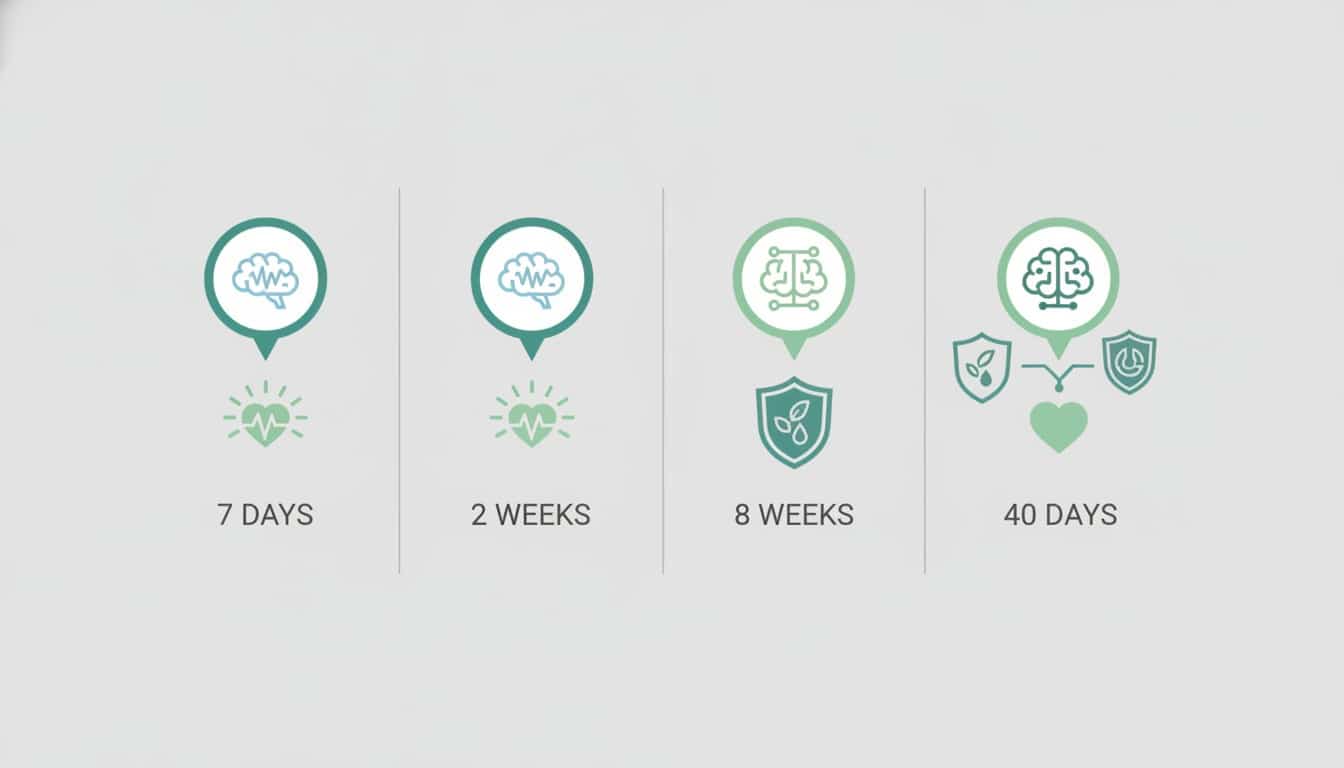
What Happens After 2 Weeks and 40 Days of Meditation?
Benefits build with consistency. Here is what the evidence suggests for common milestones beyond the first week:
- After 2 weeks of daily practice (10 to 20 minutes per day): Most beginners report better sleep, lower perceived stress, and easier focus. Early imaging work shows small functional shifts in attention networks even before structural changes dominate. If you meditated intensively for 7 days and then continue briefly daily, the integrated network state observed in the UCSD study may consolidate rather than fade, though this specific follow-up has not yet been published.
- After 8 weeks: This is the best-studied window. Meta-analyses report gray matter increases, thicker prefrontal regions, reduced amygdala reactivity, and stronger gamma coherence. Many 8-week programs like Mindfulness-Based Stress Reduction show clinically meaningful reductions in anxiety and depression.
- After 40 days: In contemplative traditions and some modern habit research, 40 days marks a point where a daily habit becomes more automatic. While no single large RCT isolates day 40, continuation of daily practice tends to deepen emotion regulation, compassion, and interoceptive awareness. Davidson’s teacher study showed that benefits from under 5 minutes per day persisted at 4 months when practice remained regular, even when woven into ordinary activities like commuting or washing dishes.
The key principle is dose over time. A 7-day immersive experience can jump-start change, but brief, consistent daily practice is what makes those changes stick.
How to Meditate to Rewire Your Brain: A Beginner’s Protocol
You do not need a week-long retreat to begin rewiring your brain. Use this evidence-informed starter protocol that borrows the mechanisms from the UCSD study and the micro-practice data:
- Pick one anchor: Breath awareness is the most studied, and it has the clearest physiological trail, since the brain tracks the shape of every individual breath. Alternatively, use a body scan, loving-kindness phrases, or mindful walking if breath focus feels uncomfortable.
- Set a minimal dose: Start with 5 minutes daily for 30 days. If you have more time, build to 12 to 20 minutes. Consistency beats length.
- Use gentle guidance at first: A guided meditation helps keep the default mode network quiet. After a week, try 2 to 3 minutes unguided at the end of each session.
- Stack with daily life: Practice 1 to 2 minutes during routine activities (waiting for coffee to brew, commuting, brushing teeth). Teachers who meditated during chores gained equal benefits to those on the cushion.
- Track quietly: Note focus, mood, and reactivity for 1 minute after each session in a journal. Look for the five signs above rather than chasing mystical experiences.
- Add kindness and reflection: The UCSD retreat combined meditation with lectures and group practice. Even briefly, reflect on intention and self-compassion before and after sitting. Loving-kindness meditation strengthens emotion-regulation circuits differently than attention training alone.
A simple 7-day launch plan:
- Days 1 to 2: 5 minutes of breath awareness in the morning and evening.
- Days 3 to 4: 10 minutes of breath plus 2 minutes of loving-kindness phrases.
- Day 5: 10-minute body scan before bed.
- Day 6: 12 minutes of mixed practice, including 2 minutes of mindful walking.
- Day 7: 15 minutes self-guided with longer pauses, then 5 minutes journaling.
If you have a health condition, chronic pain, or a trauma history, start slower and consider guidance from a qualified teacher or clinician. Meditation complements but does not replace medical care. If you are curious how long broader brain recovery takes in other contexts, see how long it takes to rewire your brain post-addiction.
Frequently Asked Questions
Can 7 days of meditation rewire your brain?
The UCSD study found that 7 days of intensive meditation and mind-body practices were associated with reduced activity in mental-chatter networks, more integrated brain connectivity, and a blood-based signal of increased neuroplasticity. That suggests rewiring can begin quickly, but the study was observational and combined several practices, so meditation alone cannot be isolated as the sole cause, and long-term persistence is not yet known.
Can you rewire your brain through meditation at any age?
Yes. Neuroplasticity occurs throughout life. Older and younger adults both show benefits, and long-term meditators show slower age-related decline in brain structure. The magnitude and speed vary by individual, health status, and practice consistency.
How long does it take for meditation to rewire your brain?
Functional changes can appear within days to weeks. Structural changes like increased gray matter and prefrontal thickening are most consistently observed around 8 weeks of regular practice. Micro-practices under 5 minutes per day can improve well-being within 30 days, with benefits lasting months if practice continues.
What chemical is released when meditating?
Key chemicals include dopamine, serotonin, and endogenous opioids, which support mood and pain relief, plus shifts in immune signaling molecules and metabolites linked to metabolism and neuroplasticity. Exact patterns depend on the type and intensity of practice.
How many days of meditation to see results?
Some people notice calmer focus and reduced stress within a few days. Measurable brain and blood changes were seen at 7 days in an intensive retreat, while population-level structural changes and robust clinical benefits are best documented at 8 weeks. Aim for daily consistency rather than a specific magic number.
Which organ benefits most from meditation?
The brain benefits most directly through rewiring and network efficiency, but effects are whole-body. The UCSD study showed parallel changes in metabolism, immune function, and pain control systems, reflecting meditation’s systemic reach beyond the brain alone.
Conclusion
Seven days is enough to start rewiring your brain, at least at the level of brain networks, blood chemistry, and lab-based plasticity signals, as the August 2026 UCSD Communications Biology study shows. That speed likely comes from intensive, combined mind-body practice, and it briefly mimics the integrated brain states usually linked to psychedelics, but without drugs. For most people, the more practical lesson is simpler: brief daily meditation, even under 5 minutes a day, can meaningfully improve attention, mood and resilience within a month, and the benefits grow with 8 weeks of steady practice. Start small, stay consistent, and let neuroplasticity do the rest.


