
Hydrogen fuel cell innovator HyPoint has joined forces with Piasecki Aircraft Corporation (PiAC) to build Piasecki’s eVTOL PA-890 Compound Helicopter, which will be the world’s first crewed hydrogen-powered helicopter. However, in the process, they plan to develop and certify a hydrogen fuel cell system that can be integrated into any electric vertical takeoff and landing (eVTOL) aircraft to boost range capabilities drastically.
Under the multi-phase partnership, both partners will fast-track global availability of hydrogen-powered eVTOLs, aiming to bring a customizable, fully FAA-certified, zero carbon-emission hydrogen fuel cell system to the global eVTOL market. The system would allow electric aircraft to carry several times more energy onboard, vastly boosting flight endurance and enabling fast refueling instead of slow charging.
The partners raised an initial US$ 6.5 million to develop five 650 kW hydrogen fuel cell systems, which will then be integrated into Piasecki’s PA-890. It would be powered by the novel HyPoint turbo air-cooled hydrogen fuel cell system.

The new system will offer four times the energy density of today’s commercially available lithium-ion batteries, which would be double the specific power of existing hydrogen fuel cell systems. This will also halve operating costs regarding turbine-powered rotorcraft.
Piasecki will hold an exclusive license to the technology as part of the partnership, and HyPoint will maintain ownership of its original hydrogen fuel cell technology. Additionally, the new system will be available for customization for clients, or eVTOL makers can partner with Piasecki and HyPoint to develop a new plan based on their particular needs.
According to HyPoint, its “fuel cell system will achieve up to 2,000 watts per kilogram of specific power, which is more than triple the power-to-weight ratio of traditional (liquid-cooled) hydrogen fuel cells systems. It will also boast around 1,500 watt-hours per kilogram of energy density, enabling longer-distance journeys.”
HyPoint claims its lightweight fuel cell system has already been validated in bench-testing of prototypes. Results showed it could generate enough continuous power to handle the vertical takeoff and landing without needing a heavy, bulky battery.
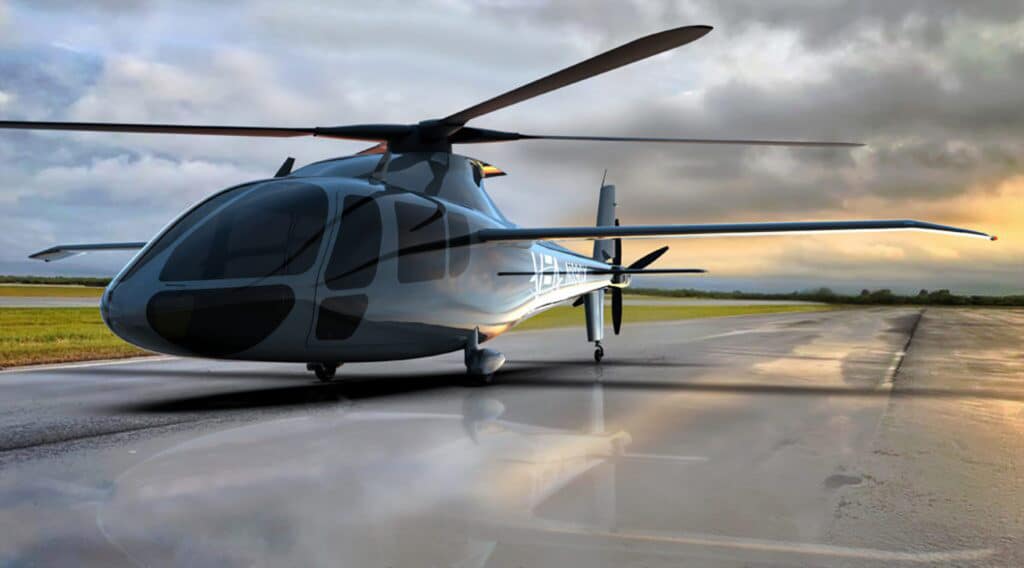
Piasecki’s PA-890 is an electric slowed-rotor five-seater with broad wings for efficient cruise and a tail rotor that tilts backward in forwarding flight, becoming a pusher prop. In addition, the wings tilt 90 degrees upward to get out of the main rotor’s way during takeoff and landing.
John Piasecki, the President, and CEO of Piasecki Aircraft said:
We are laser-focused on the development and qualification of a 650-kW system for our PA-890 eVTOL Compound Helicopter, which would be the world’s first crewed hydrogen-powered helicopter. Success will pave the way for collaboration with other eVTOL OEMs with different platform sizes to ensure the broad application of this technology.
Initial lab testing funded by Piasecki demonstrated the technical viability of HyPoint’s hydrogen fuel cell system. While we benchmark HyPoint’s technology against alternatives and continue to test and validate findings rigorously, we are very optimistic. Our objective is to develop full-scale systems within two years to support on-aircraft certification testing in 2024 and fulfill existing customer orders for up to 325 units starting in 2025.
If urban air mobility takes off, air taxis will be flying in and out of vertiports like taxicabs at a taxi rank. However, air taxi ranks will most likely be limited to the top floor of a multi-story urban car park, with enough space for four to eight landing pads. Now imagine the cabs plugging in and charging for half an hour every time they landed. It sounds like a nightmare!
Besides, battery-powered eVTOLs may not have the endurance to hover and wait until a space clears out. Plus, every minute that passes, money is lost in peak hours! So now, you can clearly see how a long-range, fast-fueling hydrogen system would be a game-changer in this type of scenario.


