
A grinder, dehydrator, digester, or composting system can process material, but it cannot decide what should be prevented, verify what a receiving facility accepts, train staff, or find a useful destination for the output. A reliable program is designed around the full path from purchasing and preparation to final use.
A commercial food-waste program succeeds when the business knows what it is discarding, has matched each stream to a real destination, and can manage the steps between the kitchen and that destination. Buying a machine before answering those questions can simply move the bottleneck, from a dumpster to a storage room, a processing line, or an output nobody can use.
For a restaurant group, campus, hotel, grocery store, or food manufacturer, the practical sequence is: prevent what can be prevented; separate edible surplus from unavoidable scraps; confirm who will accept each remaining stream; design the daily workflow; then choose technology that fits the material, site, and operating capacity.
1. Find out what the business is throwing away
A scale or audit can reveal more than a monthly hauling bill. For a representative period, record the source of discarded material, such as overproduction, spoilage, preparation, plate returns, or damaged packaging, along with the type and weight. Include busy and quiet days and different meal periods, plus seasonal patterns if they change purchasing or menus. A weekly total without a reason code may show the size of the problem but not how to reduce it.
The EPA recommends assessment as a foundation for food-waste reduction. Its tools range from a snapshot assessment to daily tracking that records the type and reason for waste. A kitchen might discover that repeated surplus follows one production schedule, while a retailer may find that a particular product expires before it sells. Those are purchasing, forecasting, or preparation questions, not equipment problems.
The audit should also distinguish edible food from inedible scraps and packaged products. That separation matters because the best next step may be different for each.
2. Keep usable food in the human food supply where possible
The EPA’s Wasted Food Scale places prevention, donation, and upcycling among its most preferred pathways, and composting remains an important option for material that cannot be kept in use higher on the scale. This is an environmental ranking of food-management pathways, not a complete business case: EPA notes that the scale does not account for economic or social factors.
For businesses, the hierarchy is a prompt to ask whether a purchasing adjustment, menu change, inventory rotation, markdown, or recovery partner could address a stream before it becomes a processing input. Food donations should be planned with recipients and handled under applicable food-safety rules; USDA’s donation guidance offers a starting point for identifying donation options. Donation is not a substitute for clear procedures about what food is suitable and how it will be kept safe.
Only after prevention and appropriate food recovery should a business size the collection or treatment system for its residual material. That can change the equipment specification dramatically: fewer tons, a different mix of ingredients, or less packaging may be headed to the organics stream than a purchasing estimate suggested.
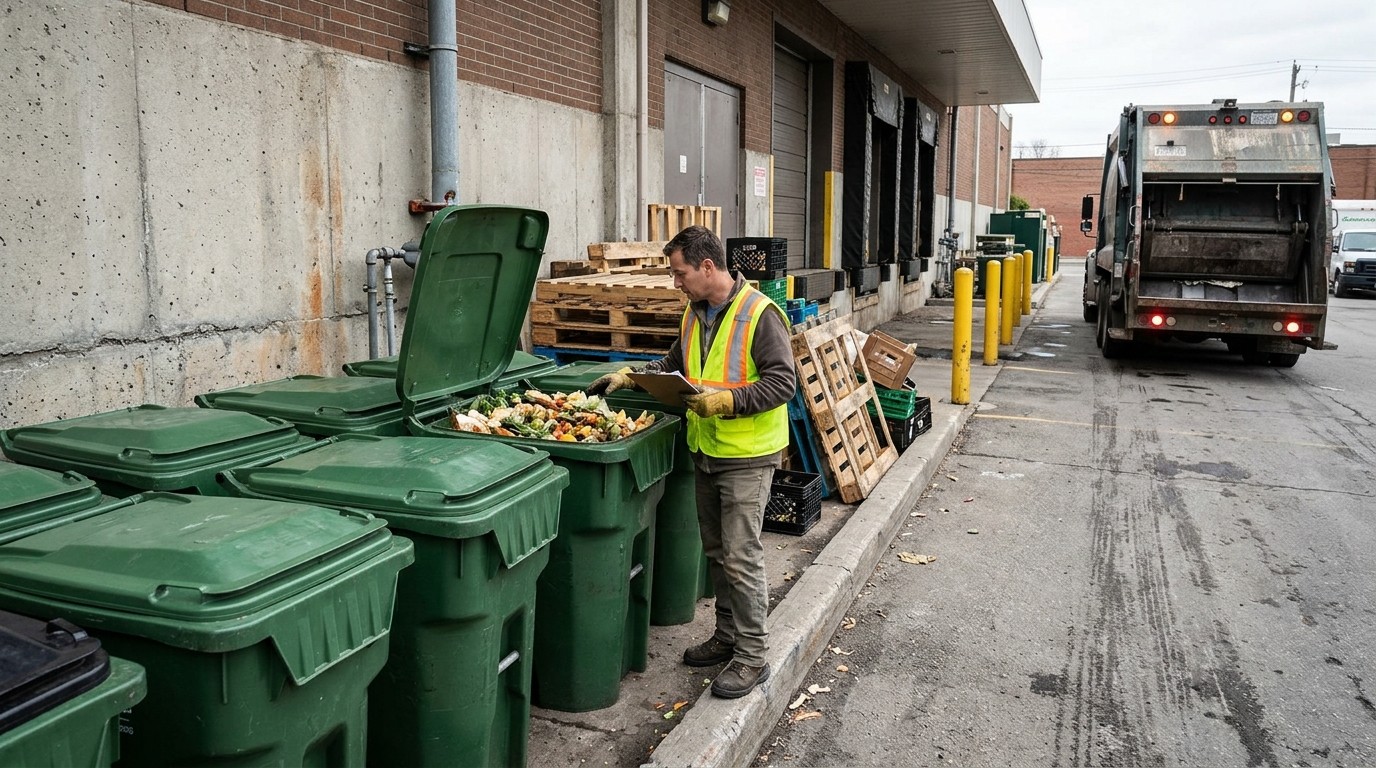
3. Secure the receiving route before selecting a process
“Compostable,” “organic,” and “food waste” are not universal acceptance categories. Collection providers and processing facilities set rules based on their equipment, permits, and end products. A facility may take food scraps but reject certain compostable serviceware, produce labels, plastic liners, or packaged products. Ask for a written acceptance list tied to the actual destination, not a general claim that a material is recyclable.
Before launch, establish who collects the material, collection frequency, container needs, contamination thresholds, rejection fees or procedures, and what happens during missed pickups or seasonal peaks. Ask what documentation is available for loads received, rejected, and processed. A filled organics cart documents collection; by itself, it does not establish that the material reached a suitable processor or became a usable product.
For an on-site system, the same questions apply to what happens after processing. Who uses the output? What quality or testing requirements apply? Is there enough land or a contracted outlet for the quantity produced? EPA’s Excess Food Opportunities Map can help identify potential local generators and recipients, including composting and anaerobic-digestion facilities, but a map listing is a lead to verify, not a service commitment.
4. Match the tool to the material, and name what it produces
Businesses may compare contracted collection, on-site composting, anaerobic digestion, or preprocessing equipment. These are not interchangeable routes. Grinding, pulping, dewatering, or drying can alter particle size, moisture, or volume, but the resulting material still needs a defined next step. EPA explicitly distinguishes material that has only been ground, dehydrated, or liquefied from finished compost in its composting guidance. Likewise, digestion produces biogas and digestate; those outputs need their own management and beneficial-use plans.
Ask vendors and service providers to describe the feedstock they can handle, the actual output, what leaves the site, any residuals, routine operator tasks, maintenance, and the evidence available to support performance statements. For systems that require biological treatment, a machine cannot replace process management. Composting depends on an appropriate balance of carbon-rich and nitrogen-rich materials, moisture, oxygen, particle size, and temperature; recipes and controls must fit the feedstock and operating conditions.
Sustainable Generation, a commercial composting-system provider, publishes a company description of its covered aerated static-pile approach. That page is useful as an example of the kinds of design and monitoring features a supplier may describe; it is not an independent comparison or a substitute for site-specific review. Any company-specific operating, environmental, or performance claims should be checked against project records and independent documentation before they are repeated.
5. Design the daily work, not just the installation
Map where each material appears, how it will be moved, and who owns each handoff. A prep-area container may be simple to use but awkward to empty; a shared collection point can be easy to service yet far from the source. Ask kitchen, cleaning, loading-dock, and facilities teams to test the route during a busy shift. Their feedback can expose missed collection points, confusing signage, insufficient capacity, or a schedule that works on paper but not in practice.
Set written responsibilities for separating material, removing packaging where required, checking loads, cleaning containers, logging weights, and contacting the hauler or operator when something goes wrong. Train new and temporary staff as well as regular employees. Review contamination findings with the people who can change the workflow; recurring mistakes may signal that an item list is unclear or the bin is poorly placed, rather than that people need another generic reminder.
An on-site treatment system adds responsibilities for trained operators, process checks, maintenance, and product handling. Site planning should also consider vehicle access, drainage, stormwater and contact-water management, odors, neighboring uses, worker procedures, and local permits. Rules vary by location and facility scale; EPA notes that composting policy and regulation are set at the state and local level. Engage the relevant authorities and qualified designers early rather than assuming a piece of equipment carries its own approval.
6. Compare the whole operating commitment
A purchase quote is only one part of the decision. Compare the full cost and staffing picture for each option: collection and hauling, containers, labor, training, utilities, consumables, repairs, service support, testing, permits, residual disposal, and management of the final product. For on-site processing, include the space and site work needed to receive, handle, and store material safely. Model realistic downtime and seasonal variation rather than assuming every day looks like the equipment brochure.
A useful comparison is cost per ton accepted and handled through the intended route, not merely cost per ton placed in a container or fed to a machine. Check the assumptions behind vendor estimates, including feedstock composition, moisture, contamination, operator hours, throughput, and the destination for output. When comparing composting with anaerobic digestion or a contracted service, state the boundary of the comparison: which transportation legs, residuals, and product uses are included?
7. Pilot with measures that can be verified
A limited trial can test staff participation, actual weights, pickup reliability, contamination, and processor acceptance before a permanent investment. Decide in advance what would count as success and who will verify it. Useful measures include food prevention, eligible food donation, material collection, load acceptance, contamination or rejection rates, processing destination, final-product use, labor time, and total cost. Retain tickets, manifests, invoices, and processor reports so results can be reconciled.
Report what was measured, over which period, and by which method. Do not treat estimated greenhouse-gas avoidance or a diversion percentage as a measured site outcome unless the calculation boundary, baseline, and assumptions are transparent. The environmental case for a pathway can be real while the result at a particular location depends on its collection distance, process, contamination, and end use.
The right investment is the one that fits the material a business actually generates and connects it to a workable downstream destination. If a hauler and receiving facility can provide that route, buying on-site machinery may not be necessary. If processing on-site is under consideration, the business needs the staff, site plan, operating discipline, approvals, and output market to support it. Start with the material and the route; let those facts determine what equipment, if any, belongs in the plan.

Source list
- U.S. Environmental Protection Agency, Tools for Preventing and Diverting Wasted Food: assessment and tracking tools; last updated March 22, 2026.
- U.S. Environmental Protection Agency, Wasted Food Scale: environmental ranking and pathway descriptions; last updated September 16, 2026.
- U.S. Department of Agriculture, Donating: food donation guidance.
- U.S. Environmental Protection Agency, Excess Food Opportunities Map: potential excess-food generators and recipients.
- U.S. Environmental Protection Agency, Composting: definition, process needs, preprocessing distinction, and state and local policy context; last updated May 18, 2026.

