
Quantum computers have a wiring problem that scaling makes worse. Each qubit typically needs its own microwave path from room-temperature electronics down into a millikelvin refrigerator, and every cable added brings heat, cost, and assembly work with it. A team at RIKEN and its collaborators has now shown that five silicon spin qubits can be driven through one shared microwave line while keeping the accuracy of their operations high enough to matter.
The work, published in Nature Physics on 15 October 2026, does not build a bigger quantum computer. It identifies what was breaking when multiple qubits were driven at once, fixes it with a compact calibration routine, and demonstrates that the fix holds as the number of simultaneously driven qubits grows. Five qubits is a small array. What the experiment establishes is that a shared quantum computing control line is not automatically a low-fidelity one, which is the awkward assumption that has sat under silicon scaling plans for years.
The headline numbers come with conditions that matter. Operated individually, every qubit in the array reached single-qubit gate fidelities above 99.99%, with some approaching 99.999%. With up to three qubits running in parallel, fidelities stayed above 99.99%. With all five driven together, fidelities were held at roughly 99.9%, the widely targeted fault-tolerant threshold. Those are three different measurements under three different conditions, and conflating them is how a careful control experiment gets turned into an inflated scaling claim.
What the RIKEN Team Actually Measured
The device is a five-dot array built in an isotopically enriched silicon-28 quantum well, nine nanometers thick, with residual silicon-29 at 800 parts per million. Three overlapping aluminium gate layers define the dots, two charge sensors at the ends handle readout, and a cobalt micromagnet deposited on top creates a magnetic field gradient. That gradient matters: it shifts each qubit’s resonance frequency so that adjacent qubits sit roughly 150 MHz apart at an external field of 0.42 tesla, letting the team address them individually by frequency even though one microwave gate electrode drives the whole array through electric dipole spin resonance.
Almost every number in the paper depends on how many qubits were switched on at once, so it is worth reading them together rather than separately.
| Operating condition | Primitive single-qubit gate fidelity | What it means |
|---|---|---|
| Each qubit on its own | Above 99.99% for all five, some approaching 99.999% | The baseline. Best-in-class for silicon spin qubits, measured by randomized benchmarking. |
| Up to three qubits in parallel | Above 99.99% | The calibration holds as simultaneous driving gets more crowded. |
| All five qubits in parallel | About 99.9%, with four of five qubits above 99.9% | At the fault-tolerant threshold, not comfortably beyond it. |
The difference between the three- and five-qubit rows is the honest core of the result. At five qubits the drive power needed for simultaneous operation rises, microwave-induced decoherence and heating creep in, and fidelity settles at the threshold rather than sailing past it. The team tested slower 500-nanosecond gates as well as 250-nanosecond gates and found broadly similar fidelity, which is a useful signal about where the limits lie.
The single-qubit gates were built from Kaiser-window pulses, a shaped envelope chosen because its excitation spectrum suppresses spectral leakage into neighboring qubits. That choice is not incidental. On a shared line, a pulse that leaks is a pulse that disturbs its neighbors, and pulse shaping is part of how the architecture is made to work at all.
Why One Control Line Per Qubit Is the Quiet Bill
Public discussion of quantum hardware tends to track qubit counts, error rates, and coherence times. The unglamorous line item is the plumbing.
In a conventional layout, a control line runs from room temperature to the coldest stage of a dilution refrigerator for each qubit, plus additional lines for readout, tuning, and bias. Those cables are not free in any sense that matters. They carry heat into a cooling system with almost no spare thermal budget at the millikelvin stage. They demand high-frequency connectors, microwave components, and cryogenic attenuators at every stage. They must be routed, anchored, and dressed by hand, which turns assembly into a labor-intensive craft process rather than a fab step. And they occupy physical real estate in the package and the sample holder that does not shrink as qubit counts grow.
The math is unforgiving. Double the qubit count and you roughly double the wiring, the heat load, the connector count, and the assembly hours. The industry response has largely been vertical: the VIO-40K architecture from QuantWare proposes stacking layers and routing 40,000 control lines vertically through a 3D interconnect so that planar congestion and thermal load per qubit fall. That is one answer to the routing wall: keep one line per qubit, but make the lines cheaper and thinner.
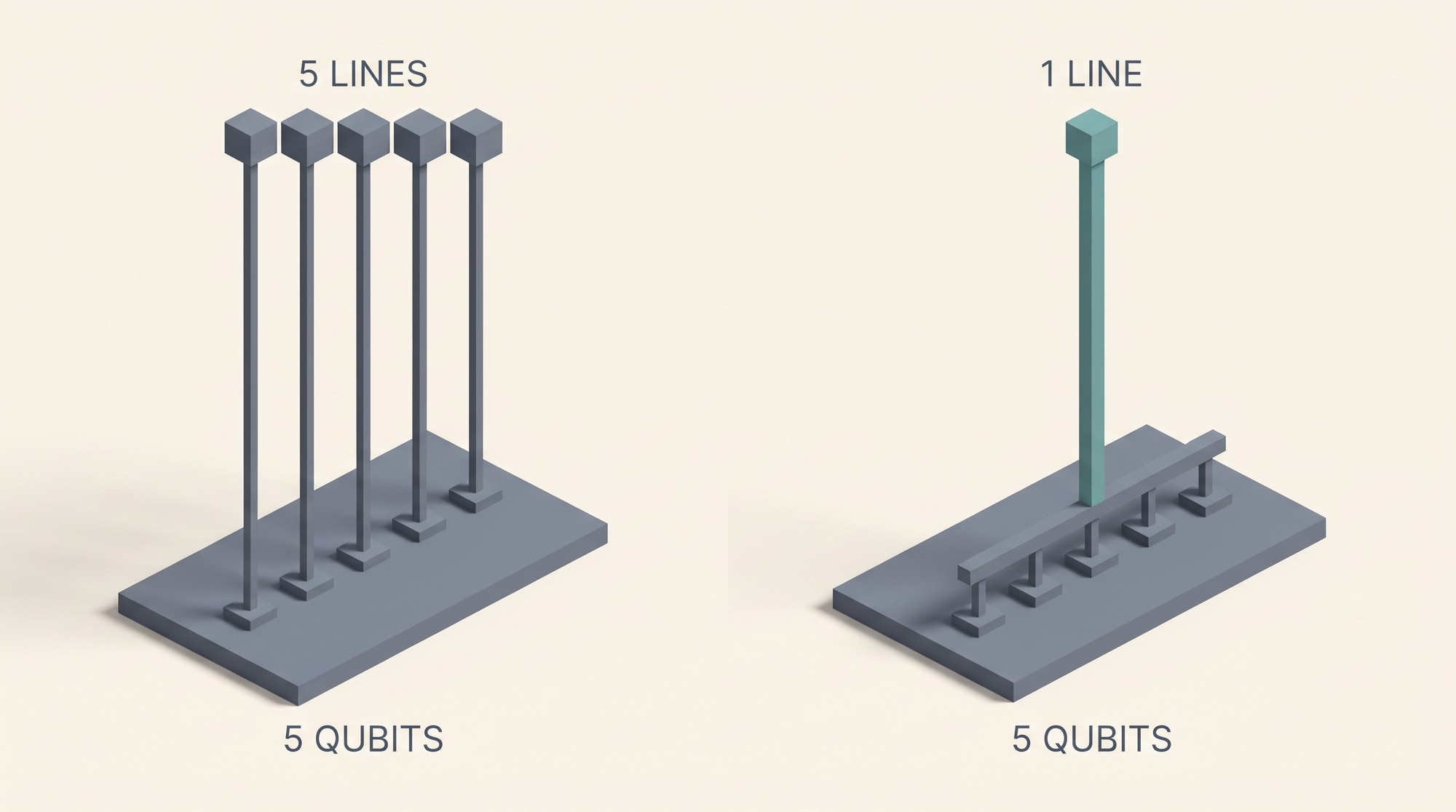
Shared control lines attack the same wall from the other side. Instead of engineering a better path for every qubit, reduce the number of paths. When one impedance-matched microwave line can drive a whole subunit, the wiring requirement stops tracking the qubit count one-to-one and starts tracking the number of subunits. For a fault-tolerant machine of the size people actually want to build, that changes the shape of the bill rather than trimming it, and it changes the assembly line with it.
There is a catch, and it is the reason this result needed a physics paper rather than an engineering note. Put multiple qubits on one line and the signal intended for one qubit also arrives, off-resonance, at its neighbors. Before this work, that crosstalk was known to hurt: prior silicon spin qubit experiments reported fidelities collapsing from 99.95% to 99.5% when just two qubits were driven in parallel. Sharing a line looked like a way to save wiring at the cost of accuracy.
The AC Stark Shift and a Calibration That Scales
The RIKEN team traced the damage to the AC Stark shift, sometimes called the Autler-Townes effect. An off-resonant microwave field does not rotate a neighboring qubit, but it does perturb its effective energy levels, which shifts its resonance frequency and introduces a phase error in everything that follows. On a shared line, every pulse is a small off-resonant field for everyone else.

The important discovery is not that the effect exists. It is that the resulting phase shifts add linearly. Measure the phase that qubit three picks up when qubit two is driven and when qubit four is driven, and the sum of those two measurements matches what happens when both are driven together. The paper reports a fitted exponent of 1.91, close to the quadratic amplitude dependence expected from an AC Stark shift.
That linearity changes the calibration cost from impossible to routine:
- Exhaustive calibration would need a separate measurement for every possible subset of simultaneously active qubits, which grows as 2N − N − 1 combinations and becomes hopeless within a few dozen qubits.
- Pairwise calibration only needs the phase each qubit picks up from each other qubit, which grows as N(N − 1) measurements: quadratic rather than exponential. For a ten-qubit subunit that is 90 measurements instead of roughly a thousand combinations.
The team then does something worth noticing. They ran the exhaustive full calibration for their five-qubit array and compared it against the pairwise result and found no difference in performance. The shortcut is not an approximation that degrades quietly; in this device it lands in the same place. There is a second effect pushing in the same direction: because a phase shift scales inversely with detuning, pairs of qubits separated by a large enough frequency gap contribute corrections small enough to ignore.
So what the paper really offers is not just a shared line but a control architecture: subunits of roughly ten qubits, each on a shared line, each driven by a common microwave source, with a calibration overhead that grows quadratically inside a subunit.
What Sharing a Line Means for Manufacturing
The reason this result lands harder for silicon than it would for most other qubit platforms is where silicon comes from.
Silicon spin qubits are built with gate-defined quantum dots, which means they are made with the same broad family of tools as ordinary CMOS: lithography, gate stack deposition, lift-off, wafer-scale processing. The isotopic purification of silicon-28 that underpins this device is itself a materials-supply question that already has industrial answers. If the control architecture can be made simple enough, silicon quantum processors inherit a manufacturing base that has spent six decades getting very good at putting enormous numbers of identical devices on one wafer.
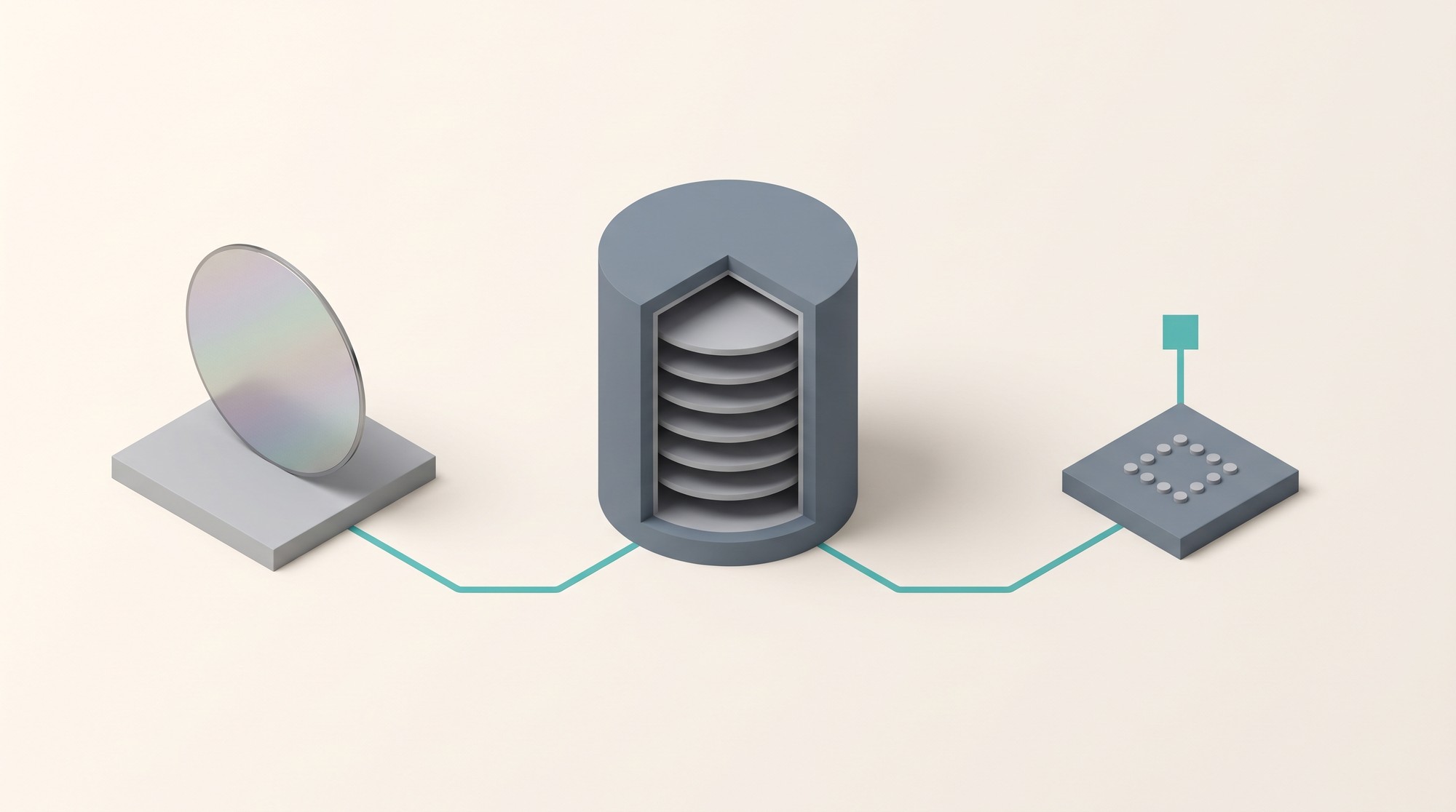
Control wiring is precisely the part of quantum hardware that does not inherit that base. Hand-dressed coaxial runs into a fridge have no equivalent in a semiconductor fab, no pick-and-place step, no wafer-scale test. They are the point where a would-be chip business turns back into an instrument-building business. Reducing the microwave wiring requirement to one line per ten-qubit subunit moves a meaningful fraction of the system back inside the domain where silicon’s cost curve applies.
The paper hints at where this goes next. The team calculates that with the same architecture, the same control approach should extend to about ten qubits at 500-nanosecond gate times, where the total microwave power matches what five qubits consume at 250 nanoseconds. Beyond that, the micromagnet itself becomes a manufacturing obstacle, because a magnetic structure sitting on top of the device has to be removed before you can add the multilayer routing that 2D arrays need. The proposed fix is to build nanomagnets into the gate layer or into back-end-of-line wiring, which keeps the field gradient strong while allowing the routing layers above. The paper estimates that a modified micromagnet design could double the driving-field gradient, enabling faster two-to-three-megahertz gates at lower microwave power.
Lower power per gate is not a side benefit. On a shared line, power is the shared resource, and the fidelity ceiling for simultaneous operation is largely a heat and decoherence problem. Every reduction in drive power buys room to run more qubits at once.
The ordering of those two problems is worth holding onto. Wiring and control are being addressed first because without them there is no array to improve, but they are not the harder physics. A machine that can address ten qubits cleanly still needs entangling operations that are an order of magnitude better than the ones this device can currently manage, and it needs readout that scales with control. Control fidelity is a prerequisite, not a finish line.
There is also a quieter cost on the other side of the ledger. A per-qubit line buys simplicity: each qubit gets its own amplifier, its own attenuator chain, and its own calibration target, and a fault is easy to isolate. A shared line concentrates all of that into one path, so a single failed component or a drifted amplifier affects an entire subunit rather than one qubit. Multiplexed architectures recover some of this through redundancy and on-chip switching, but the trade is real, and it is the kind of detail that only shows up in yield data rather than in a physics paper.
None of that is hypothetical. The IMEC analysis of upscaling silicon spin and superconducting technologies describes at least one control line per qubit running from the room-temperature stage to the coldest stage and warns that the lines contribute a massive input-output bottleneck at the refrigerator level while each wire brings in heat to a cooling system with no budget left to absorb it. Multiplexing and shared control are the standard answers. What was missing until now was experimental evidence that sharing a line could preserve the fidelity of the shared signals.
What This Result Does Not Show
Five qubits in a laboratory device is a control-fidelity result, not a scaling breakthrough, and the paper is unusually candid about the gaps.
- It is five qubits, not fifty. The extension to ten qubits is a projection based on observed power scaling, not a demonstration.
- These are single-qubit gates. A useful quantum computer also needs two-qubit gates, and in this very device the exchange-controlled CZ gate fidelity is limited to below 97% by spin-valley mixing. Excellent single-qubit control does not rescue a mediocre entangling gate.
- Readout is a constraint. The team needed tomographic readout to reconstruct individual spin states during five-qubit operation because the device produces only three bits of information per cycle. Scaling control without scaling readout just moves the bottleneck.
- The five-qubit figure sits at the threshold. Roughly 99.9% meets the widely targeted number for surface code error correction, but error correction schemes have overheads that punish anything sitting at the boundary rather than comfortably above it.
- Microwave crosstalk is not the only crosstalk. The calibration addresses phase shifts from off-resonant driving. Resonantly driven two-qubit gates, where qubits are coupled while microwaves are applied, are expected to pick up additional conditional phases that will need their own calibration.
Read alongside the rest of the field, the pattern is consistent: silicon spin qubits have spent years proving that individual devices can be precise, and the open questions have moved to whether that precision survives when many devices run at once. This paper is a contribution to that second question, and it should be judged on it rather than on how many qubits it managed to cram into one device.
Frequently Asked Questions
What is the difference between superconducting qubits and spin qubits?
Superconducting qubits are millimeter-scale circuits built from Josephson junctions and operated at roughly 15 millikelvin. Spin qubits are electron spins confined in semiconductor quantum dots, hundreds of nanometers across or smaller, and are made with CMOS-compatible processes. Superconducting devices currently lead on qubit count and two-qubit gate quality; spin qubits lead on footprint and manufacturing compatibility, which is where the shared-control-line result matters.
What are the downsides of using quantum dots?
Quantum dots are small, which is an advantage, and crowded, which is not. A single spin qubit can need many gate electrodes for confinement, tuning and readout, so the per-qubit wiring and control overhead is high. Charge noise and device-to-device variability also degrade coherence, and the tiny signal levels make readout harder than in larger superconducting circuits.
How much does a 1,000-qubit quantum computer cost?
There is no reliable public price for a 1,000-qubit machine, because so few exist and none are sold as standard products. The dominant cost drivers are not the qubits themselves but the cryogenics, the control electronics, and the wiring harness. That is precisely why shared control lines and cryogenic multiplexing attract so much attention: they attack the part of the system that scales badly with qubit count.
What fidelity does a quantum computer actually need?
Above 99.9% for single-qubit gates is the widely targeted practical threshold for surface code error correction, which is the number the five-qubit result is measured against. Real systems also need state preparation and measurement, two-qubit gates and idle qubits to clear their own thresholds, and the overall error budget is set by the worst of them.
When will shared control lines reach commercial silicon quantum processors?
Not soon, and not on a published schedule. The route the paper describes runs through ten-qubit subunits, back-end-of-line nanomagnets for stronger field gradients, and integration of magnetic structures with multilayer routing. Each of those is a fabrication problem, and the paper treats it as such. This is a research step with a clear industrial logic, not a product announcement.
The Bottom Line
Silicon spin qubits have long carried a promise that rests on manufacturing compatibility and a caveat that rests on wiring. The caveat was that a per-qubit control line does not fit into a large processor, and sharing one line traded away the fidelity that makes a qubit useful in the first place. RIKEN’s five-qubit array shows that the trade is not compulsory, provided you understand the error mechanism and calibrate for it pairwise instead of exhaustively.
The numbers deserve to be quoted carefully: above 99.99% for individual qubits, above 99.99% with up to three running in parallel, and roughly 99.9% with all five. The last figure is a threshold reached, not a threshold cleared with margin. But it is reached with one microwave line instead of five, and on a platform where a line saved is a line the semiconductor industry already knows how to avoid making.


