
Most machines built to help a person carry weight still put that weight on the person. They strap frames to the thighs and shanks, add motors at the hips and knees, and hope the extra torque arrives at the right moment. A research team in Shenzhen decided that the load never needed to travel through human legs at all.
Their answer is a wearable system the researchers call the Centaur robot: two independent robotic legs and a robotic torso mounted behind the wearer, joined to the body through an elastic coupling worn on the back. The result is a temporary quadruped, with a human as the front half.
In a load-carrying trial of five participants published in the International Journal of Robotics Research, the device carried just over half the weight of a 20 kg load and cut the net metabolic cost of walking by 35.16%, compared with a regular backpack holding the same load. That second number is the one worth interrogating, because it explains why this design works where load-carrying exoskeletons have often fallen short.
What the Centaur Robot Actually Is
The paper’s authors, Zhixin Tu and colleagues in Professor Chenglong Fu’s group at the Southern University of Science and Technology, describe the Centaur as a wearable human augmentation robot rather than a suit. It consists of three parts:
- Two independent legs, each with three degrees of freedom, grouped behind the wearer rather than alongside his or her own limbs.
- A robotic torso that carries the load and provides the attachment point for the backpack-style wearable frame.
- A passive elastic coupling at the human-robot interface, with deliberately nonlinear stiffness: comparatively stiff when forces are small and responsive, softening into compliance as loads grow, so it absorbs shock instead of transmitting it.
The coupling is the interesting piece. In the reported hardware it is built from a diamond-shaped linkage and opposed springs, giving compliant motion along the horizontal axis. When the wearer steps forward, the mechanism compresses slightly and pushes back, supplying a forward force through the body’s center of mass. When the wearer turns, stops, or stumbles, it yields, so the machine does not yank on the spine. That is why the team can model and control the robot almost independently, then let it cooperate rather than force the wearer’s gait into a fixed pattern. The paper places the system among wearable robots rather than walking aids, a distinction that matters when it is set against existing approaches to exoskeleton assistance built around a wearer’s own joints.
Sensing follows the same division of labor. Two inertial measurement units track the posture of the human and of the robot separately, a depth camera reads the ground ahead, a six-axis force sensor measures interaction forces at the interface, and an absolute angle encoder monitors how far the elastic element has compressed.
Why the 35% Figure Is Plausible, and What It Does Not Say
The headline result comes from a specific experiment, and the details matter. Five participants walked on a treadmill for five minutes carrying 20 kg, equivalent to 28.8% ± 4.03% of their body weight, in two conditions: with the Centaur and with a conventional backpack. Relative to the backpack, the robot reduced net metabolic cost by 35.16% ± 4.95% and achieved a load-sharing ratio of 52.22% ± 15.52%, while improving lateral gait stability.
Three things follow from those numbers. First, the comparison is against a backpack, not against a powered exoskeleton, so the 35% is a statement about this architecture versus unassisted carrying rather than a head-to-head victory over competing devices. Second, the spread is wide: a load-sharing standard deviation of 15.52 points on a mean of 52.22 means individual wearers got meaningfully different amounts of help, which is expected in a small sample and a reminder that the average is not a promise. Third, five people on a treadmill for five minutes is a proof of concept, not evidence that the effect holds over an eight-hour shift or on a scree slope.
Some coverage of the study reports a 52% reduction in foot pressure. The abstract attributes 52.22% to load sharing, which is a different measurement: it describes how much of the payload’s weight is routed into the robot instead of the wearer. Treating the two as interchangeable overstates the physiological result. This article uses the load-sharing figure.
Measured against a backpack carrying the same load, the reported saving was 35.16% of net metabolic cost, with a standard deviation of 4.95 percentage points across the five participants. The comparison below shows the full experimental design behind that figure and the others reported alongside it.
| Experimental detail | What was reported |
|---|---|
| Participants in the load-carriage trial | 5 (n = 5) |
| Load carried | 20 kg, equal to 28.8% ± 4.03% of participants’ body weight |
| Task | Level treadmill walking, 5 minutes per condition |
| Baseline comparison | A conventional backpack holding the same 20 kg |
| Reduction in net metabolic cost | 35.16% ± 4.95% |
| Load-sharing ratio | 52.22% ± 15.52% |
| Other reported outcome | Improved lateral gait stability versus the backpack |
Parallel Versus Serial: The Engineering Difference
A conventional exoskeleton works in parallel with the human leg. It adds torque at a joint, or supports the trunk from below, while the skeleton continues to bear the load and the muscles continue to do most of the work. Everything the device weighs below the waist becomes mass the wearer has to swing, and mass near the ankle is expensive: each extra kilogram there costs far more energy per step than the same kilogram carried on the back, because the foot has to be accelerated and decelerated twice per stride.
The Centaur works in series instead of in parallel. The load path runs from the payload, through the robotic torso, down two robotic legs, and into the ground. The human supplies navigation, balance, and decision-making at the front and receives a modest forward push; the machine supplies structure and propulsion at the rear. Almost none of the payload has to be accelerated by the wearer’s muscles or absorbed by the wearer’s joints.
That distinction is easier to see when both arrangements are drawn side by side, because the difference is not in the motors but in where the weight ends up.
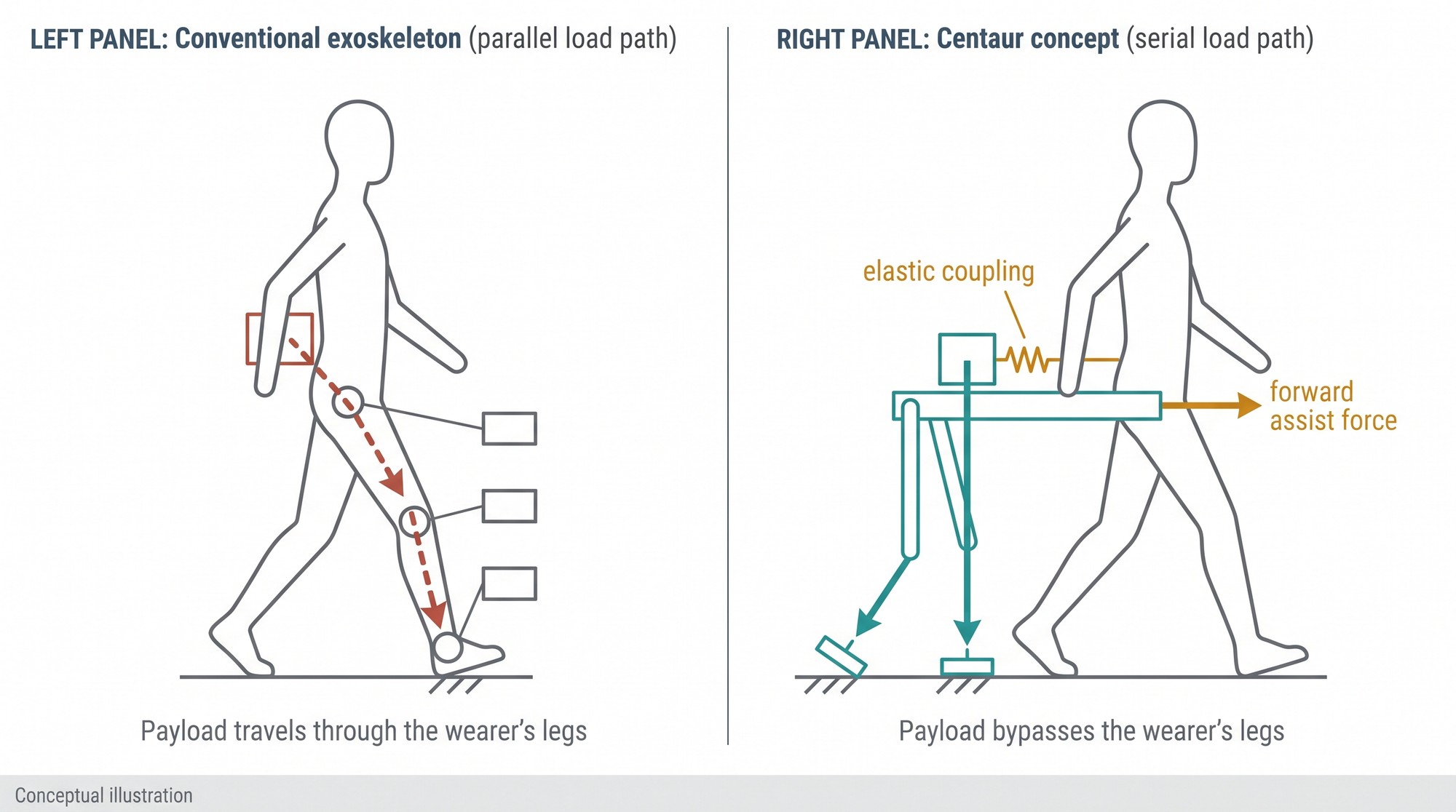
That shift has a cost. A rear-mounted machine changes the shape of the wearer’s envelope: it must handle stairs, slopes, tight turns, and uneven ground while staying out of the way, and its own balance problem is harder than a static frame’s because it is a two-legged robot with a payload and a person attached. The control stack exists precisely to solve that harder problem. The team’s locomotion-interaction framework optimizes ground reaction forces with model predictive control and adjusts joint torques with whole-body control, while a terrain-adaptive swing-leg controller uses the depth camera to plan foot placement over steps, slopes, and loose surfaces.
There is a wider lesson here that extends beyond this one device. Legged robots have spent a decade getting very good at exactly the component skills this task demands: rapid gait generation, disturbance rejection, and foot placement on hostile ground. Research platforms such as MIT’s Mini Cheetah pushed those capabilities forward as a matter of agility for its own sake. The Centaur is a sign of what happens when that capability is redirected at human endurance instead.
Centaur Robot vs Conventional Exoskeleton: A Direct Comparison
Both approaches aim to reduce the cost of moving a load. They differ in where the load goes, what the wearer still has to do, and which jobs each is actually suited to.
| Dimension | Conventional load-carrying exoskeleton | Centaur robot (decoupled legs) |
|---|---|---|
| Load path | Payload to trunk frame, then through the wearer’s pelvis and legs to the ground. The human remains the structural member. | Payload to robotic torso, down independent robotic legs, directly to the ground. The human is no longer in the vertical load path. |
| Where assistance is applied | Joint torque at hips, knees, or ankles, or trunk support that bypasses part of the spine’s load. | Vertical support at the back interface plus a horizontal forward force through the body’s center of mass. |
| Added mass position | Below the waist and often near the shank and foot, where added mass penalizes swing most. | Concentrated behind the wearer on its own legs, which carry their own weight. |
| Metabolic cost | Modest net savings in load carriage, and the device’s own mass can cancel part of the benefit; savings vary widely by device and task. Even strong joint-level assistance results, such as a simulation-trained hip exoskeleton that cut metabolic rate by 24.3% while walking, were measured without an added payload. | 35.16% ± 4.95% lower net metabolic cost than a backpack in the reported trial (n = 5, 20 kg, treadmill). |
| Wearer constraints | Rigid segments aligned to the wearer’s joints, so fit and joint-axis alignment are critical; gait can be constrained by the machine’s kinematics. | Elastic interface and no leg attachment, so the wearer’s gait is not forced; the machine must instead keep its own footing and stay clear of the wearer. |
| Stairs and uneven ground | Assist is tied to the wearer’s own foot placement, which is an advantage on irregular terrain. | Requires terrain perception and independent foot planning; the team demonstrated stairs, slopes, grass, and gravel, but the robot must remain balanced while doing it. |
| Where it fits best | Rehabilitation, gait retraining, factory and overhead work, and users with impaired strength who need help moving their own limbs. | Prolonged load carriage in unstructured environments: logistics, field research, emergency response, disaster relief. |
| Maturity | Commercial products exist across industrial and medical markets. | Research prototype. Not commercially available, and no price, endurance, or production specification has been published. |
The table also clarifies where the comparison is unfair to exoskeletons. A rehabilitation exoskeleton is not trying to save a healthy person energy; it is trying to move a limb that cannot move itself, and no rear-mounted robot leg can do that job. Devices built for the same industrial and medical markets, such as the full-body powered suits used for heavy lifting, solve a different problem again: they amplify strength during lifting tasks, not endurance during walking. The Centaur is aimed at a narrower problem: an able-bodied wearer who must transport weight, repeatedly, over ground that wheels cannot handle.
The Elastic Coupling, Explained
Decoupling is easy to describe and hard to build. A rigid connection would make the two systems fight: as the wearer’s pelvis rises and falls, a stiff link would transmit every jolt, and as the robot’s legs cycle at their own phase, they would tug at the spine. A purely free connection would be no better, since the robot could drift away and deliver no assistance.
The team’s solution is a passive elastic element whose stiffness changes with load. At small displacements it behaves like a stiff element, so the robot’s assistance is responsive and the wearer feels a prompt push. Under larger forces it becomes compliant, absorbing the peaks rather than passing them through the body. This nonlinearity is what allows one physical interface to serve two contradictory roles: a stiff transmission when you want force and a soft one when you want forgiveness.
In the reported hardware the element is a diamond-shaped linkage working against opposed springs, oriented so the compliance runs along the horizontal axis of travel. The diagram below abstracts that arrangement into the two behaviors it has to reconcile.
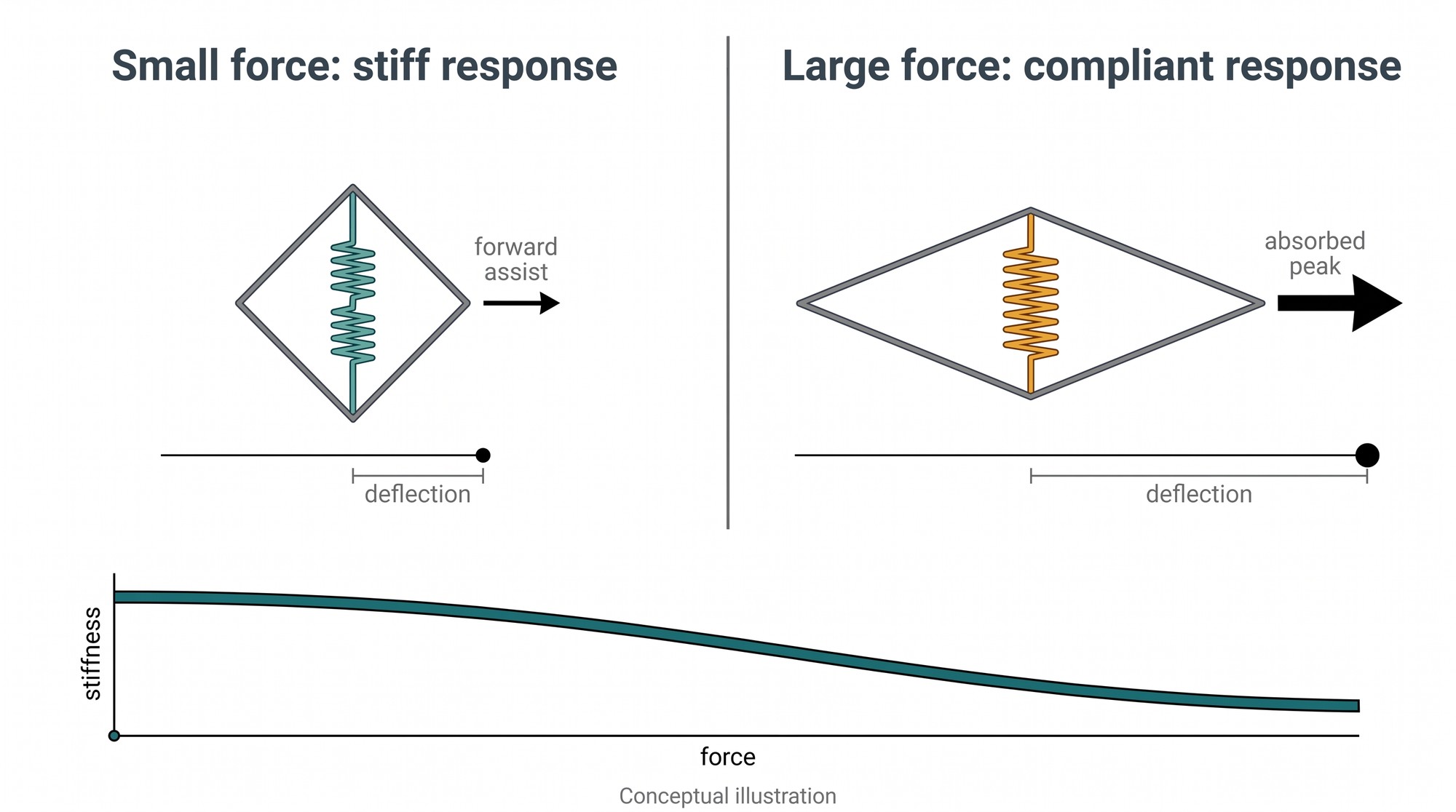
Because the coupling is passive and the robot is a separate dynamical system, the control problem splits neatly. The robot maintains its own balance, plans its own steps, and shares the load; the human chooses direction, pace, and route. Neither has to model the other perfectly, which is a far more forgiving architecture than one that demands continuous synchronization between human and machine at every joint.
What It Can and Cannot Do Yet
The paper demonstrates capability across a range of everyday conditions, and its own framing of what remains unsolved is as useful as the results.
What the researchers showed:
- Load carriage on a treadmill at 20 kg with a measured load-sharing ratio above half.
- Adaptation to changes in the wearer’s walking speed and direction, without a fixed gait to follow.
- Traversal of stairs, slopes, grass, gravel, and dirt, with the swing-leg controller adjusting foot height and torso pitch.
- Maneuvering in confined spaces, including tight turns and figure-eight paths between markers, which is where a rear-mounted machine is most likely to foul the wearer.
What remains open:
- The compliant travel is horizontal only. Multi-axis coupling would let the interface yield in more directions, and the authors identify this as future work.
- The forward assistance force is currently constant rather than tuned to terrain and gait phase, so there is room to make the push smarter.
- Efficiency over hours, not minutes, is untested in the published results. Battery endurance governs whether a machine like this is useful on a twelve-hour shift, and no figure appears in the abstract.
- Five participants means the confidence intervals are wide, and the results do not establish how the device performs across body sizes, fitness levels, or ages.
The rig is also a research platform, not a product. There is no purchase price, no release date, and no published specification for runtime or payload ceiling. Anyone encountering claims that the Centaur robot is on sale, on the market, or in military service is looking at coverage that has outrun the evidence.
Why Adding Legs Beats Powering Knees
The conventional answer to load carriage has been to make the human leg stronger. The Centaur’s answer is to stop asking the human leg to carry the load. This is a genuine change of frame rather than an incremental improvement, and it comes at a moment when two trends make it practical: legged robots can now handle rough terrain in real time, and lightweight structures make a backpack-sized chassis feasible.
But the strongest argument for the architecture is arithmetic. A parallel device must produce enough torque at the joint to matter while carrying its own mass to the joint it is trying to help. Its benefit arrives as a subtraction: assistance minus the metabolic cost of hauling the hardware. A serial device avoids the subtraction on the wearer’s side entirely because the hardware walks on its own feet. Whether that advantage survives a full working day, a heavier load, or a muddy hillside is precisely what the next round of studies needs to determine.
The line between a tool you wear and a partner you walk with is thinner than it used to be. If the Centaur’s core idea holds up outside the laboratory, it will not be because engineers finally built a stronger exoskeleton, but because they stopped building an exoskeleton at all.
Frequently Asked Questions
Has the Centaur robot been built, or is it a concept?
It has been built and tested. The work was published in the International Journal of Robotics Research, and the evaluation includes a controlled load-carriage experiment. It is a laboratory research prototype, not a commercial product.
Can you buy a Centaur robot?
No. No company has announced a product, no price has been published, and there is no release schedule. Coverage suggesting otherwise, or placing the device in warehouses or military units, is not supported by the paper.
How heavy is the device, and how long does its battery last?
Neither figure is established in the published abstract, so neither is stated here. Both matter enormously for real-world use, and both should be treated as unknown until the authors or a manufacturer publish them.
Is the Centaur robot an exoskeleton?
It is a wearable robot, but not an exoskeleton in the usual sense. An exoskeleton attaches structures to the body that work alongside the wearer’s limbs. The Centaur adds separate limbs and takes the load off the wearer altogether.
How much energy does it actually save?
In the reported trial, 35.16% less net metabolic cost than carrying the same 20 kg in a regular backpack, with a standard deviation of 4.95 percentage points. That was measured over a five-minute treadmill walk with five participants.
What is the Centaur robot used for?
Nothing yet, in a commercial sense. The intended applications are load carriage where wheels fail: logistics on foot, field research, firefighting and rescue, and disaster relief. Military use has been speculated about in coverage, but no deployment has occurred in the published work.
Could this replace a robot dog or a wheeled carrier?
The researchers argue it fills a gap between them. Autonomous load carriers struggle to navigate unfamiliar terrain reliably and lose range as payload grows, while wheels and carts fail on stairs and rough ground. The Centaur borrows the human’s route-finding and adds robotic legs that can climb. For flat warehouse floors, a cart or an autonomous platform remains the simpler answer.
The Bottom Line
The Centaur robot is a well-motivated provocation: if the goal is to help a person carry weight, stop routing that weight through the person’s legs. Its measured 35% energy saving comes from a small, controlled trial against a backpack, so it is a strong early result rather than a settled capability. On the evidence available, the design argument is more compelling than the raw numbers.
What makes it worth following is what it implies about wearables in general. The most effective way to augment a human may not be to push harder on the joints that are already working but to change the arrangement of the load entirely.


