
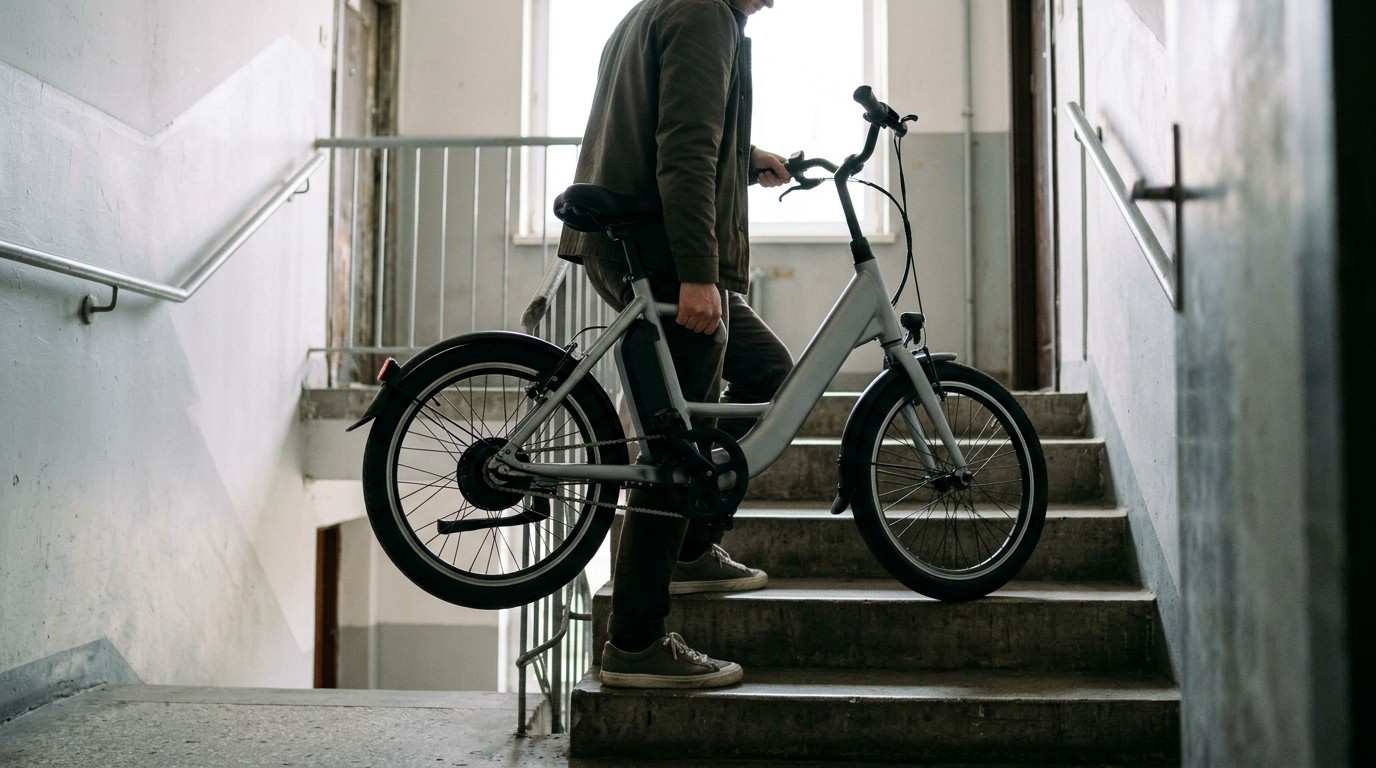
The office is three miles away. The route is manageable, there is somewhere to lock a bike, and riding would fit neatly into the morning. The awkward part is the flight of stairs between the apartment and the street. Whatever happens on the road, those stairs have to be dealt with twice a day.
This is where the weight of an electric bike becomes more than a line on a specification sheet. Motor assistance helps once a rider is turning the pedals, but it does nothing to carry the bicycle down a staircase or turn it sideways through a narrow doorway. Those small movements can influence whether cycling feels convenient enough to become a habit.
Searching for the lightest ebike is an understandable response. Before comparing numbers, though, it helps to identify exactly where weight causes a problem. Lifting, pushing, riding, and storing a bicycle place different demands on its design. A useful purchase starts with understanding which of those demands occurs most often in your day.
The Hardest Part of a Short Ride May Happen Before It Starts
Consider two people making the same commute. One rolls a bicycle out of a ground-floor garage. The other lifts it over an entrance step, carries it downstairs, and negotiates a door that swings shut. Their riding distances may be identical, but the work of owning and moving a heavier bike will be quite different.
For the second rider, reducing weight addresses a repeated physical task. It may also make the bicycle easier to retrieve when it is parked behind another bike or needs moving to reach something in a shared storage area. These are modest advantages individually. Their importance grows when the movements are repeated every morning and evening.
The layout matters as much as the scale reading. A long bicycle can be awkward on a small landing even when it is relatively light. Handlebar width, frame shape, and the room available to turn all affect the task. Removing a battery may reduce the weight of one lift, but it also creates another item to carry and potentially another trip upstairs.
Before shopping, walk through the route from the storage space to the street and note where the bike must leave the ground and where it only needs to be pushed. That walk makes it easier to distinguish a weight problem from a space problem and to judge which of the two a given design actually addresses. A broader e-bike buying guide can help frame the same questions before any model is compared.
What Does the Quoted Weight Actually Include?
A weight figure is useful only when you know what was weighed. Check whether the stated number includes the battery and pedals, which frame size it describes, and whether accessories shown in photographs are part of that configuration. Comparing a bare bicycle with a fully equipped commuter can produce a misleading impression.
Then account for what you will add. As a simple illustration, a 14 kg bicycle, a 2 kg lock and 3 kg of belongings create a combined load of 19 kg. You may carry the bag separately, but those belongings still need to reach the street. The example is hypothetical; its purpose is to distinguish the advertised bicycle weight from the load you handle each day.
This does not make a lighter frame irrelevant. Saving weight on the bicycle reduces the part of the load that accompanies every journey. It does mean that a small difference between two models deserves to be considered alongside their equipment: a bike supplied with commuting accessories may be closer in ready-to-ride weight to a stripped-back alternative than the headline figures suggest.

Think about the return trip, too. A morning ride with a laptop may become an evening ride with groceries. Where those items sit affects how you handle the bicycle while walking and parking. The lightest option on paper still needs a suitable, manufacturer-approved way to carry what your routine requires.
How Engineers Reduce Weight—and What Still Needs to Work
An electric bicycle’s weight is distributed across its frame, wheels, motor, battery, and many smaller components. Reducing it is a design exercise involving the whole machine. A carbon frame can contribute to a lighter build, but frame material alone cannot tell you what the complete bicycle will weigh or how it will ride.
Fiido’s lightweight ebike range includes the Air, which pairs a carbon-fiber frame with a compact electric-assist system. Fiido lists the model at 13.75 kg, or 30.3 lb, which makes it an example of a full-size bicycle built around low overall weight rather than around a small folding package.
Battery selection is another part of the design equation. More stored energy generally involves additional battery mass, although construction and cell technology also matter. Bosch, which publishes the energy content and weight of each of its packs, lists frame-mounted batteries from roughly 2.2 kg at about 400 Wh up to roughly 3.9 kg at about 800 Wh, so the gap between a small and a large pack is a measurable share of the whole bicycle. For a rider making short trips with convenient charging, that extra capacity may offer little practical return. A longer route, steep return climb, or limited charging access can change the calculation.
The sensible starting point is the complete journey, with an allowance for variation, because range cannot be predicted precisely. Assistance level, speed, gear use, tire pressure, gradients, surface, wind, temperature, and the combined weight of bike, rider, and luggage all affect energy use. Choosing a smaller battery solely to reduce weight can therefore become inconvenient if it leaves insufficient reserve for the rides a rider regularly makes. Equally, buying capacity for an exceptional journey means carrying that capacity on all the ordinary ones.
Other components deserve the same scrutiny. Fenders have a purpose on wet roads. A compatible rack can make carrying a work bag more practical. Stripping useful equipment to reach a lower weight figure can leave the owner adding it back later. Good lightweight design keeps the functions the rider needs while controlling the weight required to provide them.
What a Lighter Bike Changes During an Ordinary Day
The clearest difference often appears while the bicycle is stationary. Lifting it over an entrance step or moving it into an indoor parking space requires the rider to handle its mass directly, and a lighter machine asks less of the person doing that work. The trade-off is that reduced weight does not shrink the space a full-size frame occupies, so a bicycle that is easy to lift may still be awkward to store.
Once riding, the experience becomes more complicated. The motor, steering geometry, tires, riding position, and distribution of weight all contribute. A lighter bicycle does not automatically offer better grip or comfort, and reducing bicycle weight changes only part of the combined mass of rider, luggage, and machine. A few kilograms saved may be more noticeable during a lift than during an assisted cruise along a level road.
Sensors are a separate consideration. A torque sensor measures pedal effort so the assistance system can respond to the rider’s input, and it concerns how power is delivered rather than how much the bicycle weighs. A belt drive, such as the Gates CDN fitted, addresses a different part of ownership by removing routine chain lubrication while still requiring appropriate inspection and care. These features deserve to be assessed on their own terms rather than treated as consequences of a low weight figure.
Storage introduces another distinction. A full-size, non-folding layout means that lower weight does not remove the need for adequate parking space. A buyer who can lift the bicycle comfortably still needs somewhere it fits. If the main obstacle is the length of a storage cupboard, folded dimensions may deserve more attention than a small difference in mass.
Charging can also determine where the bike must go. Establish whether a model’s battery is intended for routine removal and where charging is permitted before deciding where to store it. Moving a bicycle to a suitable charging location is part of the ownership routine, just as much as taking it out for a ride.
Choose the Weight That Fits Your Routine
When choosing an ebike, the parts of the journey that involve lifting, pushing, or storing it deserve as much attention as the miles spent riding. Writing down where the bicycle leaves the ground, where it is parked, and where its battery is charged gives a clearer basis for comparison than a list of models. The right balance depends on which tasks repeat most often and which ones are currently difficult.
Use a test ride to investigate those tasks. With the retailer’s permission, try lifting the bicycle, walking it through a doorway, and positioning it as you would in storage. Check the fit and your ability to control it comfortably at low speed. A bicycle that feels manageable to someone else may still be awkward for you, regardless of its published weight.
On the road, ride the kind of gradient encountered regularly. Check how the gearing and assistance work together rather than assuming a lighter bicycle will make every hill easy, and note that a higher assistance setting uses more energy under otherwise constant conditions. Ask about servicing, replacement parts, and any accessory a rider intends to use.
The search for the lightest ebike becomes more useful when it leads to these specific questions. For someone facing stairs twice a day, that recurring lift is the variable worth weighing most heavily. Another rider may reasonably accept more weight in exchange for equipment or battery capacity used regularly. The practical test is whether the finished bicycle fits the journey, from taking it out in the morning to putting it away at night.


