Last year, The Massachusetts Institute of Technology (MIT) created the Cheetah 3 robot that could leap and gallop across rough terrain, climb a staircase littered with debris, and quickly recover its balance when suddenly yanked or shoved, all while essentially blind.

The 90-pound mechanical beast nimbly “feels” its way through its surroundings in a way that engineers describe as “blind locomotion,” much like making one’s way across a pitch-black room. It was designed intentionally to be able to maneuver without relying on cameras or any external environmental sensors.
The robot’s designer, Sangbae Kim, associate professor of mechanical engineering at MIT says:
“There are many unexpected behaviors the robot should be able to handle without relying too much on vision. Vision can be noisy, slightly inaccurate, and sometimes not available, and if you rely too much on vision, your robot has to be very accurate in position and eventually will be slow. So we want the robot to rely more on tactile information. That way, it can handle unexpected obstacles while moving fast.”
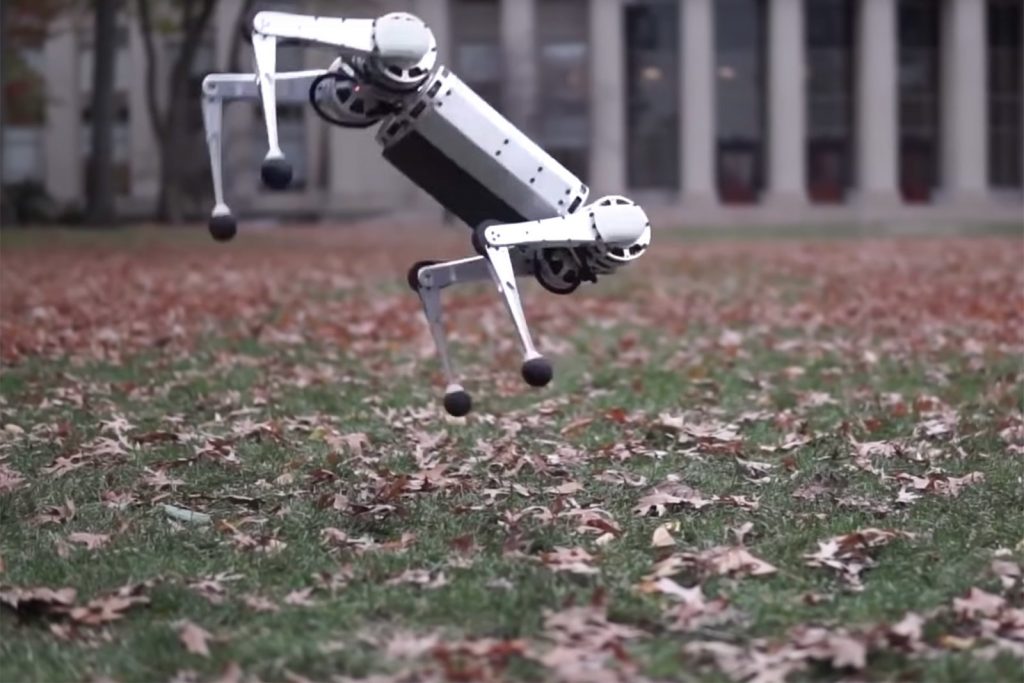
This year, MIT’s robotic cheetah 3 has gained a new sidekick – the Mini Cheetah. This little four-legged galloping droid is much smaller, lighter, and agile with a few new impressive tricks of its own. Cheetah 3’s mini-me is an acrobat with smooth natural movements and the ability to perform a gracefully executed backflip.
The Mini Cheetah is only 20 lb (9 kg). The Cheetah 3, on the other hand, is drastically larger in comparison at 90 lb (41 kg) – making it the size of a fully developed large dog. Both versions can trot along untethered terrain to cover the ground at 2.45 meters per second, however, the Mini Cheetah with its smaller frame has more impressive agility overall. It can spin around on the spot, land upright when dropped from a height, maintain its balance when kicked by a human, pick itself up again when pushed over, and most impressively, it can perform a perfect backflip from a standing start on flat ground.
As amazing as it is to be amused watching these robots flip and run around, they are actually intended to serve a greater purpose. Their creators envision that, within the next few years, these robots will be carrying out tasks that would otherwise be too dangerous or inaccessible for humans to take on.
With their ability to blindly make their way up staircases and through unstructured terrain, as well as their ability to quickly recover their balance in the face of unexpected forces – in combination with extreme agility – they will be perfect for exploring disaster zones and other dangerous or inaccessible environments. These robots were designed to do versatile tasks such as power plant inspection, which involves various terrain conditions including stairs, curbs, and obstacles on the ground.
Kim says:
“I think there are countless occasions where we [would] want to send robots to do simple tasks instead of humans. Dangerous, dirty, and difficult work can be done much more safely through remotely controlled robots.”