
On October 15, a Chongqing company called Dawa Technology walked onto a stage in Suzhou, pointed a live camera at an ordinary office, and turned the room into a hand-drawn summer meadow without moving the furniture. The product behind that demo, Scenes AI, took the excellence award at the mid-term round of the 2026 NVIDIA startup showcase, an event that drew more than 580 applicants and advanced 30 NVIDIA Inception members to the stage.
The number that matters is the operating point: a model with 34 billion parameters, of which roughly 4 billion are active per step, maintaining an editable world at 720p and 25 frames per second on a single consumer GeForce RTX card, with no cloud compute in the loop. Chinese tech outlet QbitAI reported that the card was an RTX 5090.
Every figure in this story is Dawa’s own, and none of it has been independently reproduced. What can be examined is the architecture, and that is where the real argument sits.
From Next-Frame Guessing to a World That Keeps Running
Video diffusion models are frame predictors. They look at what came before, guess what the next image should look like, and then guess again. That approach works until something in the scene has to be remembered, because the model has nowhere to store a memory except the frames themselves, and each new frame quietly overwrites the last one.
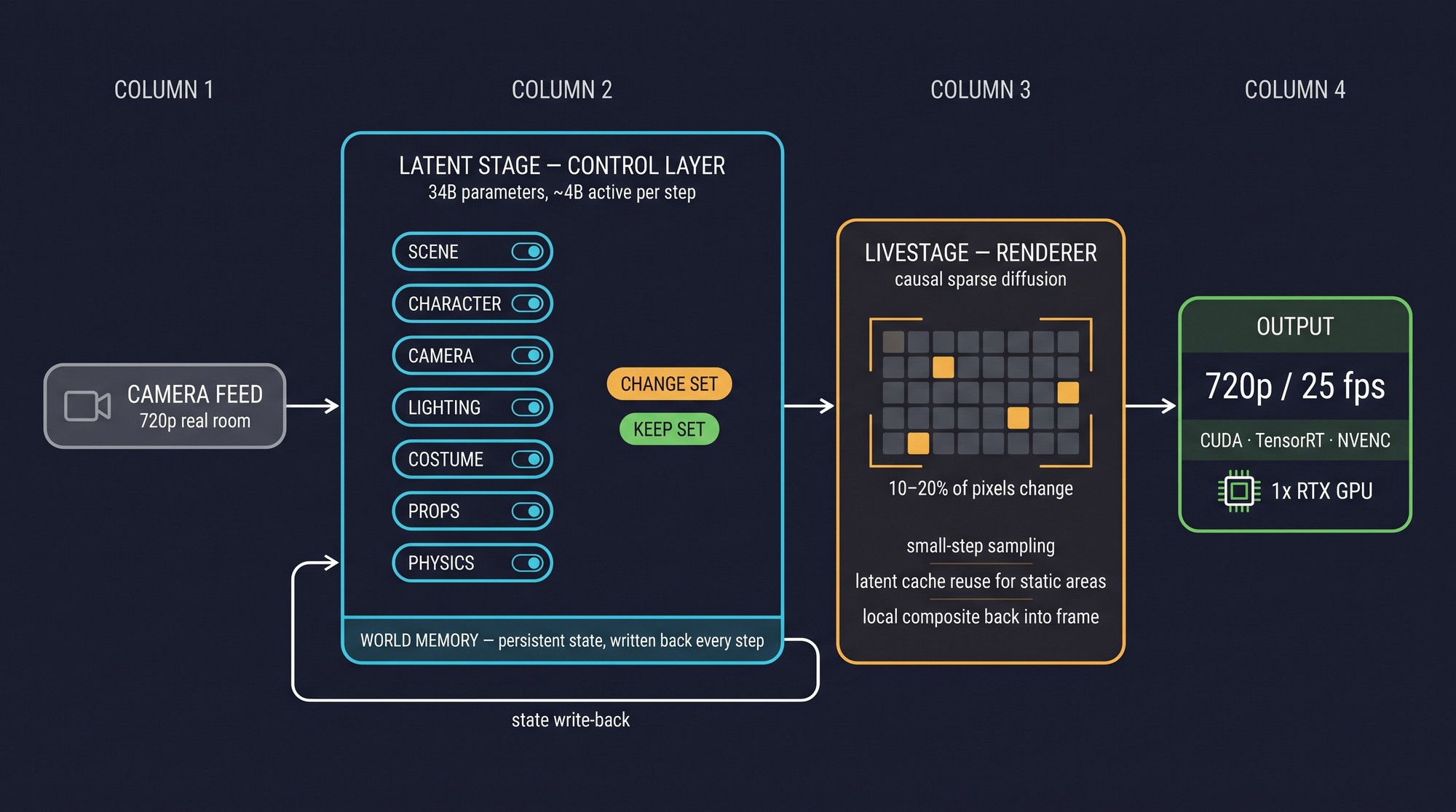
Scenes AI takes a different route. It maintains a persistent world state in which scene, people, camera, lighting, objects and physics are separate variables that can be read and written independently. When something changes, the model computes an update for the part that changed and writes it back, leaving everything else alone.
The demos make the difference visible. In September’s launch footage, a floor collapses and a yeti climbs out and leaves, but the hole stays exactly where it was dug. An iron chair is rewritten twice, first into a red spiked seat and then into a wolf-headed throne, and the presenter can sit back down in the same spot. A curtain hem catches fire, and the flame climbs the fabric, while the plush toy and flowerpot beside it remain untouched. At the end the whole office becomes a meadow, with the air conditioner, curtains and cabinet still in their original positions.
That is a different engineering problem from producing a convincing clip. As Dawa’s chief product officer Li Zongxing framed it at the Suzhou event, video generation answers what the next frame looks like, while a world model has to answer how the world evolves when a single variable changes and which parts are supposed to stay the same.
A Heavy Control Layer and a Light Renderer
Dawa describes its design as a heavy control layer sitting above a light generation layer. The control layer plans, holds state and reasons about consequences. The renderer only draws what a state change requires.
Latent Stage is where the world lives
The control layer is built around a module called Latent Stage, which Dawa also refers to as its Scene Foundation Model. This is where the parameters actually sit, rather than in the renderer. Inside a shared latent space, it separates the world into individual stages that can evolve alone or under joint constraints.
Every edit carries an explicit change set and keep set. Adjust the lighting and the scene; the person and the camera position are locked. Change the costume, and the person’s identity and body motion stay constrained. On top of that sit physics constraints for rigid bodies, cloth, fluids and particles, so a curtain behaves like fabric rather than a texture sliding across a plane.
LiveStage redraws only what moves
Dawa’s analysis of more than 300 real commercial shoots found that in a typical shot only 10 to 20 percent of the frame actually changes from one frame to the next. Walls, floors and static background get cached in latent space and reused outright, while compute concentrates on faces, hands, cloth, smoke, light and anything a person touches.
LiveStage handles that as a causal sparse micro-diffusion renderer. It receives conditions from the control layer, including event type, position, velocity, intensity, object identity, material and local history, samples only the changed regions with a small number of steps, and composites the result back into the persistent frame. Causal here means each step depends only on what has already happened, which is what allows streaming output instead of batch rendering.
The stack runs on CUDA for training and inference, TensorRT for inference optimisation, and NVENC for real-time video encoding. Dawa reports that the combination cuts GPU consumption by 40 to 60 percent and speeds inference three to five times compared with conventional video diffusion. In continuous editing tests it claims a 98.2 percent success rate for targeted edits and 93.3 percent identity retention for people.
The Arithmetic Behind 34B Parameters on a 32GB Card
The headline specification deserves a closer look, because a 34B model and a consumer graphics card are not an obvious pairing. A 34 billion parameter model stored in bf16 needs about 68GB, and even at FP8 it needs about 34GB. The RTX 5090 has 32GB of GDDR7. The weights therefore cannot be sitting in video memory at full precision.
There are only two sensible ways around that ceiling: quantise the weights to roughly four bits, which lands around 17GB, or stream inactive parameters from system memory. Dawa has not said which it uses. This is not a contradiction in the claims, but it is the deployment detail that decides whether the demo machine is an ordinary desktop or a carefully tuned one.
The bandwidth maths is friendlier. Reading 4 billion active parameters once in bf16 moves about 8GB, and doing that 25 times a second works out to roughly 200GB of traffic per second, against 1,792GB/s of memory bandwidth on the card. Halve the precision, and the figure halves with it. The margin is real, but it is not generous once latents, caches and video encoding share the same memory bus.
The frame-level arithmetic explains the rest. A 720p frame is 921,600 pixels, so a change region that small means the renderer is genuinely computing somewhere between 92,000 and 184,000 pixels per frame and reusing the other 80 to 90 percent.
The Data Comes From a Film Studio, Not the Internet
Dawa’s explanation for why it can do this at all is data rather than architecture. It operates an 84,000 square metre digital production base in Yongchuan, Chongqing, which the company describes as the only virtual production stage in China running above 90 percent utilisation. From more than 300 commercial productions it has accumulated about 180TB of what it calls structured world-state data: camera movement, actor motion, lighting changes, spatial geometry, object relationships, physics and narrative state.
The distinction it draws is between video data and process data. An internet video records the pixels that were finally shown. A film set records how the shot was lit, how the camera moved and why the scene ended up looking the way it did, which is the information a world model needs if it is going to reason about causes instead of correlations.
“We shoot real films and short dramas every day. Every time we light a set, every camera move, it tells the model how this world works,” said co-founder Chen Liang, translated from Chinese.
That production business is also where the money comes from. Dawa was founded in 2014 by Lu Qi, and its 2025 revenue passed 100 million yuan, up nearly 300 percent over three years, according to a Pencil News interview with its founder and CTO. It has since closed a round in the region of 100 million yuan, led by Yicun Capital and Baojiehui Innovation Fund, with existing backers Qifu Capital and the Yongchuan state platform following on. The company runs three model tiers, Latent Stage for understanding and constructing a world, CineStage for professional content generation and LiveStage for real-time work, plus two products, the FilmOS production pipeline and Scenes AI.
That naming matters, because English-language coverage tends to use Scenes AI, Latent Stage and LiveStage interchangeably. They are three different things: a control model, a renderer and a product. Dawa says FilmOS cuts the cost of a single short drama by about 40 percent, shortens pre-production on larger projects from four to six weeks down to three to five days and improves budget accuracy by 60 percent. Its virtual production credits include a Bi Gan science fiction feature that took a special jury prize at Cannes last year, according to Pencil News.
Some of the work has outside scrutiny as well. On October 13, Dawa’s AIGC research institute, with Hong Kong Polytechnic University, the University of Illinois Urbana-Champaign and Newcastle University, had a paper accepted at ACM UbiComp/ISWC 2026 on non-linear view matrix fusion for real-time multi-view visual synthesis in virtual production. Across ten categories of production task, including set replacement, relighting and recomposition, the authors report hardware costs down 72 percent and deployment time down 63 percent. That is peer review for the view-synthesis module rather than for the 720p world model, but it is more external checking than most world model announcements attract.
How Scenes AI Compares to Genie 3 and ABot-World-0
The comparison that matters is not parameter count. It is what each model takes as input and what it has to keep consistent while running.
| Model | Developer | Input | Output | Hardware | Access |
|---|---|---|---|---|---|
| Scenes AI | Dawa Technology | Live camera feed of a real room | 720p at 25fps, persistent editable world | One consumer RTX GPU (RTX 5090 reported) | Private, no public demo |
| Genie 3 | Google DeepMind | Text prompt | 720p at about 24fps, up to a few minutes | Google cloud infrastructure | Research preview |
| ABot-World-0 | Alibaba AMAP CV Lab | Keyboard actions | Up to 1280×704 at about 16fps | One RTX 5090, about 19GB of VRAM | Open inference weights (Apache 2.0) |
Google’s Genie 3 is the reference point for most people, and its session limit of a few minutes with roughly a minute of visual memory is the number Dawa is implicitly claiming to beat. Alibaba’s AMAP lab has the most directly comparable engineering result: ABot-World-0 runs a 5 billion parameter causal student on a single RTX 5090 at up to about 16 frames per second and roughly 19GB of memory, with open weights, which makes it reproducible in a way Scenes AI currently is not.
The asymmetry is in the input. Genie 3 and ABot-World-0 generate a world from a text prompt or a keystroke, so consistency only has to hold within their own output. Scenes AI has to parse a real room from a camera feed, track a real person’s face and hands, and keep the chair where the chair actually is, all inside one frame time. That is harder, and it is also why the resolution is 720p rather than something higher. The broader shift from clips to stateful, interactive worlds is the same direction Lightricks’ open LTX-2.5 model is pulling in, and the kind of workload that recent work on running large models on a single GPU makes practical.
What Dawa Has Not Shown
The gaps are worth stating plainly, because the presentation was a pitch and not a paper.
- The 34B parameter split, the 720p at 25fps figure and the 98.2 percent edit result have no published test protocol or baseline definition. The peer-reviewed paper covers a different module, so these remain company claims rather than measurements.
- No weights, no API, no public sandbox and no footage with published latency numbers. The demo ran on hardware Dawa chose, and every primary source is in Chinese.
- Session length is never stated. Error accumulation over minutes is the hardest unsolved problem in autoregressive world models, and the September demo illustrates short edits rather than long uptime.
- 720p is a monitor feed, not a delivery format, and 25fps is short of the 30 or 60 frames per second interactive applications usually want, so this reads as a virtual production preview rather than a final-resolution pipeline.
- An RTX 5090 is a 575W, roughly 2,000 dollar card that has traded well above list price since launch. Consumer hardware is not the same thing as cheap hardware, and no minimum spec has been published.
The Bottom Line
The claim worth taking seriously is not that a 34B model runs on a graphics card. It is that a model can hold a room in memory, change one thing about it, and leave the rest alone, which is the property that separates a video generator from something you could actually build a production around. The 10 to 20 percent figure is the whole trick: if only a fifth of the frame changes, you only have to be fast about a fifth of the frame.
Whether that survives contact with a paying client, an eight-hour livestream or a long day on set is the open question, and Dawa has the unusual advantage of owning the studio where the answer will be found. As Li Zongxing put it, a video can end, but a world has to keep running.

