
LTX-2.5 is Lightricks’ newest open-weights world model, a 22-billion-parameter system that generates synchronized video and audio from text, images, or existing clips. Released on August 11, 2026, it stands out for generating a 10-second 720p video in just 6.8 seconds on its own hardware, supporting native 4K HDR, and keeping character, lighting, and voice consistent across multiple shots in a single pass. This guide explains what LTX-2.5 does, why its parameter size is surprisingly efficient, how its controllability and upscaling work, and how it compares to closed alternatives like Google’s Gemini Omni.
What Is LTX-2.5?
LTX-2.5 is an open world model developed by LTX, the company spun out of Lightricks. Unlike a narrow text-to-video tool, it is built as a foundation for video generation, real-time applications, and physical AI such as robotics simulation. It is available as open weights on Hugging Face, natively integrated into ComfyUI, and accessible through a managed LTX API.
The model is a 22-billion-parameter asymmetric dual-stream diffusion transformer. One stream handles video, a separate stream handles audio, and the two are coupled through bidirectional cross-attention. That architecture allows LTX-2.5 to produce video and synchronized audio together in a single unified pass, rather than generating them separately and stitching them afterward. The approach echoes recent open-weight efficiency wins, such as the 27B Qwen 3.8 rivaling much larger frontier models with smarter architecture rather than brute scale.
Key capabilities carried forward and expanded in this release include:
- Text-to-video, image-to-video, and video-to-video generation with synchronized audio
- Generation at resolutions from 720p to native 4K, at 24 to 50 frames per second
- Clip lengths from 6 to 20 seconds per generation, with support for extensions and retakes
- A split checkpoint design where transformer, text encoder, VAEs, and upscalers are distributed as individual .safetensors files compatible with ComfyUI and Diffusers
LTX describes LTX-2.5 as a stronger foundation rather than a simple feature update. The company reports that the LTX model family has surpassed 33 million downloads, making it the most used open world model line to date.
Why 22 Billion Parameters Punches Above Its Weight
On paper, 22 billion parameters places LTX-2.5 below the largest frontier language models, but for a video world model that must predict pixels, motion, and audio together, the design prioritizes efficiency over sheer scale.
The model uses a custom Gemma 4 12B text encoder that is co-trained with the video transformer. Paired with a dedicated prompt enhancer, it retains complex instructions that include multiple characters, camera moves, lighting changes, and actions without dropping details across a longer sequence. Short prompts are automatically expanded into richer cinematic instructions at minimal extra compute, which improves prompt adherence without requiring users to write verbose descriptions.
Efficiency also comes from quantization and distillation:
- Distilled checkpoint: A fixed 8-step schedule with classifier-free guidance set to 1 retains near-full-model quality while cutting inference steps dramatically. LTX co-optimized this distilled model with NVIDIA for local deployment.
- FP8 quantization: Casting weights to FP8 reduces VRAM usage by approximately 40% with minimal quality loss. On the quantization formats explained by LTX, FP8 is the practical choice for most local deployments today and is natively supported in the codebase.
- NVFP4 for Blackwell: At half a byte per weight, NVFP4 roughly halves the footprint again compared to FP8. A 22B model that needs about 22 GB for weights in FP8 drops to around 11 GB in NVFP4, enabling deployment on smaller Blackwell hardware or with larger batch sizes.
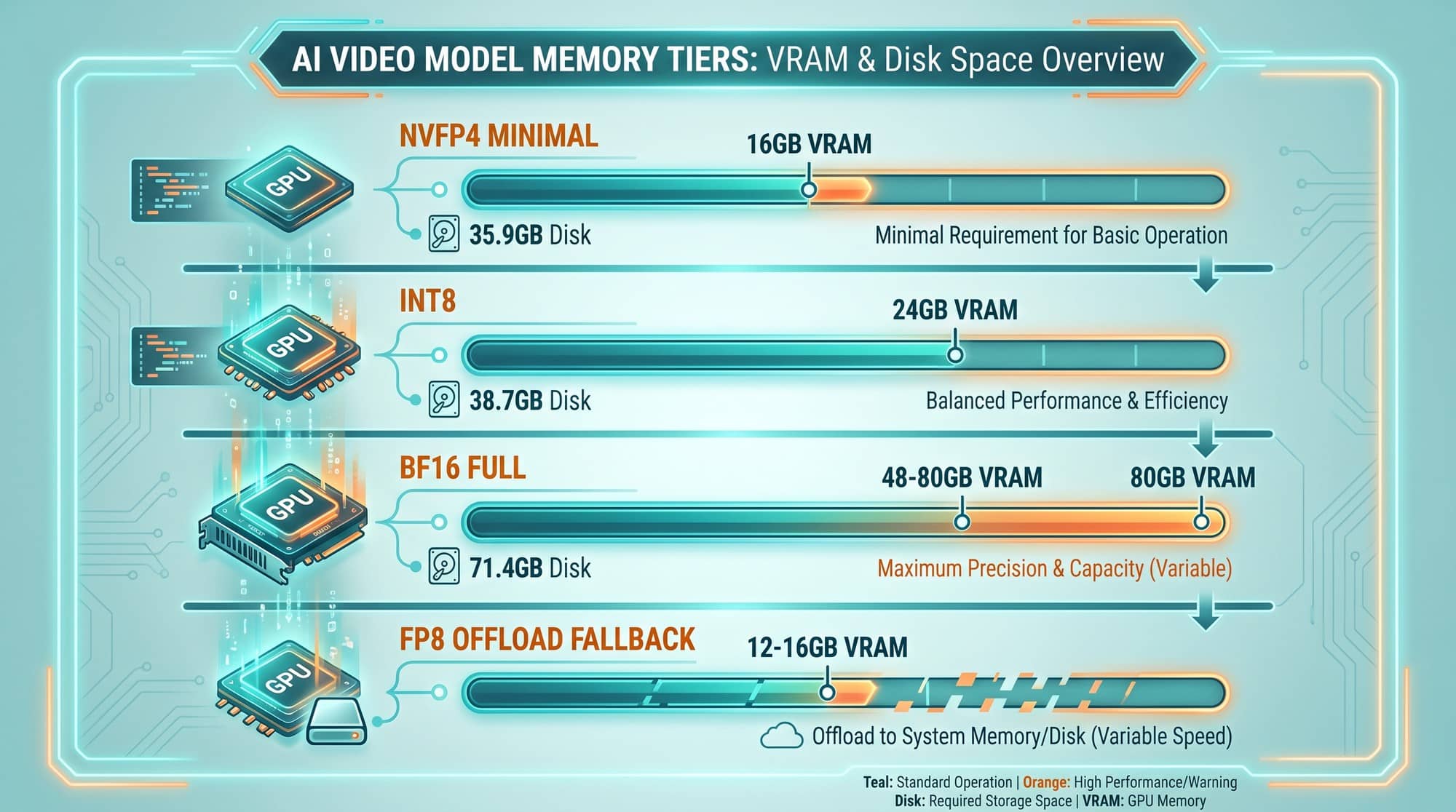
Official guidance lists a minimum of 16 GB VRAM, with practical requirements ranging from 16 GB to 80 GB depending on the chosen checkpoint and quantization. Total download size spans approximately 35.9 GB for the minimal NVFP4 distilled pack to 71.4 GB for the full BF16 set. Community reports suggest an RTX 4090-class 24 GB card as a workable floor for the INT8 configuration, while full-precision operation benefits from A100, H100, or RTX 6000 Ada class hardware.
This tiered approach is central to the LTX-2.5 proposition. Rather than requiring a single massive cluster, teams can select a precision and checkpoint that matches the hardware they already own, from data center GPUs to RTX-class creator desktops and DGX Spark systems.
Diffusion Fidelity Rendering and a New Video Decoder
Two of the most substantial technical changes in LTX-2.5 address image quality where previous video models often falter: fine detail and high-motion stability.
Diffusion Fidelity Rendering
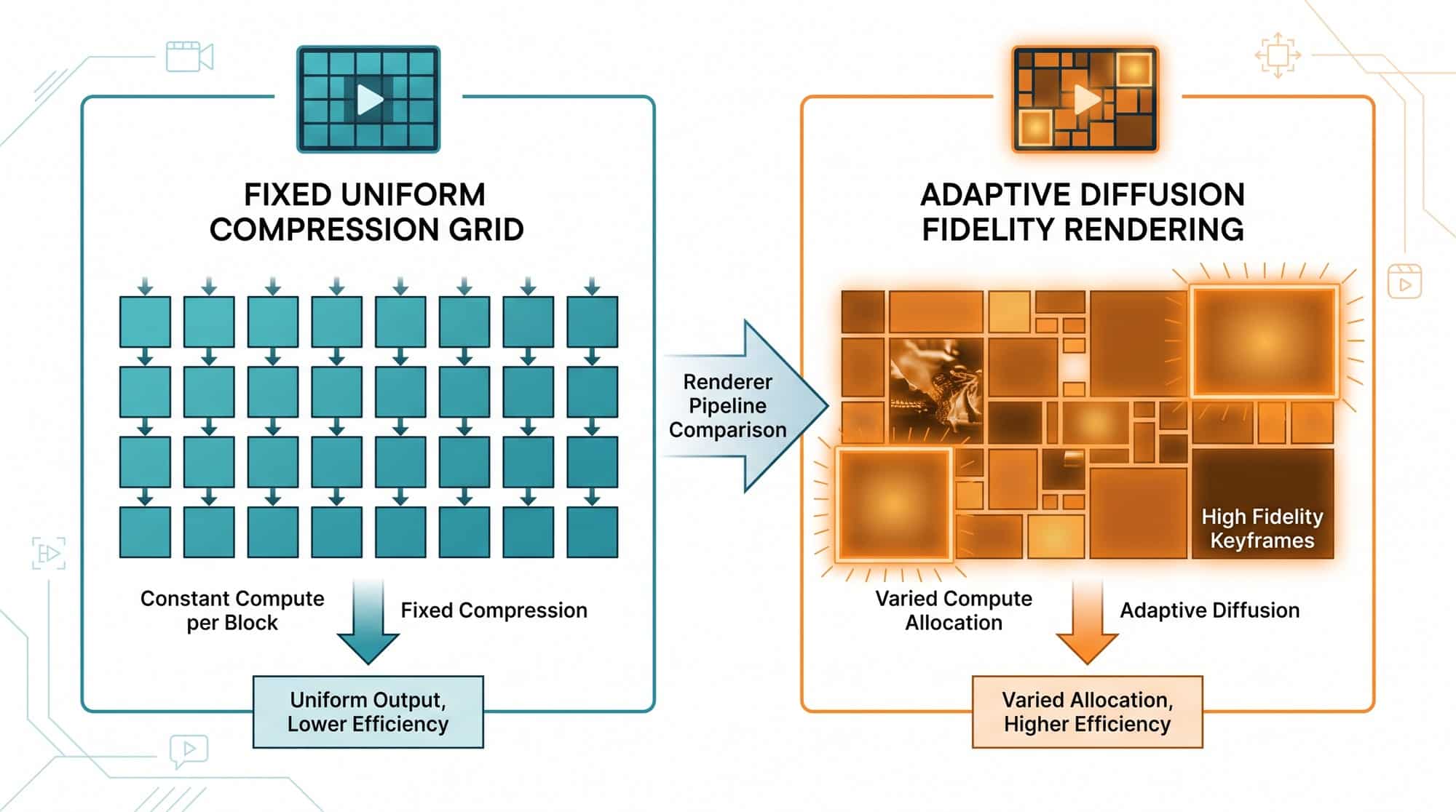
Instead of locking every scene to a single compression rate, LTX-2.5 introduces Diffusion Fidelity Rendering, a technique that allocates rendering compute based on scene complexity. The pipeline builds every scene on a grid of high-fidelity keyframes, then distributes denoising effort where it matters most. Dense textures, hard edges, and small foreground details hold up frame by frame rather than collapsing into soft motion blur or artifacting.
The company positions this as delivering industry-leading pixel quality that holds up even on a cinema screen, and it underpins the model’s cleaner motion profile.
New Diffusion Video Decoder
The traditional VAE reconstruction stage is replaced by a new diffusion video decoder. In practice, this produces sharper faces, textures, and on-screen text, along with smoother, more natural motion and fewer artifacts in demanding scenes. A lighter convolutional VAE remains available as an option for users who prioritize speed or lower VRAM over maximum fidelity, allowing a choice between quality and efficiency at decode time.
Together, these changes contribute to the model’s benchmark performance on artifact suppression. On an automated text-to-video evaluation across 98 identical prompts, LTX-2.5 Pro recorded 0.28 visible glitches per clip, the lowest among ten models tested, with LTX-2.5 Fast at 0.39. For comparison, FLUX 3 scored 0.45, MiniMax H3 0.46, and Google’s Veo 3.1 1.20 on the same test.
Controllability Beyond Regular Video Models
Where many video generators produce a single continuous shot, LTX-2.5 is built for controllable storytelling.
Native Multishot Generation
The headline control feature is native multishot generation. In a single pass, the model can generate multiple connected shots that maintain character identity, environment, lighting, voice, and visual style across cuts. Earlier versions produced one continuous shot; LTX-2.5 renders an entire sequence as a single coherent output instead of stitching individually generated clips together. This addresses a persistent continuity problem where characters or scenes drifted between cuts.
Better Prompt Adherence and Auto Duration
The custom Gemma 4 12B encoder plus prompt enhancer improves handling of complex, multi-subject cinematic instructions. An optional duration predictor analyzes the action described in a prompt and automatically sets the clip length and frame count, rather than relying on a fixed-duration parameter. Generation constraints remain simple: frame counts must satisfy frames modulo 8 equals 1, and width and height must be divisible by 32.
Precise Editing and Fine-Tuning
LTX-2.5 adds beta support for precise editing of existing footage and ships as a pretrained foundation that teams can fine-tune on their own data and domain. A dedicated checkpoint tuned for physical AI and robotics gives groups working on warehouse floors, factory lines, or offshore environments a base that looks nothing like cinematic video. Most LoRAs and IC-LoRAs trained for LTX-2.3, including audio-only steering, ID-LoRA, and 360-degree outpainting, continue to work on LTX-2.5.
Upscaling, Native 4K HDR, and RAW Workflow
Resolution and finishing pipeline support separate LTX-2.5 from models that top out at 1080p compressed output.
The model supports native 4K HDR output at up to 50 frames per second, built for professional review, color decisions, and high-resolution delivery where highlight detail and latitude matter. A native RAW workflow allows teams to generate and edit inside color and finishing pipelines using ACES EXR input and output at 16-bit linear, without compromising the master file through premature compression.
For users who generate at lower resolutions, a latent spatial upscaler provides an upscale-plus-second-pass workflow to recover sharper detail. The official upscaler checkpoint, ltx-2.5-latent-spatial-upscaler-x2-bf16, doubles resolution in latent space before decoding. This is distinct from simple post-process upscaling because the model re-renders detail through the diffusion decoder rather than interpolating pixels afterward.
ComfyUI workflows expose these options directly, with dedicated text-to-video, image-to-video, and first-last-frame templates that include the upscaler as an optional node. The combination of Diffusion Fidelity Rendering, the diffusion decoder, and native 4K HDR output is intended to make generated footage usable in professional post-production with less manual correction.
Speed, Efficiency, and Running Locally
Speed is where LTX-2.5 makes its most quantifiable claim.
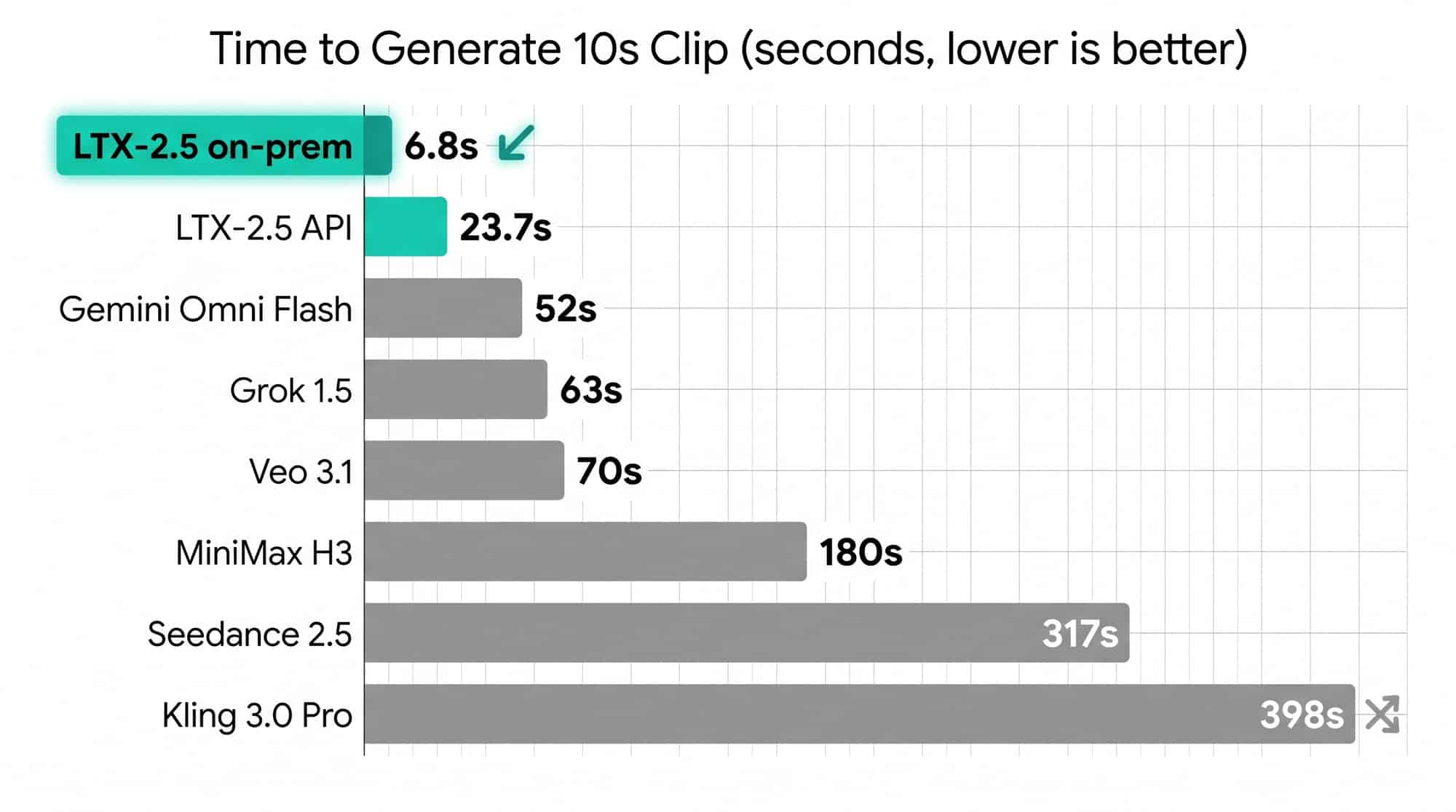
On LTX’s published image-to-video benchmark for a 10-second, 24fps clip, self-hosted generation on two NVIDIA GB200 superchips completes in 6.8 seconds at 720p. That is faster than the clip’s own runtime. Through the LTX API, the same job takes 23.7 seconds end-to-end at 1080p at steady state, a figure measured on fal.run that includes queue time.
By LTX’s end-to-end measurements of competitor APIs on the same task, the nearest closed alternatives are substantially slower:
| Model | Time for 10s Clip | Notes |
|---|---|---|
| LTX-2.5 on-prem (2x GB200) | 6.8 s | 720p, self-hosted |
| LTX-2.5 API | 23.7 s | 1080p, includes queue |
| Gemini Omni Flash | 52 s | Closed API |
| Grok 1.5 | 63 s | Closed API |
| Veo 3.1 | 70 s | 8-second clip |
| MiniMax H3 | 180 s | Closed API |
| Seedance 2.5 | 317 s | Closed API |
| Kling 3.0 Pro | 398 s | Closed API |
That makes LTX-2.5 approximately 7.6 times faster than the nearest closed rival on premises and roughly 58 times faster than the slowest system in the comparison. On the API, it remains the fastest even while rendering at higher resolution than most of the comparison set.
Local deployment is a deliberate part of the strategy. The model is optimized for NVIDIA RTX GPUs and DGX Spark, with the distilled checkpoint and FP8 quantization lowering the practical floor to mainstream creator hardware. Organizations with fewer than 10 million dollars in annual recurring revenue can use the open weights freely under the LTX-2.x Community License, with no per-generation billing and no mandatory branding. Larger companies negotiate a commercial agreement but can still validate workflows locally before committing, keeping intellectual property on their own hardware.
API pricing reinforces the efficiency narrative. The fast variant is billed at 0.09 dollars per second at 720p, 0.13 dollars at 1080p, 0.19 dollars at 1440p, and 0.30 dollars at 4K. The pro variant is 0.12 dollars at 720p and 0.17 dollars at 1080p. Per 10-second clip, that translates to as little as 0.90 dollars at 720p, which LTX frames as roughly one-seventh the render cost of comparable closed models.
LTX-2.5 as an Alternative to Controllable World Models Like Gemini Omni
The world model framing is where LTX-2.5 most directly positions itself against systems like Gemini Omni. Where a large language model predicts the next word, a world model predicts the next moment: it generates an environment, simulates how that environment behaves, and lets a user or agent act inside it.
Gemini Omni approaches this as a managed multimodal platform that lets users generate, edit, and enhance cinematic-quality video through natural language prompts without advanced editing skills. It is powerful and accessible, but it operates as a closed hosted service.
LTX-2.5 offers a contrasting trade. It is an open-weights foundation that teams run on their own infrastructure, fine-tune on their own datasets, and deploy on their own terms, including on-premises, at the edge, or in air-gapped environments. Capabilities that Gemini Omni delivers through a hosted API, such as controllable editing and synchronized audio-video generation, are available locally in LTX-2.5 with the added ability to build custom workflows in ComfyUI, a pattern also seen when FLUX.2 turned generative images into a controllable local workflow, train domain-specific LoRAs, and extend the model for real-time or robotics use cases.
The distinction is not purely philosophical. LTX co-founder Zeev Farbman has argued that video and world models have a far wider surface area of use cases than language models, requiring access to weights and the ability to create flows that work for specific domains. ComfyUI co-founder Yoland Yan frames the LTX-ComfyUI partnership as the open ecosystem’s connection layer, where enterprises can experiment first and license later.
Benchmarks suggest the open approach does not sacrifice quality for openness. In vendor-reported human preference evaluations labeled preliminary, LTX-2.5 achieved a 67 percent win rate, ahead of Seedance 2.5 at 65 percent, Gemini Omni Flash at 55 percent, and FLUX 3 at 28 percent. Independent verification is still pending, but the artifact and speed benchmarks above point to a similar competitiveness.
For creators choosing between the two philosophies, the decision often comes down to control. Gemini Omni offers convenience and Google-scale infrastructure. LTX-2.5 offers ownership, fine-tuning, and deployment flexibility, with performance that on current benchmarks matches or exceeds closed alternatives while keeping generation local and billable per second only when using the managed API.
How to Use LTX-2.5: ComfyUI, API, and Local Setup
LTX-2.5 is distributed through three primary paths, and all lead to the same model family.
ComfyUI (Recommended for Creators)
The fastest way to start is through ComfyUI, which ships with three native workflow templates for LTX-2.5:
- Text-to-Video: Generate from a text prompt, with optional spatial upscaling for higher resolution.
- Image-to-Video: Animate a single input image into a synchronized audio-video clip.
- First-Last-Frame to Video: Interpolate between a starting and ending frame, useful for continuity and transitions.
Setup requires updating ComfyUI to the latest version, requesting access to the gated Hugging Face repository, and downloading the split weight files into the ComfyUI models directory. Generation supports the prompt enhancer, auto duration, and multishot modes directly in the workflow.
LTX API (Managed Generation)
For teams that prefer not to self-host, the LTX API provides managed generation with synchronized audio-video output, multishot support, and up to 4K resolution for the fast variant. Pricing is per second of output, and generation includes the same multishot, HDR, and RAW capabilities as the open weights.
Local Python Pipeline
Developers can run LTX-2.5 locally via ltx-pipelines, which requires Python 3.12 or higher, CUDA 12.7 or higher, and PyTorch 2.7. The repository supports BF16, FP8-cast, FP8-scaled-matmul for Hopper GPUs, and NVFP4 for Blackwell. A typical distilled generation command specifies paths for the transformer, the 12B Gemma text encoder, video and audio VAEs, the spatial upscaler, and the optional duration head.
System requirements scale with precision and mirror the broader shift toward sustainable local AI, where smaller active-parameter models are challenging much larger systems on efficiency. LTX lists official ComfyUI guidance of at least 32 GB VRAM and 100 GB of free disk, with community builds demonstrating quantized operation on 16 to 24 GB cards using FP8 and CPU offloading. As with any large video model, generation time, maximum resolution, and VRAM footprint depend on the chosen weights, VAE, and upscaler combination.
Frequently Asked Questions
How much does LTX-2.5 cost?
There are two cost layers. If you self-host the open weights, there is no per-generation fee: you provide the GPU and run as much as you want. Organizations with under 10 million dollars in annual recurring revenue, including subsidiaries and affiliates, can use LTX-2.5 freely for commercial and production use under the LTX-2.x Community License. Larger organizations negotiate a commercial use agreement. If you use the managed LTX API, pricing is per second of generated video, ranging from 0.09 dollars per second at 720p to 0.30 dollars at 4K for the fast variant.
Is LTX Studio free to use?
LTX Studio, the broader creative platform around the LTX models, offers free tiers for experimentation, but LTX-2.5 itself is governed by the Community License threshold. Under 10 million dollars in annual revenue, commercial use of the open weights is free with no mandatory branding. Above that threshold, a paid license applies. Access to the Hugging Face repository is gated and requires agreeing to share contact information before download.
What hardware do I need to run LTX-2.5 locally?
The official minimum is 16 GB VRAM, but recommended setups vary. The minimal NVFP4 distilled pack at about 35.9 GB total download can run on 16 GB Blackwell-optimized hardware, while INT8 configurations target 20 to 24 GB cards such as the RTX 4090. Full BF16 at about 71.4 GB benefits from 48 to 80 GB cards like the RTX 6000 Ada, A100, or H100. Low-VRAM fallbacks using FP8 cast with CPU offloading can squeeze onto 12 to 16 GB cards at reduced speed.
Does LTX-2.5 generate audio too?
Yes. LTX-2.5 generates synchronized high-fidelity video and audio together in a single pass, holding voice and audio design consistent across multishot sequences. Audio is produced through a separate audio VAE and vocoder coupled to the video stream, rather than added as a post-process.
Can I fine-tune LTX-2.5 on my own data?
Yes. The dev transformer checkpoint is fully trainable via the LTX-2 Trainer. Teams can fine-tune on their own domain data, including non-cinematic environments for robotics and physical AI. Most LoRAs trained for LTX-2.3 remain compatible, though Lightricks advises validating specific checkpoints.
What is the difference between the fast and pro variants?
The fast variant supports up to 4K resolution and 6 to 20 second durations and is priced from 0.09 to 0.30 dollars per second. The pro variant tops out at 1080p and 10 seconds per generation, priced from 0.12 to 0.17 dollars per second, and is tuned for maximum fidelity with the lowest artifact rate at 0.28 glitches per clip versus 0.39 for fast.
Conclusion
LTX-2.5 reframes what a 22-billion-parameter video model can deliver when architecture, quantization, and workflow design are co-optimized. Diffusion Fidelity Rendering and a new diffusion decoder raise pixel-level quality, native multishot and auto duration expand directorial control, and native 4K HDR with a RAW workflow bring generated footage into professional finishing pipelines. Faster-than-real-time on-prem performance and a 16 GB VRAM floor make that capability locally deployable, while open weights and fine-tuning position LTX-2.5 as a controllable world model alternative where ownership matters as much as output. As teams extend it into real-time applications and physical AI, the model’s value will be measured less by any single clip and more by the custom systems built on top of it.


