
Access to safe drinking water remains one of the most urgent challenges of our time. More than two billion people worldwide still lack safely managed drinking water, and climate change, population growth, and pollution are making the problem harder to solve. From simple household filters to city-scale desalination and nature-based purification, clean water solutions now span a remarkable range of technologies that work at every scale. This guide explains how they work, where they shine, and how to choose the right approach for your needs.
Why the World Still Needs Better Clean Water Solutions
The numbers tell a sobering story. According to the World Health Organization’s drinking-water fact sheet, 2.2 billion people still lack access to safely managed drinking water services, and 3.5 billion lack safely managed sanitation. Contaminated water spreads cholera, dysentery, and typhoid, and the WHO and UNICEF Joint Monitoring Programme estimates that unsafe water causes hundreds of thousands of preventable deaths each year.
Three pressures are intensifying the crisis:
- Climate variability: Longer droughts and more intense floods disrupt both surface water and groundwater supplies.
- Urbanization and industrial pollution: Agriculture, mining, and manufacturing release nitrates, heavy metals, and microplastics into waterways.
- Aging infrastructure: Leaking pipes, under-capacity treatment plants, and unregulated wells lose or contaminate water before it reaches taps.
The good news is that innovation has accelerated. The UN World Water Development Report 2024 highlights how decentralized technologies, better membranes, and data-driven management are expanding access even in remote and arid regions. The sections below break those advances into practical categories you can act on today.
Household-Level Clean Water Solutions You Can Use Today
For families and renters, the fastest gains come from point-of-use treatment. These options require little infrastructure and can be deployed in hours.
1. Filtration Systems
- Activated carbon filters: Remove chlorine, odors, and many organic chemicals through adsorption. Found in pitcher filters and under-sink cartridges. Inexpensive but do not remove dissolved salts or most pathogens alone.
- Ceramic and microfiltration membranes: Pore sizes around 0.1 to 10 microns trap bacteria and sediment. Cleanable and long-lasting, popular in camping and emergency kits.
- Ultrafiltration and nanofiltration: Tighter membranes remove viruses and multivalent ions with less energy than reverse osmosis.
- Reverse osmosis (RO): Forces water through a semipermeable membrane to remove salts, arsenic, fluoride, and most contaminants. Highly effective but produces brine waste and needs water pressure or electricity.
2. Disinfection Methods
- Ultraviolet (UV) purification: UV-C light inactivates bacteria, viruses, and protozoa without chemicals. Effective when water is pre-filtered to reduce turbidity.
- Solar disinfection (SODIS): Clear PET bottles exposed to sunlight for six hours can inactivate most pathogens, a WHO-recognized low-cost method for off-grid communities.
- Chemical disinfection: Chlorine or iodine tablets remain vital for emergencies. Follow dosing guidelines to avoid under-treatment.
3. Portable and Emergency Options
- Straw filters and gravity-fed bag filters for hiking and disaster relief
- Solar stills that evaporate and condense water using only sunlight, useful where fuel is scarce
- Compact atmospheric water generators for homes that extract moisture from air, now viable at lower humidity thanks to new hydrophilic membranes
If you are choosing a home system, match the technology to your water test results. Carbon plus UV covers biological and chemical risks in most municipal supplies, while RO is warranted for high salinity or heavy metals.

Community and City-Scale Innovations Transforming Access
Beyond the household, a new generation of decentralized systems is helping towns and cities close the gap without building massive centralized plants.
Atmospheric Water Harvesting
Atmospheric water generators use desiccants or condensation surfaces to pull moisture from air and then filter it to drinking standards. Advances described in the Water Innovation Index 2025 include polymer composites and nano-engineered hydrophilic membranes that lower the humidity threshold for operation. Field trials in parts of sub-Saharan Africa and the Middle East have shown these units can deliver potable water during prolonged droughts with minimal energy input.
Solar-Powered Desalination
Conventional desalination is energy intensive and produces concentrated brine. New solar-thermal desalination systems reduce both problems. By using renewable heat to evaporate seawater and capture the condensate, these plants avoid chemicals and can manage brine more sustainably. Modular designs now let coastal villages deploy units sized for a few hundred to a few thousand people.
Decentralized Treatment and Greywater Recycling
Systems such as the Hydraloop greywater recycling system treat shower and laundry water on site for reuse in toilets, gardens, and washing machines, cutting household freshwater demand by up to 45 percent.

For neighborhoods, containerized treatment pods can be trucked in, powered by solar, and operated remotely with IoT sensors that monitor flow and water quality in real time.
Smart Monitoring and Leak Control
Industrial IoT sensors and satellite analytics detect leaks, track consumption, and forecast demand. Cities using these tools routinely reduce non-revenue water losses by 20 to 30 percent, freeing supply without drilling a new well.
Nature-Based and Low-Tech Clean Water Solutions
Not every breakthrough requires high tech. Nature-based approaches often cost less, use local materials, and restore ecosystems while purifying water.
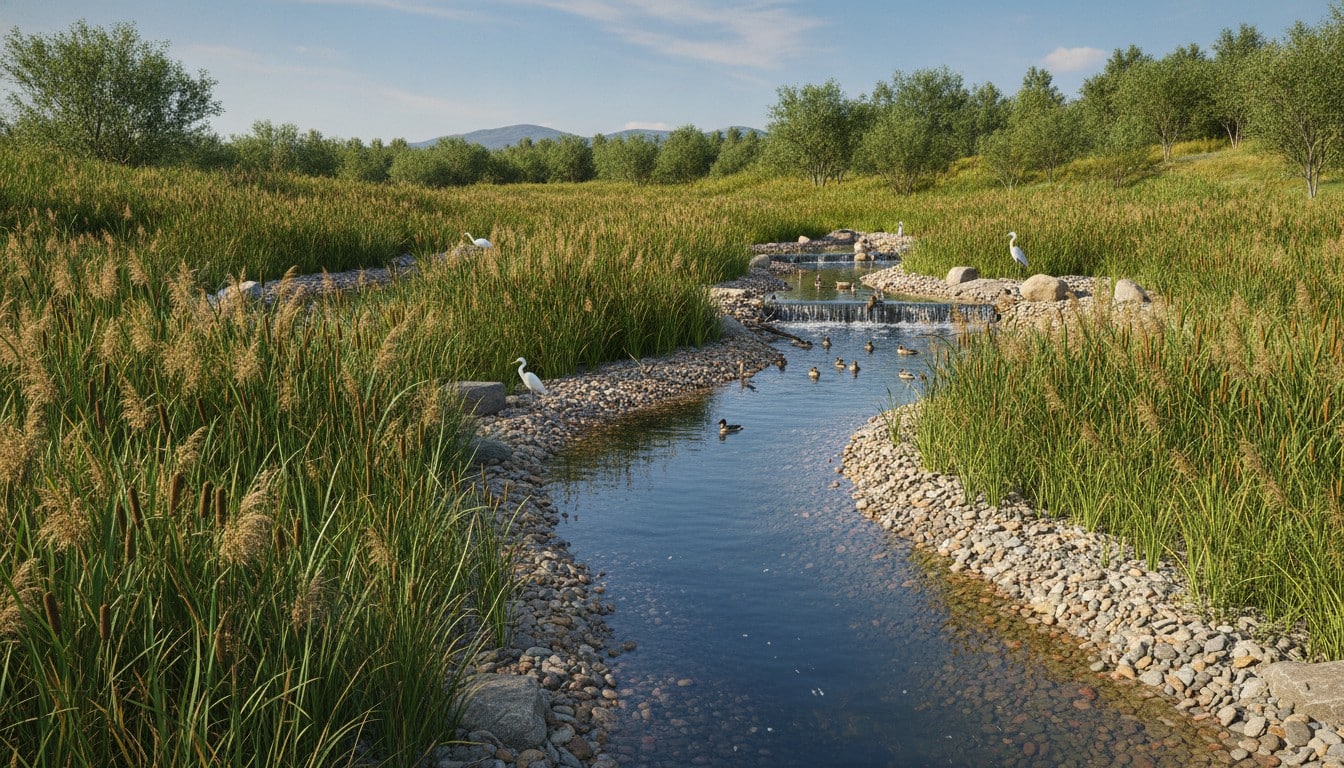
- Constructed wetlands: Engineered marshes with reeds and gravel filter nutrients and pathogens as water flows through root zones. Widely used for municipal and agricultural runoff.
- Biochar and biosand filters: Charred biomass and layered sand and gravel remove turbidity, organics, and some heavy metals. A well-maintained biosand filter can serve a household for years with no electricity.
- 2D-material sunlight purification: Researchers have demonstrated ultra-thin materials that kill up to 99.9 percent of bacteria in water using only sunlight, offering a chemical-free disinfection path for off-grid use.
- Rainwater harvesting and fog nets: Rooftop catchment with first-flush diverters provides seasonal storage, while vertical mesh nets in coastal mountains harvest fog, a technique proven in Morocco, Chile, and Nepal that can yield thousands of liters per day.
- Aquifer recharge: Managed infiltration basins and permeable pavements return rainwater underground, stabilizing supplies for dry seasons.
These methods work best in combination. A village might pair rooftop harvesting for the rainy season, biosand filtration for daily use, and an atmospheric water unit for the driest months.
Choosing the Right Solution: Cost, Scale, and Impact Compared
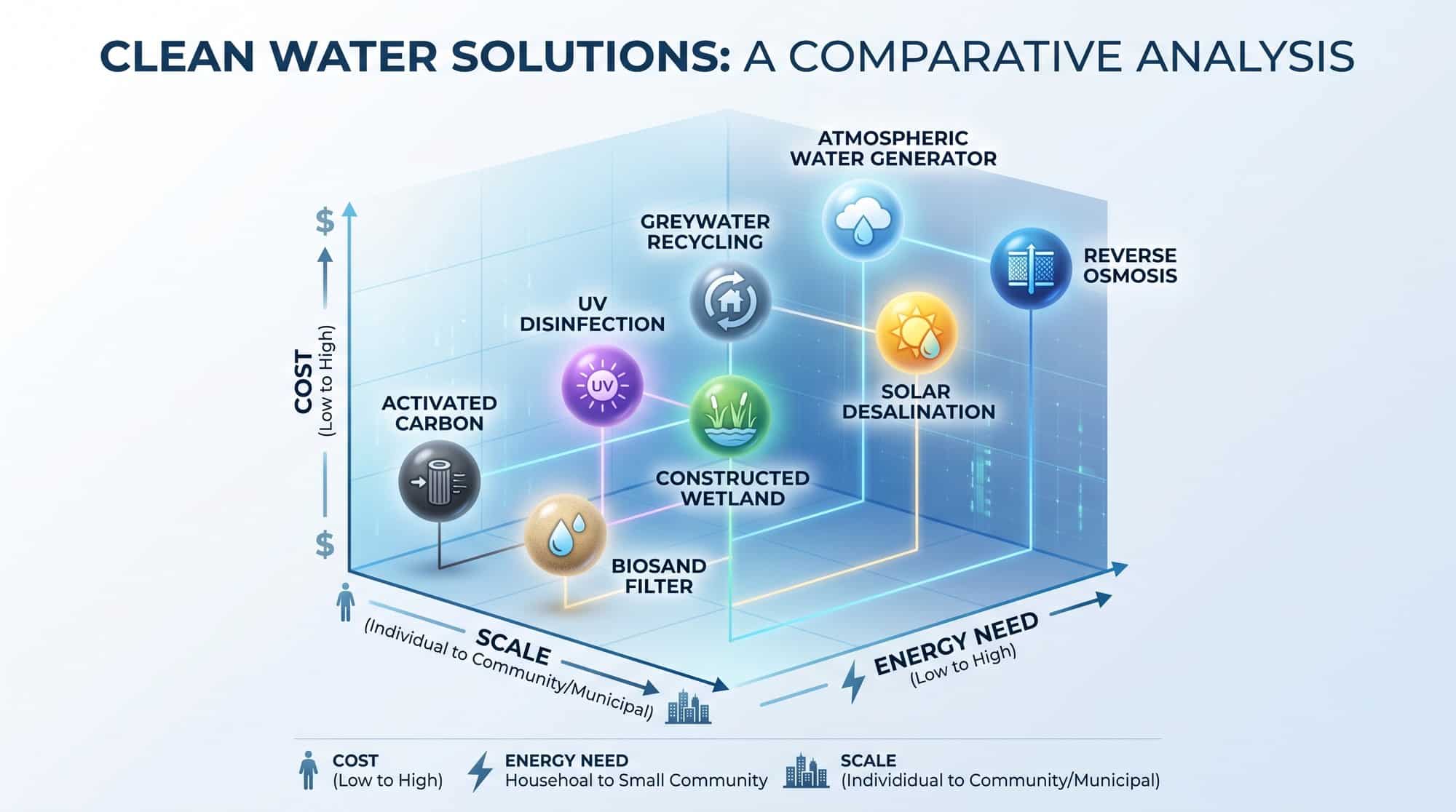
The best clean water solution depends on water quality, energy access, budget, and how many people you need to serve. Use this comparison to narrow your options.
| Solution | Best For | Typical Cost Range | Energy Need | Key Strength | Limitation |
|---|---|---|---|---|---|
| Activated carbon filter | Household, municipal tap | $20 to $150 per year | None | Low cost, improves taste | Does not remove pathogens or salts |
| Reverse osmosis | Household, high salinity | $150 to $600 plus cartridges | Electricity or pressure | Removes salts and metals | Brine waste, needs maintenance |
| UV purifier | Household, well water | $80 to $400 | Low electricity | Chemical-free disinfection | Needs clear water and power |
| Biosand filter | Household, rural | $25 to $100 built | None | Durable, no power | Limited virus removal alone |
| Atmospheric water generator | Household to community, arid areas | $500 to $5,000 | Low to moderate | Works off-grid in low humidity | Output varies with climate |
| Solar desalination | Community, coastal | $10,000+ modular | Solar | No chemicals, scalable | Higher upfront cost |
| Constructed wetland | Community, agriculture | Varies by size | None | Restores habitat, low operating cost | Needs land area |
| Greywater recycling | Household to apartment building | $2,000 to $6,000 | Low electricity | Cuts demand up to 45% | Requires plumbing changes |
For renters and homeowners, start with a certified lab test, then address the specific risk. For community leaders, map seasonal water availability first. Funding from microfinance, municipal grants, or pay-as-you-go models, as demonstrated by market-driven approaches like WaterCredit, can spread upfront costs where household savings are tight.
Frequently Asked Questions
What are the 10 ways to clean water?
The most common methods are boiling, activated carbon filtration, ceramic microfiltration, ultrafiltration, nanofiltration, reverse osmosis, ultraviolet disinfection, chlorination, solar disinfection, and distillation or solar stills. In practice, most safe-water systems combine two methods, such as filtration followed by UV or chemical disinfection, to cover both particles and pathogens. Community systems add coagulation, sedimentation, and constructed wetlands at a larger scale.
What are 5 ways to purify water at home?
Five reliable home options are: 1) a certified carbon or ceramic filter for sediment and chemicals, 2) boiling for 1 minute to kill pathogens, 3) a UV purifier for chemical-free disinfection, 4) reverse osmosis if you have high salts or heavy metals, and 5) solar disinfection in clear bottles when you have sun but no power. Always pre-filter cloudy water first so disinfection can work effectively.
What is the healthiest, cleanest water to drink?
The healthiest water is safe, balanced, and free of pathogens and excess contaminants. For most people, properly treated municipal water or well water that meets U.S. EPA drinking water standards is ideal. Over-purified water stripped of all minerals is safe but not more healthy, and adding a remineralization stage after RO can improve taste. What matters most is consistent safety, not marketing claims about special water types.
What is the cheapest way to purify water?
The lowest-cost proven methods are boiling, solar disinfection in PET bottles, and biosand or ceramic filters made from local materials. Chlorine tablets cost pennies per liter and are widely used in emergencies. For longer term use, a maintained biosand filter or a simple ceramic pot filter offers the best cost per liter over several years with no electricity.
How do clean water solutions help fight climate change?
Efficient solutions reduce energy use for pumping and treatment, and nature-based options like wetlands and aquifer recharge store water while sequestering carbon and buffering floods and droughts. Decentralized solar desalination and atmospheric harvesting avoid long pipelines and diesel transport, cutting emissions while improving resilience.
Building a Future Where Safe Water Is Standard
Progress toward universal safe water will not come from a single invention but from matching the right blend of technologies to local conditions. Household filters and UV units can protect families today, community-scale solar desalination and atmospheric generators can bridge gaps where pipes cannot reach, and wetlands, biochar, and aquifer recharge can heal watersheds for the long term.
If you are ready to act, test your water, start with the simplest effective barrier, and layer additional steps as needed. For those supporting broader change, community-managed systems paired with transparent financing tend to last longest because residents have ownership from day one. To explore how energy-smart upgrades complement water savings at home, see our guides to six innovative technologies that create clean water and innovations in energy efficiency for modern buildings.
Safe water is not only a health outcome but also a foundation for education, economic opportunity, and climate adaptation. The tools exist. The task now is to deploy them where they are needed most.


