
Ask an image generator for a café menu or a product poster, and the picture may look flawless until you try to read it. Letters bend, words fuse, and prices dissolve into plausible nonsense. That single failure mode has outlived every generation of image models, and a newly released open-source project was built specifically to kill it.
MOSS-Image, a 5-billion-parameter text-to-image model, was released on October 16, 2026, by the OpenMOSS team, the research group under the Shanghai Innovation Institute that collaborates with Fudan University, together with MOSI Intelligence. Code and weights are published under the Apache 2.0 license, one of the most permissive terms in the field, allowing commercial use and unrestricted fine-tuning.
The release became a phenomenon almost overnight: the team reports roughly 1.3 million downloads across Hugging Face repositories in the first four days, about 1,400 GitHub stars, and the top position on Hugging Face’s trending list for text-to-image models. Those figures come from the team and Chinese tech press and have not been independently audited. Popularity, however, is the least interesting thing about this model. The interesting part is what its benchmarks claim.
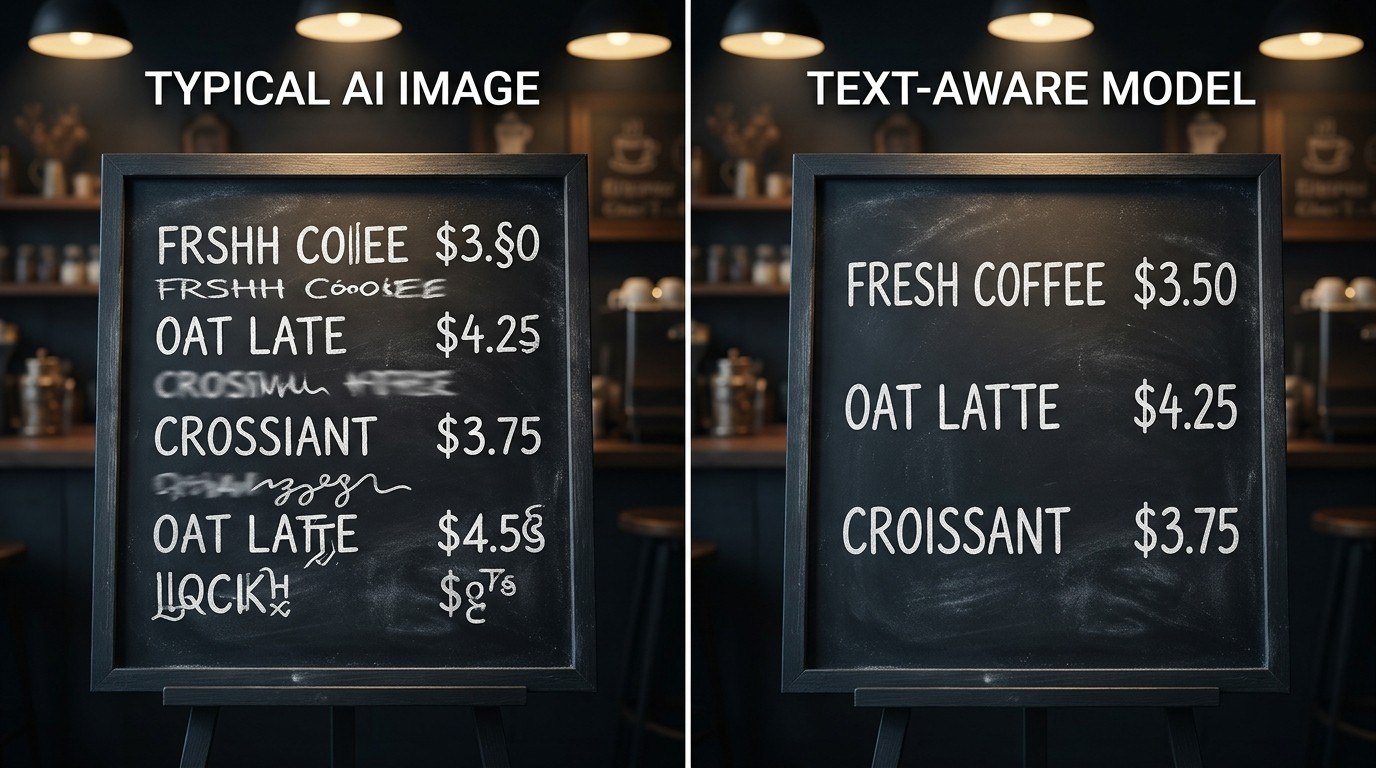
Built for Text and Layout, Not Just Pretty Pictures
MOSS-Image is a single-stream diffusion transformer (DiT), 42 layers deep, trained from scratch. Around that 5B generator, the team wrapped two frozen components: a Qwen3.5-9B text encoder that reads the prompt and a FLUX.2 VAE that decodes the image, the same latent decoder used in Black Forest Labs’ FLUX.2 stack. The 5B figure covers the generator alone; the full pipeline weighs about 27 GB in bf16 precision, with the text encoder accounting for the largest share.
Three design choices stand out. Prompts can run to 4,096 tokens, long enough to spell out every line of copy on a poster rather than hint at it. Text rendering is bilingual, with the team treating Chinese and English lettering as a first-class target rather than an afterthought. And beyond prose, the model accepts a structured JSON layout in which each text block and object is assigned its own bounding box.
The intended use cases follow directly from those choices: posters, packaging, menus, slides, infographics, and interface mockups, the artifacts where accurate lettering and placement matter as much as the pixels around them.
The Benchmarks: A 5B Model Among Closed Giants
Because existing tests had stopped separating strong models, the team built its own yardsticks. On LongTextBench, a widely used short-text benchmark averaging about 120 characters per task, open-weight models already cluster between 96 and 98.9, so the team argues the metric is saturated. Its replacement, LongLongTextBench (LLTB), raises the stakes to 240 literary-text tasks, split evenly between English and Chinese, with targets averaging roughly 1,340 characters, about eleven times longer.
On that benchmark, MOSS-Image scores 96.3 Mean-6 text coverage: 97.1 on long English text and 92.4 on long Chinese. The nearest open-weight competitor, Qwen Image 2512, manages 64.9, with Z-Image Base at 40.8 and FLUX.2 at 11.8. Among closed systems, GPT Image 2 leads at 99.0 and Nano Banana Pro scores 96.6, which places MOSS-Image within a fraction of a point of Google’s top image model, from an architecture a fraction of the size.
Layout tells a similar story. On 7Bench, which measures how precisely objects land inside specified boxes, MOSS-Image posts 0.88 mIoU and a 0.70 Layout AUC, roughly double Ideogram 4 at 0.44 and 0.20, and far ahead of GPT Image 2 at 0.30 and 0.16. The technical report attributes this to the model reading coordinates directly through JSON input rather than interpreting them from prose.
The flagship comparison, RealLayoutArena, asks blind human judges to vote between images generated from the same design brief across 61 tasks: 20 posters, 20 infographics, and 21 user interfaces. The full MOSS-Image system, model plus its prompt enhancement module, scores an Elo of 1,698.70, second only to GPT Image 2 at 1,844.35 and ahead of Seedream 5.0 Pro, Qwen Image 3.0 Pro and Nano Banana Pro. Two caveats keep the table honest. The score is a system result, not the generator alone; evaluated with identical enhanced prompts, the MOSS-Image backbone ranks first among the generators tested. And every number in the report is vendor-run and vendor-benchmarked, so independent replication is still pending.
JSON Layout Control, the Designer-Friendly Trick
The JSON layout mode is the feature most likely to matter outside AI circles. Rather than leaving placement to chance, a designer can specify that a headline sits in one box, a price tag in another, and a product photo in a third, each with coordinates. The model then renders each element where it was told to. The team’s own ablation on RealLayoutArena puts JSON layout prompts at 1,622.87 Elo versus 1,506.20 for natural-language prompts, a meaningful jump.
A demonstration on the official model card shows the flavor of the thing: a refrigerator scene with a handwritten sticky note whose Chinese text, a shopping list for milk, eggs, and bread, comes out line by line exactly as requested. A built-in prompt enhancer rewrites short requests into the detailed captions or layout specifications the model prefers, using the same text encoder the generation process already requires.
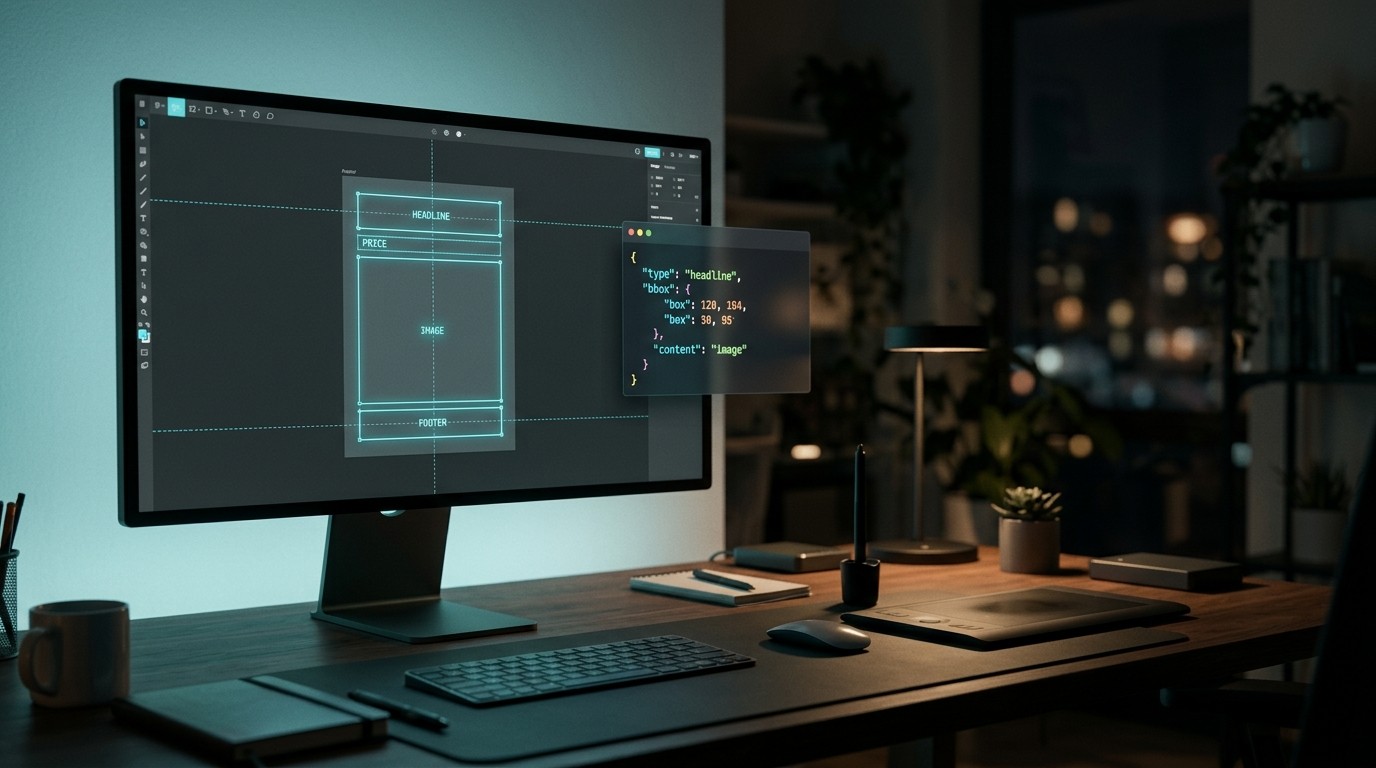
Base and SFT: Two Checkpoints, Two Audiences
The release ships as two checkpoints. MOSS-Image-Base skips post-training and CFG distillation entirely, keeping the raw training signal intact, which makes it the starting point for community fine-tuning. MOSS-Image-SFT, fine-tuned on curated data, is the version the team recommends for generation, with tidier text grouping and cleaner layouts. Both run from the same interface, so switching is a matter of swapping one loader.
The official reference configuration is conservative: 50 sampling steps at a CFG of 3.0. The user guide recommends the Euler sampler at shift 5.0, skip-layer guidance at layer 22, and outputs in the 1 to 2 megapixel range, extrapolatable from 512×512 up to 2K. The community treated that as a starting line. Within days, developers published 8-step DMD and 4-step accelerated variants, INT8, GGUF, and MLX builds for lower VRAM and Apple Silicon, and an FP16 fix by KBlueLeaf for better precision headroom. The pattern mirrors what we covered in 1-bit quantization work: release an open model, and compressed, practical versions appear almost immediately.
Training tools moved just as fast. KohakuMossTrainer arrived on October 18 with full fine-tuning and LoRA support down to 6 GB of VRAM for adapters, DiffSynth-Studio added its own training support, and style LoRAs ranging from phone photography and film grain to gouache, anime portraits, and pixel art began appearing across model hubs.
What the Community Found in the First Nine Days
On Reddit’s r/StableDiffusion, the model became one of the most discussed releases of the month, complete with a pinned AMA from a core developer. Praise centers on natural skin texture and prompt adherence, with testers comparing it against FLUX.3-klein, Krea 2 and Qwen Image 2.1, and generally highlighting its realism, human detail, and text rendering. Ostris, a well-known ComfyUI developer, offered a notable hypothesis: the model’s more natural look may come from the team excluding AI-generated images from its training data, a counter-trend at a time when models trained heavily on AI output converge on a similar aesthetic. That remains his speculation, but it resonated because many users do find the skin tones less synthetic than FLUX’s.
The criticism is just as specific. Some testers find faces unimpressive at 5B scale. Early SFT outputs showed a vertical banding artifact, which was mitigated by community LoRAs and presets. First, turbo LoRAs produced blur before maturing. And patience is still a requirement at official settings: one tester reported about 10 seconds per 1080p image running a community turbo build on an RTX 5070 Ti, which is quick, but the official configuration is a different story on modest hardware.
The integration ecosystem is unusually broad for a brand-new release: day-zero support from SGLang and vLLM-Omni, native ComfyUI support plus an official plugin, a Diffusers pipeline, a prompt enhancer skill for agents, the MOSI API platform launched on October 20, and availability through MOSI’s MosMos desktop voice assistant. The team says a full-duplex real-time interaction system, MOSS-Live, and a next-generation speech model, MOSS-TTS 2.0, are next.
The Limits Worth Knowing
- It is text-to-image only. There is no image editing and no reference-image input; the team lists reference-based generation as future work.
- The benchmarks are in-house. Both LLTB and RealLayoutArena were designed by the team behind the model.
- Style stability varies. Community testing reports inconsistent results in some styles, particularly away from tuned settings.
- Local use wants VRAM or quantization. The ComfyUI INT8 repackage cuts the transformer’s memory footprint roughly in half compared with full-precision weights.
None of these are unusual for a young open release, but they set expectations: MOSS-Image is a foundation being built on in public, not a polished consumer product.
Why It Matters
The deeper story is a bet on capability at small scale. While frontier image labs chase ever-larger closed systems, OpenMOSS shipped a 5B Apache 2.0 model that renders text and obeys layouts at a level the closed leaders paid enormous compute budgets to reach, then trained it on domestic Chinese PPU accelerator hardware to prove the stack can exist beyond NVIDIA’s ecosystem. If the numbers replicate, designers, e-commerce teams, and local-AI builders gain a tool they can run, study, modify, and ship, with no API bill attached. And if the community’s training-data hygiene hypothesis holds, it may also nudge the whole field toward cleaner data.
Frequently Asked Questions
Is MOSS-Image free to use?
Yes. The weights ship under the permissive Apache 2.0 license with no licensing fee. You can run it locally through ComfyUI or Diffusers, or use MOSI’s hosted API if you prefer not to deploy it yourself.
Can MOSS-Image edit existing images?
Not yet. It creates images from text or layout specifications only. Feeding it an existing photo to restyle or edit is on the team’s roadmap, not in the current release.
How does MOSS-Image compare with Qwen Image 2.1?
Qwen Image 2.1 is a 7B model focused on editing and multi-reference workflows, while MOSS-Image focuses on long text, layout control and fine-tunability at 5B. On long-text rendering, MOSS-Image’s reported 96.3 score far exceeds the 64.9 reported for the nearest open competitor, though all figures are vendor-reported.

