
Alibaba’s Qwen team released Qwen Image 2.1 on September 20, 2026, an image generation and editing model whose visual generation component carries just 7 billion parameters. Within hours, the headline wrote itself: on the vendor’s own benchmark, the compact model scored higher than Nano Banana 2.0 and GPT Image 1.5. For a brand-new open-weights image model, the numbers look impressive.
Two details that the announcement leaves out matter as much as the scores themselves. The benchmark is the vendor’s own, and the license that shipped with the weights restricts commercial use. Here is what Qwen Image 2.1 actually delivers, what the benchmarks really say, and what the fine print means.
What Qwen Image 2.1 Actually Is
Qwen Image 2.1 unifies text-to-image generation and image editing in a single model. Its visual generation component uses 32 single-stream diffusion transformer (DiT) layers with 7B parameters, and it generates natively at 2K resolution. The model absorbs capabilities that previously lived in separate Qwen releases, most notably the transparent-image generation introduced with Qwen-Image-Layered in December 2025.
According to the official Qwen announcement, the headline features include:
- Native transparency: prompts can request regular images or RGBA output with a transparency channel, and transparent layers can be edited directly.
- Multi-reference editing: up to 10 input images can be combined into one coherent composition.
- Local editing: regions can be marked with circles, painted annotations, or separate masks, and edits are confined to those areas.
- Fidelity preservation: portrait identities and product details such as text, textures, and shapes survive edits more consistently.
- Task coverage: the model handles panoramas, infographics, storyboards, and improved typography rendering.
Key Specs at a Glance
- Release date: September 20, 2026, on Hugging Face, ModelScope, and GitHub
- Visual generation component: 7B parameters across 32 single-stream DiT layers
- Full core pipeline: roughly 15B parameters, including a Qwen3-VL 8B text encoder
- Native output resolution: up to 2K
- Reference images: up to 10 per editing task
- License: Qwen Research License, with commercial use restricted
- Day-zero tooling: Diffusers, ComfyUI, vLLM-Omni, SGLang, and LightX2V
Weights are published on Hugging Face, ModelScope, and GitHub. Tooling support arrived on day zero: Hugging Face Diffusers merged the QwenImage21Pipeline on September 18 (PR #14804), and ComfyUI, vLLM-Omni, SGLang, and LightX2V all announced same-day support.
The Benchmark Claim: Ahead of Nano Banana 2.0, Narrowly
The comparison that generated the headlines comes from Qwen-Image-Bench, an evaluation suite developed by Qwen itself. As covered by Sina Finance, the overall scores place Qwen Image 2.1 first among open models, slightly ahead of two high-profile closed competitors. The fuller leaderboard, compiled in release analyses by CellCog and XenoSpectrum, adds context the headlines omit: of 29 models on the vendor chart, Qwen Image 2.1 places seventh, with six closed models above it, led by GPT Image 2.5 Sunburst at 67.01. Seedream 5 Pro (59.53) and Nano Banana Pro (59.45) sit just below Qwen on the same chart.
The margin over Nano Banana 2.0 is 0.46 points, roughly 0.8 percent. Context matters here: Qwen-Image-Bench was built by the same organization that built the model. No independent evaluation existed at launch, and the only advance signal was a September 17 early-access program that offered 50 ModelScope slots, with testers asked to publish samples or reviews by September 29.
Independent data is thinner but more telling. The GenAI Showdown benchmark, an external evaluation tracked by explainx.ai’s review, scores the model 7 out of 15 points. That is a real improvement over Qwen-Image 1.0’s 4 out of 15, but it still trails Ideogram 4’s 8 out of 15, and it does not include a direct head-to-head with Nano Banana 2.0. The score is consistent with an early independent text-to-image test that a Hacker News user published at 21:23 UTC on release day, noted in CellCog’s release analysis.
| Model | Qwen-Image-Bench (vendor) | GenAI Showdown (independent) |
|---|---|---|
| GPT Image 2.5 Sunburst | 67.01 | not tested |
| Qwen Image 2.1 | 60.28 | 7 / 15 |
| Nano Banana 2.0 | 59.82 | not tested |
| GPT Image 1.5 | 59.65 | not tested |
| Seedream 5 Pro | 59.53 | not tested |
| Nano Banana Pro | 59.45 | not tested |
| Qwen-Image 1.0 | not published | 4 / 15 |
| Ideogram 4 | not published | 8 / 15 |
The honest reading: Qwen Image 2.1 improved sharply over its predecessor, and at 7B parameters the efficiency story is genuine. The specific claim that it beats Nano Banana 2.0 rests on vendor-run data, and third-party benchmarks may vary as independent testing lands over the coming weeks.
The 7B Headline Covers Only Part of the Pipeline
The advertised 7B parameters refer to the visual generation component alone. As detailed in technical breakdowns of the release, the full core pipeline is roughly 15B parameters: the 7B DiT plus a Qwen3-VL 8B text encoder and a 64-channel RGBA autoencoder, totaling about 33 GB of downloadable weights. Two optional prompt rewriters, PE-T2I and PE-I2I, add fine-tuned Qwen3.5-VL 9B models at roughly 18.8 GB each.
For comparison, the predecessor Qwen-Image 1.0 ran a roughly 20.4B DiT under the permissive Apache 2.0 license. Shrinking the core generator from 20B to 7B while improving benchmark performance is a meaningful engineering achievement. It is also true that anyone downloading the full system is fetching far more than 7B parameters.
Hardware Reality: Datacenter-Class at Native Resolution
Efficiency claims deserve a hardware footnote. A test documented during the Diffusers integration, compiled in mushroom.cv’s deployment guide, measured peak memory of 56.5 GiB for a single 2048 by 2048 image on one Nvidia H100 in bfloat16, batch size one, 20 inference steps. Generation took 32.7 seconds, or 31.8 seconds with compiled attention. Defaults run 40 steps at CFG 1.0.
No official quantized builds shipped at launch: no GGUF, FP8, or INT8 versions from Qwen on day zero. Community coverage suggests unofficial 8-bit quantization can run at roughly 16 GB of RAM for smaller 512 by 512 images on CPU, at around three minutes per image, per RuntimeWire’s release analysis. The practical picture: inference-server deployments are viable today, while local hobbyist use depends on community quantization maturing.
The License Question: Open Weights, Not Open Source
The detail absent from the Qwen blog post generated the most discussion. Every prior release in the series, including Qwen-Image 1.0, Qwen-Image-Edit, Qwen-Image-Layered, and the 2512 update, shipped under Apache 2.0, the permissive license that made them genuinely open source. Qwen Image 2.1 ships under a new Qwen Research License that prohibits commercial use without a separate licensing deal with Alibaba.
The reaction was immediate. As explainx.ai noted, the Hacker News thread for the release drew 483 points and 152 comments, and most of the debate centered on the license rather than the architecture. The vendor announcement does not mention the change at all.
The distinction matters for different audiences. Researchers, students, and hobbyists can download and use the weights freely. Businesses that want to ship products built on the model need to negotiate with Alibaba first. For a commercial team weighing a Nano Banana alternative that runs on its own infrastructure, a hosted editor may currently be the simpler path legally, even when the Qwen model looks stronger on paper. Anyone searching for an open source image generation model should note that this release is open weights in the practical sense, not open source by the standard definition.
What the Model Can Do Beyond Generating Images
Capability-wise, the release is more than a text-to-image engine. The transparency pipeline lets prompts decide whether output includes an alpha channel, allows direct editing of transparent layers, and can extract subjects from ordinary RGB photographs as RGBA assets for design work. Text inside a transparent layer can be edited independently, replacing, for example, a word on a graphic without touching the background.
The multi-reference system produced some of the release’s most practical examples: six individual portraits combined into a single group photograph, five product images (a model, clothing, shoes, a bag, and a hat) assembled into a complete virtual try-on, and 10 furnishing references composed into a full interior scene. One head-to-head caveat for readers weighing this as a Nano Banana alternative: Google’s Nano Banana 2.0 accepts up to 14 reference images against Qwen’s 10, so raw reference count is not a Qwen advantage, as XenoSpectrum’s comparison notes.
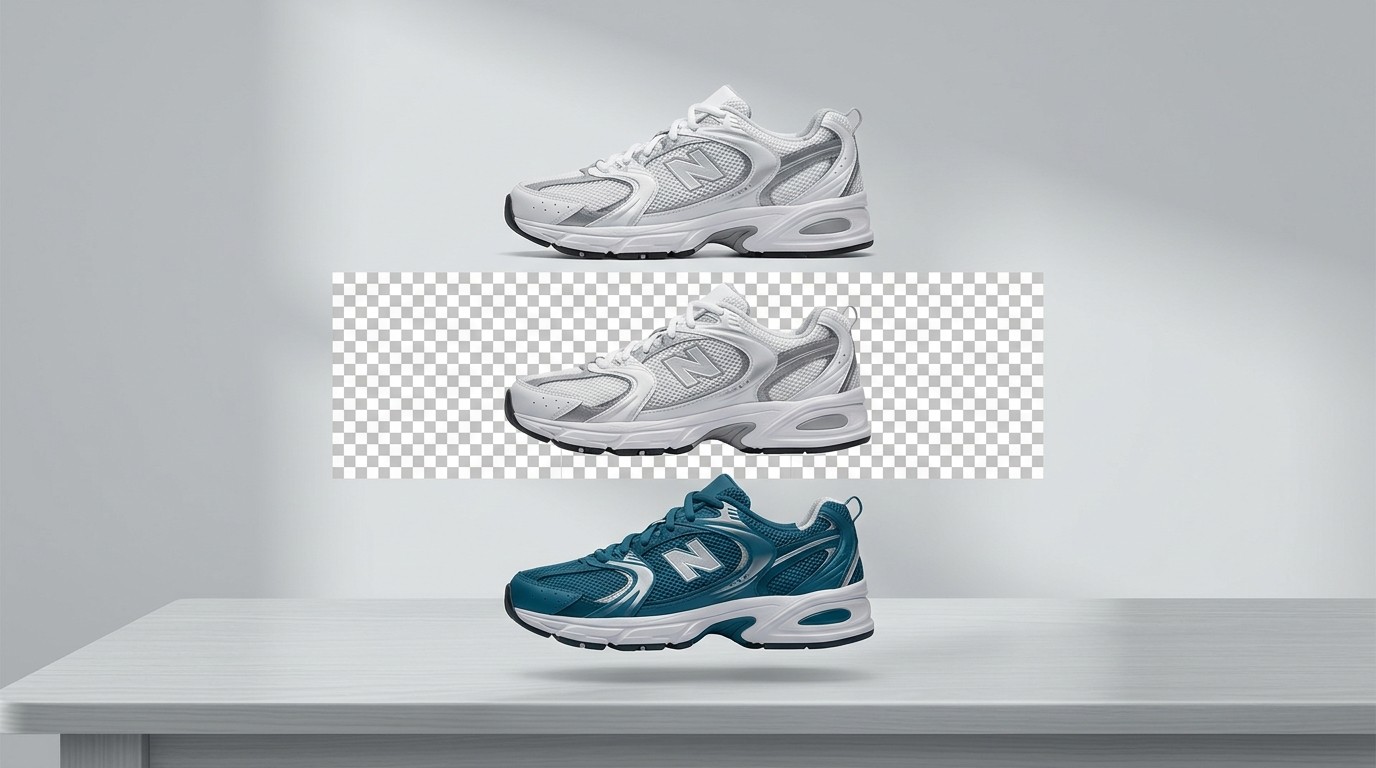
Local editing supports simultaneous multi-region changes, such as removing a watch, recoloring hair, and replacing clothing in one instruction using differently colored circles. Sequential edits that preserve the rest of the scene can be assembled into simple animations. On the generation side, the model can expand a selfie into an explorable panorama, turn a product photograph into a detailed infographic, and convert a three-view character reference into a full storyboard.
Where Qwen Image 2.1 Fits in the Image Model Landscape
The image model space is unusually competitive at the moment. Intelligent Living recently covered the MAI-Image-2.6 preview, which topped image-editing leaderboards, the GPT Image 2.5 Flare and Sunburst specs, batch production workflows with Nano Banana Pro, and the API pricing of the Agnes Image 2.5 Flash. Qwen Image 2.1 enters that field with a different pitch: not the absolute best score, but the best score per parameter, on weights you can host yourself.
The efficiency angle fits a pattern Alibaba has been building toward. The company’s Qwen 3.8 text model challenged frontier giants at 27B parameters, while Qwen3.8-Flash matched DeepSeek V4 Pro on coding benchmarks at a fraction of the price, and its Qwen3-VL 4B/8B vision models made the case that bigger is not always better. Compact open models like the MiniCPM5-2B have pushed the same theme in language. Qwen Image 2.1 now extends the argument to image generation, though notably alongside a closed-weight sibling, Qwen-Image-3.0, that remains focused on layout and text tasks.
Frequently Asked Questions
Can Qwen AI make images?
Yes. The Qwen family includes several image models, and Qwen Image 2.1, released September 20, 2026, is the newest. It combines text-to-image generation and image editing in a single model, available through the Qwen chat interface and downloadable from Hugging Face, ModelScope, and GitHub.
Is Qwen AI free?
The chat interface offers free access tiers, and the Qwen Image 2.1 weights can be downloaded at no cost. The catch is the license: the weights ship under the Qwen Research License, which bars commercial use without a separate agreement with Alibaba. Free to explore and research, not free to build a business on.
Does Qwen Image 2.1 really beat Nano Banana 2.0?
On Qwen’s own Qwen-Image-Bench, yes, narrowly: 60.28 versus 59.82. Independent data is more modest. The GenAI Showdown benchmark scores it 7 out of 15, up from its predecessor’s 4 but still behind Ideogram 4’s 8. No independent head-to-head with Nano Banana 2.0 has been published yet, and specific benchmarks may vary as third-party testing arrives.
What hardware do I need to run Qwen Image 2.1?
At native 2K resolution, documented tests show 56.5 GiB of peak VRAM on an Nvidia H100 in bfloat16. Unofficial community quantizations suggest roughly 16 GB of RAM can handle smaller resolutions at 8-bit on CPU. Day-zero support in ComfyUI, Diffusers, vLLM-Omni, and SGLang provides multiple deployment paths.
Is Qwen Image 2.1 a good Nano Banana alternative?
For researchers, hobbyists, and teams that need local inference with strong editing and transparency tools, it is the most capable open-weights alternative to launch this month. Commercial teams should read the license terms first, since shipping a product built on the weights currently requires a separate deal with Alibaba.
Bottom Line
Qwen Image 2.1 is a genuine efficiency milestone: 7B parameters in the visual generation component, unified generation and editing, native transparency, multi-reference composition, and day-zero ecosystem support. The two asterisks next to the headline deserve equal billing. The Nano Banana 2.0 comparison comes from a benchmark Qwen built, and the weights carry a research-only license that the announcement does not mention. As independent evaluations land over the coming weeks, the claims will either firm up or fade. Either way, the open source image generation model space just gained a serious compact contender, and the fine print will determine who actually gets to use it.

