
On August 10, 2026, Microsoft AI executed an unusually rapid ascent in the image-generation hierarchy. Within fifteen days, its in-house model MAI-Image-2.6 simultaneously held No. 2 on the Arena text-to-image leaderboard and No. 1 on the Artificial Analysis image-editing leaderboard, a dual ranking no non-OpenAI lab has previously achieved under independent evaluation. The model surpassed Google’s Nano Banana family, Meta’s Muse Image, and xAI’s Grok Imagine in text-to-image, then displaced its own predecessor MAI-Image-2.5-Pro along with OpenAI’s GPT Image 2 in image editing.
The convergence of those two results represents the strongest independent verification yet that Microsoft’s AI division, led by Mustafa Suleyman, has constructed a credible in-house image model after years of strategic reliance on the OpenAI partnership. It joins a wave of recent Microsoft-first-party model launches detailed in our coverage of Microsoft Maia’s vertical-integration strategy. This guide explains what MAI-Image-2.6 actually does, how it compares to its predecessor, where you can try it, and what it might cost when full pricing arrives.
What Is MAI-Image-2.6 Preview?
MAI-Image-2.6 is the latest model in Microsoft’s MAI-Image family of in-house image generators, developed by the Microsoft AI division that Suleyman runs. The “Preview” label in MAI-Image-2.6 Preview refers to its availability status: it is in private preview on Microsoft Foundry and accessible to the public through MAI Playground, but it does not yet have a public API or general-availability release date.
The architecture constitutes a single unified inference system that handles both text-to-image generation and image editing within a common parameter space, conceptually analogous to Google’s Nano Banana family of models. For context on the broader trend toward unified generation-plus-editing models, our guide to unified AI photo editing workflows covers why users are increasingly testing single-model pipelines instead of chaining separate tools. It is the third major revision of the line:
- MAI-Image-1 established the technical foundation.
- MAI-Image-2 (March 2026) made a major jump in photorealism, text rendering, and creative range.
- MAI-Image-2.5 (June 2026) pushed further into professional-grade imagery, with a Pro variant (July 23) that took No. 1 in image editing until 2.6 displaced it.
- MAI-Image-2.6 continues that climb with broad gains across every measured Arena category.
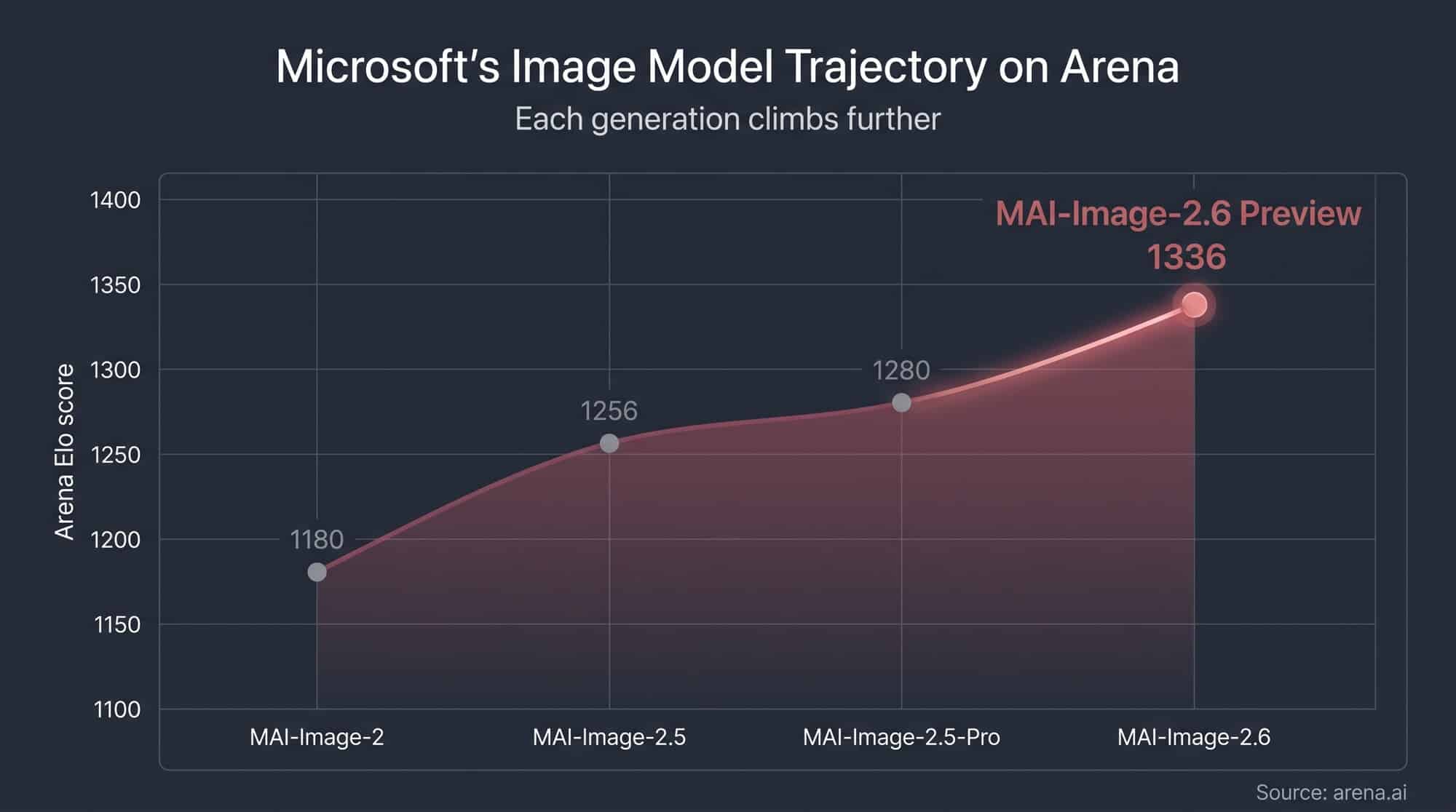
The model represents the first Microsoft image generator to penetrate the Arena text-to-image top three while simultaneously occupying the No. 1 position on an independently administered image-editing board.
Arena Leaderboard Results: Text-to-Image and Image Editing
Arena, operated by the Chatbot Arena research collective, ranks image generators through blind, side-by-side human preference voting: voters see two unlabeled outputs from the same prompt and select the stronger one. The methodology differs fundamentally from automated benchmarks, because the Elo ratings reflect aggregated human perception rather than fixed problem scoring. Two boards matter here.
Text-to-Image Leaderboard (August 10, 2026 snapshot)
On its debut, MAI-Image-2.6 posted an Arena score of 1,336, placing it at No. 2 among 77 ranked models and consolidating a position above every non-OpenAI competitor. The top of the board at the time of writing was as follows:
| Rank | Model | Provider | Arena Score | Gap to MAI-Image-2.6 |
|---|---|---|---|---|
| 1 | GPT Image 2 (Medium) | OpenAI | 1,381 | +45 |
| 2 | MAI-Image-2.6 Preview | Microsoft AI | 1,336 | N/A |
| 3 | Grok Imagine Image 2.0 (Low) | xAI | 1,316 | -20 |
| 4 | Reve 2.1 | Reve | 1,302 | -34 |
| 5 | Muse Image | Meta | 1,282 | -54 |
| 6 | Reve 2.0 | Reve | 1,270 | -66 |
| 7 | Nano Banana 2 | 1,264 | -72 | |
| 8 | Seedream-5.0 Pro | ByteDance | 1,258 | -78 |
| 9 | Qwen-Image-3.0-Pro | Alibaba | 1,257 | -79 |
| 10 | MAI-Image-2.5 | Microsoft AI | 1,256 | -80 |
Source: Arena text-to-image leaderboard.
A key caveat: the leaderboard entry was built from about 3,488 community votes, compared with more than 70,000 votes for GPT Image 2 at No. 1. Arena’s 95% confidence interval for MAI-Image-2.6 spans roughly 1,325 to 1,347, meaning the model sits in the 2nd-to-3rd rank band. Still, the gap to Grok at No. 3 is wide enough that the No. 2 position is statistically robust.
Image-Editing Leaderboard
Two weeks after launch, Microsoft updated its announcement to add an image-editing result: MAI-Image-2.6 reached No. 3 on Arena’s image-editing board, a 19-point Elo jump from MAI-Image-2.5. Then on August 25, the independent benchmarking firm Artificial Analysis ranked the preview build No. 1 on its image-editing leaderboard, ahead of MAI-Image-2.5-Pro, Reve 2.1, and GPT Image 2.
The No. 1 spot on Artificial Analysis gives Microsoft the top two positions on that board, since 2.5-Pro holds No. 2. It is the first time a single vendor has held both slots on an independent image-editing leaderboard. For comparison, Google’s approach with the Nano Banana family has set the template for combined generation-and-editing models, which we covered in our complete guide to Nano Banana.

Where MAI-Image-2.6 Improves Over 2.5
Microsoft reports a +79 Elo overall gain over MAI-Image-2.5 on Arena, accompanied by a +91 Elo improvement in text rendering as the single largest category-specific gain. The complete per-category deltas, derived from Microsoft’s own comparative chart, are enumerated as follows:
| Arena Category | MAI-Image-2.6 | MAI-Image-2.5 | Gain |
|---|---|---|---|
| Overall | 1,336 | 1,256 | +79 |
| 3D Modeling | 1,362 | 1,248 | +114 |
| Cartoon | 1,355 | 1,270 | +85 |
| Realistic/Cinematic | 1,332 | 1,252 | +80 |
| Art | 1,345 | 1,278 | +67 |
| Portraits | 1,364 | 1,259 | +105 |
| Text Rendering | 1,374 | 1,283 | +91 |
| Commercial Design | 1,344 | 1,265 | +79 |
Three categories warrant particular emphasis:
- 3D Modeling (+114 Elo) is the largest single jump, with MAI-Image-2.6 climbing from outside the top 10 in that category to the upper third.
- Portraits (+105 Elo) addresses the most common complaint about generative models: uncanny faces and inconsistent likeness.
- Text Rendering (+91 Elo) is the single biggest practical improvement, because readable on-image text has been the failure mode most visible in real-world product, branding, and signage work.
On Artificial Analysis’s refreshed 19-category text-to-image taxonomy, MAI-Image-2.6-Preview takes the top spot in five categories: Material, Knowledge, Frontier, Retail & Ecommerce, and Marketing & Advertising. GPT Image 2 leads the other 14.
How to Try MAI-Image-2.6 Today
Two access paths exist today, each offering a materially different evaluation experience depending on the user’s intended deployment context.
MAI Playground (Free, Public, Rate-Limited)
The fastest way to test MAI-Image-2.6 is at playground.microsoft.ai. Sign in with a Microsoft account, pass the 18+ age gate, and MAI-Image-2.6 is the default image model in the picker. The picker lists a model description of “Generate high quality images from text prompts.”
Each session gives you two choices before generating:
- Fast returns four variations per run, useful for exploring directions quickly.
- Quality returns one image, useful for the final pick.
Iteration proceeds through the integrated editing tools, which enable compositional manipulation without regenerating the underlying image: backgrounds can be substituted with shadow-matched continuity, label text on a bottle can be replaced while preserving the surrounding surface, and lighting conditions can be modified without disturbing the remainder of the composition. The session retains up to six images simultaneously, and any single image can be designated for in-place refinement.
Rate constraints are deliberately restrictive: 2 requests per minute and 20 images per day per authenticated user, supplemented by IP-level quotas of 3 per minute and 60 per day. Generated output is licensed for personal, non-commercial utilization exclusively.
Microsoft Foundry Private Preview (Enterprise)
On August 19, Microsoft opened private preview access on Microsoft Foundry by application. Foundry is the enterprise tier where developers build, evaluate, and deploy AI applications, and the preview gives selected customers a controlled environment to test MAI-Image-2.6 against their own workloads.
Private preview is categorically distinct from general availability. Microsoft has not disclosed commercial terms, supported regions, throughput ceilings, content-control configurations, or a definitive release date for unrestricted Foundry availability. Organizations evaluating the model for production deployment should therefore verify applicable regional coverage, interface compatibility, content safeguards, and intellectual-property provisions prior to any procurement commitment.
Pricing and Costs: What 2.6 Might Cost When It Ships
Microsoft has not published commercial pricing for MAI-Image-2.6 to date. The contemporary Microsoft Foundry price schedule exclusively enumerates the MAI-Image-2.5 lineage and its derivatives. For comparative context, the prevailing per-million-token rates across the existing catalog are enumerated as follows:
| Model | Text Input | Image Input | Image Output |
|---|---|---|---|
| MAI-Image-2 (original) | $5 | N/A | $33 |
| MAI-Image-2-Efficient | $5 | N/A | $19.50 |
| MAI-Image-2.5 | $5 | $8 | $47 |
| MAI-Image-2.5-Flash | $1.75 | $1.75 | $19.50 |
| MAI-Image-2.5-Pro | $5 | $8 | $106 |
| MAI-Image-2.6 Preview | Not published | Not published | Not published |
The historical precedent is consistent: each new Microsoft image-model flagship has commanded a premium over its predecessor, while a parallel Flash or Efficient variant has simultaneously reduced cost by approximately 40% or more. If Microsoft adheres to this established pattern, MAI-Image-2.6 pricing is likely to exceed the $47 per million output-token rate that 2.5 currently commands, with a complementary higher-throughput variant materializing alongside the flagship.
Until Microsoft publishes a price card, all cost estimates are speculative. The current public list rate for MAI-Image-2.6 Preview on third-party trackers is listed as N/A.
The Broader Image-Model Race
MAI-Image-2.6’s debut comprehensively reshuffles a competitive landscape that had remained relatively static for most of 2026. Until August, the text-to-image top three on Arena had been occupied by GPT Image 2, Grok Imagine, and Reve 2.1, in that precise order. Microsoft’s release demoted Grok to No. 3 and displaced Reve, Meta, Google, ByteDance, and Alibaba each by one position in the consolidated ranking.
The result constitutes the first time one of the major frontier laboratories has simultaneously occupied the No. 2 spot on Arena’s text-to-image board and the No. 1 spot on an image-editing board under independent evaluation. The closest historical analogue is OpenAI, which has led one of the two boards in isolation but never both at once through independent measurement.
For Microsoft’s broader strategic posture, the timing is consequential. Microsoft has been methodically reducing its dependence on OpenAI, with which it cultivated a deep commercial partnership through 2023 and 2024. A homegrown image model that demonstrably outperforms Google’s, Meta’s, and xAI’s offerings on a public benchmark furnishes Microsoft with a credible response to the recurring question of whether it requires OpenAI for image generation at all. The identical strategic logic underpins Microsoft’s parallel investment in MAI-Voice, MAI-Transcribe, and the MAI-Thinking reasoning family, each positioned as a proprietary alternative to external providers.
For a sense of scale, the image-generation space has become more crowded than the text-generation space was a year ago. Frontier text models numbered in the low single digits in early 2024; image-generation models now routinely publish new flagship versions every six to eight weeks. The pace extends beyond the frontier labs: Singapore’s Sapiens AI released Agnes Image 2.5 Flash in July 2026, with all output tiers currently free. Developers looking for open-weight alternatives to proprietary models can also explore pipelines like FLUX.2 for local or cloud image generation, which addresses a different point on the quality-versus-control tradeoff.
What to Watch Next
Four developments will determine whether MAI-Image-2.6 consolidates its position or follows the trajectory of numerous fast-climbing Arena entries that subsequently regressed toward the median.
- Vote accumulation. As Arena collects more votes, the Elo will stabilize. The current 3,488-vote base is enough to lock in No. 2, but a larger sample could shift the rank up or down by one.
- Public API pricing. Until Microsoft publishes a price card, enterprises cannot budget for the model. A Foundry general-availability date would be the next major milestone.
- Independent benchmarking beyond Artificial Analysis. The Aug 25 No. 1 image-editing result came from a single independent evaluator. Cross-confirmation from a second board would strengthen the claim.
- Rollout to Bing and Copilot. Microsoft has not said when MAI-Image-2.6 will become the default image generator inside Bing Image Creator or Copilot. Switching the default in those products would signal production readiness.
Until those developments materialize, the practical implication is unambiguous: MAI-Image-2.6 Preview represents the most rigorously evaluated non-OpenAI image generator presently accessible on a public leaderboard, and it can be empirically tested in approximately five minutes through the MAI Playground interface.
Frequently Asked Questions
How does MAI-Image-2.6 differ from MAI-Image-2.5?
MAI-Image-2.6 posts a +79 Elo overall gain over 2.5 on Arena’s text-to-image board. The largest category jumps are in 3D Modeling (+114), Portraits (+105), and Text Rendering (+91). It also adds image-editing capability that matches or beats MAI-Image-2.5-Pro on the Artificial Analysis board, where the preview build now holds No. 1.
Is MAI-Image-2.6 open source?
No. MAI-Image-2.6 is a proprietary model available only through Microsoft’s own products: MAI Playground for free personal use, and Microsoft Foundry private preview for enterprise customers. Microsoft has not released weights, a model card, or a public API as of August 2026.
What does “Private Preview” on Microsoft Foundry mean?
Private preview denotes a controlled Foundry environment in which selected customers may apply to evaluate the model against proprietary workloads. It is categorically distinct from general availability: pricing remains unpublished, regional coverage and throughput quotas are constrained, and the model architecture is subject to material revision prior to commercial release. Organizations contemplating the model for production deployment should therefore treat it as a beta rather than a procurement-ready service.
Can you edit images with MAI-Image-2.6?
Yes. MAI-Image-2.6 is a unified model architecture that handles both text-to-image generation and image editing within a single inference system. On the Artificial Analysis image-editing leaderboard, the preview build occupies the No. 1 position as of August 25, 2026, surpassing MAI-Image-2.5-Pro, Reve 2.1, and GPT Image 2. The integrated editing capabilities exposed through MAI Playground include background substitution with shadow-matched continuity, in-place textual replacement on existing surfaces, and conditional lighting modification without compositional regeneration.
When will MAI-Image-2.6 have a public API?
Microsoft has not announced a public API date or pricing for MAI-Image-2.6. The model is currently accessible only through MAI Playground (free, rate-limited, personal use) and Microsoft Foundry private preview (by application). Until a price card appears on the Foundry pricing page, all cost estimates are speculative.


