
On October 20, Chinese embodied AI company Qianjue Technology unveiled Polibrain, a predictive world model designed to help robots anticipate how their actions change the world. Founder Gao Haichuan presented it in the opening keynote of the first Physical AI and World Model Conference in Nanjing, in a talk the program lists as The Industry and Technology Development of Predictive World Models. Rather than rendering future video, Polibrain predicts task-relevant state changes in a compact representation space and uses those predictions to plan and recover.
What Qianjue Unveiled in Nanjing
Polibrain was positioned as a robot brain foundation rather than a new robot. Qianjue builds software that other machines run, while hardware partners supply the quadrupeds, humanoids, wheeled platforms, and arms. The company traces its roots to Tsinghua University, where Gao started work on predictive world models in the laboratory around 2017 before founding Qianjue in Beijing in June 2023.
The Nanjing launch carried local weight. The conference was the first national-level event dedicated to physical AI and world models, hosted with Jiangsu data groups and the Chinese Association for Artificial Intelligence. A Nanjing city account of the conference describes Turing Award winners, leading researchers, and industry groups discussing how AI moves from text and images toward physical prediction, alongside a Jiangsu dataset action plan, an industry alliance, and a national standard pre-study for AI world models. City accounts report project signings above 6 billion yuan around the event.
Qianjue used the moment to anchor itself in the region. A Jiangsu report on Qianjue’s move south says the company relocated its headquarters from Beijing to Xuzhuang High-Tech Zone in Nanjing’s Xuanwu District in under three months, drawn by data access, customers, and testing scenes. At the conference, its Yangtze River Delta base for world models and robot brains signed for the Yangzhou Data Industrial Park. Chinese industry coverage reports nine funding rounds in three years, a recent A+ round worth several hundred million yuan, and a valuation around 7 billion yuan, though these figures come from the company and are not independently audited.
Why Predicting States Beats Generating Video
Many current world models are judged by video. They generate plausible future frames of a room, street, or workbench. Polibrain takes a different bet: for a robot that must act, a good-looking video is less useful than a correct forecast of what will change because of an action.
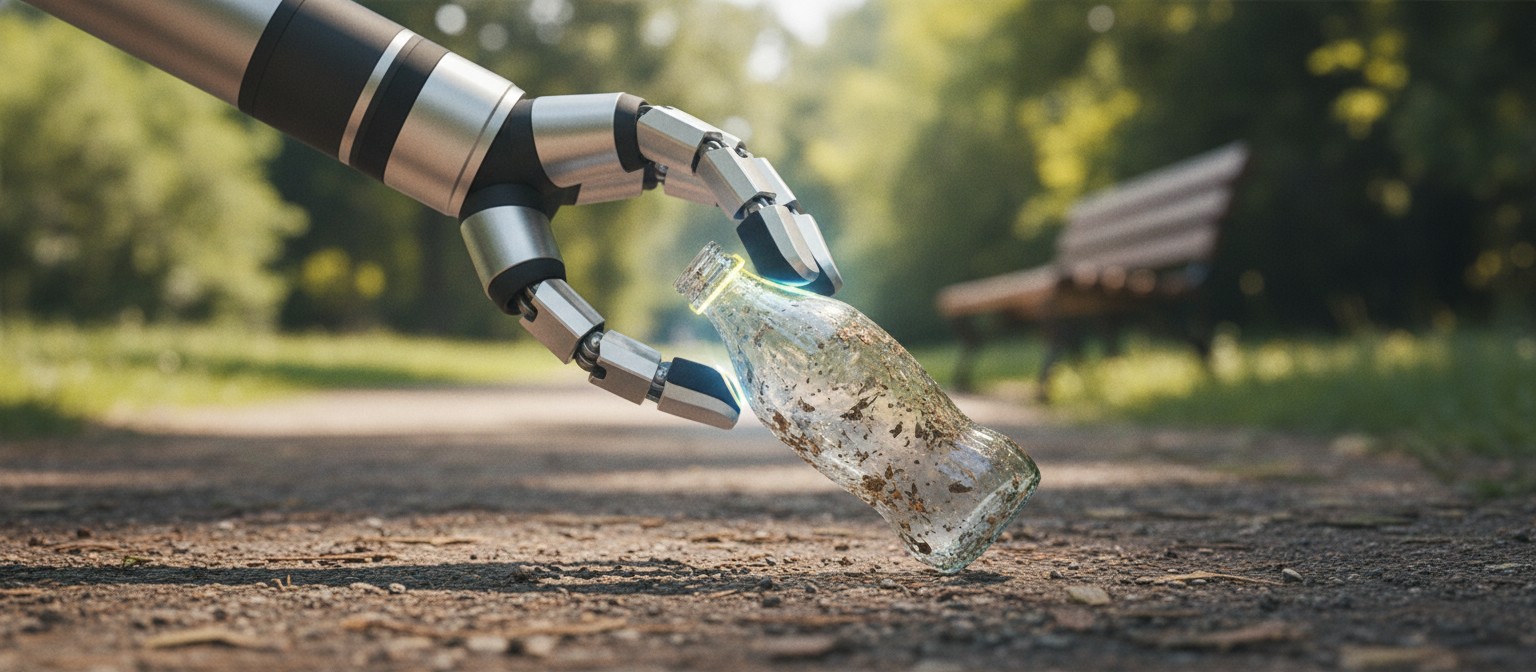
Qianjue illustrates the point with litter collection. For a robot picking up trash, the color of the pavement and background texture matter little. What decides success is where the object sits, how the arm relates to it, and how a grasp will change its position and state. Polibrain, therefore, learns links between environment state, history, and action outcomes, then forecasts those key variables in latent space rather than reconstructing every pixel.
Gao has explained the idea with a map analogy. One way to move lychees from Guangzhou to Chang’an is to walk every possible road and remember which worked. A better way is to learn which cities exist and how they connect. In this telling, trial-heavy action policies walk every road, while a predictive world model draws the map of cause and effect and plans on it.
The distinction matches a wider shift in robotics. As analysis of world action models notes, a vision language model learns to describe a scene, and a generative video model can show a believable pickup that still gets contact timing or geometry wrong. A robot needs to know how a specific gripper at a specific pose will move a specific object, not just what the motion might look like.
| Approach | What it predicts | Strength | Failure mode |
|---|---|---|---|
| Polibrain style predictive model | Task-relevant state changes | Focuses compute on what affects success | Planning drifts if state forecast is off |
| Generative video world model | Full future frames | Rich visual imagination | Realistic video with wrong physics |
| Vision language action policy | Action commands directly | Strong semantic generalization | High trial cost without explicit foresight |
How Polibrain Recovers When Actions Fail
Prediction alone is not autonomy. Qianjue links perception, state understanding, action prediction, decision-making, execution, and feedback into a closed loop. The model forecasts an outcome, the robot acts, sensors report what actually happened, and the next plan starts from the new measured state.
That loop is where failure handling lives. If a grasp misses, the observed state no longer matches the expected state. Qianjue says key feature decoding tracks that gap to help locate the fault, then the system re-evaluates the task from the updated scene and adjusts its next steps rather than replaying a fixed script.
Three technical choices support this design:
- Polynomial representation architecture: organized around key task variables to reduce feature pollution, where background texture or lighting gets mixed into task features.
- Counterfactual history filtering: a method that asks which past observations truly affect future decisions, so the model keeps useful memory through occlusions and delays and drops the rest.
- Multi-source training: support for robot body data, first-person video, and human operation video, so different data forms can feed one model.
One Brain, Many Bodies
Qianjue’s pitch is one brain for many forms: a shared layer holds environment and task understanding, prediction, and planning, while each machine keeps its own control, so different robots and potentially connected appliances can pursue the same intended change in their own way. The company reports adaptation across quadruped, humanoid, wheeled, single-arm, and dual-arm forms, with Chinese reports citing seven broad categories, more than 50 machine types, and terminal counts near 100,000. Those scale figures are company-reported and should be read as deployment claims rather than verified shipments. The approach resembles other cross-body efforts, such as a shared representation retargeted to different robot bodies, but Qianjue frames the shared layer as predictive state understanding rather than motion tokens.

Planned tasks span companion service, food service, tidying, and fine manipulation. Companion use is already a live consumer test in China, where companion humanoid deliveries to homes target presence and emotional value rather than housework. Qianjue is aiming at the harder companion plus chores mix, where a machine must both interact socially and change physical states reliably.
What the Litter-Picking Demo Actually Shows
In the company-provided demo, a quadruped robot carrying an arm and a collection basket works outdoors. It searches for litter, approaches the target, plans the arm motion, and places items in the basket. The sequence exercises the full loop: detect, localize, navigate, predict the grasp outcome, execute, and confirm.
It is a well-chosen showcase because it is ordinary and unforgiving: outdoor light shifts, objects deform, wind moves light trash, and a missed grasp is visible to anyone watching. Qianjue has not released independent success rates, episode counts, or intervention rates for the demo, so it is best read as a capability illustration rather than a benchmark.
A near-term street test may be more telling. Qianjue and partner Tianchuang jointly developed a sanitation robot dog that is expected to appear in Nanjing’s Xuanwu District, bringing the same litter task from a demo clip to municipal streets with pedestrians, traffic, and waste that was never staged.
From Lab Theory to Product
Polibrain builds on academic work Qianjue published with a Tsinghua team. Their paper on when neural networks learn world models, presented at ICML 2025, gives a formal definition of world model learning, analyzes the identifiability problem where many internal models fit the same observations, and argues that low degree bias plus multi-task training can help a network recover true latent variables under mild assumptions. The authors also link world models to out-of-distribution generalization, the ability to keep working when scenes differ from training.
Company reports describe follow-on work on an Effective Degree measure of model complexity and the counterfactual history method noted above, plus claims of three consecutive years of world model results at major machine learning venues and a fully domestic model plus chip stack. Those publication and supply chain claims need primary paper and product verification, but the ICML paper itself is public and provides the theoretical backbone for the product story: prefer simple shared structure, train across tasks, and predict underlying causes rather than surface pixels.
What Remains Unproven
Qianjue acknowledges that reliability in complex scenes still needs fuller real-world testing. That caution matters because the hardest problems for world models show up after the launch video.
- Independent evaluation: no third-party success rates, latency figures, or recovery rates have been published for Polibrain.
- Scene breadth: homes, restaurants, and streets add clutter, people and changing light that lab tests rarely cover.
- Cross body proof: sharing a brain across forms is easy to announce and hard to maintain, since contact dynamics differ by gripper, weight and gait.
- Data flywheel: the hope that data from different robot forms improves one model depends on data quality, rights, and calibration across fleets.
That is also why the Nanjing and Yangzhou moves matter. Qianjue says real scene data decides model performance, and the Jiangsu data port plus restaurant, home, and store mock scenes are meant to supply compliant training material. If the sanitation dog, hotel, and retail deployments generate steady feedback, the closed-loop claim can be tested where it counts. If they stall at pilots, Polibrain remains an elegant architecture awaiting evidence.
Frequently Asked Questions
What is Polibrain?
Polibrain is Qianjue’s predictive world model for robots. It forecasts how task-relevant states will change after candidate actions and feeds those forecasts to planning and control, rather than generating full future video frames.
How is a predictive world model different from a video-generating world model?
A video model predicts what the next frames should look like. A predictive model predicts what a task cares about, such as object position, arm-to-object relation, and task progress. The first optimizes visual plausibility; the second optimizes action consequences.
Which robots can use Polibrain?
Qianjue says Polibrain is being adapted to quadruped, humanoid, wheeled, single-arm, and dual-arm robots for tasks including companion service, food service, tidying, and fine manipulation. Chinese reports cite broader compatibility across seven categories and more than 50 machine types, based on company figures.
Who is Qianjue?
Qianjue Technology is a Tsinghua-linked embodied AI company founded in 2023 by Gao Haichuan. It supplies robot intelligence rather than building robot hardware, with research roots in brain-inspired computing and predictive world models.
When was Polibrain released, and how mature is it?
It was unveiled on October 20, 2026, at the first Physical AI and World Model Conference in Nanjing. The litter picking demo shows the intended loop working in one outdoor task, but Qianjue says complex scene reliability still needs fuller real-world validation.
What Comes Next
Polibrain arrives as China treats physical AI as infrastructure, with datasets, alliances, funds, and standards moving in parallel. Qianjue’s bet is that the winner will not be the best video generator or the most dexterous single robot, but the team that turns everyday physical outcomes into reusable understanding every machine can use. The sanitation dog headed for Xuanwu streets, the Yangzhou data factory, and the hotel and retail pilots will show whether that map of cause and effect survives contact with the real world.

