
Measuring whether an AI-generated video is good enough for an ad requires more than checking whether it looks impressive. Advertisers need clips that follow the brief, keep the product and presenter consistent and look realistic, all at the same time. Newer evaluation methods score each clip on several of these criteria and count it as a success only when every one meets a minimum standard, using automated judges that are checked against human preferences. Even then, testing before launch can only predict quality. Whether an ad actually persuades people still has to be proven with real audiences.
A beautiful AI video can still be a bad ad.
Why General Benchmarks Fall Short
Most public comparisons of AI video models focus on broad qualities: visual detail, motion smoothness or how closely a clip matches a written prompt. Those measures are useful, but they do not capture what matters in advertising.
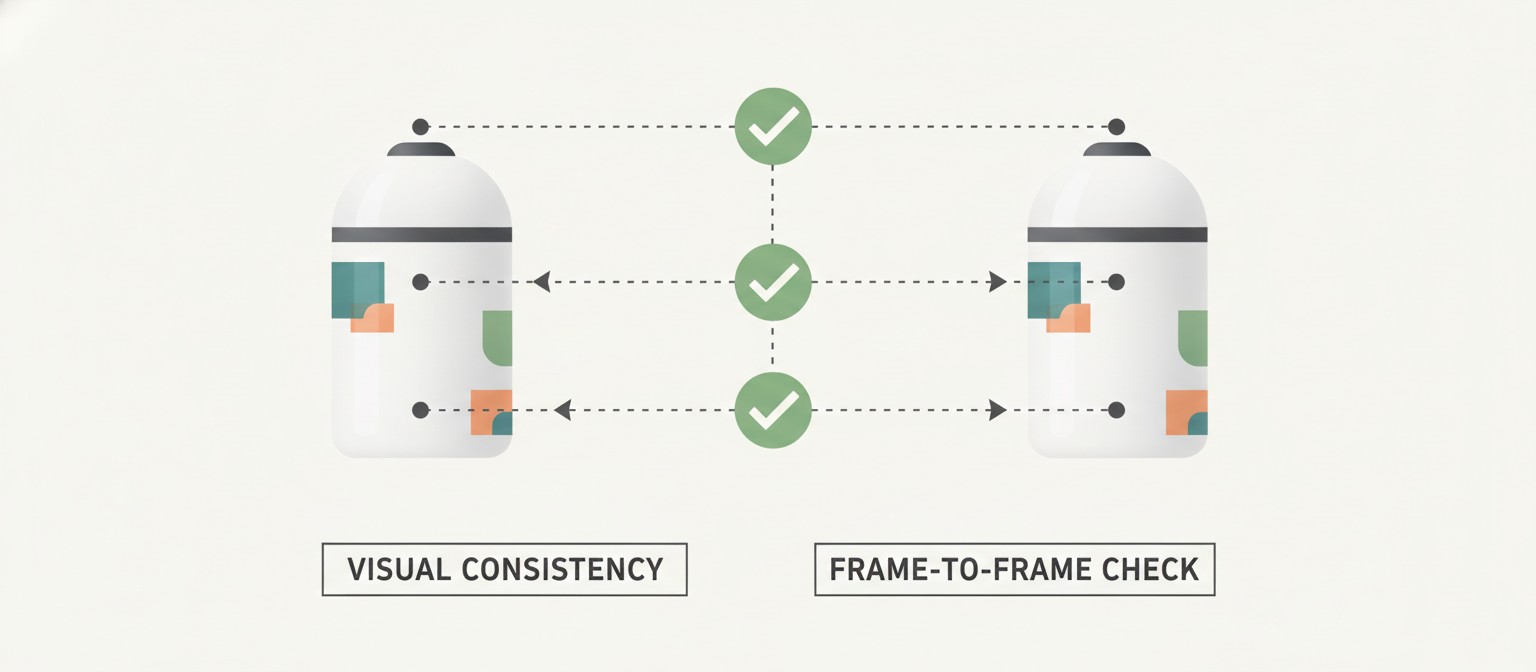
An ad has a narrow job. The product must look like the real product. The person speaking must remain the same person throughout. The message must match what the brand actually wants to say. A clip that scores well on general visual quality might still fail because a label is unreadable, a bottle changes shape halfway through or the presenter’s face subtly shifts.
As AI video moves into commercial use, the industry is developing more specific ways to measure success.
What “Good” Means for an Ad
For advertising, a usable AI clip typically needs to:
- Follow the brief closely, including actions, tone and messaging
- Preserve the product exactly as shown in reference images
- Keep the presenter consistent from the first frame to the last
- Look realistic, without distracting artifacts
- Move naturally, with believable motion and continuity
Falling short on any one of these can make an ad unusable, even if the others are perfect.
A Pass-or-Fail Approach
One example of advertising-specific evaluation comes from Creatify Labs, which released its Boreal-H3 video model in October 2026. In its launch details, the lab describes an Ads Quality Index that measures how often a model produces a clip that works as an ad.
Rather than averaging scores, the index counts a clip as passing only when prompt following, reference consistency and visual realism each score at least 6 out of 10. Each model’s pass rate is then indexed against a baseline. This approach reflects how advertisers think: a clip with stunning visuals but a distorted product still fails.
The lab also uses a broader set of dimensions when assessing generated ads:
| Dimension | What it asks | Why it matters |
| Brief execution | Did the clip do what the brief asked? | Ads must deliver a specific message |
| Product integrity | Does the product match the reference? | Misrepresenting a product damages trust |
| Creator identity | Is the presenter the same person throughout? | Inconsistency looks unnatural and unprofessional |
| Realism | Does the clip look believable? | Artificial-looking footage reduces credibility |
| Motion and continuity | Does movement flow naturally? | Jerky or broken motion distracts viewers |
Using these measures, the lab reports that Boreal-H3 reached 85.3% on reference fidelity at a stricter 7 out of 10 threshold and raised completion of difficult production briefs from about 28% to 50% compared with its base model.
Machines Judging Machines, Checked by Humans
Evaluating thousands of AI clips by hand would be slow and expensive, so many teams use automated judges, AI systems trained to score outputs. The obvious concern is whether those judges agree with real people.
Creatify Labs says its automated judges were validated against human preferences, and its human studies used anonymized, randomized outputs so reviewers could not tell which model produced each clip. This kind of blind comparison helps reduce bias and gives more confidence that automated scores reflect what people actually notice.
Fixing the Measuring Stick First
There is a well-known problem in optimization: when a measure becomes a target, systems can learn to game it rather than genuinely improve. In AI training, a model might learn to satisfy a scoring system in ways that do not match real quality.
The Boreal-H3 approach tackles this by revising the evaluator or reward whenever its feedback seems unreliable, before using it to train the generator further. In other words, the team prioritizes measurement quality over simply training on more data. It is a small but important principle for anyone building AI systems: if the yardstick is wrong, every improvement built on it may be wrong too.
Guardrails at the Point of Use
Measurement does not stop once a model is trained. Tools that use these models can add their own checks. Creatify’s AI agent, for example, confirms brand names, logos, product details and key claims before generating an ad, then compares outputs against those confirmed details to catch errors such as logo drift or incorrect text. Platforms like Creatify.ai combine model-level testing with these practical checks to reduce the chance that a flawed clip reaches an audience.
Broader frameworks encourage the same mindset. The US National Institute of Standards and Technology’s AI Risk Management Framework emphasizes measuring and monitoring AI systems throughout their lifecycle, not just during development.
The Limits of Testing Before Launch
Even the best evaluation methods have a ceiling. Creatify Labs itself notes that its evaluation measures ad quality before launch, while real campaign testing is still needed to determine which ads convert.
A technically flawless clip may still fail to persuade, while a simpler one might perform surprisingly well. Pre-launch testing helps filter out errors and weak outputs, but audience behavior remains the final judge.
What This Means for Anyone Using AI Video
For marketers, creators and businesses evaluating AI video tools, a few questions can help:
- 1. How does the provider define quality? Look for measures tied to your actual goals.
- 2. Are results checked by humans? Automated scores should be validated against real preferences.
- 3. Does the tool protect brand details? Product accuracy and consistent presenters matter.
- 4. How are errors caught before publishing? Built-in checks reduce risk.
- 5. How will you test real performance? Plan small campaigns to see what works.
Understanding how a tool measures success makes it easier to trust, and to challenge, the results it produces.

Better Measurement, Better Machines
As AI video becomes part of everyday advertising, the way we measure quality is becoming just as important as the models themselves. Specialized benchmarks, blind human testing and careful evaluator design help ensure AI clips meet real-world standards.
The future of AI video will not be defined only by more powerful models. It will also depend on smarter ways of knowing when those models are truly getting it right.


