
The wait for a new AI data center in Europe rarely starts with servers. It starts with a grid connection. An interconnect queue is the formal waiting line to plug a large load into the transmission network, and it can stretch for years while utilities study capacity, reinforce substations, and permit new lines. That queue is the schedule that matters. Against that background, Nvidia introduced a container that shortens a different schedule entirely.
At GTC Berlin on 21 October 2026, the company introduced DSX POD, a reference design for complete Vera Rubin AI factories built by partners inside modular containers. The hardware scope and builder list are concrete, with deliveries scheduled from early 2027. The framing deserves a closer read. Nvidia says on-site work drops from about six months to as little as 14 days, measured from a prepared site. An AI factory here means a data center designed to manufacture tokens, the output units of AI models, at industrial scale. The 14 days covers the factory-built part. It does not cover the grid.
The Grid Connection Is the Schedule
Independent analysis makes the limit plain. Futurum, in its assessment of the binding constraint on AI factories in Europe, states that access to grid power remains the constraint and that DSX POD does not address it. The Register made the same qualification in plainer terms, noting that the 14-day figure excludes getting power, connectivity, and other site infrastructure ready first, in its report on the GTC Berlin keynote. Those are independent observations, not Nvidia claims, and they belong in the same sentence as the headline number.
This distinction matters because an AI factory is an electrical project before it is a computing project. A single DSX POD concentrates hundreds of accelerators in one container. Many pods make a campus. The campus needs firm megawatts, substation capacity, backup, and heat rejection. No container design can create grid headroom. It can only arrive faster once headroom exists. Readers who follow the earthly limits of exascale systems, where power and siting already decide what gets built, will recognize the pattern. Compute scales in factories. Power scales through utilities.
What the 14 Days Actually Measures
The 14 days measures relocated integration work, not eliminated site work. Nvidia describes a repeatable, validated architecture that partners preintegrate in the factory. That is an Nvidia claim about its reference design, and it is specific. Rack to rack cabling, wiring, piping, and functional validation happen in a controlled manufacturing hall. Site teams prepare foundations, power, and external connectivity in parallel. When the container arrives, the remaining steps are placement, connection to prepared utilities, and final burn-in and testing.
The table below separates what fits in the 14-day window from what has to exist before that clock can start. The division follows Nvidia’s own qualification.
| Stage | Inside the 14-day window | Where the work happens |
|---|---|---|
| Rack installation and rack to rack cabling | Yes | Partner factory, before shipment |
| Copper and fiber runs, piping, power wiring | Yes | Partner factory, before shipment |
| Functional validation and burn-in | Yes, with final validation on site | Factory first, then prepared site |
| Foundations, pads, placement, and multi-pod assembly | No | Customer site, in advance |
| Grid connection, substation capacity, 800-volt power supply | No | Utility and customer site, in advance |
| Heat rejection, water hookup, network backhaul | No | Customer site, in advance |
| Connect to utilities and serve first production tokens | Yes, within as little as 14 days | Prepared site, after utilities are ready |
Time to first token is Nvidia’s term for the moment a facility starts producing billable AI output. It is a commercial clock, not an engineering benchmark. Shortening it matters because idle GPUs earn nothing while capital costs accrue. The container shortens that commercial clock. It does not shorten the utility clock that must run first.
Inside One DSX POD: 504 GPUs in a Box
A rack is a tall steel cabinet that holds servers, networking, and power distribution in a standard footprint. NVL72 is Nvidia’s term for a rack-scale system in which 72 GPUs operate as one tightly linked domain. In DSX POD, seven such racks travel together. That is 504 graphics processors, plus 252 Vera central processors, in one shippable unit. For scale, that is roughly the accelerator count of a small university research cluster, packed into a single container.
The table below summarizes the pod as specified by Nvidia. Every figure in this table is a Nvidia claim about its reference design, not an independent measurement.
| Component | Nvidia specification | What it means in plain terms |
|---|---|---|
| Compute racks | 7 Vera Rubin NVL72 racks | Seven linked cabinets that act as one compute block |
| Accelerators and processors | 504 GPUs and 252 Vera CPUs | Graphics chips do the AI math, central chips manage data and control |
| Networking | Spectrum-X Ethernet, plus about 20 km of NVLink copper and 17 km of scale-out cabling | Spectrum-X is Nvidia’s Ethernet system for AI traffic, NVLink is the short, fast link between GPUs |
| Power delivery | 800-volt direct current (DC) input boundary | Higher voltage DC cuts copper losses and current versus older AC distribution inside dense racks |
| Cooling | Closed liquid loop with dry coolers, coolant up to 45 degrees Celsius | Water or coolant carries chip heat to outdoor radiators that dump it to air without evaporation |
| Size and weight | About 28,000 kilograms, standard container footprint for road transport | Heavy but truck movable on normal roads, no special wide load design |
| Builders and schedule | 17 partners, worldwide delivery from early 2027 | Dell, HPE, Lenovo, Foxconn through Ingrasys, GIGABYTE, Pegatron, QCT, Wistron, Bull, Delta, Schneider Electric, and Vertiv are among the named builders |
Nvidia has not disclosed pricing. Analysts cited by CNBC estimate that a single Vera Rubin rack can cost more than $7 million. That is an analyst estimate reported by CNBC coverage of the per-rack cost discussion, not a Nvidia price. The hardware list is from Nvidia. The dollar figure is not.
Why Time to First Token Matters Commercially
That revenue timing is why Nvidia frames DSX POD around tokens rather than raw build speed. Factory testing reduces exposure to component delays and on-site rework. Standard units simplify planning and financing because delivery dates look more like product shipments than construction milestones.
There is a supply chain angle here that goes beyond one product. When advanced packaging becomes scarce, finished accelerators wait for slots, and power demand arrives in steps rather than smoothly, a pattern detailed in coverage of how CoWoS advanced packaging creates stepwise jumps in power demand. A container does not solve that upstream packaging limit. It moves the next bottleneck, on-site integration, into factories that can work in parallel with site preparation. That is useful, but it is a partial fix by design.
The Water and Power Efficiency Claims, at the Stated Scale
Cooling is where water enters the story. Traditional data centers often use evaporative cooling, which boils off water to reject heat. A closed liquid loop paired with dry coolers rejects heat through outdoor radiators to air, without that evaporation step. Dry coolers are simply large radiator and fan units. Coolant temperature up to 45 degrees Celsius matters because warmer coolant makes air cooling more effective and reduces chiller work.
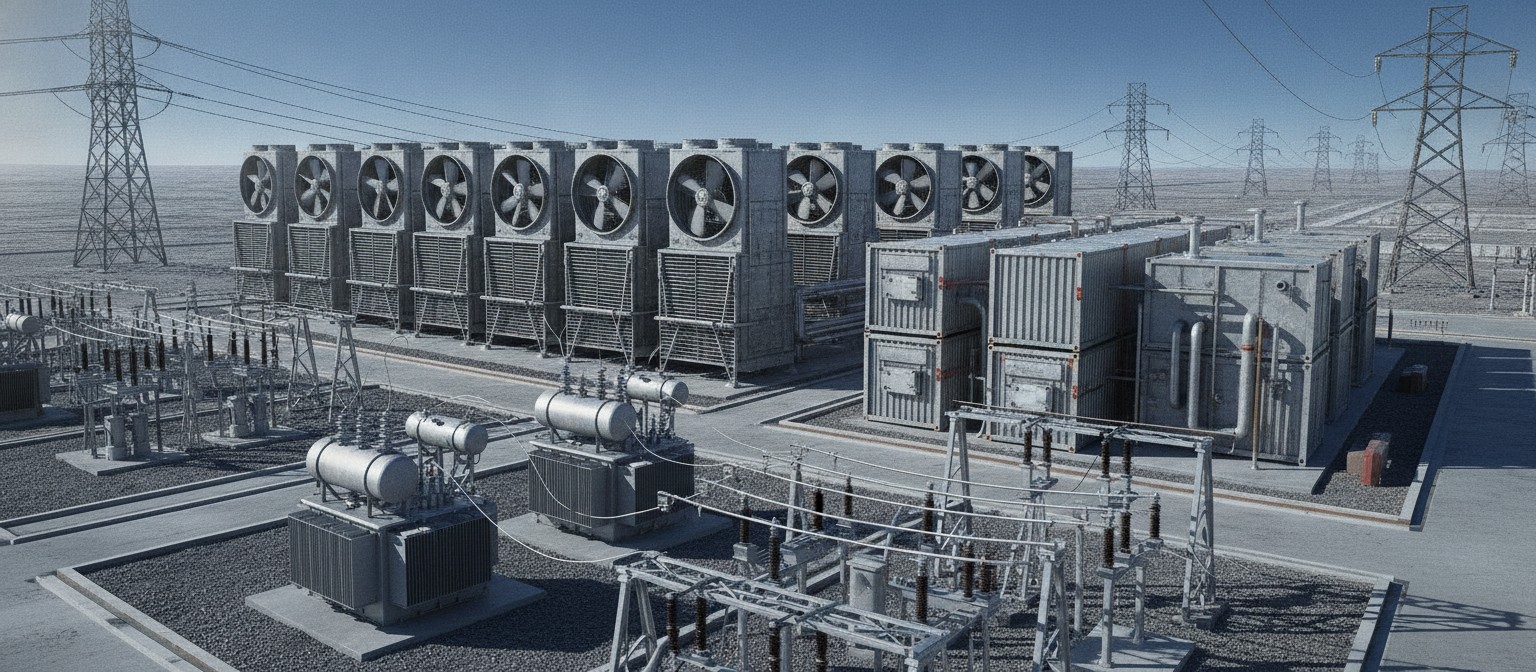
Nvidia claims its DSX platform can reduce water use for cooling by up to 100 percent and generate the same AI output with up to 30 percent less power when its wider software controls are applied, including savings of 54 million liters of water per day at 2 gigawatts. Each of those figures is an Nvidia claim at a stated scale and with stated software conditions, not an independent audit. Data Center Knowledge, in its analysis of the modular push and community objections, notes that dry coolers could ease one common local objection around water while warning that faster deployment may sharpen opposition where projects already move quickly.
The power efficiency point needs the same care. Using less power per token is valuable when a site has a fixed power allocation, because efficiency becomes usable capacity. That logic only helps if the site already has an allocation. This is where flexible load controls enter. Nvidia describes software that adjusts load to grid conditions. Independent work on carbon-aware computing that treats AI training as a steerable load shows why grid operators might prefer flexible demand, but preference is not a connection agreement. A flexible pod still needs a signed interconnection.
What the Container Format Does Not Fix
Four constraints sit outside the container, and none are moved by factory integration.
- Interconnect queues. The utility study and approval sequence that grants firm capacity. It involves substations, transmission planning, and permits. It is measured in years in constrained markets, not weeks.
- Heat rejection at site. Dry coolers still need space, airflow, noise permits, and local approval. Closed loops save water, but they do not remove heat from planning review.
- Water availability and discharge. Even low-water designs need makeup water, treatment, and community acceptance. Local aquifers and rivers set limits that a reference design cannot change.
- Local grid capacity. Transformers, feeders, and backup must exist before pods can ramp.
None of this makes DSX POD vaporware. The supply chain behind it is concrete. The honest description is simply narrower than the headline.
Readers weighing where AI should run can apply the same math used in comparisons of when local AI is greener than the cloud, where grid intensity and utilization decide the outcome. Location matters less than the carbon intensity of the electricity actually delivered, the efficiency of the facility, and how fully the hardware is used. A container that fills faster still inherits the grid it plugs into.
Frequently Asked Questions
What exactly is an AI factory?
An AI factory is a data center optimized to train AI models and serve inference at scale. The factory metaphor refers to inputs of power, data, and chips and outputs of tokens. A containerized AI factory puts much of that system inside shippable modules.
How much does an AI factory cost?
Nvidia has not disclosed DSX POD pricing. Analysts cited by CNBC estimate more than $7 million per Vera Rubin rack, which would imply tens of millions per seven-rack pod before site, power, and networking costs. Treat that as an analyst estimate, not a Nvidia list price.
Who owns the AI factories?
Ownership varies. Sovereign deployments may be state-owned, enterprise pods may be company-owned, and cloud capacity may be leased. DSX POD is a reference design that partners build, so the buyer owns or leases the physical pod while Nvidia supplies the architecture and key silicon.
How is an AI factory different from a data center?
All AI factories are data centers, but not all data centers are AI factories. The difference is density and purpose. AI factories use liquid cooling, high voltage DC distribution, and specialized networking to sustain hundreds of accelerators in a small footprint for training and high-volume inference.
Can a container avoid a grid queue?
No. Factory integration runs in parallel with site preparation, but the pod still needs firm power, heat rejection, and network backhaul at the destination. The Register and Futurum both flag that the 14-day figure assumes those utilities are already ready.
The Bottom Line: A Faster Box on a Slow Grid
DSX POD solves a genuine problem. Moving cabling, plumbing, and testing into partner factories is a sensible industrial step, and the 17-builder roster gives it weight. The water and power efficiency features are directionally useful, stated at specific scales and software conditions by Nvidia.
What it does not solve is access. Grid queues, substation capacity, water rights, and local permits still set the start date. Until those are secured, a pod built in 14 days still waits on an interconnection measured in years. Buyers should read the headline as a measure of factory discipline, not site readiness, and plan the grid application before the container order.


