
The era where artificial intelligence existed solely within the confines of remote hyperscale data centers has ended. Today, these powerful models hum across our office desks and within university laboratories, powered by compact personal AI supercomputers that deliver professional-grade capability without a cloud connection. Localized computing raises a deceptively simple question: Is running AI locally actually better for the environment than relying on the cloud?
The answer depends on math, not marketing.
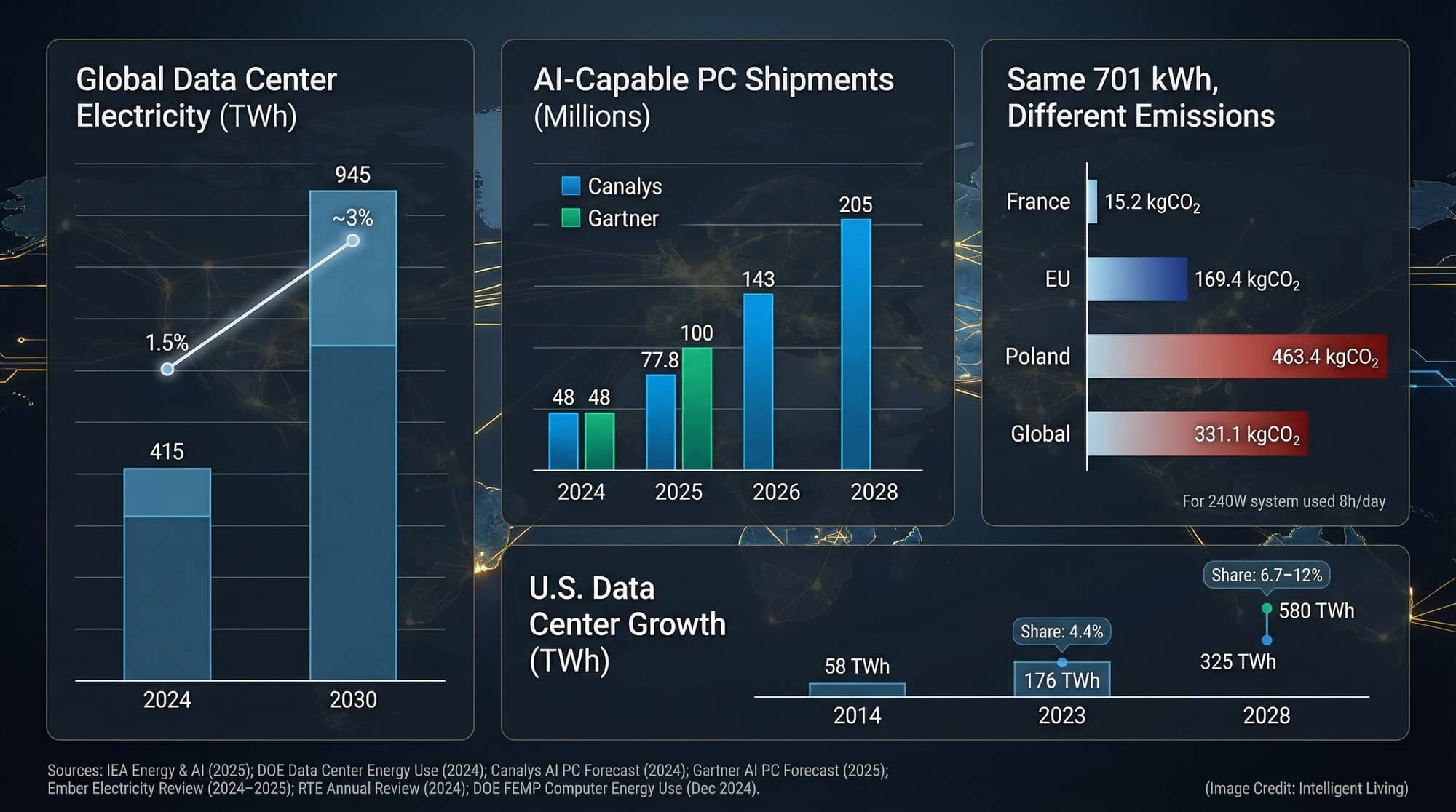
In many regions, infrastructure challenges at the grid level emerge long before software constraints become the primary bottleneck. Projections within recent assessments of global energy demand from artificial intelligence suggest that consumption could reach 945 TWh by 2030. Such a scale rivals the total electricity demand of entire industrialized nations. At the same time, desk-side systems such as NVIDIA’s DGX Spark list a 240-watt external power supply and a 140-watt system-on-chip thermal design power, offering a real-world reference point for desktop AI workstation power.
The physical location of your AI compute remains secondary to the efficiency and timing of its operation. Instead, a complex array of operational factors dictates the final carbon footprint:
- Local grid mix and carbon intensity
- Facility cooling and power efficiency
- Real-time hardware utilization rates
- Total hardware lifespan and upgrade cycles
- Waste heat recovery and reuse potential
Evaluating these metrics reveals that where AI runs matters far less than how and when it operates. Maintaining a high utilization rate on a clean grid can often outperform the efficiencies of a remote facility tied to a fossil-heavy power source. Assessing these trade-offs is the first step toward building a truly sustainable personal or organizational compute strategy.
Typical scenarios often highlight this growing environmental tension. A graduate student trains a model overnight on a campus cluster while radiators in the same building quietly draw heat recovered from that data center. Across town, a freelance designer leaves a desktop AI workstation idling most of the day because it feels empowering to own the compute. Both are using advanced AI. Only one setup may be reducing emissions. That trend is now visible in the hardware itself, as enthusiasts build home AI servers in basements and wine cellars.

Calculating the AI Carbon Footprint: Local vs. Cloud Emissions Models
Quick Facts: Local AI vs. Cloud Energy, PUE, and E-Waste
Evaluating the comparative impact of local and cloud environments requires analyzing specific energy and waste benchmarks. These figures provide a baseline for determining how hardware utilization and grid efficiency dictate the environmental cost of modern computing.
- Projections within recent assessments of global energy demand from artificial intelligence suggest that consumption could reach 945 TWh by 2030.
- A widely cited benchmark puts average annual PUE near 1.56, while modern facilities often operate closer to 1.3, according to the Uptime Institute’s 2024 Global Data Center Survey.
- NVIDIA lists a 240 W power supply for DGX Spark-class desk-side AI systems, with the GB10 superchip rated at 140 W TDP.
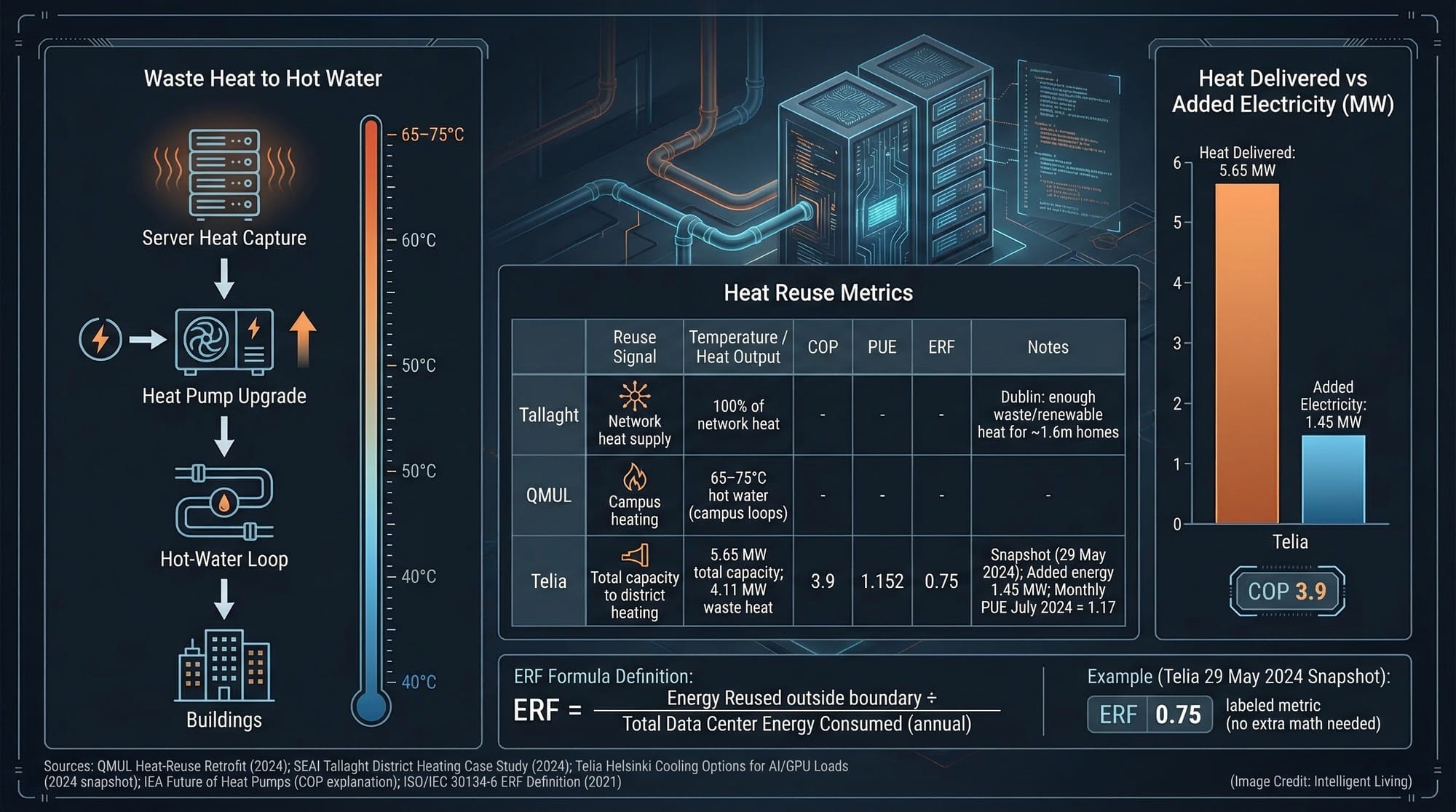
- A real-world proof point for heat reuse is the Tallaght District Heating Scheme, which supplies 100% of its network heat using waste heat from a nearby data center.
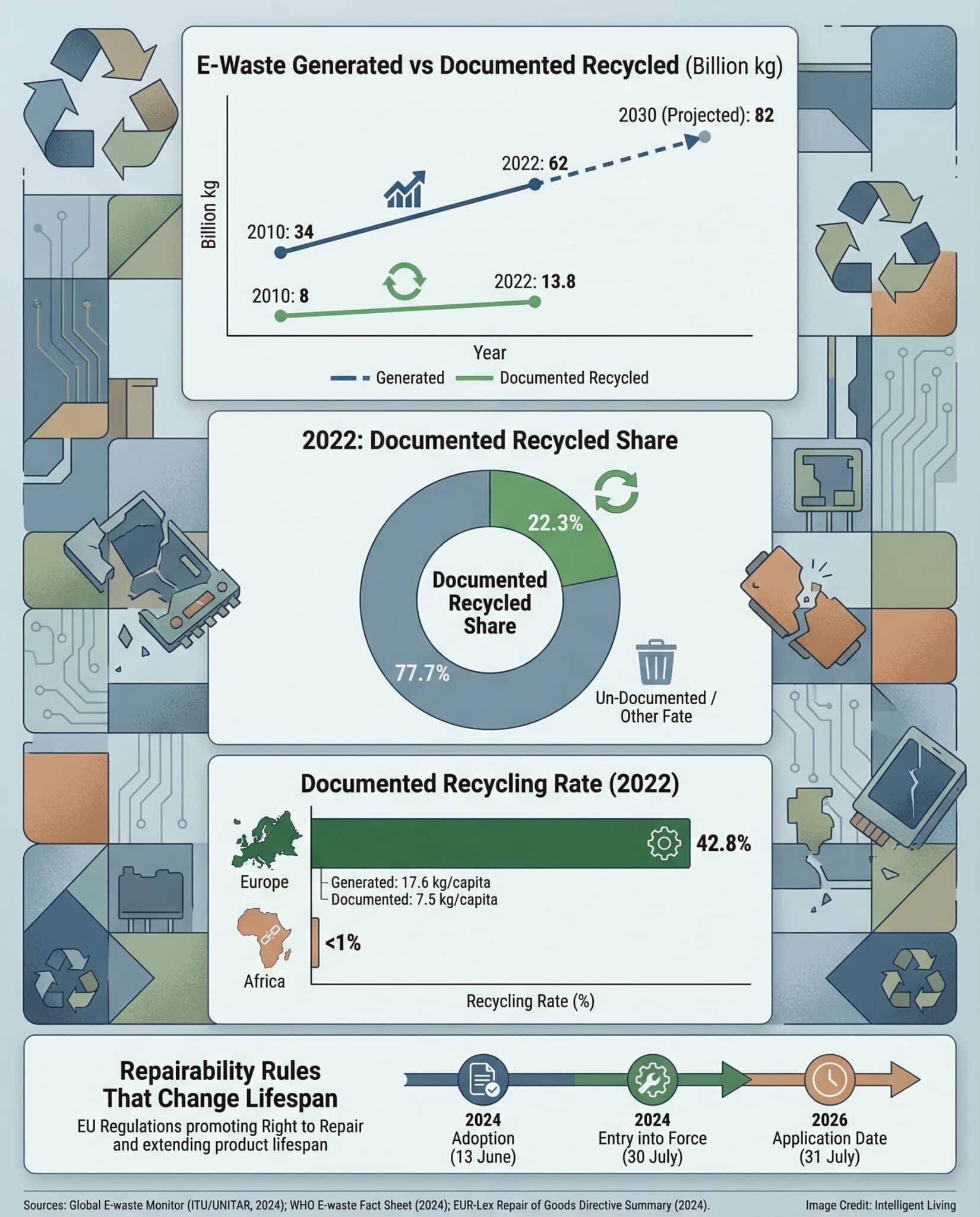
- A record 62 million tonnes of e-waste was generated in 2022, according to recent tracking of discarded electronics, yet only 22.3% was formally collected.
- Carbon-aware scheduling depends on whether decisions use average or marginal signals, and marginal vs. average carbon intensity can change what “cleaner hours” actually mean.
Technological benchmarks allow us to move past marketing narratives and into the rigorous math of sustainability. Analyzing the interplay between power usage effectiveness and e-waste volume highlights the specific trade-offs inherent in decentralized AI infrastructure.
What Actually Determines Whether Local AI is Greener than Cloud AI?
Quantifying the operational carbon footprint of AI requires analyzing a fundamental mathematical relationship:
Carbon Emissions = Energy Used × Carbon Intensity of Electricity
PUE Explains Overhead, Not Grid Cleanliness
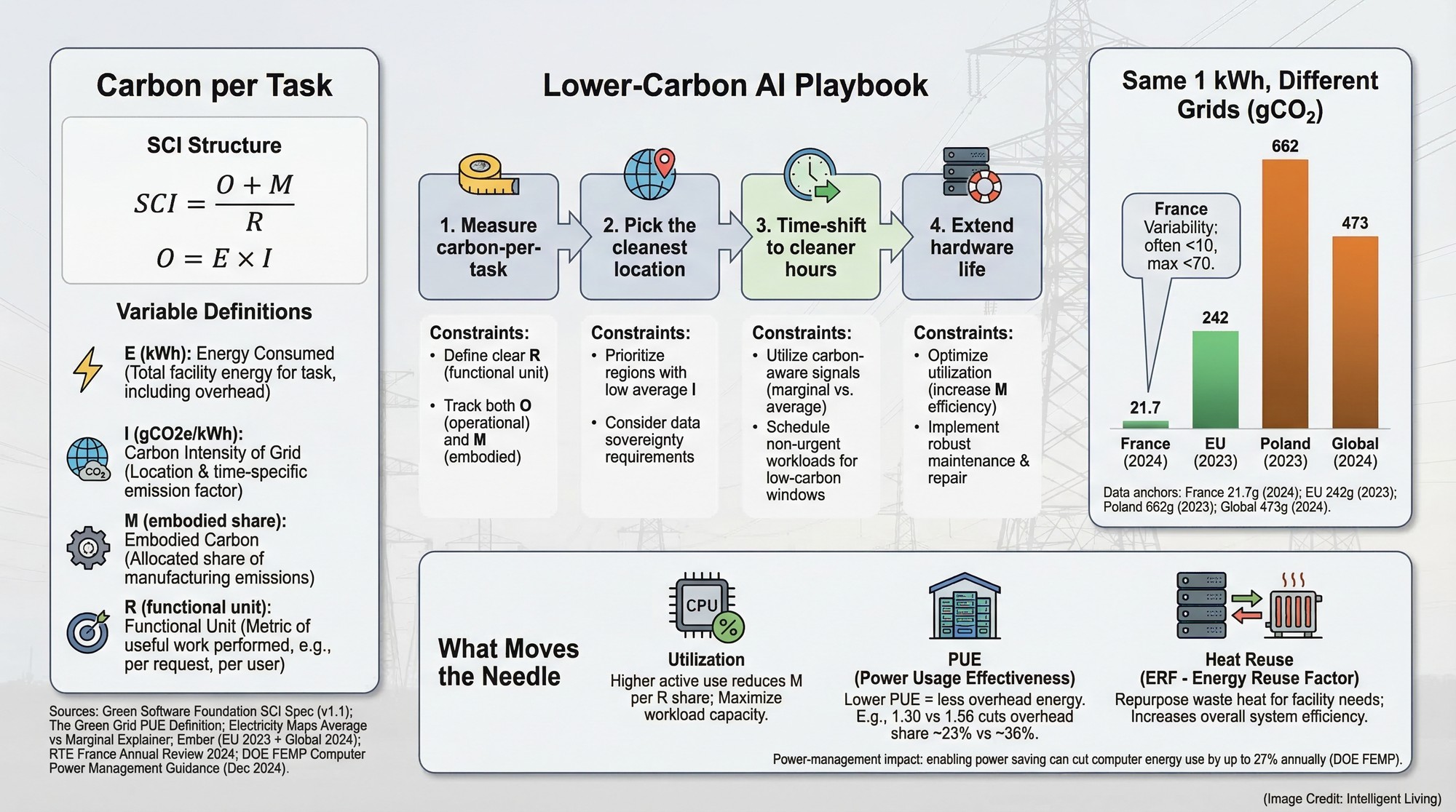
In cloud environments, total energy used is often estimated as IT energy multiplied by Power Usage Effectiveness (PUE). PUE represents how much extra energy is required for cooling, lighting, and facility overhead beyond the servers themselves. Industry surveys commonly place the annual average near 1.56, while newer data center builds often operate closer to 1.3.
A lower PUE is a distinct advantage, but it is not a magic number. It fails to account for grid cleanliness or how efficiently a model converts electricity into useful output. Architecture belongs in that second term as well. Sparse designs such as Recursive’s Flint route each token through roughly 2.5 billion of their 40 billion parameters, so they perform less arithmetic for the same answer. A well-run on-prem setup in a clean-grid region can beat a more efficient facility on a dirtier grid.
The Break-Even Test: Local vs. Cloud
The break-even logic is straightforward:
If (PUE_local × Grid_Intensity_local) is lower than (PUE_cloud × Grid_Intensity_cloud), local compute can produce fewer operational emissions.
Cooling and Utilization are the Swing Factors
Cooling remains a primary driver of PUE variance between facilities.
At the facility level, the implementation of innovative cooling controls and economizer designs can significantly reduce mechanical load. Automated systems can target specific hotspots and utilize outside air whenever environmental conditions allow. Some operators now treat geography as an efficiency lever, building in caves, fjords, or underwater capsules because extreme cooling locations can cut overhead energy when power density rises.
Utilization is the hidden variable. A desktop AI system that runs at high capacity for meaningful workloads can justify its operational footprint. A powerful device that remains idle for most of the day amortizes manufacturing emissions across minimal output. This inefficiency often causes local compute to fall behind in carbon-per-task metrics, even when the electricity source is relatively clean.
Local AI PCs and Energy Efficiency: Analyzing the Shift in Power Demand
The Power Envelope Is Now Desk-Sized
Devices marketed as personal AI supercomputers shift compute from centralized campuses to homes and offices. HP has taken the idea furthest so far, pre-installing an offline AI for scientific research on its Z-series workstations. NVIDIA’s DGX Spark hardware specifications list a 240-watt power supply and a 140-watt system-on-chip TDP, which makes the power envelope concrete rather than hypothetical.
Household Energy Creep, Scaled Up
Data from standard household electricity consumption references places average U.S. residential use at about 12,194 kilowatt-hours. Applying a practical energy model reveals the potential impact: a 240-watt system utilized for eight hours daily consumes approximately 700 kilowatt-hours per year.
Individual homes may not see dramatic changes from a single device. However, multiplying this demand across millions of households creates a significant impact on local grids, especially in neighborhoods where electrification is already stacking new loads.
Utilization and Embodied Carbon Matter More than Peak Watts
There is also the question of embodied carbon, the emissions produced during hardware manufacturing. Meta’s sustainability team describes component-level embodied-carbon accounting in data center hardware, highlighting why device lifespan and upgrade cadence matter as much as watts.
Scenarios where a startup runs a workstation constantly for three months, then leaves it mostly idle for nine, demonstrate how the climate impact shifts from compute efficiency to idle draw and replacement timing. Professional autonomy remains a high priority for many users, but it does not inherently guarantee energy efficiency without disciplined scheduling.
Supply Chains and Data Movement Shape the Footprint
Supply constraints can also shape behavior. When advanced packaging becomes a bottleneck, it pushes prices up and nudges buyers toward faster upgrade cycles, especially during advanced chip packaging bottlenecks like CoWoS.
As models scale, the energy required to move data between chips can rival the cost of the compute itself. This is why photonic networking in AI data center fabrics is now a critical area of exploration to minimize copper losses and excessive heat. Optical inference is following the same efficiency path: a UCLA processor that detects deepfakes using light draws roughly 86% to 96% less power at the decoder level than a comparable digital model.
Localized AI systems effectively decentralize the geography of emissions, but they offer no guarantee of a net reduction in the total carbon footprint without intentional optimization. One emerging approach that tackles both hardware waste and emissions is Google and UC San Diego’s project to build a data center from old phones, repurposing 2,000 discarded Pixel devices into a working cloud cluster launching this year.
Campus AI Networks and Waste Heat Reuse: Sustainable Computing Strategies
Why Campuses Can Beat Cloud on Carbon
Universities maintain a distinct advantage in the AI energy debate by controlling the buildings, heating infrastructure, and research clusters within a single physical boundary. That integration creates an opportunity few households have: waste heat reuse.
Heat Reuse Turns Exhaust into Hot Water
Nearly all electricity consumed by compute ultimately becomes heat. The Uptime Institute’s heat reuse primer emphasizes that heat recovery is technically well understood, yet still underused across much of the industry. Where a campus sits on a district network, the pipe may not even start at the data center: wastewater heat recovery draws on a city sewer that is already carrying 10 to 25 degree Celsius water past the building and lifts it into the same kind of loop. In Europe, energy-efficiency rules now push data centers above 1 MW toward waste-heat recovery unless infeasible, which is starting to make heat reuse a planning requirement instead of a nice-to-have.
Queen Mary University of London provides a concrete example. The university describes a retrofit that upgrades data center waste heat into 65–75°C hot water, then circulates it through campus heating loops to reduce reliance on gas boilers.
The Campus Break-Even Checklist
In such a scenario, the carbon footprint of AI workloads can fall because some of the energy displaces fossil heating rather than being vented into the atmosphere. The math changes:
Net Emissions = (Energy × Grid_Intensity) – (Useful_Heat_Reused × Displaced_Heating_Emissions)
Universities also tend to run hardware for longer cycles than consumer markets, which improves the carbon story by spreading manufacturing emissions across more useful work. Long-horizon planning in other high-performance deployments shows how district heating can absorb supercomputing waste heat as a local energy resource instead of vented exhaust.
Late-night research labs are a familiar sight. Visible evidence of sustainability depends on whether the heat from those accelerators is warming student housing or escaping through rooftop vents. That design choice can determine whether on-campus AI is climate-forward or simply decentralized.
The Local AI E-Waste Wave: Grid Constraints and Hardware Repairability
Household Load Growth Meets Grid Constraints
Individual consumption of a few hundred kilowatt-hours may seem negligible, but the aggregate adoption of personal AI PCs creates a significantly different narrative for the power grid. When combined with electric vehicles and heat pumps, these systems can significantly strain residential grids already reaching their capacity. The U.S. Energy Information Administration warns of accelerating load growth in a January 2026 electricity demand outlook that flags large computing facilities as part of the demand story.
E-Waste and Critical Minerals Become the Constraint
The environmental risk is not limited to electricity. The World Health Organization notes that global e-waste reached 62 million tonnes in 2022 and that only 22.3 percent was documented as formally collected and recycled.
Repairability Policy Is Now an Emissions Lever
Adopting the rapid upgrade cycles prevalent in the gaming industry would inevitably accelerate the accumulation of embodied carbon and the depletion of critical minerals. In this high-turnover environment, repairability becomes a central pillar of environmental policy. Under EU rules promoting the repair of goods, manufacturers must offer repair on request for certain product categories with EU repairability requirements, and they cannot block repair purely for economic reasons.
Much of the current hardware repairability debate focuses on ‘parts pairing’—a software practice that restricts device functionality after a third-party component is installed. This shift is why emerging right-to-repair legislation has become a critical emissions issue rather than a simple consumer rights debate. Repair is becoming infrastructure.
The e-waste story is also a materials story. Even small improvements in device longevity can reduce demand for new mining and refining, especially when critical minerals locked inside discarded electronics are treated as recoverable resources. Emerging graphene-based recovery methods for metals in e-waste demonstrate that recycling science matters alongside policy. Durability logic across consumer tech categories, where longevity testing that rewards longer service life highlights an emissions lever, shows that keeping functional hardware in use longer is essential.
How to Cut AI Emissions without Losing Capability
So What Should We Do? A Practical Playbook for Lower-Carbon AI
A Habit-Based Approach that Scales
Achieving lower-carbon AI requires shifting from isolated hardware decisions to a comprehensive framework of operational habits.
Track Emissions like Cost
First, measure the carbon-like cost. A practical yardstick is the Software Carbon Intensity (SCI) standard, which treats emissions as a rate per unit of useful work rather than a vague total. Carbon-aware computing shifts heavy workloads into cleaner hours by using real-time grid carbon intensity data as a scheduling signal instead of treating electricity as a flat background resource.
Match Workloads to the Right Location
Second, match workload to location intentionally. Burst training tasks may still belong in efficient hyperscale facilities with strong renewable procurement. Steady, predictable inference workloads in regions with clean grids can be good candidates for local or campus clusters, especially if heat can be reused.
Buy for Longevity and Repair
Third, prioritize longevity. Repairable design and longer replacement cycles reduce both manufacturing emissions and the sheer volume of devices entering the waste stream. Organizations increasingly adopt ‘GreenOps’ as a core discipline, ensuring sustainability is monitored with the same rigor as system performance by leveraging carbon-aware computing practices to optimize workloads during periods of clean grid energy.
Eliminate Idle Runtime
Finally, avoid idle waste. Turning off or scheduling down powerful AI workstations when they are not needed often beats marginal efficiency tweaks because it attacks the biggest hidden emitter: unnecessary runtime.
The most sustainable AI strategy is rarely the most glamorous one. It is disciplined, measured, and grounded in real data.
The Future of AI Infrastructure Depends on Where and How It Runs
AI’s environmental footprint will not be decided by a single company or device class. It will be shaped by millions of decisions about where compute runs, when it runs, how efficiently facilities operate, whether heat is reused, and how long hardware stays in service.
Local AI can be greener than the cloud. It can also be a distributed emissions shift into neighborhoods and campuses. The difference is not philosophical. It is mathematical.
Evidence suggests that the next technological frontier will prioritize infrastructure constraints over raw performance metrics. As compute demand grows, the bottlenecks increasingly look physical, and the physical limitations of orbital computing and space-based data centers demonstrate why power delivery and heat rejection will ultimately dictate the scale of software.

Scaling Sustainable AI Through Local Innovation and Infrastructure
The transition toward localized compute represents more than just a technological shift; it is a geographic reorganization of our environmental responsibilities. Prioritizing high utilization and investing in repairable hardware allows us to ensure that the rise of personal supercomputers contributes to a lower-carbon future rather than adding to the global e-waste wave.
Workloads processed in massive data centers or on desk-side workstations share the same collective goal: leveraging the transformative power of artificial intelligence while minimizing its physical impact on the planet we share. Sustainable AI strategy remains grounded in transparency and measured action.
Decoded: AI Energy Consumption and Environmental Impact
How does local AI energy use compare to hyperscale cloud facilities?
Local systems can be cleaner if they operate on a renewable-heavy grid with high utilization, but cloud centers often hold an edge due to superior cooling efficiency and lower PUE.
What are the primary drivers of carbon emissions in AI computing?
Emissions are determined by the total energy consumed multiplied by the carbon intensity of the local grid, alongside the ’embodied carbon’ generated during hardware manufacturing.
Can we actually use AI waste heat for residential or campus heating?
Yes, university retrofits already demonstrate that server exhaust can be upgraded into hot water for campus loops, effectively displacing fossil fuel heating.
Does a personal AI PC significantly increase home electricity bills?
A high-performance workstation running 8 hours a day can add roughly 700 kWh annually, representing a noticeable single-digit percentage increase for a typical household.
Why is the ‘right to repair’ considered a climate issue for AI hardware?
Repairable designs extend the lifespan of high-performance chips, slowing the extraction of critical minerals and reducing the massive volume of global e-waste.


