
Light is replacing electricity in the most surprising places—inside the processors and networking equipment that power the modern AI revolution. While the term “photonic chips” suggests a distant reality, the technology is already emerging in tangible products, not just laboratory experiments. Over the next few years, the data centers that train and run artificial intelligence models will rely more on photons than electrons to move and process information.
Necessity, rather than novelty, drives this shift. As compute demand and power use skyrocket, traditional silicon chips have hit physical and thermal limits that electrons simply cannot overcome. By transitioning to light-based data movement, the industry is breaking through these barriers to enable the next generation of hyperscale computing.

Quick Facts About Photonic Computing and Networking
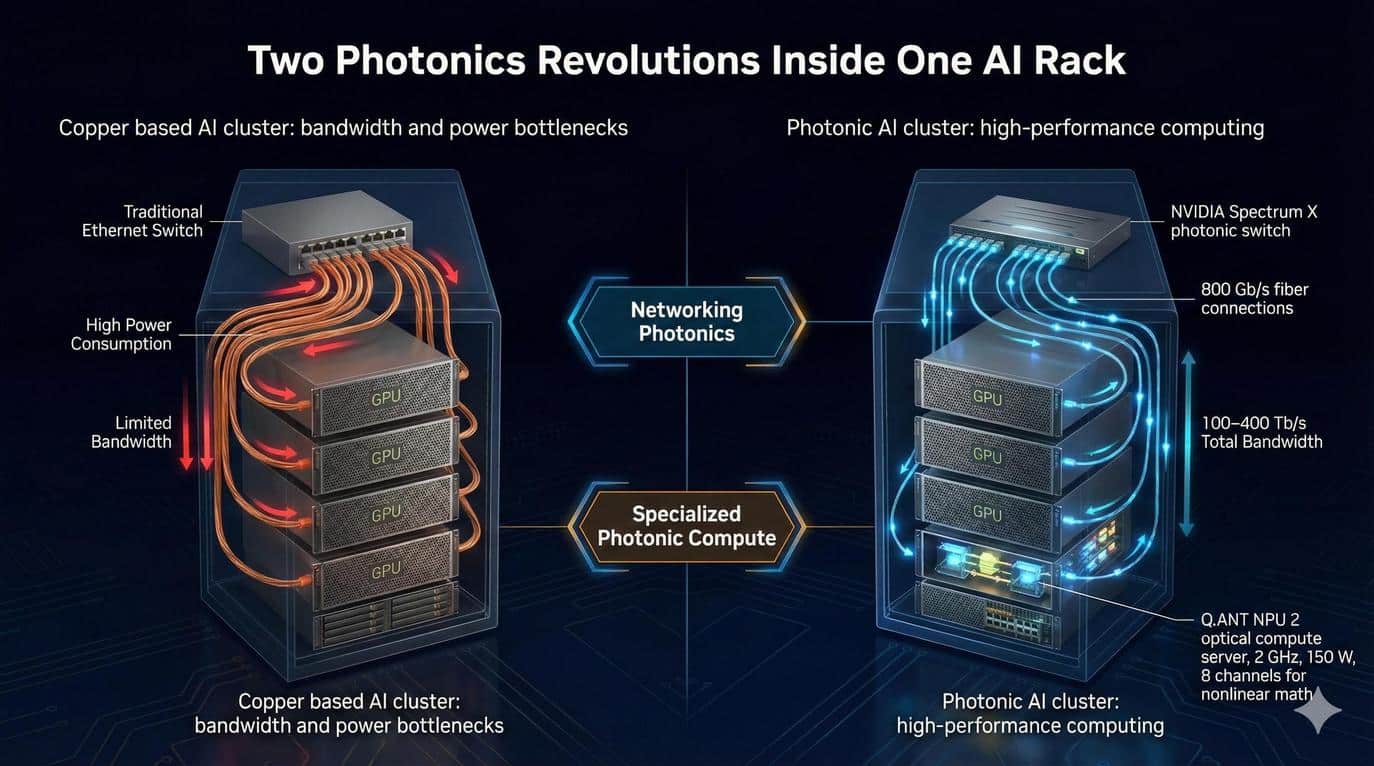
- Mainstream adoption starts with networking: NVIDIA networking platforms are commercializing co-packaged optics (CPO) in their new Spectrum-X and Quantum-X switches, expected to reach large-scale deployment between late 2025 and 2026. These use light instead of copper to transfer data within and between racks, cutting power consumption and latency.
- Photonic compute is entering the prototype-to-product phase: German photonics startup Q.ANT announced its NPU 2 photonic processor built on thin-film lithium niobate (TFLN) technology, targeting shipment in the first half of 2026.
Key Drivers and Regional Developments
- Energy efficiency is the key driver: AI data centers already approach the so-called 10-megawatt wall of energy draw seen in exascale systems like JUPITER and Google’s latest AI clusters, which makes efficiency gains from photonics critical to continued scale.
- Europe is a strategic early mover: The Jülich Supercomputing Centre is collaborating with Q.ANT to integrate early photonic compute systems into high-performance infrastructure, signaling a push for technological sovereignty.
- Optical reliability remains a limiting factor: NVIDIA’s CEO Jensen Huang cautioned that optical links between GPUs are still less reliable than copper—the final barrier before full mainstreaming.
The Surprise: “Photonic Chips” Doesn’t Mean Photonic GPUs (Yet)
Most people hearing about photonic chips imagine glowing processors instantly replacing silicon GPUs. The reality is more nuanced. In 2025, the mainstreaming of photonics is happening first in networking, not computing. Copper connections that link chips together have become both a heat sink and a performance bottleneck. The data shuffling between accelerators in large AI clusters consumes enormous power and space. Photonic computer chips used for AI and telecommunications already show how transmitting information as pulses of light through fiber eliminates the resistive losses that plague copper at scale.
NVIDIA’s photonic switch rollout for AI networks highlights the commercial arrival of this technology. Specifically, NVIDIA’s upcoming Spectrum-X switches serve as the first major step in this optical transformation designed for next-generation AI data centers. However, Jensen Huang also stated that optical interconnects between GPUs are still not reliable enough for production use. This constraint moderates expectations—photonic GPUs are on the horizon but not yet in the server racks running today’s AI workloads.
Meanwhile, startups like Lightmatter are pushing optical interposers and chiplets for 2025–2026, aiming to move light closer to the GPU and CPU package itself, and the Enosemi acquisition for co-packaged optics in large AI systems underscores how major chipmakers are racing to secure a foothold. Each step brings photonics deeper into the hardware fabric, but the first and largest benefits come from faster, cooler networking.
Optical Interconnects: Solving the Data Movement Bottleneck
Why the Data-Movement Problem Is the Real Bottleneck
The demand for AI model training and inference has exposed a painful truth: AI model training exposes a critical bottleneck: data movement now rivals computation speed as a primary constraint. As clusters grow to thousands of GPUs, the interconnect wires between them consume as much or more power than the chips themselves.
The physical limits of copper—signal loss, heat, and power inefficiency—mean data centers can’t simply scale by adding more hardware. In experimental setups, optical chips that move data at 1.8 petabits per second hint at how far light-based interconnects can push bandwidth compared with metal traces.
Consequently, the industry regards optical networking as the first viable solution. NVIDIA Spectrum-X silicon photonics switches use co-packaged optics that sit directly on switch ASICs, replacing traditional pluggable modules. The result delivers three critical advantages for modern data centers:
- Faster Throughput: Accelerating data transfer rates between nodes.
- Lower Energy Use: Reducing the power overhead of copper transmission.
- Less Rack Congestion: Eliminating bulky cabling to improve airflow.
Such a shift aligns with the broader adoption of silicon photonics used in modern data centers, where light carries more data with less energy than copper. This shift is accelerating now because it directly addresses the most urgent bottleneck in AI infrastructure.
Reliability: The Final Barrier to Full Adoption
Despite their promise, optical interconnects face an engineering hurdle: reliability. As Reuters has noted, even Jensen Huang admits copper remains more dependable for GPU-to-GPU communication. While light offers speed, it remains fragile compared to copper. Signal loss can be triggered by minor environmental variances, including:
- Micro-Misalignments: Even the slightest physical shift disrupts the optical connection.
- Heat Variations: Fluctuating temperatures can warp materials and degrade signal integrity.
Broadcom’s co-packaged optics teams have reported a million hours of link flap-free testing in optical switch environments. However, scaling that reliability across the full GPU interconnect stack remains a work in progress.
Still, the momentum is undeniable. As data centers hit the power wall, photonics offers the most straightforward way to increase bandwidth without multiplying heat or carbon emissions. The trajectory of AI infrastructure clearly points toward optical integration.

Photonic Compute Processors: The Next Frontier for Specialized AI
If networking photonics solves how data moves, photonic computing addresses how it is processed. Projects such as the Q.ANT NPU 2 photonic processor define this next frontier, replacing traditional transistor logic with integrated light circuits built on thin-film lithium niobate. Instead of performing simple multiply-accumulate (MAC) operations, these processors manipulate waveforms to execute nonlinear mathematical functions such as Fourier transforms and convolutions, the building blocks of modern AI.
Such architecture leverages the inherent speed of light. Photons travel faster than electrons and can occupy multiple states simultaneously, enabling massive parallelism. Yet Q.ANT is not claiming to replace GPUs. Instead, the company is targeting specific workloads that benefit most from optical efficiency, including:
- Sensor Fusion: Merging complex data streams from multiple inputs.
- Video Analysis: Processing high-bandwidth visual information in real time.
- Robotic Perception: Enabling rapid, low-latency spatial awareness.
This targeted approach ensures that optical processors are applied where they offer the highest performance gains. Video authenticity is an early example: a UCLA team used a light-powered optical processor to screen deepfake videos with nearly 98% accuracy. Its partnership with the Jülich Supercomputing Centre anchors the technology in real-world deployment rather than lab theory.
The Strategic Value of Thin-Film Lithium Niobate
The use of TFLN isn’t arbitrary. Research on thin-film lithium niobate photonics shows the material can modulate light at high speeds with minimal power, while newer manufacturing methods allow it to be produced on scalable wafers. This combination of efficiency and manufacturability provides Q.ANT a practical path to production—a critical difference from older photonic computing concepts that stalled due to fabrication limits.
A Realistic Timeline for Photonic Compute
Despite these advances, photonic compute is still in its infancy compared to established semiconductor ecosystems. Q.ANT’s H1 2026 shipment target marks the beginning of commercialization, not full market maturity. As Reuters has cautioned, optical systems face unique challenges in durability, temperature control, and integration with existing electronic infrastructure. For now, expect hybrid systems, where photons handle bandwidth-heavy tasks and electrons manage logic and memory, to define the first generation of truly photonic computing environments.
In this staged evolution, the data centers of tomorrow won’t glow like science fiction. They’ll look much the same, but beneath the surface, light will be doing more of the heavy lifting.

The Mainstream Adoption Timeline for Photonic Technology (2025–2028)
Corporate announcements regarding mainstream photonic technology typically refer to the transition from prototypes to early production within specific niches. In practice, “mainstream” for the next few years will mostly describe data center networking—not consumer products or general-purpose computing. The period between 2025 and 2028 will define the difference between promising and proven.
Networking photonics will dominate this phase as manufacturers like Broadcom and NVIDIA scale co-packaged optics for switches that connect AI servers. These advances solve immediate pain points, such as power consumption and heat buildup, that already limit AI cluster growth. At the same time, global photonics market trends show sustained demand for optical components across telecoms and computing. In contrast, photonic compute chips like Q.ANT’s TFLN-based NPU will still be entering testing and pilot deployments.
Photonic technologies in this stage will coexist with traditional electronics, not replace them. Optical networking will complement GPUs, CPUs, and accelerators instead of competing directly. Success will also depend on meeting reliability milestones, such as the million hours of failure-free operation demonstrated by vendors like Broadcom. Simultaneously, advanced packaging bottlenecks—specifically regarding CoWoS high bandwidth memory modules—will continue to dictate where new optical hardware can realistically be deployed. The focus of 2025–2028 will be on scaling these stable optical links throughout full datacenter networks.
Europe’s Strategic Investment in Photonic Supercomputing
While most photonics news revolves around Silicon Valley startups, Europe has quietly positioned itself as a long-term player in photonic compute. The Jülich Supercomputing Centre, Germany’s flagship research hub, has already partnered with Q.ANT to test photonic processors within high-performance computing systems. More than a technological experiment, the partnership represents a calculated sovereignty strategy.
By investing in photonic processors built on thin-film lithium niobate, Europe is diversifying beyond reliance on U.S. and Asian semiconductor suppliers. The partnership will allow European engineers to validate optical compute modules under realistic workloads, establishing a domestic knowledge base before mass production begins. This proactive stance mirrors Europe’s earlier moves in renewable energy and battery manufacturing—de-risking new technology through public-private cooperation.
From a sustainable technology perspective, the bigger picture is that Europe’s photonics push may reduce global supply chain vulnerability and encourage sustainable hardware development. Photonics uses less energy and fewer rare materials than high-end semiconductor fabrication, aligning neatly with broader sustainability goals, and experiments with hidden quantum internet upgrades that run on existing fiber cables show how these optical systems can piggyback on infrastructure that already exists.

Why Nonlinear Math and Future AI Models Require Photonic Speed
The current wave of AI hardware is built around transformers and large language models, but the next evolution of AI will require new types of math. Systems that handle perception, robotics, and continuous data flows need nonlinear and analog-style computations. This is where photonic processors have a natural edge.
Instead of relying on digital multipliers, photonic chips perform calculations by manipulating light wave interference patterns. This allows them to efficiently execute Fourier transforms, convolutions, and other operations that power machine vision and sensor fusion. Research on thin-film lithium niobate photonics demonstrates high modulation speeds with minimal power use. Furthermore, quantum photonic chips that harness single molecules to generate identical photons point to even more exotic architectures tuned for low-energy, high-precision workloads.
In practice, this means future photonic processors could handle complex sensory data far more efficiently than digital logic. They could serve as front-end processors that preprocess visual or spatial information before handing it off to traditional GPUs. Q.ANT’s focus on nonlinear math suggests it is targeting precisely this segment of next-generation AI systems—bridging the gap between optics and neural computation.
Key Indicators for Tracking the Shift to Photonic Infrastructure
- Follow the deployments, not the demos: When companies claim breakthroughs, look for verified installation dates, customer pilots, or shipment announcements.
- Watch the interconnect ecosystem: If major players like NVIDIA, AMD, and Broadcom continue integrating co-packaged optics into their server platforms, that’s proof photonics is scaling.
- Track hybrid system announcements: Early adopters will combine photonic interconnects with traditional chips before all-optical computing arrives.
- Note the energy numbers: Efficiency improvements—not raw speed—are the best indicator of genuine progress.
- Be skeptical of vague timelines: Photonic compute is advancing quickly but remains several product cycles behind networking photonics.
From a sustainability perspective, it’s also worth monitoring power efficiency metrics. Data centers currently consume enormous amounts of electricity, so even incremental photonic efficiency improvements can yield major environmental benefits.

The Future of AI Infrastructure is Optical
The transition to photonics represents a fundamental rewrite of how data moves and is processed. This evolution ensures that AI scaling continues without colliding with the energy limitations of traditional hardware. Light is entering the computing stack precisely where electrons struggle the most: in high-bandwidth, high-heat environments. From co-packaged optics in switches to the first photonic NPUs, the industry’s direction is clear.
Rather than replacing silicon overnight, this shift represents an intelligent integration dictated by physics. By offloading data transmission and specialized math to optical circuits, data centers will become faster, cooler, and more sustainable. Over the next few years, photons will quietly take on the heavy lifting of computational work, one wavelength at a time.
Frequently Asked Questions About Photonic AI Hardware
How do photonic chips differ from electronic chips?
A photonic chip uses light instead of electricity to transmit and process data, which significantly reduces energy loss and allows for much higher bandwidth than traditional silicon circuits.
Why is photonic networking adopting faster than compute?
Networking is an easier immediate problem to solve because data transmission benefits instantly from light’s speed, whereas compute requires complex optical logic operations that are still maturing.
When will photonic processors be available for AI?
Prototypes like the Q.ANT NPU 2 are expected to ship in 2026, but mainstream deployment will likely take several more years as manufacturers refine fabrication and reliability.
What is the role of thin-film lithium niobate?
Thin-film lithium niobate (TFLN) enables high-speed light modulation with extremely low power consumption, making optical processors more practical and scalable for mass production.
Can photonics replace traditional GPUs completely?
No, not in the foreseeable future. The first real-world systems will use a hybrid approach, combining photonic speed for data movement with electronic precision for logic and memory.


