
Carbon monoxide is a lethal, invisible gas. It binds to hemoglobin with enough aggression to block oxygen transport, making it a silent killer in homes and workplaces. Researchers, however, are now harnessing this same aggressive reactivity to build cleaner, more efficient fuel cells. By using carbon monoxide not as a fuel but as a precise manufacturing tool, scientists have developed a way to construct hydrogen fuel cell catalysts faster and with atomic-level control.
This manufacturing breakthrough, known as Carbon Monoxide Adsorption-Induced Deposition (CO-AID), inverts the molecule’s role from contaminant to architect. Instead of poisoning the catalyst, carbon monoxide molecules act as a temporary scaffold, guiding platinum atoms into ultra-thin layers. This process solves a critical cost barrier in the hydrogen economy by drastically reducing the amount of expensive platinum required while boosting performance. If scalable, this method could make hydrogen technology significantly more affordable.
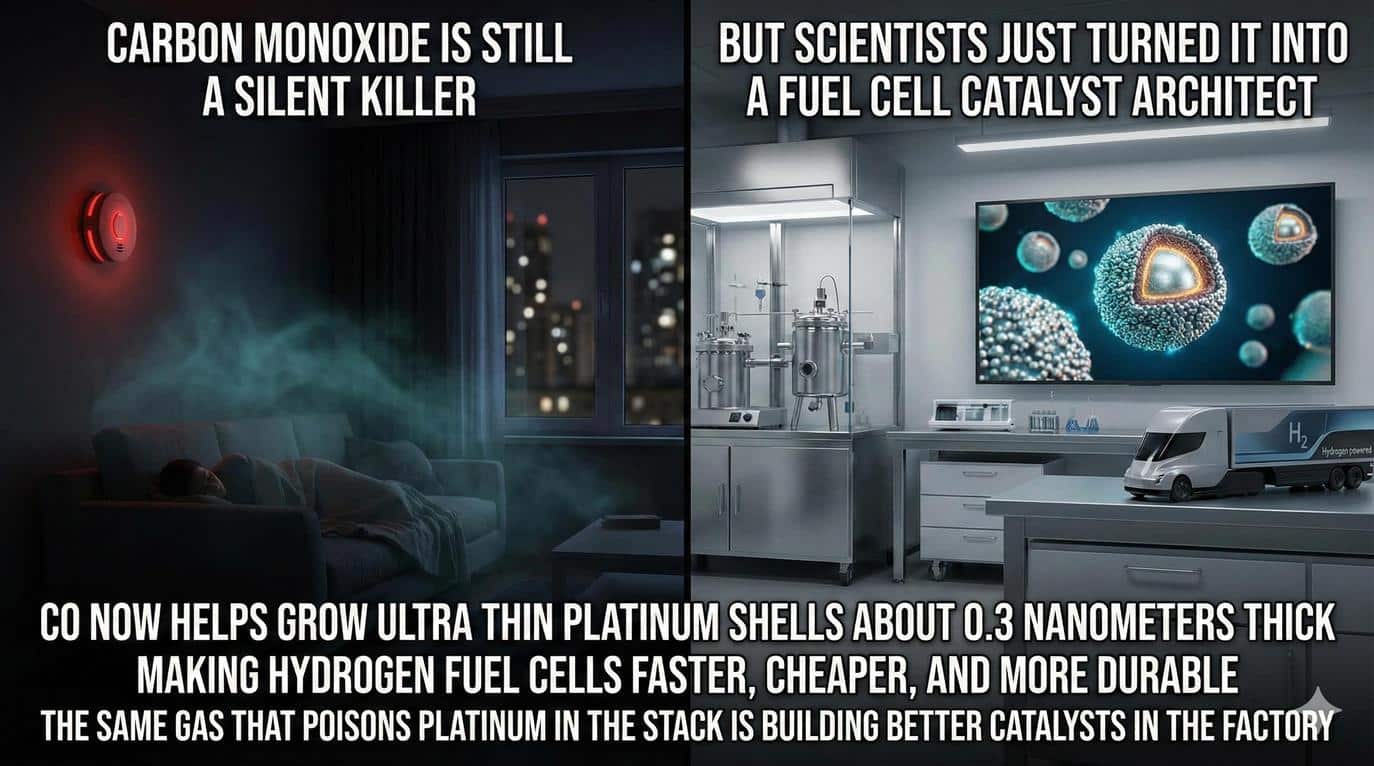
CO-AID Process Overview: Efficiency and Atomic Control
- What it Is: A manufacturing method where carbon monoxide molecules guide the growth of platinum shells around metal cores, layer by layer.
- Why it Matters: Fuel cells rely heavily on platinum, one of the most expensive and supply-constrained materials in clean energy technology.
- Key Achievement: Researchers produced core-shell catalysts with atomically thin platinum layers, only about 0.3 nanometers thick, in under two hours, a process that traditionally can take more than 24 hours.
- Reported Results: Peer-reviewed ACS Nano studies confirm the catalysts achieved about twice the oxygen reduction reaction (ORR) activity and roughly 1.5 times the durability compared with conventional platinum-on-carbon benchmarks.
- Health Reminder: CDC carbon monoxide safety guidelines emphasize that the gas remains highly toxic to humans and can cause serious neurological and cardiac harm even at relatively low concentrations.
Harnessing Carbon Monoxide for Precision Catalyst Synthesis
Using carbon monoxide in a fuel cell factory sounds absurd. The gas is notorious for killing both people and catalysts. In fuel cell systems, even a few parts per million of carbon monoxide can poison the reaction sites that split hydrogen and generate electricity. In spite of that danger, researchers at the Korea Institute of Energy Research saw potential in this reactivity and decided to use it as a deliberate design tool rather than a contaminant.
Mechanism of Adsorption-Induced Deposition
In the CO-AID process, carbon monoxide molecules attach to the metal surface like a molecular stencil. Once in place, they direct exactly where platinum atoms settle. When the base metal core is made from materials such as palladium, gold, or iridium, the carbon monoxide coverage helps platinum form a thin, uniform shell one atomic layer at a time.
The result is a core-shell catalyst, often written as M@Pt, where M is the base metal core and Pt is the outer platinum shell. This architecture dramatically improves catalytic efficiency because the thin shell exposes more active surface area while requiring much less platinum overall. With platinum prices regularly measured in hundreds of dollars per ounce and supply centered in a small number of countries, this kind of efficiency gain is both a technical achievement and a cost-reduction strategy.
Hydrogen fuel cells are already being deployed in vehicles, industrial equipment, and pilot infrastructure projects that demonstrate real-world performance. Advanced hydrogen fuel cell material research into cheaper membranes and improved catalyst structures supports these deployments. A catalyst technology that preserves performance while reducing noble metal usage strengthens the case for these systems as a long-term decarbonization tool.

Development of CO-AID Core-Shell Platinum Catalysts
The researchers behind CO-AID set out to simplify a process that had been complex, slow, and difficult to scale. Traditional manufacturing techniques such as copper underpotential deposition, often abbreviated as Cu UPD, rely on tightly controlled voltages and multiple chemical baths to create thin, uniform coatings on tiny particles. These processes can take longer than a full day to produce a batch of catalysts and can be challenging to standardize at higher volumes.
In their experiments, the team demonstrated precise control over the core-shell architecture. Their key technical achievements included:
- Versatile Combinations: Creating both palladium-at-platinum and gold-at-platinum structures.
- Atomic Precision: Tuning platinum shells to exactly one, two, or three atomic layers.
- Performance Insight: Confirming that platinum usage could be decreased without sacrificing chemical stability.
This level of control allowed researchers to isolate the exact relationship between shell thickness and catalytic activity.
In laboratory demonstrations, the team produced kilogram-scale quantities of these catalysts with consistent platinum layering, a meaningful step toward industrial relevance. The reported results showed roughly double the oxygen reduction reaction activity and about fifty percent better durability compared with standard platinum-on-carbon catalysts used in many commercial fuel cells. Data from the National Research Council of Science and Technology validates these findings.
This innovation relies on molecular control rather than exotic new materials. Because carbon monoxide naturally adheres to specific metallic sites, it allows researchers to fine-tune the growth of the platinum shell without relying on complicated voltage sequences. The shells produced through CO-AID are roughly 0.3 nanometers thick, which corresponds to just a few atomic layers, giving a practical balance between material savings and surface activity.

Overcoming the Platinum Cost Barrier in Fuel Cell Stacks
Hydrogen fuel cells have long been presented as a way to generate electricity using hydrogen and oxygen while emitting only water vapor at the point of use. A fuel cell electric vehicle uses compressed hydrogen to feed a stack, which then produces electricity that powers an electric motor instead of burning fossil fuel in a conventional engine. Today’s hydrogen car technology landscape follows this same basic architecture.
However, most proton exchange membrane fuel cells still rely on platinum group metals. These metals are essential for catalyzing the oxygen reduction reaction at the cathode. Platinum is rare, costly, and geographically concentrated, with a large share of global production coming from South Africa and Russia. That concentration exposes the hydrogen economy to significant vulnerabilities:
- Price Spikes: Sudden cost increases due to market scarcity.
- Geopolitical Risk: Dependence on a limited number of supplying nations.
- Supply-Chain Disruptions: Fragility in the logistics of raw material transport.
Reducing platinum use without compromising performance is therefore one of the central goals of fuel cell research. In September 2026, a Beijing Institute of Technology team showed how far that goal can be pushed, with a fuel cell design that delivers four times the power at 6.9 kilowatts per gram of platinum, attacking the same cost barrier by engineering the catalyst’s microenvironment rather than the shell thickness. Atomic-precision methods such as CO-AID directly target this constraint by spreading a very thin layer of platinum over a more abundant core material while maintaining high catalytic activity. If the same or better power output can be achieved with significantly less platinum, the cost per kilowatt of a fuel cell stack can drop in a meaningful way.
Meeting DOE Cost and Performance Targets
The United States Department of Energy’s Fuel Cell Technologies Office has published aggressive targets for platinum group metal loading and mass activity. Their aim is to reduce platinum content in future stacks by more than eighty percent while still achieving a mass activity target of around 0.44 amperes per milligram of platinum group metals for the oxygen reduction reaction.
Those targets are not abstract goals. These benchmarks reflect U.S. Department of Energy Fuel Cell Technologies Office guidance on whether next-generation stacks can compete economically with internal combustion engines and battery electric systems.
Beyond vehicles, platinum-heavy catalysts show up anywhere hydrogen is produced or used at scale, from industrial hydrogen production to stationary backup power. Improvements in catalyst efficiency can ripple across the ecosystem. The growth of global green hydrogen supply chains connects production sites, pipelines, and large offtakers to build this new energy network.

Scalability and Speed in Commercial Catalyst Production
Scientific breakthroughs often remain confined to the laboratory when they cannot be manufactured at scale. What makes CO-AID especially noteworthy is that it tackles performance, materials usage, and manufacturing practicality at the same time. Instead of requiring complex electrochemical programming to deposit each layer of platinum, the method leverages the natural behavior of carbon monoxide to guide thin-film growth.
That shift from day-long processing toward shorter, more repeatable runs matters significantly for industrial scaling. Facilities must balance several critical operational factors:
- Throughput: Increasing the volume of catalyst produced per shift.
- Equipment Utilization: Maximizing the return on expensive reactor infrastructure.
- Energy Consumption: Reducing the power required for long, complex heating or plating cycles.
Shorter, well-controlled processes ultimately support lower production emissions and more predictable operating costs.
Aligning with Hydrogen Infrastructure Growth
Faster, more scalable catalyst production also aligns with the pace of hydrogen infrastructure build-out. Pilots are now expanding into diverse sectors to test supply chain limits:
- Heavy-Duty Transport: High-output hydrogen engine platforms are being tested for large-scale logistics.
- Waste-to-Energy: Projects utilizing plasma-enhanced gasification to turn waste into green hydrogen are coming online.
- Marine Systems: Coastal initiatives are exploring an emerging ocean refinery approach for seawater desalination and hydrogen generation.
As these deployments accelerate, the demand for efficient and affordable catalysts will increase. Processes like CO-AID do not solve infrastructure, permitting, or policy challenges by themselves, but they lower one of the technical and economic thresholds that often slow progress. By making platinum-based catalysts less resource-intensive to produce, they support a more resilient and diversified hydrogen ecosystem.
However, the researchers remain careful not to overpromise. Accelerated life testing, cycling under realistic load patterns, and multi-year durability data are still needed before CO-AID catalysts can be fully trusted in commercial stacks. Safety protocols for handling carbon monoxide at scale must also be rigorous and auditable. The breakthrough is promising, but it is a chapter in a longer story that includes engineering, policy, and market adoption.
Safety Protocols and Toxicity Management
Carbon monoxide remains a lethal gas even with its emerging role in advanced catalyst manufacturing. It is invisible and odorless and binds to hemoglobin in the blood more than two hundred times more strongly than oxygen. This bond prevents oxygen from being transported efficiently through the body. Exposure triggers a range of dangerous symptoms:
- Early Signs: Headaches, dizziness, nausea, and confusion.
- Severe Outcomes: High doses lead to loss of consciousness and eventual death.
The health risks increase for children, pregnant people, older adults, and individuals with heart or lung disease.
Safety measures are therefore non-negotiable in industrial settings that use carbon monoxide for research or manufacturing. Facilities that work with CO rely on sealed reactors, continuous gas monitoring, ventilation controls, and strict exposure limits to protect workers and surrounding communities. Public health agencies cite comprehensive CDC carbon monoxide exposure data regarding neurological effects.
The innovation behind CO-AID does not change carbon monoxide’s inherent toxicity. Instead, it changes the way industry might use the gas, restricting it to sealed equipment and carefully engineered processes. Laboratories safely handle dangerous chemicals like chlorine or hydrogen fluoride through containment and training, not by making the substances safe. CO-AID relies on that same rigorous safety culture. Readers should see this breakthrough as a redefinition of carbon monoxide’s utility in controlled environments, not a downgrade of its real risks in homes, garages, or workplaces without proper protection.

Managing Carbon Monoxide Contamination in Operational Cells
The same molecule that enables precise platinum shell growth in CO-AID is also one of the main operational threats to fuel cell performance. When trace amounts of carbon monoxide enter a working hydrogen fuel cell, they can attach to the platinum surface of the catalyst and block the active sites where hydrogen would normally react. Even concentrations on the order of a few parts per million can dramatically cut efficiency and shorten stack life. Detailed studies of CO contamination in proton exchange membranes document this efficiency loss. Because of this risk, hydrogen fuel used in vehicles and power systems must be carefully purified.
This dual nature—where carbon monoxide helps build catalysts but damages them in operation—illustrates the delicate electrochemistry of hydrogen systems. Research groups around the world are exploring catalysts that resist CO poisoning. Innovations include alloys and CO-immune single-atom catalyst designs that maintain activity even when small amounts of carbon monoxide are present. Those efforts complement manufacturing strategies like CO-AID by making the catalysts themselves more robust.
In the hydrogen economy, this irony is simply a design challenge, not a contradiction. Engineers aim to keep carbon monoxide where it is helpful, inside carefully controlled synthesis equipment, while aggressively excluding it from the hydrogen streams that flow through real fuel cell stacks. That separation is part of the broader systems thinking that also links hydrogen production, storage, and use. Projects range from on-farm hydrogen and ammonia production to residential storage. Early home-scale hydrogen battery deployments demonstrate energy storage potential on both agricultural land and residential rooftops.
Path to Commercialization: Validation and Field Testing
Moving from a laboratory success to hardware in vehicles or industrial plants is a long road. For CO-AID, the next steps include proving that kilogram-scale runs can be reproduced at the ton scale without losing the fine control over platinum thickness that drives performance. Manufacturers require rigorous proof of performance before adoption:
- Longevity: Stable operation confirmed across thousands of hours.
- Resilience: Demonstrated tolerance to temperature swings and humidity.
- Real-World Cycling: Predictable behavior under start-stop cycles that mirror vehicle operation.
Economic analysis will also matter. The process has to demonstrate that the savings from reduced platinum loading and improved efficiency outweigh the costs. Specifically, the economic benefits must justify the added complexity and safety infrastructure required for handling carbon monoxide. That equation depends on platinum prices, plant design, and local regulations. U.S. carbon capture and hydrogen fuel policy roadmaps explore these evolving market trends.
If CO-AID clears those hurdles, it could become part of the toolkit that large catalyst producers use to serve fuel cell manufacturers, electrolyzer companies, and industrial hydrogen users. By then, it will need to compete with other approaches to reducing platinum usage, including alternative catalyst materials and designs that rethink how fuel cells are structured. The future catalyst landscape is likely to be diverse, and carbon monoxide-guided deposition could be one pillar among several.

Redefining Catalyst Manufacturing for Clean Tech
This innovation does not make carbon monoxide safe, nor does it turn a household danger into a benign gas. It does, however, fundamentally reshape how engineers approach catalyst manufacturing for hydrogen systems. By containing this dangerous molecule within sealed reactors and using its natural chemical affinity to guide platinum deposition, CO-AID offers a path to produce high-performance components with a fraction of the precious metal usually required.
Scalability remains the final hurdle. If this approach moves successfully from the lab to the factory floor, it will help lower the cost barrier for hydrogen fuel cell adoption in vehicles and industry. A complementary advance shows how that cost saving could apply to AI infrastructure, with hydrogen fuel cells designed to power data centers using far less platinum. The true breakthrough is not just the chemistry but the manufacturing logic that transforms a known industrial pollutant into a precision tool for building a sustainable energy future.
FAQ: CO-AID Technology and Hydrogen Fuel Cell Catalysts
1. What is Carbon Monoxide Adsorption-Induced Deposition (CO-AID)?
CO-AID is a manufacturing process that uses carbon monoxide molecules to guide platinum atoms into ultra-thin, uniform layers on a metal core, reducing material waste.
2. Does this process make carbon monoxide safe to breathe?
No. Carbon monoxide remains deadly. The process takes place in strictly controlled, sealed industrial reactors with rigorous safety monitoring.
3. How does this technology reduce hydrogen fuel cell costs?
It drastically lowers the amount of expensive platinum needed by creating a shell just a few atoms thick, maximizing efficiency without sacrificing performance.
4. Can these catalysts be used in vehicles today?
Not immediately. While promising in the lab, the catalysts require extensive durability testing and real-world validation in commercial stacks before wide deployment.
5. How much faster is CO-AID than traditional manufacturing?
The process produces catalysts in under two hours, a significant improvement over traditional methods that often require more than 24 hours.


