
AI product teams rarely use one model forever. A feature may start on a frontier model because quality matters more than cost during early testing. A few months later, the same feature may need a faster model for routine requests, a cheaper model for background jobs, and a stronger model for hard cases. That shift is healthy, but it creates a new engineering problem: every model has its own pricing, latency profile, context limits, request format, and failure pattern.
Controlling AI API costs in this environment is not just a finance exercise. It is a product reliability problem. When model choice is hard-coded into application logic, every pricing change or quality issue turns into a release cycle. Teams that treat AI access as part of their infrastructure have more room to experiment, control spend, and keep user-facing features stable.
The hidden cost of single-model architecture
The simplest AI integration usually starts with one provider and one model. This is a reasonable way to ship a prototype. The problem appears when that first integration becomes the permanent shape of the system.
Different parts of a product do not need the same level of intelligence. A customer support summarizer, a code explanation tool, an image prompt generator, and a compliance review workflow may all call an LLM, but their cost and quality requirements are different. Some requests need deep reasoning. Some need speed. Some only need a predictable structured response.
If all of these requests go through the same premium model, the product pays premium prices for routine work. If everything is moved to a cheaper model, quality may drop in the places where users notice it most. A single-model setup makes the team choose one compromise for every use case.
Model routing should match the job
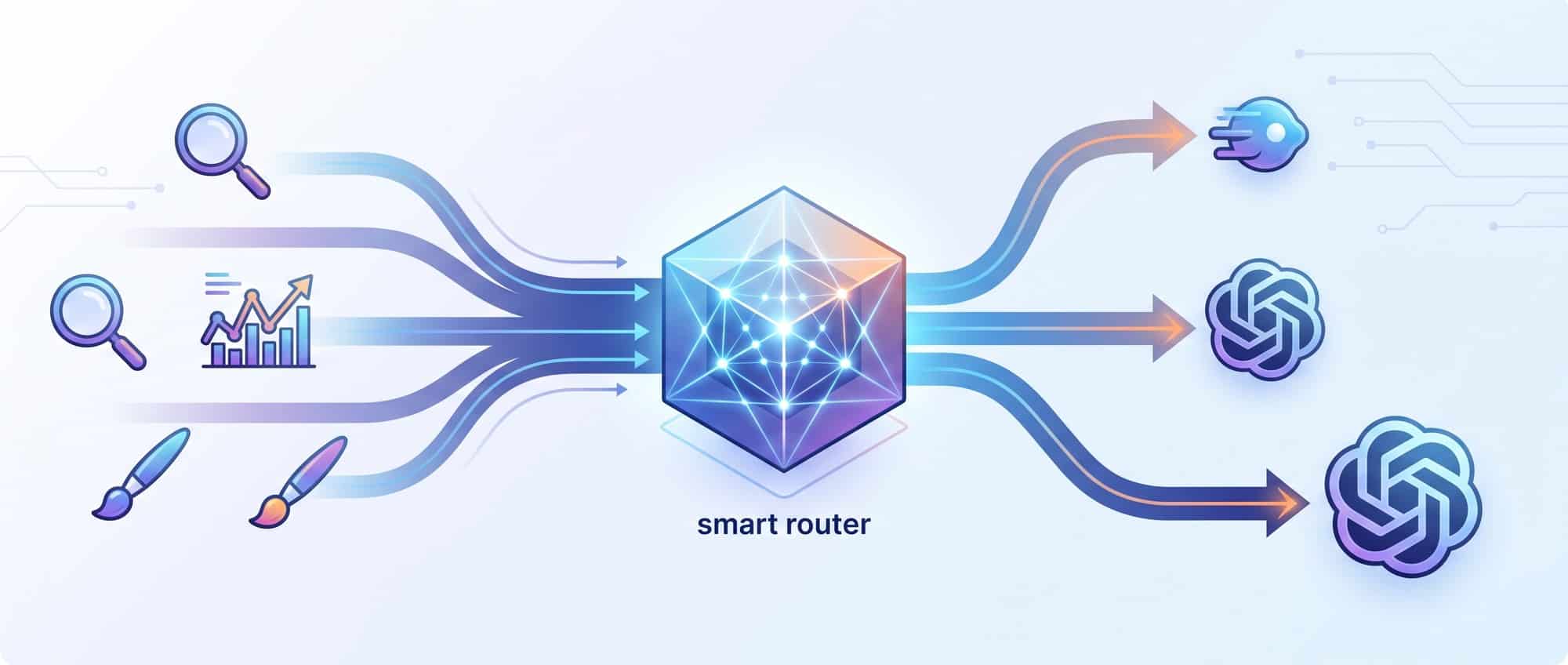
The more practical approach is to route requests by task type. Simple extraction, classification, and formatting can often use smaller or lower-cost models. More complex reasoning, agentic workflows, and high-stakes responses can be routed to stronger models. Background tasks can tolerate slower responses if the price is better. Interactive features may need a model with lower latency even if it is not the cheapest option.
This routing does not have to be complicated at first. A team can start by mapping each AI feature to three questions: how much quality does this task require, how quickly does the user need the answer, and how much volume will this workflow generate? Those three answers usually reveal where premium models are necessary and where they are wasteful.
Over time, routing can become more dynamic. A request may start with a cheaper model and escalate only when confidence is low. A product may use one model for drafting and another for verification. A support workflow may use a fast model for triage, then send only difficult cases to a stronger model. These patterns reduce cost without forcing the team to weaken the user experience.
Fallbacks are part of cost control
Fallbacks are usually discussed as a reliability feature, but they also matter for cost. AI providers change prices, rate limits, model names, and availability. A product that depends on one provider has little leverage when those changes happen.
A fallback strategy gives the team options. If one model becomes expensive, slow, or temporarily unavailable, traffic can move to another model with similar capabilities. If a provider has a regional outage, the product can keep core workflows alive. If a new model becomes much cheaper for a specific task, the team can test it without rewriting the product. DeepSeek’s new vision model is a recent example: it added image understanding at V4-Flash text rates, giving teams a cheaper option for screenshot analysis and document extraction overnight.
The key is to avoid scattering provider-specific code throughout the application. When every feature calls a different SDK directly, fallback logic becomes difficult to maintain. A unified API layer makes it easier to switch models, compare outputs, track cost, and roll back changes when needed.
Observability matters before optimization
Teams often try to reduce AI spending before they can clearly see where the money is going. That usually leads to guesswork. A better starting point is observability.
Every AI request should be tied to a feature, model, provider, token usage, latency, and result status. This gives product and engineering teams a shared view of what is actually happening. They can see which workflows drive the most spend, which models fail most often, and where latency hurts the experience.
With that data, optimization becomes more precise. A team may discover that a small number of high-volume background jobs account for most of the monthly bill. They may find that a premium model is being used for short classification tasks. They may notice that retries are quietly increasing costs because the first request often times out.
Without request-level visibility, these problems stay hidden until the invoice arrives.
A unified gateway keeps experimentation manageable
The AI model market changes quickly. New models appear, older models improve, and pricing can shift faster than normal product planning cycles. Teams need a way to test new options without turning the codebase into a collection of one-off integrations.
A unified gateway solves this by creating one consistent access layer for multiple AI models. Instead of wiring every product feature directly to a provider, the application sends requests through a shared interface. The gateway can handle routing, fallback, usage tracking, provider credentials, and model configuration.
This is the kind of infrastructure that tools such as hiAPI are designed to support. The value is not only that a team can access more models. The larger benefit is that model choice becomes easier to manage as a product grows. Engineers can test alternatives, change routing rules, and monitor usage without rebuilding each feature around a different provider.

Cost control should not slow product development
AI costs are easiest to manage when the system is flexible from the beginning. That does not mean every startup needs a complex routing engine on day one. It means the team should avoid locking product logic too tightly to a single model or provider.
The useful pattern is simple: keep model access behind a stable layer, track usage at the feature level, route tasks according to quality and latency needs, and maintain fallback options for important workflows. This gives the product room to improve while keeping costs visible.
As AI becomes a normal part of software infrastructure, product teams will need to treat model access the same way they treat payments, search, analytics, or cloud hosting. The best setup is not the one that picks a single perfect model. It is the one that lets the team keep choosing the right model as the product, users, and market change.


