
Cellular energy decline drives muscle aging through a gradual progression rather than an overnight shift, manifesting as subtle reductions in daily physical capability. An individual might notice one or two fewer push-ups during a workout or find that climbing a familiar flight of stairs begins to feel like a deliberate effort rather than a secondary thought. Recovery takes longer than it did a decade ago.
Adults over 40 often find that these subtle shifts spark a search for something that can protect muscle strength, endurance, and day-to-day independence at home. Sarcopenia is the clinical term often used for age-driven decline in muscle capacity, appearing first as faster fatigue and lower strength during ordinary tasks.
Urolithin A, often sold under the branded ingredient Mitopure, has emerged as one of the most discussed compounds in longevity and mitochondrial health research. In a supplement market where vetting high-quality nutritional evidence is essential, the blunt question matters: what do the human trials actually show?
Peeling back the layers of marketing reveals a clinical reality far more complex than a simple headline.
Across multiple randomized controlled trials and recent clinical analysis of mitochondrial endurance, urolithin A demonstrates modest but measurable changes in certain muscle endurance tests and mitochondrial-related biomarkers. At the same time, some primary endpoints in major trials did not significantly outperform placebo. The evidence is promising, but it is not definitive.
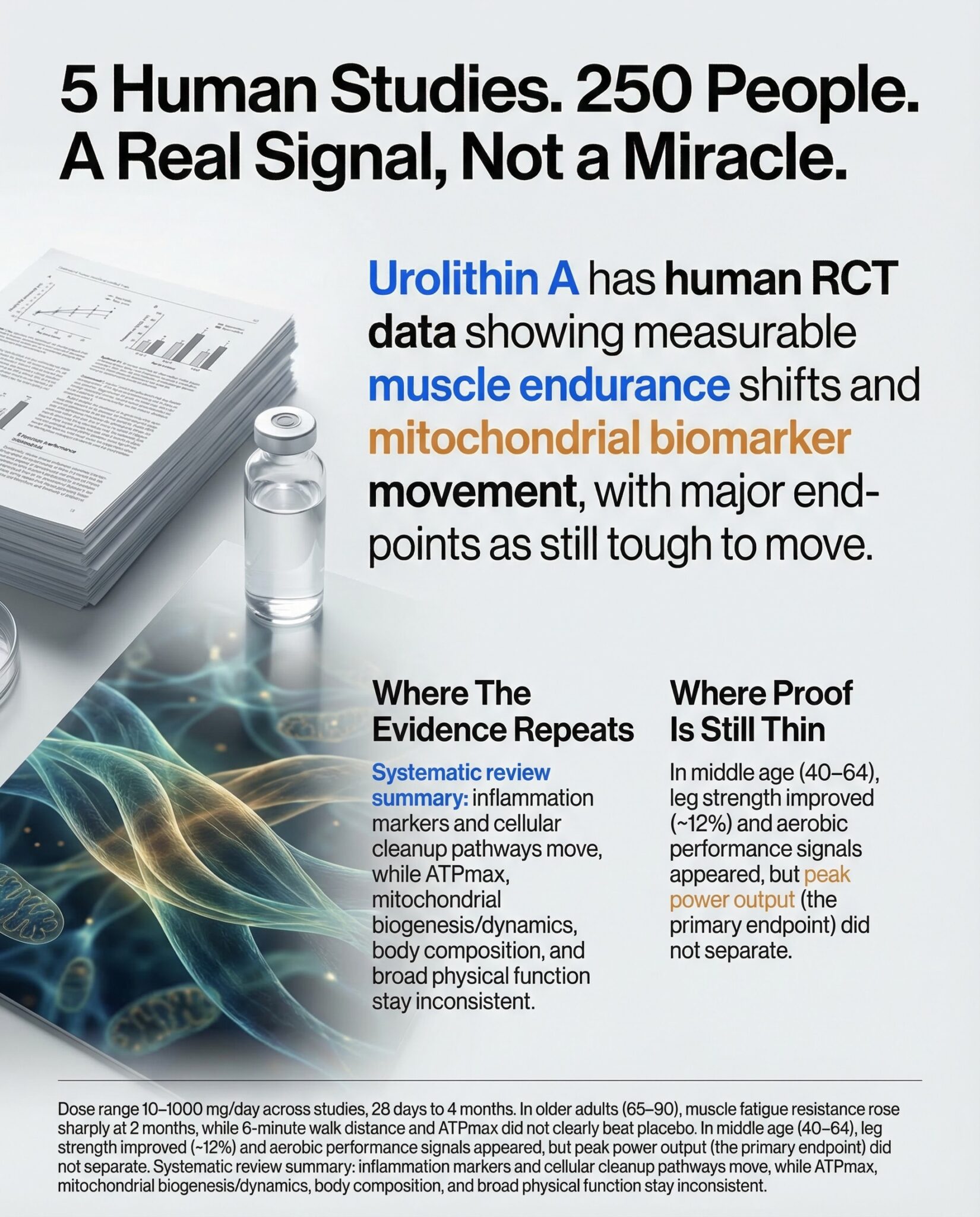
Urolithin A Mechanisms: Mitophagy Activation and Mitochondrial Quality Control
Urolithin A Human Trials: Muscle Endurance, Mitochondrial Biomarkers, and Clinical Reality
Evidence supporting Mitopure clinical use stems from rigorous datasets investigating age-driven decline in muscle capacity, where researchers meticulously tracked how this postbiotic metabolite influences performance across diverse age groups.
- Multiple human randomized controlled trials have tested urolithin A at doses between 500 mg and 1000 mg daily for up to four months.
- In a randomized trial in JAMA Network Open, older adults taking urolithin A showed improvements in specific muscle endurance measures, while primary endpoints such as 6-minute walk distance and maximal ATP production did not significantly differ from placebo.
- A 2022 randomized trial in Cell Reports Medicine reported strength and aerobic endurance improvements, but the primary endpoint of peak power output was not significantly improved.
- A comprehensive analysis of clinical autophagy markers concluded that urolithin A produces dose-dependent anti-inflammatory effects and modulates some mitochondrial and autophagy-related markers yet does not consistently improve mitochondrial maximal ATP production or whole-body functional outcomes.
- Preliminary meta-analysis of functional aging outcomes pooling limited RCT data found non-significant changes in 6-minute walk distance and insufficient evidence for muscle mass improvement at present.
Clinical findings suggest a consistent biological signal rather than a dramatic transformation in functional aging outcomes. Clinicians continue to analyze whether longer intervention windows or specific dosages yield more definitive whole-body functional improvements.
What Urolithin A is (and Why Researchers Call it a Mitophagy Lever)
From Pomegranates to a Postbiotic Metabolite
Classified as a gut-derived metabolite rather than a vitamin or hormone, Urolithin A is produced when intestinal microbes transform ellagitannins found in walnuts and pomegranates. Patterns seen in Mediterranean-style eating emphasize polyphenol-rich fruits and nuts as the primary dietary source. Because not everyone produces it efficiently through diet alone, supplemental forms have been developed.
Previous coverage on the cellular rejuvenation potential of pomegranate ellagitannins has explored how these metabolites may influence cellular health pathways, including mitochondrial quality control.
Think of mitochondria as the metabolic furnace of the cell, generating the power required for every muscular contraction. As muscle ages, mitochondrial efficiency and quality decline.
Mitophagy Explained as Mitochondrial Quality Control
Mitophagy refers to the selective removal of damaged mitochondria so cells can recycle their components. Researchers describe urolithin A as a “mitophagy activator” because early mechanistic work and subsequent human biomarker studies suggest it may enhance cellular pathways involved in mitochondrial turnover.
What Early Human Biomarkers Show
In a first-in-human trial in Nature Metabolism, supplementation for four weeks at 500 mg to 1000 mg was shown to be safe and bioavailable while also modulating plasma acylcarnitines and skeletal muscle mitochondrial gene expression signatures. These initial results did not prove that muscle strength or endurance would dramatically improve, but they confirmed that the compound influences human mitochondrial markers.
For a middle-aged office worker who feels that afternoon fatigue more sharply than before, the appeal is obvious. If mitochondrial quality can be nudged in a healthier direction, perhaps muscle performance and recovery follow. The pivotal inquiry remains: do these cellular signals translate into actual physical strength in human subjects?
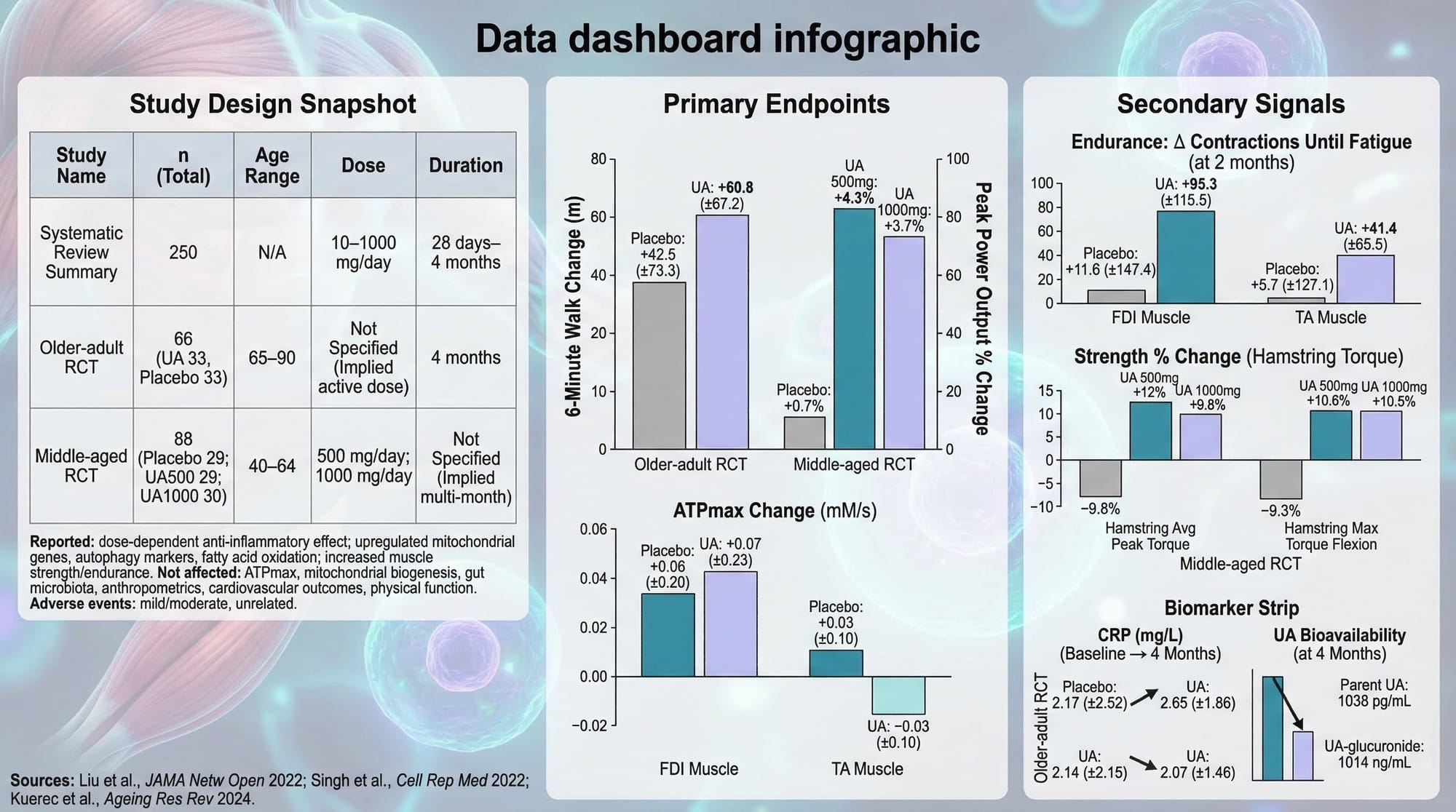
Urolithin A Human Clinical Trials: Analyzing RCT Evidence and Performance Metrics
The Urolithin A Evidence Stack at a Glance
The strongest human evidence comes from two four-month randomized controlled trials and one comprehensive 2024 systematic review.
The older-adult trial in JAMA Network Open enrolled 66 adults aged 65 to 90 who received 1000 mg daily for four months. Researchers measured 6-minute walk distance using established mobility assessment protocols, maximal ATP production in muscle using 31P magnetic resonance spectroscopy, and specific muscle endurance tests.
The middle-aged trial in Cell Reports Medicine enrolled adults aged 40 to 64 and tested 500 mg and 1000 mg doses over four months. It included performance testing, blood biomarkers, and muscle biopsy analyses.
The 2024 systematic review in Ageing Research Reviews synthesized five human studies totaling 250 healthy individuals. It evaluated inflammatory markers, mitochondrial function markers, muscle performance outcomes, and safety data.
Collectively, this evidence stack paints a picture of biological activity tempered by clinical caution. There is measurable biological activity. There are modest functional signals. There are also gaps and inconsistencies.

The 2022 Older-Adult RCT (65–90): Endurance Improves, Primary Endpoints Don’t Separate
Study Design and Endpoints
In a double-blind, placebo-controlled trial in adults aged 65 to 90, older adults received 1000 mg of urolithin A daily for four months. The study ran in Seattle from 2018 to 2020 and tested outcomes at multiple time points.
Investigators monitored muscle fatigue and plasma biomarkers at multiple intervals, while simultaneously assessing the 6-minute walk test and ATP-related muscle energetics at baseline and month four. The trial’s phase 2 design and enrollment criteria for adults with signs of low mitochondrial function are summarized in the ENERGIZE trial record.
What Did Not Separate from Placebo
The key finding is important for readers who want clarity. Urolithin A did not significantly improve 6-minute walk distance or ATPmax compared to placebo. In other words, the primary endpoints did not statistically separate. At the same time, the average walking-distance gain was still sizable in both groups, with the urolithin A arm improving by about 61 meters and the placebo improving by about 43 meters, a pattern consistent with a strong participation effect in mobility studies.
What Improved in Endurance and Biomarkers
However, certain muscle endurance measures did improve, particularly at the two-month mark. The study used single-muscle fatigue-resistance tests in the hand and lower leg that quantify how many contractions a muscle can sustain until fatigue. In the urolithin A group, the increase in contractions to fatigue was meaningfully higher than the placebo at two months in both the hand muscle (first dorsal interosseous) and the lower-leg muscle (tibialis anterior).
Advanced metabolic profiling indicated a cellular cleaning process, where markers like acylcarnitines and C-reactive protein shifted toward a state of improved efficiency. Acylcarnitines are metabolites that can rise when fatty-acid handling is inefficient, so a downward shift is often interpreted as a sign the body is processing fuel a bit more cleanly.
Why the Placebo Group Improved Too
Why did both groups improve in some measures by month four? The researchers acknowledged that physical activity was not tightly controlled and that behavioral changes may have influenced outcomes. Motivation often spikes during clinical participation—such as the simple act of tracking steps—nudging individuals toward healthier daily habits.
Behavioral shifts from participation can compress the measurable differences between treatment and placebo groups, particularly when baseline fitness levels remain relatively high. The trial also reported that supplementation was generally well tolerated, with no meaningful difference in adverse events between groups.
For an active 72-year-old trying to maintain independence, this distinction matters. A supplement that improves a muscle’s fatigue resistance in a lab-style test could still feel subtle in daily life, showing up as getting through a longer grocery trip without the same leg burn rather than suddenly walking farther on demand. Urolithin A may support certain aspects of muscle endurance, but it did not dramatically improve walking distance compared to placebo in this study.

The 2022 Middle-Aged RCT (40–64): Strength and Performance Signals, But the Primary Endpoint Misses
Study Design, Doses, and the Primary Endpoint
The second major trial, a randomized, placebo-controlled study in adults aged 40 to 64, tested two doses of urolithin A for four months. This trial randomized 88 untrained, overweight participants into placebo, 500 mg, or 1000 mg groups, and it did not add a new exercise program, which makes the results easier to attribute to supplementation rather than a training effect. The primary endpoint was defined as cycle-ergometer power output in the ATLAS trial record.
Observed Shifts in Performance Testing
Peak power output served as the primary endpoint; however, this measure failed to show a significant improvement over placebo, yielding only a minor rise from baseline. Yet several secondary measures moved in a more encouraging direction.
The trial reported roughly 12% improvement in leg muscle strength and noted improvements in aerobic endurance metrics, including peak oxygen consumption, with the higher dose showing the clearest signal. A desk-bound individual might find that these subtle shifts mean finishing a brisk walk without feeling winded, even if their explosive leg power remains unchanged.
What the Biopsies and Blood Markers Suggested
The investigative team observed changes in proteins and gene expression patterns linked to mitochondrial metabolism and mitophagy, including signatures consistent with improved mitochondrial protein complexes and changes in pathways related to contractile fibers. The paper’s combined muscle transcriptome and proteome analyses are available in the full open-access report. Blood biomarkers also shifted in directions interpreted as favorable, including lower plasma acylcarnitines and lower C-reactive protein, which the authors interpret as signals aligned with higher mitochondrial efficiency and reduced systemic inflammation.
How to Read a Primary Endpoint Miss
Interpreting these clinical patterns requires a disciplined eye. A primary endpoint miss does not erase secondary signals. But it does prevent strong claims.
In clinical research, primary endpoints are pre-specified to reduce bias, so they carry the most weight in interpretation. When those do not reach statistical significance, a cautious read is that the effect may be real but smaller than the trial was designed to detect or that it shows up more reliably in certain kinds of performance tests than others.
The publication also includes clear disclosure of sponsor involvement, which makes independent replication especially important for translating these signals into broad claims about muscle aging.
For a 50-year-old recreational runner who notices slower recovery times, these findings may still be meaningful. Subtle endurance gains and improved mitochondrial markers could translate into better fatigue resistance. However, the data do not yet justify claims of reversing muscle aging.

The 2024 Systematic Review: Where Results Converge (and Where They Don’t)
Where Studies Agree Most Often
Synthesizing data from five distinct trials involving 250 participants provides a much clearer lens into how urolithin A behaves in healthy humans. Across these studies, urolithin A demonstrated dose-dependent anti-inflammatory effects and modulation of mitochondrial and autophagy-related markers. The included trials spanned doses from 10 mg to 1000 mg per day and ran from 28 days to four months, which helps explain why the review emphasizes signal detection over long-term outcome certainty.
Where Effects Did Not Show Up Reliably
Importantly, the review also highlights what did not change consistently. Mitochondrial maximal ATP production, mitochondrial biogenesis, mitochondrial dynamics, and gut microbiome composition were not significantly altered in the included studies.
Biogenesis refers to building new mitochondria, while dynamics describes how mitochondria fuse and split as part of normal quality control, and those deeper structural shifts may require different populations, longer durations, or different measurement approaches to detect in humans.
Muscle strength and endurance showed improvements in certain contexts. Whole-body physical function outcomes, however, were not uniformly improved. The review also reports no meaningful effect on anthropometrics or cardiovascular outcomes in the small human literature so far, and it describes adverse events as mild or moderate and generally unrelated to supplementation.
What the Review Still Says is Missing
This dual message is critical. Biological plausibility is supported. Some functional measures improve. But not all mitochondrial or performance metrics move in parallel. A clean way to interpret the review is as a short list of consistent signals rather than a guarantee of whole-body transformation, with the strongest repeat patterns appearing in inflammation-related markers, metabolomics signatures, and selected endurance measures.
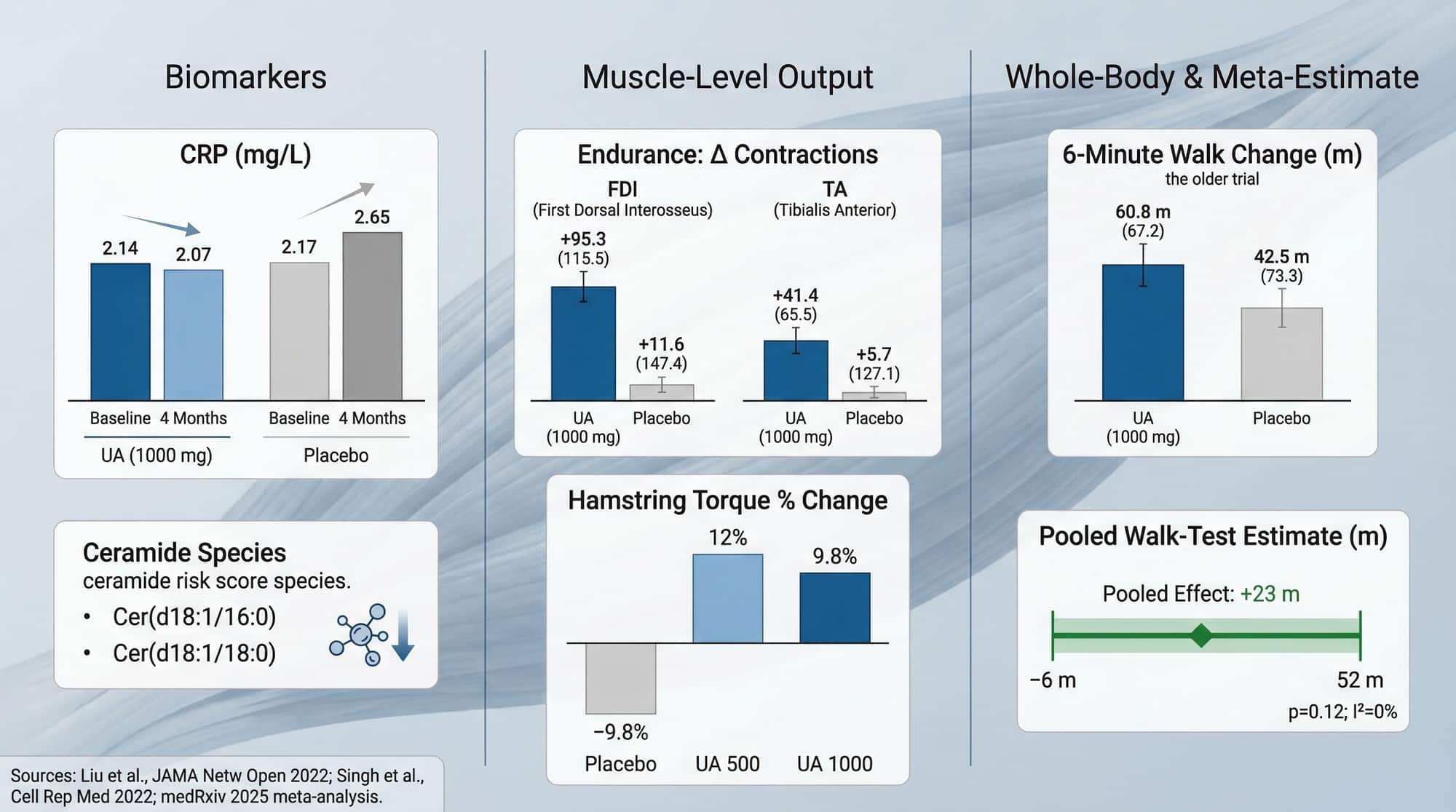
Analyzing Mitopure Clinical Data: Biomarkers Versus Functional Muscle Performance
Biomarkers vs. Real-World Function: Why Translation Can Look Slow
A central question often arises: if mitochondrial markers improve, why doesn’t walking speed or peak power automatically increase?
Biomarkers often shift before visible functional changes occur. Mitochondrial turnover and lipid metabolite profiles can improve within weeks, partly because NAD+-linked mitochondrial quality control supports cellular cleanup cycles. Whole-body performance metrics depend on neuromuscular coordination, cardiovascular conditioning, and behavior.
In aging research, small shifts in cellular efficiency may accumulate over longer durations. Most urolithin A trials lasted four months or less. Muscle aging unfolds over decades.
For someone searching online for “best supplement for muscle endurance after 60,” it is tempting to equate biomarker movement with immediate performance transformation. Current data indicate an incremental process.
How Geroscience Researchers Read these Effect Sizes (Without Overclaiming)
Researchers trained in geroscience focus on effect size, consistency, and replication.
When a trial shows improvement in secondary endpoints but not in the primary endpoint, scientists ask whether the primary measure was too insensitive, whether the study was underpowered, or whether the effect is context-specific.
They also examine trial duration, population diversity, and sponsor involvement. Transparency matters. Replication by independent groups strengthens credibility.
A 2025 systematic review preprint pooling limited RCT data found that improvements in 6-minute walk distance were not statistically significant overall and that evidence for muscle mass improvements remains insufficient at present. Preprints are not peer-reviewed, but they can signal where consensus is heading.
The balanced interpretation is this: urolithin A shows biologically coherent signals across multiple trials. The magnitude of benefit is modest. Larger and longer studies are needed to confirm durable functional impact.
The Trust Layer: Sponsorship, Replication, and What a Next-Gen Trial Must Include
Nutritional longevity research often involves commercial stakeholders. That does not invalidate results. It does increase the importance of rigorous design and independent replication.
Future trials would ideally include longer follow-up, objective activity tracking, more diverse populations, pre-registered endpoints, and independent funding streams.
A prospectively registered six-month trial currently recruiting adults aged 40 to 65 suggests that the field is moving toward longer intervention windows. Extended duration may clarify whether modest endurance signals accumulate into meaningful functional gains.
For readers evaluating supplements, transparency and replication are as important as headline results.

Geroscience Beyond Muscle Aging: Systematic Review Signals And Metabolic Impacts
UA Beyond Muscle Aging: What Athlete and Non-Muscle RCTs Add (and What They Don’t Prove)
What the Athlete Trial Adds
An eight-week randomized trial in resistance-trained young men explored strength and endurance outcomes alongside inflammatory and oxidative stress markers.
The clearest reported performance differences favored urolithin A for measures like maximum voluntary isometric contraction and repetitions to failure, while classic one-rep max lifts did not show a clean, statistically significant separation in this small sample. The study also tracked a urine marker of muscle protein breakdown called 3-methylhistidine, which decreased within the urolithin A group, adding a metabolic layer to the performance readouts.
The younger cohort studied differs fundamentally from those facing sarcopenia, requiring that these results be viewed as performance-specific data rather than direct proof of anti-aging efficacy.
What Non-Muscle RCTs Suggest About Mitochondrial Remodeling
Meanwhile, clinical research into immune system remodeling reported shifts in immune cell subsets and increased fatty-acid oxidation capacity in middle-aged adults after four weeks of supplementation. The reported changes were modest in absolute size but statistically meaningful, including an expansion of naive-like, less exhausted CD8-positive T cells and an increase in the fatty-acid oxidation capacity of CD8 cells.
Mitochondrial remodeling matters because immune and muscle aging often occur in parallel, driven by shared pathways of inflammation.
Why These Findings Still Don’t Prove Muscle-Aging Reversal
Collectively, these studies broaden the mechanistic understanding, alongside other lines of research exploring exercise-mimicking compounds that strengthen muscle and bone as a separate category of muscle-support ideas.
Clinical evidence currently does not prove that urolithin A reverses muscle aging. Researchers are also examining urolithin A and gut health, but oral benefits for inflammatory bowel disease remain unproven. Instead, the data suggest that mitochondrial-related pathways across tissues are responsive to supplementation, providing a unique mitophagy lever for cellular health.
For a health-conscious reader comparing urolithin A to other mitochondrial or NAD-focused interventions, it is helpful to understand that each compound targets overlapping but distinct pathways. A gym regular who measures progress by how long a set stays strong may care most about fatigue resistance, while a person focused on aging well may care more about whether those fatigue gains show up as steadier walking, easier stair climbs, and better recovery across months rather than weeks.
Where UA Looks Real, Where It’s Early, and How to Think About it Like a Scientist
Urolithin A is a clinically substantiated compound. It has been tested in multiple human randomized controlled trials. It consistently modulates certain mitochondrial-related biomarkers and shows modest improvements in some muscle endurance and performance measures.
At the same time, major primary endpoints in key trials have not always separated from placebo. Whole-body functional outcomes remain mixed. Evidence for muscle mass improvement is limited.
The scientifically grounded view is neither dismissive nor enthusiastic. Urolithin A appears to nudge aspects of mitochondrial quality and endurance. It does not currently demonstrate dramatic reversal of muscle aging.
For individuals exploring longevity strategies, the rational approach is layered: progressive resistance exercise protocols, adequate protein intake, sleep, metabolic health, and then cautiously evaluated adjuncts such as urolithin A and creatine. Current clinical trajectories appear promising; however, the actual magnitude of functional benefit remains modest at this stage of research.

Urolithin A Muscle Aging FAQ: Clinical Evidence and Practical Use
Can Mitopure Effectively Reverse Sarcopenia?
Evidence suggests modest endurance shifts rather than dramatic muscle mass restoration in human subjects.
What Dosage Of Urolithin A Is Most Effective?
Human randomized controlled trials typically utilize 500 mg or 1000 mg daily doses to achieve measurable results.
Does Supplementation Increase Mitochondrial ATP Production?
Clinical energetics testing via magnetic resonance spectroscopy shows over 31P signals that no significant ATPmax separation from placebo occurs in older populations.
Is Urolithin A Safe For Long-Term Human Use?
Short-term human evidence indicates high tolerability, though multi-year safety data are currently unavailable for review.
How Long Does It Take To Observe Results?
Biomarker shifts often occur within weeks, while functional performance gains may take several months to manifest.


