
Engineers in Huizhou have finished building a far smaller accelerator designed to aim cancer radiation more gently. The first demonstration unit of China’s new heavy ion therapy system stands complete at the Huizhou Heavy Ion Medical Center in Guangdong, and it has now entered equipment testing, with clinical trials expected by the end of 2026, according to the Institute of Modern Physics under the Chinese Academy of Sciences.
This is a machine milestone, not a treatment milestone. No patients are being treated on this unit yet, and wider use will depend on testing, trial results, and regulatory review that are still ahead.
What was actually completed in Huizhou
The unit completed is a demonstration device, not an open clinic. It was reported by the Institute of Modern Physics on October 23 and published through the Chinese Academy of Sciences announcement of the demo milestone on October 26, 2026.
The location matters. The system sits at the Huizhou Heavy Ion Medical Center in southern China, where the institute is developing its second-generation medical machine, known as SIMM. That name stands for an ultra-compact rotating beam heavy ion therapy system.
The status also matters. Installation is done, and the device has moved into equipment testing. The institute says clinical trials are expected by the end of 2026, which means safety checks, beam checks, and controlled human studies must still happen before routine use.
Why aim radiation more gently
All radiotherapy faces the same tension. It must damage tumor DNA enough to stop growth while sparing nearby healthy tissue that patients need to keep.
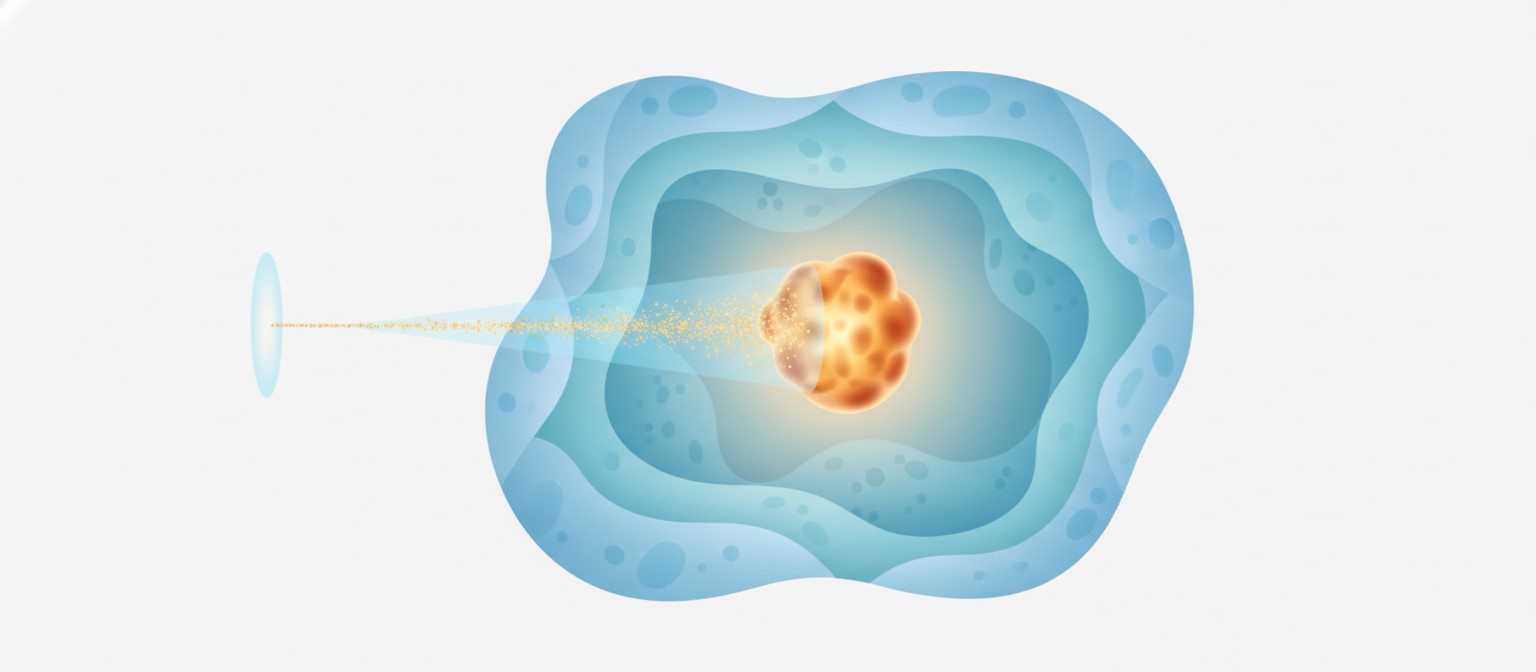
Heavy ions approach this problem with mass and control. The Bragg peak means a particle beam releases most of its energy at a set depth inside the body and very little beyond that point.
Carbon ions, the heavy ions most used for this therapy, add denser biological damage at that stopping point than photons or protons in the same dose region.
That combination is why heavy ion therapy is studied for some solid tumors that are hard to remove by surgery, respond poorly to conventional radiation, or sit near sensitive structures. The promise is real but narrow, and it still requires careful patient selection and long follow-up, which is why trial data matters more than machine size. Like other radiotherapy, it can still cause side effects such as skin irritation, fatigue, or hair loss near the treated area, which is why controlled trials track safety as well as tumor control.
Heavy ions, protons and X-rays in one glance
Readers often ask how heavy ion therapy fits beside more familiar options. The short answer is precision first, then biology.
| Approach | How it delivers dose | What distinguishes it | Access today |
|---|---|---|---|
| X-ray photon therapy | Enters and exits through tissue | Widely available and flexible, but with entry and exit dose | Standard in hospitals worldwide |
| Proton therapy | Stops at a tuned depth | Lower dose beyond the tumor than X-rays, which can help near sensitive organs | About 120 proton centers operating globally in recent counts |
| Heavy ion therapy, often carbon ions | Stops at a tuned depth with denser damage at the stop | Sharp depth control plus higher biological effect in the target, which is studied for radiation-resistant tumors | Far scarcer, concentrated in Asia and parts of Europe |
Global scarcity shapes the story. A 2026 PTCOG review counted 17 operational carbon ion facilities across seven countries and about 57,500 patients treated with carbon ions through the end of 2023, which shows clinical experience is growing but remains concentrated in Asia and parts of Europe, according to the PTCOG-guided review of carbon ion studies.
Mayo Clinic describes the same physics in plain terms, noting that carbon ions can be tuned to release energy at tumor depth while limiting surrounding exposure, and it is building the first clinical carbon ion center in North America in Jacksonville, as described in its explanation of how carbon ion therapy works.
Why shrinking the machine matters
Heavy ion systems have long been huge. Magnets, shielding, power, and a rotating gantry can fill a hospital wing, which keeps costs high and sites few.
The SIMM design attacks size directly. The footprint falls from 4,600 square meters in the first generation to 1,200 square meters, energy use drops to about one third, and annual capacity is projected to rise from about 1,000 cases to 2,000 to 5,000 cases, according to the institute.
Three technical changes carry most of that shift. A compact high-current linear injector starts the beam, a short-circumference rapid-cycling synchrotron accelerates it, and an intelligent rotating beam delivery system aims it, including what Chinese reports describe as an internationally novel smart distribution design.
Speed is part of the same plan. Chinese coverage of the Huizhou unit describes offline preparation for patient positioning so irradiation itself can take about half a minute, with treatment given on an outpatient basis. That workflow could raise daily throughput, but only if safety, imaging and quality checks keep pace in real clinics, which testing has not yet shown.
Digital design is the quieter change. The team reports a full digital twin of equipment and utilities with AI-assisted modeling for installation, plus AI support for contouring tumors and planning dose. This echoes a wider push to make accelerators more compact and usable, a direction also seen in research on a miniature particle accelerator built on a silicon chip, though that project is experimental and far from clinical use.
Lower building and running costs could help lower treatment fees, but only if regulators approve the device and hospitals can operate it reliably at higher volume, which remains unproven for this demo unit.
A demo is not a clinic
It helps to separate four stages. Built means hardware is assembled. Testing means engineers verify the beam’s safety and stability without patients. Clinical trials mean small, controlled patient studies under approval. Clinical availability means routine treatment after evidence and licensing.
The Huizhou SIMM is at stage two. Equipment testing is underway and trials are expected by late 2026, so patients should not travel to Huizhou expecting treatment on this machine now.
China does have separate clinical experience with an earlier generation. The first fully domestically developed heavy ion accelerator began treating patients in Wuwei in Gansu in 2020, and ten domestically developed units have been promoted nationally. That history supports engineering confidence without proving anything yet about the new compact system.
Who it could help one day, within limits
Search interest clusters around pancreatic and prostate tumors, plus comparisons with proton therapy and questions about access in the United States. Those are sensible questions because heavy ions are studied where precision and biological effect may matter most.
The Chinese reports point to tumors unsuitable for surgery, tumors insensitive to conventional rays, and tumors prone to recurrence. Published carbon ion literature has explored head and neck, pelvis, lung, liver, and prostate settings, among others, but results vary by tumor type, stage, and center, so no single outcome applies broadly.
Children illustrate both the interest and the caution. Better depth control could reduce dose beyond a tumor, which matters for growing tissue, yet heavy ions also create secondary particles that need careful study. The benefit for any child would depend on tumor location, age, trial eligibility, and long-term follow-up in the same careful evaluation.
Other precise cancer approaches show why context helps. Ultrasound-activated microbubbles, for example, are being studied to improve drug access in liver tumors, as covered in recent work on microbubble-enhanced liver cancer treatment. Heavy ions take a different path with physics rather than drug delivery, but both fields share the same test: controlled human data before routine hope.
Frequently Asked Questions
Is the Huizhou heavy ion therapy unit treating patients now?
No. The institute says the SIMM demonstration unit has entered equipment testing and is expected to begin clinical trials by the end of 2026. Testing must come first, then approved trials, then any decision on routine care.
How is heavy ion therapy different from proton therapy?
Both can stop at a tuned depth, which limits the dose beyond the tumor compared with X-rays. Heavy ions, often carbon ions, can deliver denser damage at that stopping point, which researchers study for tumors that resist conventional radiation, though evidence differs by cancer type.
Is heavy ion therapy available in the United States?
Not for routine care yet. Mayo Clinic is building a carbon ion facility in Jacksonville expected to bring clinical carbon ion treatment to North America, but access remains limited worldwide while programs complete construction, research, and approvals.
What cancers is heavy ion therapy studied for?
Reports and studies most often mention solid tumors that are hard to operate on, insensitive to standard radiation, or located near critical structures, including head and neck, lung, liver, prostate, and pancreatic research settings. Eligibility always depends on individual diagnosis and trial criteria.
Will a smaller machine make treatment cheaper?
A smaller footprint, lower energy use, and higher throughput could reduce construction and operating costs, which could support lower fees if performance holds in clinics. Chinese reports cite a Hangzhou first-generation example with a 46,500 yuan first phase and a 200,000 yuan full course cap, with a goal below 100,000 yuan in the future, but those figures describe a different unit and efforts to cut costs, not a price for the Huizhou demo.
What to watch next
Watch for three concrete signals:
- Completion of equipment testing reports from Huizhou.
- Registration and start of the planned clinical trials.
- Independent safety and outcome data rather than capacity projections.
The engineering direction is clear. A huge machine is being taught to act more gently by aiming tightly, working faster, and using less space and power. Whether that gentler aim reaches more patients will be decided the slow way, through testing, trials, and careful follow up.


