
A rooftop solar panel looks much the same as it did a decade ago. Dark blue or black, framed in aluminium, quietly turning light into power. But a change is coming from inside the panel, and it starts with a thin extra layer on top of the silicon.
That layer is making solar cells more efficient than silicon could ever be on its own. Here is what is happening and what still stands in the way.
The Ceiling Above Silicon
Silicon has powered the solar boom for good reason. It is affordable, well understood, and tough. But a single material can only use sunlight so well.
Physicists have worked out a rough ceiling for cells made from one light-absorbing layer, known as the Shockley-Queisser limit. For a single-junction cell, it sits at about 33.7 percent. Real silicon cells fall short of that. The best silicon-only cells have reached 27.81 percent in the lab, and top commercial silicon modules sit at roughly 25 percent.
Squeezing out more from silicon alone has become slow, hard work.
A Second Layer on Top
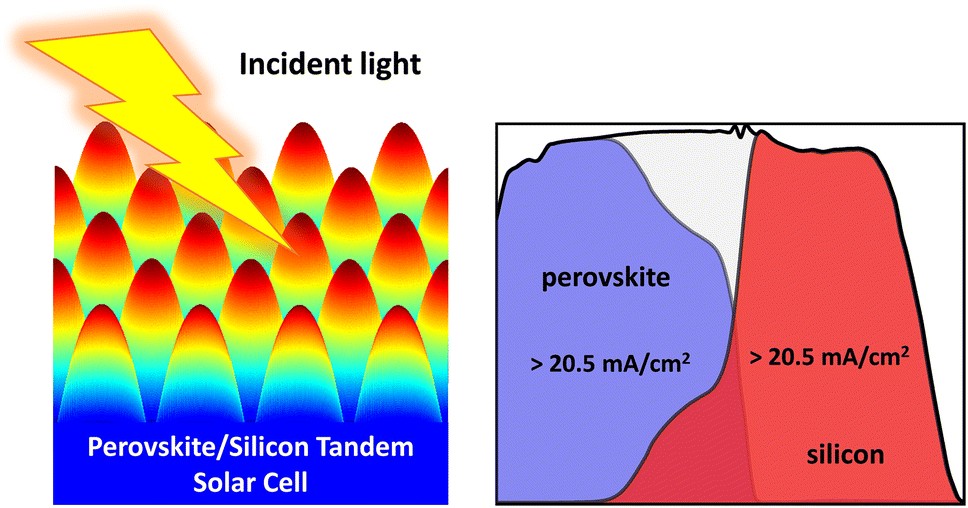
The idea behind tandem cells is simple. Sunlight is a mix of colours, and each colour carries a different amount of energy. One material cannot capture all of them well.
So engineers stack two. A thin top layer made from a material called perovskite catches the higher-energy light, the blues and greens. The silicon layer underneath then catches the lower-energy red and infrared light that passes through.
Each layer does the job it is best at. In theory, a silicon-perovskite tandem could reach an efficiency of up to about 43 percent, well above the single-junction ceiling.
The Numbers Keep Climbing
The results so far are striking. The Chinese manufacturer LONGi reported a tandem cell efficiency of 33.9 percent in November 2023, then 34.6 percent in June 2024. Its 34.85 percent result was certified by the US National Renewable Energy Laboratory. A 35.2 percent cell was later included in the 68th edition of the Solar Cell Efficiency Tables, compiled by a team led by Professor Martin Green at the University of New South Wales in Australia.
In July 2026, the company reported 35.5 percent, certified by the European Solar Test Installation. These figures are company-reported, but the 34.85, 35.2, and 35.5 percent results were each confirmed by an independent testing lab. All of them are above the 33.7 percent ceiling for single-junction cells.
Early records were set on very small cells, often about one square centimetre. That matters, because small cells are easier to perfect. LONGi has also reported 34.3 percent for a 261 square centimetre cell and 32.2 percent for a 274 square centimetre one, along with tandem modules at 31.4 and 29.4 percent. Larger devices come out a little lower, but they are much closer to what a real panel looks like.
From Lab Bench to Real Panels
Records are one thing. Products are another.
Oxford PV, a spin-out of the University of Oxford, made the first commercial sale of perovskite-silicon tandem modules in September 2024. The buyer was a US-based customer planning a utility-scale installation. The 72-cell modules had an efficiency of 24.5 percent and were produced on the company’s pilot line in Brandenburg an der Havel, Germany.
The firm has also reported a 26.9 percent efficiency for a 60-cell residential-size module, measured and certified by the Fraunhofer CalLab. That is above the roughly 25 percent typical of the best silicon-only modules. Production is still small, though. Tandem panels are only starting to appear outside the lab.
The Hard Part: Staying Power
The biggest question is durability. A silicon panel is often guaranteed to work for 25 years or more. Perovskite materials are known to be sensitive to moisture, heat, and light, and they can degrade faster than silicon when exposed to real weather.
A record-breaking cell means little if it fades after a few seasons. That is why so much research now focuses on protecting the perovskite layer and testing it over long periods. Teams around the world are working on the problem, including researchers at the Technical University of Munich, who have traced how repeated temperature swings age the material and have proposed molecular anchors to hold its crystal structure together.
Manufacturing is another hurdle. Making thin, even perovskite layers across a full-size panel, again and again, at low cost, is difficult. Those problems are solvable, but they are real, and they explain why tandem panels are not yet on every roof.
Why This Matters
Roof space and land are limited. A panel that turns more of the same sunlight into electricity means more power from the same footprint. That can lower the cost of each unit of electricity and make solar work in places where space is tight.
Even a few extra percentage points add up when millions of panels are installed. It is one reason the solar industry is watching tandem technology so closely.
Records in this field move quickly, and the details can change from one month to the next, so a quoted efficiency figure is worth reading alongside its certification date and the laboratory that signed it off.
Solar is only one corner of a wider field. Batteries, materials, and clean energy research are all advancing at a similar pace, and reading science news from reliable sources helps readers tell a laboratory result apart from something that will reach their roof. Topic Red covers developments of this kind and the context around them.
Final Thoughts
Solar panels may look the same from the outside, but the technology inside is changing. Tandem cells have already passed a limit that once seemed hard to beat, and the first commercial panels are now on the market.
The next test is time. If perovskite layers can survive years of sun, rain, and heat, tandem cells could become the new standard. If they cannot, the records will stay impressive, but only in the lab.
Either way, the progress is real. A familiar technology is getting better, and it is worth watching closely.


