
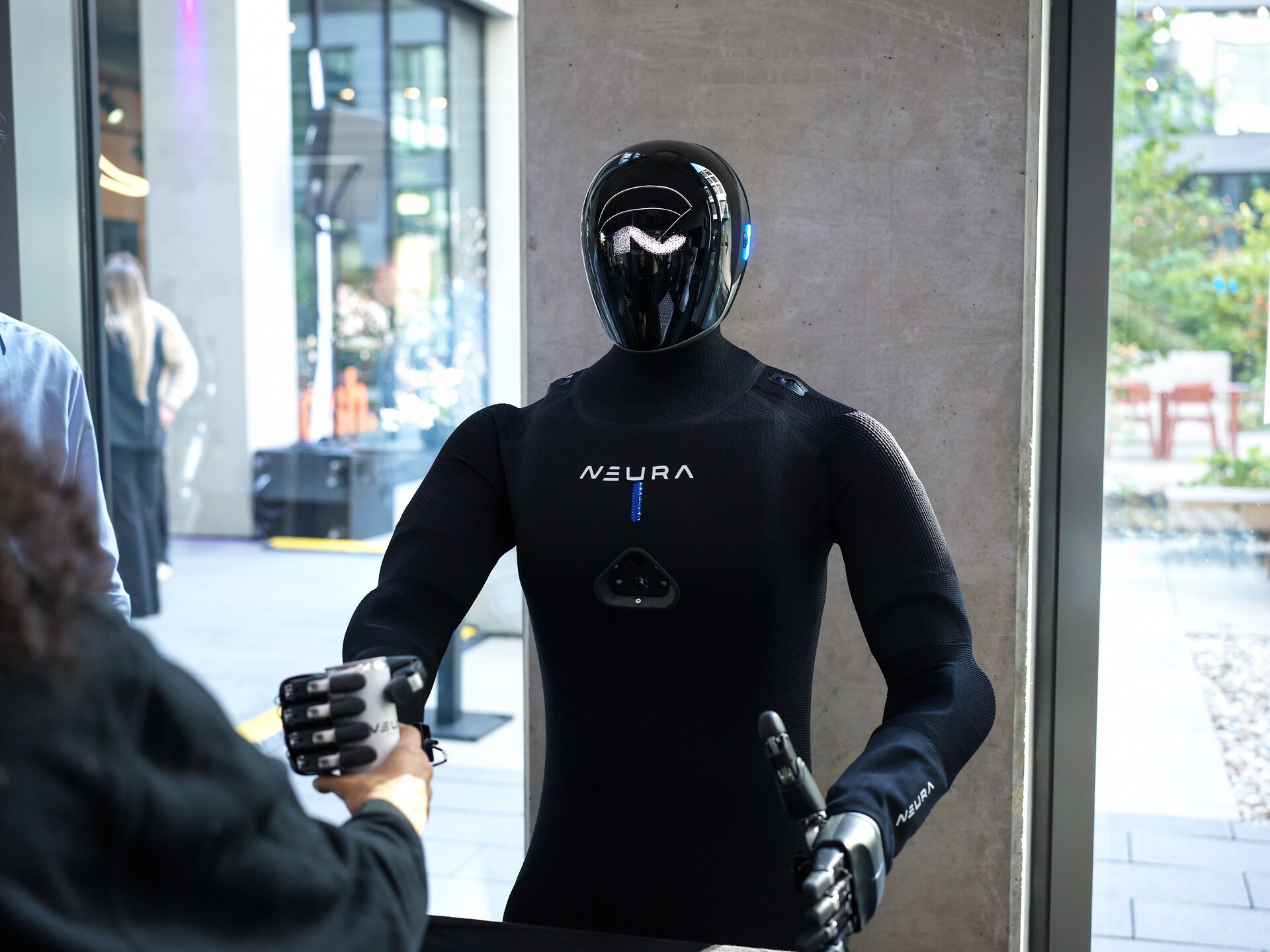
NEURA Robotics unveiled the NEURA 4NE1 Gen 4 on October 22, 2026, at the opening of the TUM RoboGym in Munich. The German company presents it as a slimmer, production-oriented humanoid with a textile skin, local limb reflexes, and Neuron AI for physical work. All figures below are vendor claims unless noted.
The robot matters, but the room it launched in may matter more. The TUM RoboGym is a €17 million, 2,300 square meter training center at LabCampus near Munich Airport, built with the Technical University of Munich’s Munich Institute of Robotics and Machine Intelligence (MIRMI), as described in NEURA’s official RoboGym launch announcement. Companies from more than ten industries have been training there since September, bringing real tasks such as handling cardboard boxes, filling bottles, and loading wooden components. This article covers the Gen 4 changes, what remains undisclosed, and why a purpose-built gym changes how humanoids learn real work.
What changed in the Neura 4NE1 Gen 4?
NEURA lists the robot at 180 cm tall and 80 kg on its official 4NE1 product page, which it says is roughly 20 percent lighter than the previous generation. The company has not published a Gen 3 weight figure, so the saving cannot be independently checked. One third-party report, from Heise, describes the new robot at about 64 kg, which conflicts with NEURA’s own 80 kg listing. That figure is an unconfirmed third-party claim, and this article uses NEURA’s published number while flagging the discrepancy so readers who find both are not confused.
The black textile outer skin replaces a hard shell. NEURA says the fabric makes the robot appear more approachable for work alongside people and allows simple customization. Redesigned hands are meant to grip more precisely. Smart Limbs add local reflexes, so each limb can respond to a bump, a slipping grip, or a shifting load without waiting for the central model. The result, according to NEURA, is faster reactions and smoother, more human-like motion.
A lighter body needs less motor torque, uses less energy per movement, and does less harm in a fall or accidental contact. That logic matters most once humanoids work beside staff rather than behind a fence, though NEURA has published no independent test data proving the gain.
The payload is listed at 10 to 20 kg, with a walking speed of 5 km/h. NEURA offers wheeled and extended-reach variants for different floors and tasks. The robot is being prepared for series production and is already operating in NEURA gyms, where companies can test tasks on the new generation. NEURA has announced no date when companies can buy or deploy it. NEURA also showed the robot at NVIDIA GTC Berlin in the same week.
Neuron AI and Neuraverse: how the robot learns
Neuron AI is NEURA’s foundation model for Physical AI. It fuses vision, touch, force, sound, and the robot’s own state, then translates perception directly into movement. That matters for industrial tasks where vision alone is not enough, for example, sensing whether a fastener has clicked into place. NEURA says the model trains on real robot data from its gyms, human demonstrations, and simulation.
The Neuraverse is the sharing layer. When one connected robot learns a skill, it can be made available to other connected robots, so Gen 4 benefits from everything learned across the gym network. NEURA says companies can also keep a skill private. That data ownership choice deserves attention from any organization planning a pilot, since every task trained in Munich adds to the data pool NEURA is building.
NEURA says 4NE1 Gen 4 runs Neuron AI locally, without a cloud connection. If confirmed in deployment, on-device inference would keep production data on site and allow work to continue during a network outage. NEURA has published no benchmarks or technical report for Neuron AI, so performance remains a vendor claim.
Inside the TUM RoboGym: a gym model for humanoid training
The TUM RoboGym brings research, robot training, and industrial use into one facility. According to TUM’s opening announcement, the gym holds 48 training cells for around 100 humanoid and service robots, with data flowing into a curated cloud data lake for training physical AI models. NEURA contributes robots, computing, infrastructure, and operating staff. TUM provides space, scientific expertise, and research resources. The partnership runs for an initial three years.
On funding, TUM’s March release states the partners are jointly investing around €17 million, with NEURA contributing the lion’s share at eleven million euros, primarily to procure robots and maintain hardware infrastructure, in return for participation in TUM research. That university attribution is stronger than trade press summaries repeating the same numbers.
Training started in September with companies from automotive, pharmaceuticals, medical technology, packaging, logistics, agriculture, care, and more. Early tasks include handling cardboard boxes, filling bottles, and loading and unloading wooden parts. Companies can test an application, judge training needs, and assess which robot form fits before expanding at their own sites. Alongside humanoids, the gym uses mobile assistance robots such as MiPA and cognitive robot arms.
A purpose-built gym changes training in three ways compared with field trials. First, it concentrates repetition: the same task runs many times under controlled but realistic conditions. Second, it mixes three data sources in one place: real robot operation, human demonstrations with sensor suits, motion capture and teleoperation, and simulation that adds variations. Third, it shortens the path from research to deployment, since scientists can test ideas under practical conditions while industrial tasks generate new research questions. Munich is planned as the first node in an international network, with another German gym in development with RWTH Aachen and further sites planned in Europe, the United States, and China.
This funding and industrial context builds on NEURA’s reported €1B round with Tether backing European physical AI, which we covered separately. That story explains the capital behind the expansion. This story focuses on the Gen 4 hardware and the gym model itself.
What NEURA has not disclosed
These core figures remain unpublished, and they should not be guessed at:
- No price, delivery date, or production volumes. Series production is described only as being prepared.
- No battery capacity or runtime per charge. For a robot expected to work shifts, that is a central figure.
- No degrees of freedom or detailed hand specifications.
Training volume and success rates are unpublished too. No source reports episodes per day, hours of demonstrations, or stable success rates for gym tasks, so this article states no throughput figure. There are also no independent measurements of the weight saving or grip improvement, and no published benchmarks for Neuron AI. Treat the lighter body, better handling, and learning speed as company claims until third-party data appears. Unverified third-party figures for price, chips, or joint counts circulate online, and none of them are adopted here.
Why the gym model is the real story
Most humanoid launches focus on the body. The harder problem is data: thousands of hours of real grasps, failed attempts, corrections, and edge cases. Field trials produce that data slowly, one customer site at a time. A shared gym produces it faster by letting many companies bring many tasks to the same robots, sensors, and researchers, with results pooled in a common data lake.
For buyers, the model also changes the first step. Instead of purchasing robots and training them on site, an organization brings a task and its process knowledge to Munich, watches what the robot can do, and decides before committing capital. The key questions before a pilot are practical: which tasks fit a 10 to 20 kg payload, who owns the resulting data and skills, what runtime each charge delivers, and what success rate the training reached after how many hours.
Frequently Asked Questions
How tall and heavy is the NEURA 4NE1 Gen 4?
NEURA lists 180 cm and 80 kg, which it says is about 20 percent lighter than the prior generation. Payload is 10 to 20 kg and walking speed is 5 km/h. These are vendor figures, and one third-party report gives a different weight that NEURA has not confirmed.
How much does the 4NE1 Gen 4 cost?
NEURA has not announced a price, delivery date, or volumes. Companies can currently work with the robot inside NEURA gyms rather than buying or deploying it.
What is the TUM RoboGym?
A 2,300-square-meter training center near Munich Airport run by NEURA and TUM, with 48 training cells for around 100 robots, where companies train robots on real tasks using robot data, human demonstrations, and simulation.
What is Neuron AI?
NEURA’s Perception-Language-Action model that fuses vision, touch, force, sound, and robot state into movement, trained on gym data, demonstrations, and simulation.


