
Solar cells are a truly ingenious creation. They present us with one of the best things modern technology can provide—clean electricity from sunlight. The downside is, they are not perfect. They are quite inefficient. Most of the sunlight they absorb ends up being lost in the form of heat. Other researchers have taken a different approach, using that waste heat to produce fertilizer from urine instead of converting it back to electricity. Because of that, the average efficiency of a commercial solar panel is between 11% and 22%.
In a search to rectify this defect and make solar cells the superstars they should be, a pair of Rice University scientists, Gururaj Naik and Junichiro Kono, designed a device that could make use of the heat and turn it into electricity. When added to a solar panel, the device could boost its efficiency by up to 80%! They introduced their technology in the scientific journal ACS Photonics.
The design is based on an array of single-wall carbon nanotubes. These ever-more-humble carbon nanotubes recapture the thermal photons of infrared radiation—that’s the heat—lost by solar cells. The energy collected then gets emitted as light in a different wavelength, which in turn can be recycled into electricity.
In other words, the device is a hyperbolic thermal emitter that can absorb intense heat that would otherwise be spewed into the atmosphere. It then squeezes the absorbed heat into a narrow bandwidth and emits it as light that can be turned into electricity.
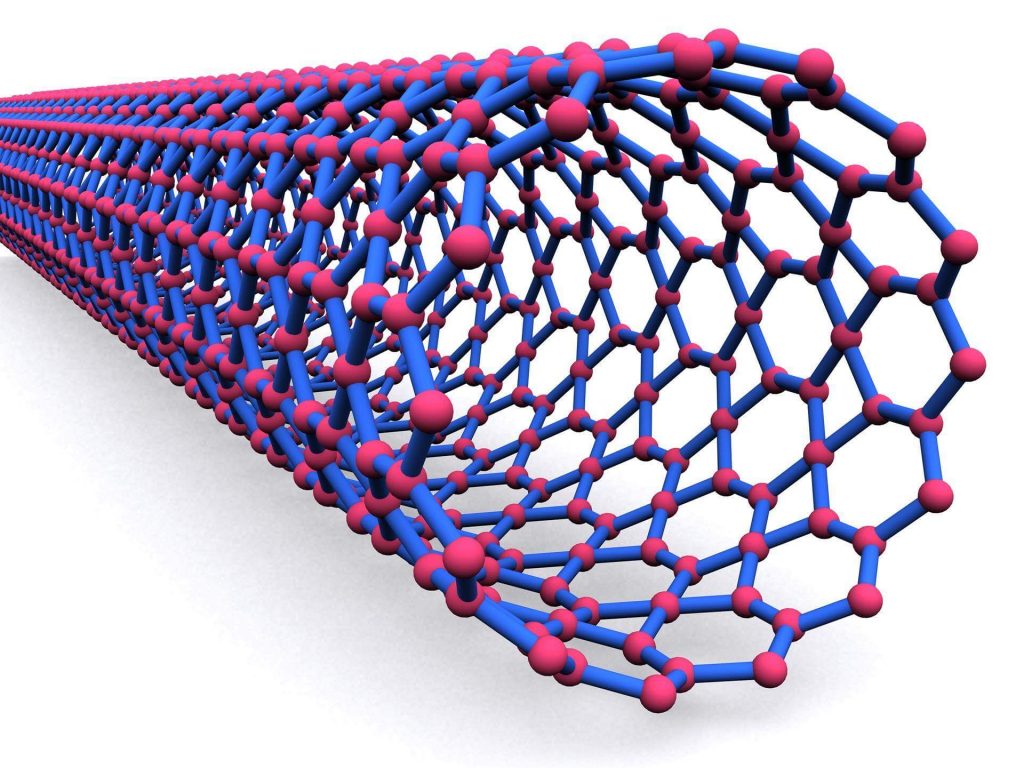
This invention actually uses a previous discovery by Kono’s group in 2016 in which they found a simple method to make highly aligned, wafer-scale films of closely packed nanotubes. When discussing it with Naik, who joined Rice in 2016, they came up with the idea to see if the films could be used to direct “thermal photons.”
Kono explained, “Thermal photons are just photons emitted from a hot body. If you look at something hot with an infrared camera, you see it glow. The camera is capturing these thermally excited photons.”
Naik continued, “Infrared radiation is a component of sunlight that delivers heat to the planet, but it’s only a small part of the electromagnetic spectrum. Any hot surface emits light as thermal radiation. The problem is that thermal radiation is broadband, while the conversion of light to electricity is efficient only if the emission is in a narrow band. The challenge was to squeeze broadband photons into a narrow band. The nanotube films presented an opportunity to isolate mid-infrared photons that would otherwise be wasted. That’s the motivation. A study by (co-lead author and Rice graduate student) Chloe Doiron found that about 20% of our industrial energy consumption is waste heat. That’s about three years of electricity just for the state of Texas. That’s a lot of energy being wasted.”
Naik goes on to explain how the most efficient way to turn heat into electricity now is to use turbines and steam or some other liquid to drive them—which can give you nearly 50% conversion efficiency. That’s the most; nothing else is as efficient, but those systems are not easy to implement. So, in search of not only the most efficient method, Naik and his colleagues also aim to simplify the task with a compact system that has no moving parts.
How the nanotube film works:
- The aligned nanotube films are conduits that absorb waste heat and turn it into narrow-bandwidth photons.
- Electrons in nanotubes can only travel in one direction, so they made the aligned film metallic in that direction.
- Then they insulated it in the perpendicular direction. This makes it so thermal photons can strike the film from any direction but can only leave via one.
- The resulting effect is called hyperbolic dispersion.
Naik said, “Instead of going from heat directly to electricity, we go from heat to light to electricity. It seems like two stages would be more efficient than three, but here, that’s not the case. By squeezing all the wasted thermal energy into a small spectral region, we can turn it into electricity very efficiently. The theoretical prediction is that we can get 80% efficiency.”
Even adding the emitters to standard solar cells could boost their efficiency from the current peak of about 22%. Naik continued, “There’s an array of such resonators, and each one of them emits thermal photons in just this narrow spectral window. We aim to collect them using a photovoltaic cell and convert it to energy, and show that we can do it with high efficiency.”
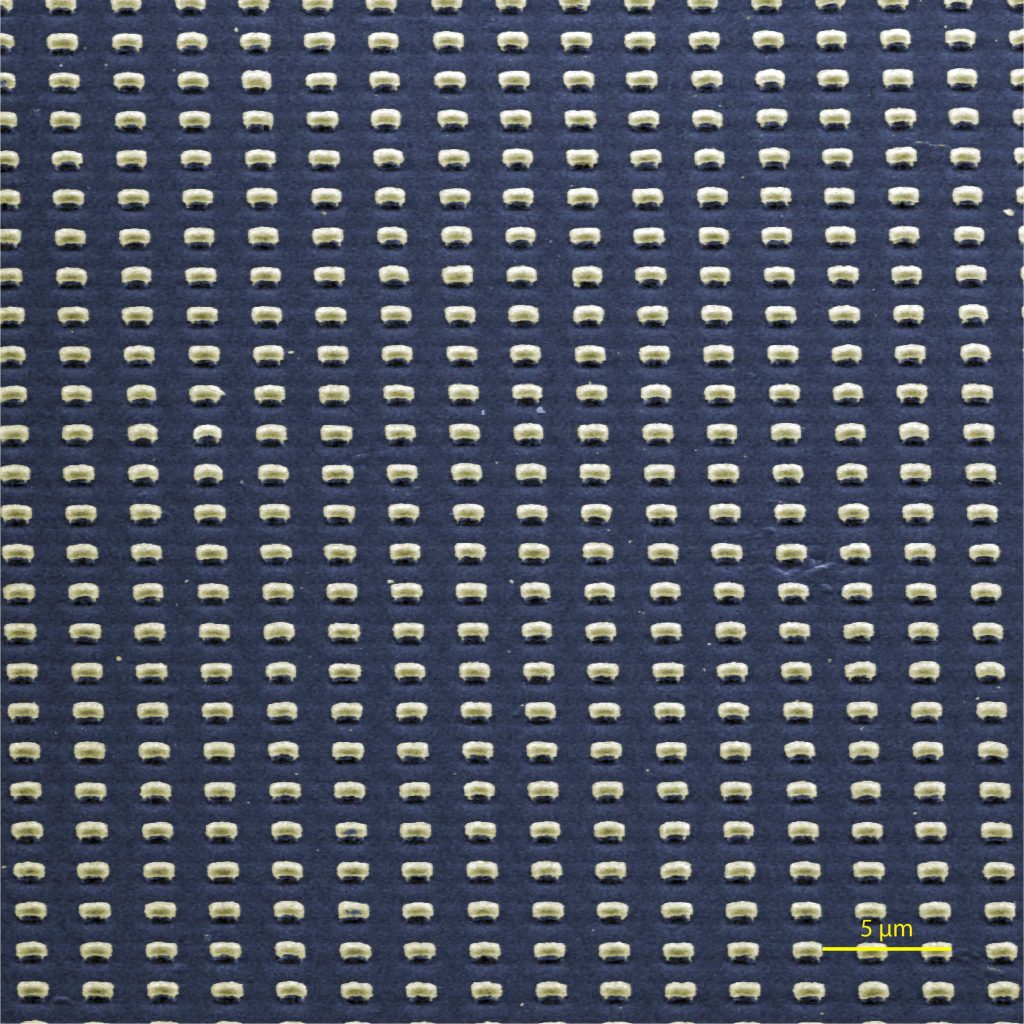
Naik’s team built proof-of-concept devices by patterning arrays of submicron-scale cavities into the chip-sized films. The prototype allowed them to operate at up to 700°C (1,292°F) and confirm their narrow-band output. However, the films are capable of withstanding temperatures as high as 1,700°C (3,092°F).


