
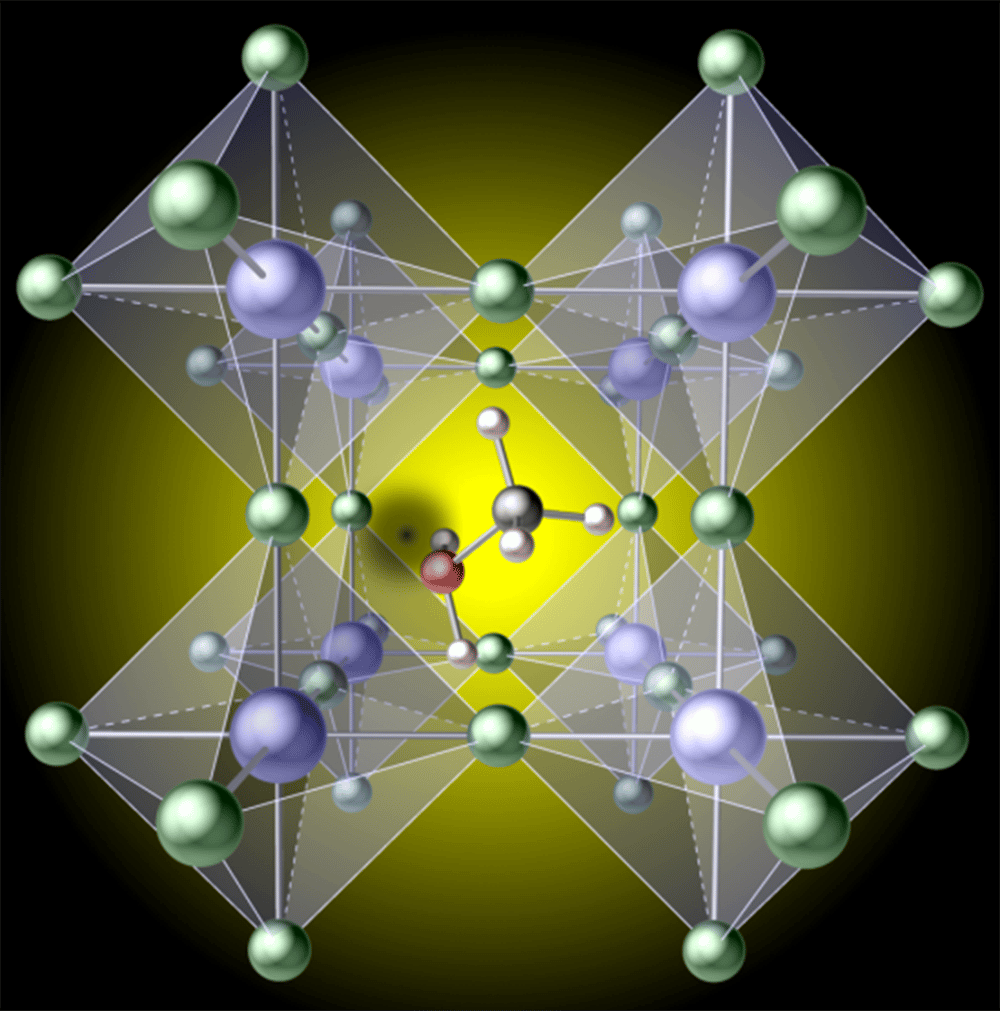
Perovskite is a crystalline structure made up of repeating cages of molecules. It looks like a bunch of boxes joined at the corners. A while back, scientists realized that they could dust perovskite crystals with organic molecules to fill in any gaps of imperfection. It efficiently harvests solar energy, converting over a quarter of the light that falls on them into electricity. Since it’s also a cheap material, this discovery was a breakthrough in solar cell development.
Silicon-based solar cells remain the most abundant solar panel technology, but cells made of perovskite crystals could, theoretically, push the efficiency limit beyond 30% and cost far less to manufacture. However, something has been holding the technology back. So, scientists from the University of California, Santa Barbara (UCSB) decided to figure out the matter.
Until now, scientists assumed that adding more organic molecules (Methylammonium) would solve the efficiency problem by patching up any flaws in the crystal lattice. However, the UCSB researchers found that the defects limiting solar-cell performance were caused by the hydrogen in the Methylammonium.
The team, led by materials professor Chris Van de Walle, used cutting-edge computations to reveal that it’s missing hydrogen atoms in the organic molecules causing massive efficiency losses. So, adding more Methylammonium isn’t the wise move after all, and it’s not the crystalline perovskite structure that is the problem.
Xie Zhang, the lead researcher on the project, said:
Methylammonium lead iodide is the prototypical hybrid perovskite. We found that it is surprisingly easy to break one of the bonds and remove a hydrogen atom from the methylammonium molecule. The resulting ‘hydrogen vacancy’ then acts as a sink for the electric charges that move through the crystal after being generated by light falling on the solar cell. When these charges get caught at the vacancy, they can no longer do useful work, such as charging a battery or powering a motor, hence the loss inefficiency.
Mark Turiansky, a senior graduate student who is part of Van de Walle’s group, added:
Our group has created powerful methods for determining which processes cause efficiency loss, and it is gratifying to see the approach provide such valuable insights for an important class of materials.
Van de Walle explained:
The computations act as a theoretical microscope that allows us to peer into the material with much higher resolution than can be achieved experimentally. They also form a basis for rational materials design. Through trial and error, it has been found that perovskites in which the methylammonium molecule is replaced by formamidinium exhibit better performance. We are now able to attribute this improvement to the fact that hydrogen defects form less readily in the formamidinium compound.
This insight provides a clear rationale for the empirically established wisdom that formamidinium is essential for realizing high-efficiency solar cells. Based on these fundamental insights, the scientists who fabricate the materials can develop strategies to suppress the harmful defects, boosting additional efficiency enhancements in solar cells.
The process is still entirely theoretical. Nevertheless, the calculations allow the team to uncover ways around the flaw potentially. They’ve already come to one possibility: to shoot for a middle ground in Methylammonium concentrations. The researchers have even backed this suggestion with experimental findings. Or, swapping out Methylammonium for another cation organic molecule, like cesium or formamidinium, could also result in a radical improvement in inefficiency.
However, it’s going to take a lot more testing and planning to transform this theoretical work into a practical method of electricity generation.


