
On August 31, 2026, Google Research released TimesFM-3, the third generation of its time-series foundation model family. The headline change is structural rather than incremental: for the first time, a TimesFM model is pretrained natively for multivariate forecasting, which means it can forecast multiple related signals in a single forward pass and let those signals inform each other. Previous TimesFM releases (1.0, 2.0, and 2.5) were strictly limited to univariate forecasting, predicting one series at a time from its own history.
This release is part of a deliberate strategy at Google Research. Within roughly nine days in late August and early September 2026, the team published GlucoFM, a foundation model for continuous glucose monitoring data, and contributed to the Planetary Prediction Engine for Earth systems modeling. That cadence is consistent with the broader Google AI release wave Intelligent Living has tracked since April 2026. TimesFM-3 sits alongside those releases as the general-purpose time-series member of a broader Google Research pattern: build domain-aware foundation models that can replace hand-engineered pipelines for specific forecasting problems.
What TimesFM-3 Is and Why It Matters
TimesFM-3 is a 330-million-parameter zero-shot time series foundation model that can jointly forecast multiple coevolving time series along with past covariates (features known historically, such as past foot traffic) and past-future covariates (features whose future values are known, such as a scheduled promotion calendar). All three input types work without any task-specific fine-tuning.
The model was pretrained on a corpus of more than 1 trillion time points drawn from real-world and synthetic series, and it inherits the decoder-only transformer backbone used by TimesFM 1.0, 2.0, and 2.5. Context length is unchanged from the previous release at 16,384 time steps.
The multivariate capability matters because most production forecasting problems are not shaped like one isolated series. A retailer wants to forecast 10,000 SKUs at once, and substitution effects between products cannot be modeled by calling a univariate model 10,000 times. A grid operator wants to forecast temperature, load, and price together. A DevOps team wants to forecast CPU, memory, and request latency across a fleet of correlated services. TimesFM-3 is Google’s answer to that bundle-of-series shape: feed in the full bundle plus any known future signals, and get back the whole forecast in one call.
TimesFM-3 vs. TimesFM 2.5: What Actually Changed
The shift from 2.5 to 3.0 is more than a version-number bump. The table below summarizes the headline differences:
| Feature | TimesFM 2.5 | TimesFM-3 |
|---|---|---|
| Parameters | 200M | 330M |
| Training corpus | Undisclosed scale | 1T+ time points (real + synthetic) |
| Context length | 16,384 | 16,384 (unchanged) |
| Multivariate forecasting | No (univariate only) | Yes (native, single forward pass) |
| Covariate support | XReg (added Oct 2025) | Past covariates + past-future covariates, native |
| Quantile forecasting | Continuous quantile head | 9 quantiles (10th–90th percentile) |
| Decode strategy | Autoregressive, one patch at a time | Non-autoregressive, Contiguous Patch Masking |
| Pretrained weights license | Apache 2.0 | timesfm-non-commercial-license-v1.0 |
| Inference code license | Apache 2.0 | Apache 2.0 (unchanged) |
The parameter increase runs against the trend of the 2.0 to 2.5 jump, which shrunk the model from 500M to 200M parameters while extending context. TimesFM-3 spends that extra capacity on the variate-attention mechanism needed to model cross-series dependencies, a reasonable trade if multivariate reasoning is the point of the release.

Under the Hood: Architecture and the 2D Attention Grid
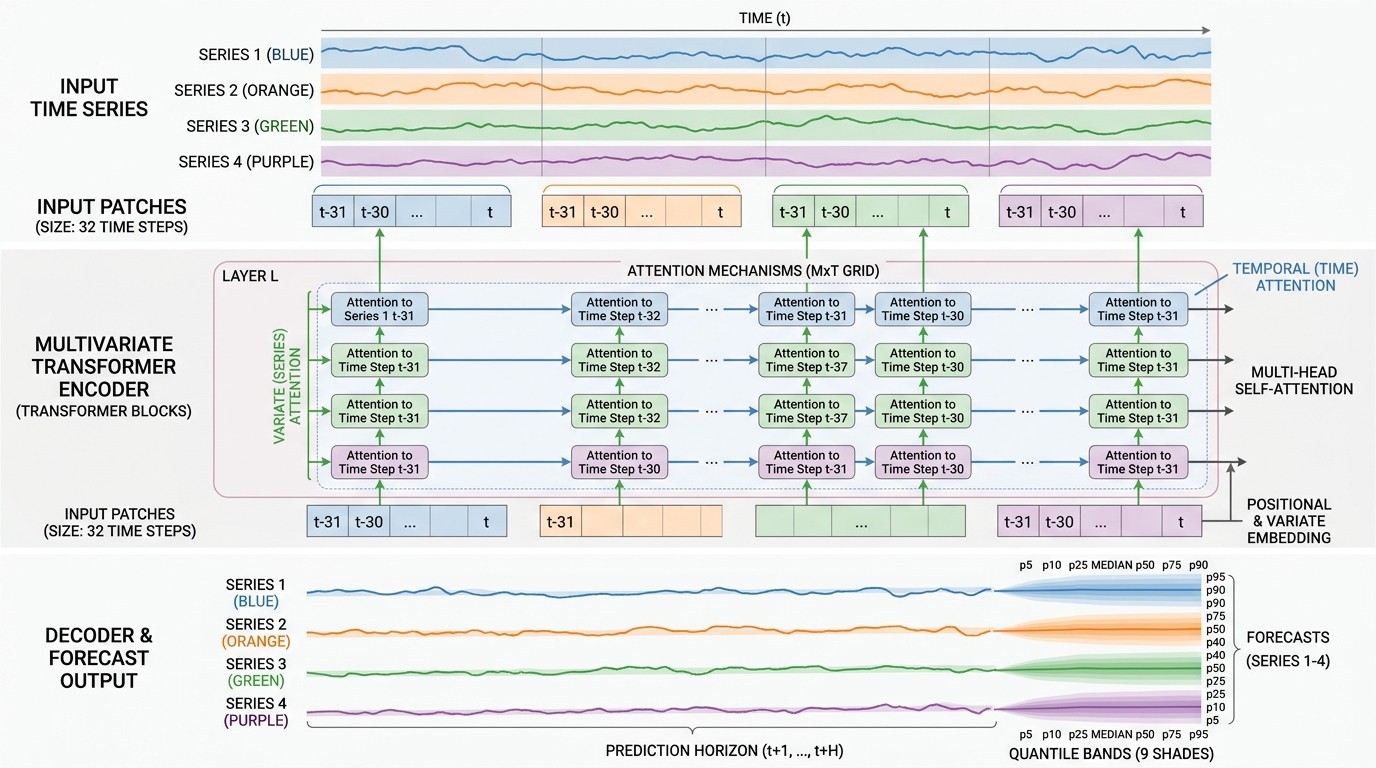
TimesFM-3 keeps the decoder-only transformer backbone of its predecessors but reorganizes how attention is applied. Three architectural choices are worth understanding.
Patching and normalization
Contiguous data points are grouped into patches of 32 time steps for the context window and 64 time steps for the forecast horizon. Each series is normalized independently so that wildly different scales (a stock price and a sensor temperature reading) do not dominate the model. This part of the design is essentially unchanged from TimesFM 2.5.
Multivariate token construction
For target series and past covariates, a token is constructed directly from a single patch. For past-future covariates, TimesFM-3 uses a lookahead strategy: the current patch is concatenated with future patches, allowing the model to peek at upcoming known signals. This is how a promotion calendar (where every future date is either promotional or not) can be fed into the model as a single signal without losing the forward-looking information.
Alternating attention: 2D grid, two mechanisms
Once patches are tokenized, they pass through an input residual block and enter the main transformer stack, which operates as a 2D grid. Two attention mechanisms alternate across layers:
- Causal temporal attention runs horizontally across time. It is strictly causal and confined to earlier tokens within the same series, which prevents data leakage from the future to the past.
- Full variate attention runs vertically across series. At any given time step, a token reads every other series at that step, learning cross-series correlations such as how a promotion on one product lifts sales of another.
The alternation blends temporal patterns with cross-series relationships. Earlier TimesFM versions had only the horizontal pass.
Non-autoregressive decode via Contiguous Patch Masking
Previous TimesFM models generated forecasts one patch at a time, introducing latency, compounding error accumulation, and computational cost. TimesFM-3 generates the entire forecasting horizon in a single forward pass using Contiguous Patch Masking, a training-time masking strategy introduced with the TiRex model earlier in 2026.
The mechanism works as follows. Masked placeholder tokens are appended for the entire horizon alongside the observed context. Targets and past covariates are masked in the horizon because their future values are unknown. Past-future covariates remain visible, so the model can still condition on holidays or scheduled events. Through the alternating attention layers, the model fills all masked horizon patches simultaneously. Each target receives 9 quantiles (10th through 90th percentile) at every horizon step, providing a full probabilistic view of forecast uncertainty.
The Promotion Example Decoded: Why Multivariate Buys You ~20% Sales Lift
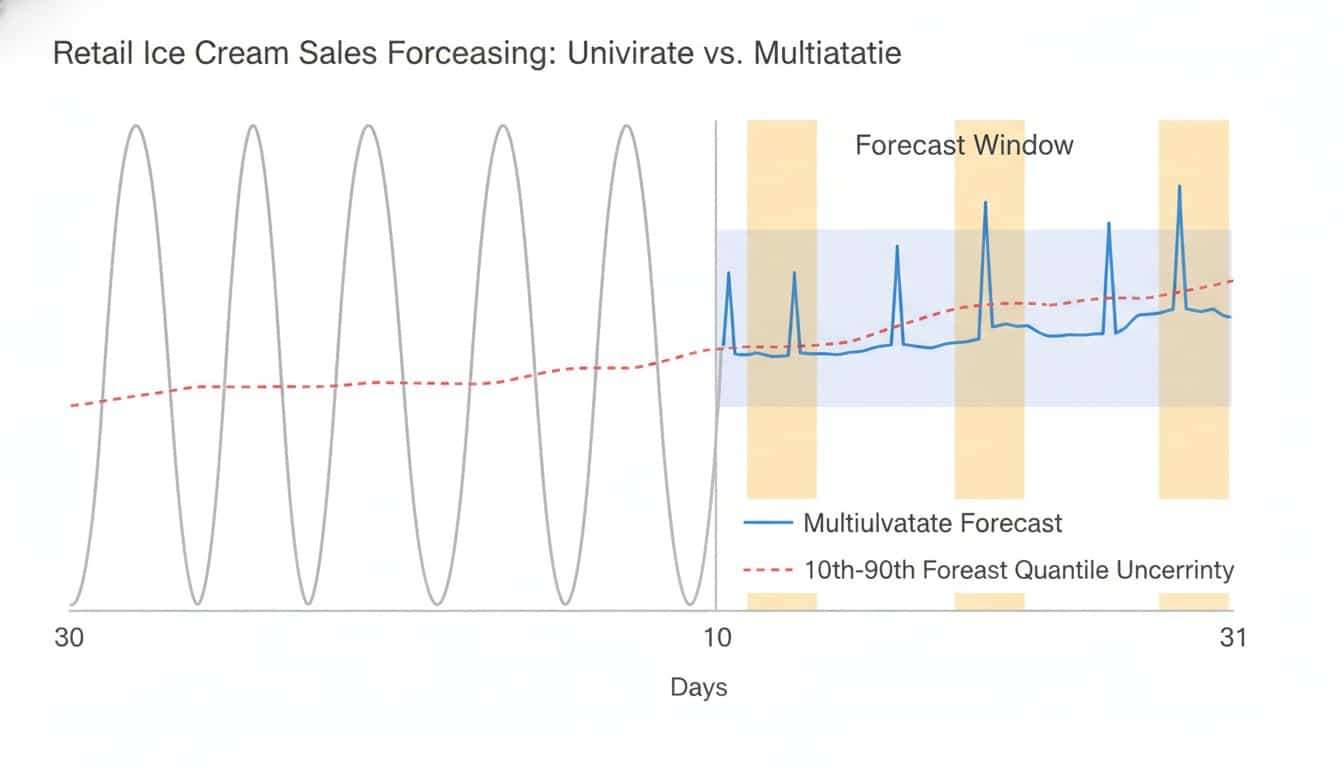
Google’s blog post uses an ice-cream-sales example to illustrate what multivariate covariates actually buy a practitioner. Here is the example decoded, with the underlying mechanics made explicit.
A retail chain wants to forecast ice cream sales for the next month. Two approaches are available:
- Univariate forecast. The model looks at historical sales alone and projects a weekly pattern forward. It has no information about planned promotions on specific days.
- Multivariate forecast with past-future covariate. The model receives the planned promotion schedule (which days have a promotion and which do not) as a past-future covariate. From the historical context, it learns the relationship between promotion days and sales lift. It then applies that learned relationship to future days where promotions are scheduled.
The result is a forecast that anticipates a sales lift on each promotion day. In the example, the lift is roughly 20% on each promotional day. The 20% number is illustrative, drawn from the historical correlation the model learned between promotion flags and observed sales spikes, and it is not a hard-coded multiplier.
The chart Google published shows this divergence in action. The red univariate line continues a flat weekly pattern regardless of promotion days. The blue multivariate line lifts visibly on the days flagged as promotional. Over a month, the divergence compounds into materially different revenue projections, the kind of accuracy gain that changes an actual planning decision rather than just nudging a benchmark number.
Benchmark Performance: GIFT-Eval, FEV-Bench, and TIME
Google evaluated TimesFM-3 on three comprehensive public forecasting benchmarks. The model takes the top average rank on all three, in both point-forecast and probabilistic-forecast metrics, among pretrained foundation models.
| Benchmark | Coverage | TimesFM-3 rank | Comparison set |
|---|---|---|---|
| GIFT-Eval | Broad zero-shot forecasting, many domains and frequencies | Rank #1 (foundation models) | Chronos-2, Toto 2.0 family, TimesFM 2.5 |
| FEV-Bench | 100 real-world tasks | Rank #1 overall | Chronos-2, Toto 2.0 family, TimesFM 2.5 |
| TIME | 50 domain datasets, 98 evaluation tasks | Rank #1 overall | Chronos-2, Toto 2.0 family, TimesFM 2.5 |
The benchmarks stress different things. GIFT-Eval tests zero-shot performance across diverse domains. FEV-Bench evaluates generalization to held-out forecasting tasks. The TIME leaderboard focuses on multiple forecast horizons. Together, they cover breadth (GIFT-Eval), generalization (FEV-Bench), and horizon robustness (TIME).
One important wrinkle: Google reports that even when TimesFM-3 is run in univariate mode (no covariates and no cross-series information, treating each target independently), it still matches or outperforms competing models. Multivariate mode adds further gains on top of an already-competitive univariate baseline, rather than being the only thing propping up the benchmark wins.
Independent researcher caution is worth flagging. Average-rank metrics can mask effect-size variation across individual benchmark tasks, and how much a multivariate model actually gains depends heavily on whether a given dataset’s series are structurally related. The headline benchmark wins are a strong signal worth testing on your own data, not a guarantee that multivariate mode will help every dataset equally.
How to Access TimesFM-3 Today
TimesFM-3 is available across four distribution channels today, with a fifth on the way:
- GitHub at google-research/timesfm. The reference inference code is Apache 2.0.
- Hugging Face at google/timesfm-3.0-pytorch. The pretrained weights ship under the new non-commercial license.
- PyPI via pip install timesfm[torch]. Same code and weight licensing as the channels above.
- BigQuery ML: Google says the integration is “coming weeks”. TimesFM-2.5 is available immediately through the AI.FORECAST command in BigQuery for users who want to familiarize themselves with the workflow before 3.0 lands.
Vertex AI Model Garden and Google Sheets have not yet confirmed a TimesFM-3 rollout as of publication; both serve TimesFM 2.5 currently.
The Licensing Catch: Why the Weights Are Not Open for Production
This is the part of the launch that practitioners jumped on within hours. TimesFM 2.0 and 2.5 both shipped their pretrained weights under Apache 2.0, fully open, freely redistributable, and self-hostable anywhere. TimesFM-3’s weights ship under a new timesfm-non-commercial-license-v1.0, restricted to non-commercial, non-production use. The inference code itself stays Apache 2.0, but the pretrained checkpoint is now gated.
James LePage, who runs the independent time-series-model site tsfm.ai, flagged this directly in reply to Google’s announcement: “Sadly the terms don’t allow us to host it!” His concern is that third-party mirrors and community-hosting sites, which have historically redistributed open forecasting model weights, are now blocked from doing the same for TimesFM-3.
What the new license means in practice:
- Research and evaluation: fine. Download the weights, benchmark them, write about them, use them in a non-commercial pipeline.
- Commercial product built directly on the raw checkpoint: not covered by the default license terms. You would need a separate arrangement with Google.
- Third-party hosting and mirroring: explicitly blocked.
- Google’s managed surfaces (BigQuery ML, Vertex AI Model Garden, Google Sheets): sidestep the issue, since you are calling Google’s hosted endpoint rather than redistributing the weights yourself. This is likely where Google expects commercial usage to land.
If you are evaluating TimesFM-3 for a production system, the practical read is to prototype freely against the open checkpoint but plan the production path through Google’s managed offerings or wait for licensing clarity, rather than assuming you can self-host the raw weights the way you could with TimesFM 2.5. The licensing shift is consistent with a broader pattern at Google Research: foundation models ship open weights for research evaluation, then weight access is tightened as commercial deployment considerations take over.
Frequently Asked Questions
What is TimesFM-3?
TimesFM-3 is a 330-million-parameter zero-shot time series foundation model released by Google Research on August 31, 2026. It is the first TimesFM model natively pretrained for multivariate forecasting, meaning it can jointly predict multiple related time series and let them inform each other in a single forward pass.
How is TimesFM-3 different from TimesFM 2.5?
TimesFM 2.5 was strictly univariate (one series at a time). TimesFM-3 adds native support for multiple targets, past covariates, and past-future covariates, along with a non-autoregressive decode strategy (Contiguous Patch Masking) that produces the entire forecast horizon in one forward pass instead of one patch at a time.
Can I use TimesFM-3 commercially?
Not under the default license. The pretrained weights ship under timesfm-non-commercial-license-v1.0, which restricts them to non-commercial, non-production use. Commercial deployment paths run through Google’s managed services (BigQuery ML, Vertex AI, Google Sheets) once they ship 3.0, or through a separate arrangement with Google.
Where can I download TimesFM-3?
The pretrained weights are on Hugging Face at google/timesfm-3.0-pytorch, and the inference code is on GitHub at google-research/timesfm. The package is also installable via PyPI with pip install timesfm[torch]. BigQuery ML integration is coming in the following weeks.
How does TimesFM-3 compare to Chronos-2 and the Toto 2.0 family?
Google reports TimesFM-3 takes the top average rank on GIFT-Eval, FEV-Bench, and TIME in both point-forecast and probabilistic-forecast metrics among pretrained foundation models. The headline benchmark wins are strong signals worth testing on your own data, but average-rank metrics can mask effect-size variation across individual benchmark tasks.
Conclusion
TimesFM-3 is Google’s first time-series foundation model that actually solves the shape of most real-world forecasting problems. Instead of forcing practitioners to call a univariate model thousands of times and stitch the results together, the model forecasts bundles of related series together, with attention that lets each series inform the others, and with support for known-future signals like promotion calendars or AI weather forecasts such as Google’s WeatherNext 3. The 330M-parameter decoder-only transformer, pretrained on more than 1 trillion time points, sets a new top rank across GIFT-Eval, FEV-Bench, and TIME.
The licensing shift is the part worth watching. Google has shifted the pretrained weights from Apache 2.0 to a non-commercial license, blocking third-party mirrors and restricting production deployment to Google’s managed surfaces. That decision signals where Google expects commercial usage to flow: through BigQuery, Vertex AI, and other Google-hosted endpoints, not through community-hosted raw weights. For researchers and benchmarkers, the model is fully accessible. For production teams, the deployment path now runs through Google.
Whether the multivariate architecture and the licensing model both become the new template for time-series foundation releases will be clearer once Chronos-3, Toto 3.0, and any competitors respond over the next few months.


