
Tooth decay and missing teeth are two of the most common dental problems, but they are also two areas where early advice can make a major difference. Tooth decay often develops gradually, starting with small changes in the enamel before progressing into cavities, pain, or infection. Missing teeth can also seem manageable at first, especially if the gap is not visible, but they may affect chewing, speech, confidence, bite balance, and long-term oral health.
The good news is that modern dentistry offers effective ways to prevent decay, repair damaged teeth, and replace missing teeth. From dental hygiene and fluoride advice to dental implants, bridges, dentures, and cosmetic dentistry, the best approach depends on the individual patient’s teeth, gums, bite, and long-term goals.
This guide explains how tooth decay develops, how to prevent it, when to seek dental care, and what options may be available if a tooth has already been lost.
What Is Tooth Decay?
Tooth decay, also called dental caries, happens when the hard outer surface of the tooth is damaged by acids produced by bacteria in dental plaque.
Plaque is a sticky film that forms on the teeth every day. When plaque bacteria come into contact with sugars from food and drink, they produce acids. These acids gradually remove minerals from enamel. If the process continues, the enamel can break down and a cavity may form.
Tooth decay can affect adults and children. It may occur between teeth, around old fillings, near the gum line or on the biting surfaces of molars.
Why Tooth Decay Should Not Be Ignored
Early tooth decay may not cause pain. This is one reason regular dental check-ups are important. A dentist may detect early changes before the patient notices any symptoms.
If decay progresses, it may lead to:
- Tooth sensitivity
- Toothache
- Pain when biting
- Visible holes or dark marks
- Food trapping
- Bad breath
- Broken tooth structure
- Infection or abscess
- The need for root canal treatment
- Tooth extraction in severe cases
When decay is treated early, a simple filling or preventive care may be enough. When it is left untreated, the treatment can become more complex and costly.
How to Prevent Tooth Decay
Preventing tooth decay is usually a combination of good daily habits, sensible dietary choices, and professional dental care. Consistent preventive dentistry for healthy teeth and gums helps reduce the risk of cavities and gum problems over time.
Brush Twice Daily with Fluoride Toothpaste
Brushing twice a day with fluoride toothpaste is one of the most important habits for protecting teeth.
Fluoride helps strengthen enamel and makes teeth more resistant to acid attack. According to NHS guidance on keeping teeth clean, most adults should use toothpaste containing at least 1,350 to 1,500 ppm fluoride unless advised otherwise by a dental professional. This concentration is widely recommended to help prevent decay.
Brush last thing at night and on one other occasion. After brushing, spit out the toothpaste but avoid rinsing immediately with water, as this washes away the fluoride.
Clean Between the Teeth
A toothbrush cannot reach every surface. Plaque can remain between the teeth and below the contact points, where decay and gum inflammation may begin.
Interdental brushes, floss, or other cleaning aids may be recommended depending on the size of the spaces between your teeth. A dental hygienist can show you which products are most suitable and how to use them effectively.
Reduce the Frequency of Sugar
Sugar frequency is a major factor in tooth decay. Eating or drinking sugar repeatedly throughout the day creates repeated acid attacks.
It is not only sweets and fizzy drinks that matter. Sugar can also be found in:
- Fruit juices and smoothies
- Flavoured coffees
- Energy drinks
- Biscuits and cakes
- Sweetened cereals
- Cereal bars
- Dried fruit
- Flavoured yoghurts
- Sauces and processed foods
Keeping sugary foods and drinks to mealtimes is generally better than snacking on them throughout the day. Water and milk are usually more tooth-friendly everyday drink choices than fizzy or sweetened drinks.
Be Careful with Acidic Drinks
Acidic drinks can contribute to enamel erosion. These may include fizzy drinks, sports drinks, citrus juices, lemon water and some flavoured sparkling waters.
Even sugar-free drinks can be acidic. Sipping acidic drinks slowly over several hours increases contact time with enamel. If you drink them, it is usually better to have them with a meal rather than repeatedly between meals.
Attend Routine Dental Examinations
Regular check-ups allow a dentist to identify early decay, failing fillings, enamel wear, gum problems and other issues before they become more serious.
The ideal recall interval is not the same for everyone. Some patients need more frequent reviews because of a higher risk of tooth decay, gum disease, dry mouth, medical conditions or previous dental problems.
Visit a Dental Hygienist
Dental hygiene appointments are not only about making teeth feel clean. A hygienist helps remove plaque and tartar, assesses gum health and improves home-care techniques.
Professional dental hygiene can help reduce the risk of gum inflammation, bad breath and plaque-related problems. It is also important before and after cosmetic dentistry, orthodontic treatment or dental implants.
Tooth Decay Prevention Checklist
| Habit | Why it helps |
|---|---|
| Brush twice daily with fluoride toothpaste | Strengthens enamel and removes plaque |
| Spit, do not rinse after brushing | Keeps fluoride on the teeth for longer |
| Clean between teeth daily | Removes plaque from areas a brush cannot reach |
| Limit sugary snacks and drinks | Reduces repeated acid attacks |
| Drink water between meals | Helps rinse the mouth without adding sugar or acid |
| Attend dental check-ups | Allows early detection and prevention |
| Visit a dental hygienist | Supports gum health and plaque control |
| Treat decay early | Helps avoid pain, infection and tooth loss |
What If Tooth Decay Has Already Started?
The right treatment depends on how far the decay has progressed.
Early Enamel Decay
Very early decay may sometimes be managed without drilling if the enamel surface has not broken down. The dentist may recommend fluoride treatment, improved oral hygiene, diet changes and monitoring.
Dental Fillings
If decay has created a cavity, a filling may be required. Tooth-coloured composite fillings can restore shape and function while blending with the natural tooth.
Root Canal Treatment
If decay reaches the dental pulp, the soft tissue inside the tooth, root canal treatment may be needed to remove infection and save the tooth where possible.
Tooth Extraction
When a tooth is too damaged to restore predictably, extraction may be recommended. If this happens, the dentist should explain whether the missing tooth should be replaced and what options are available.
What Happens When a Tooth Is Missing?
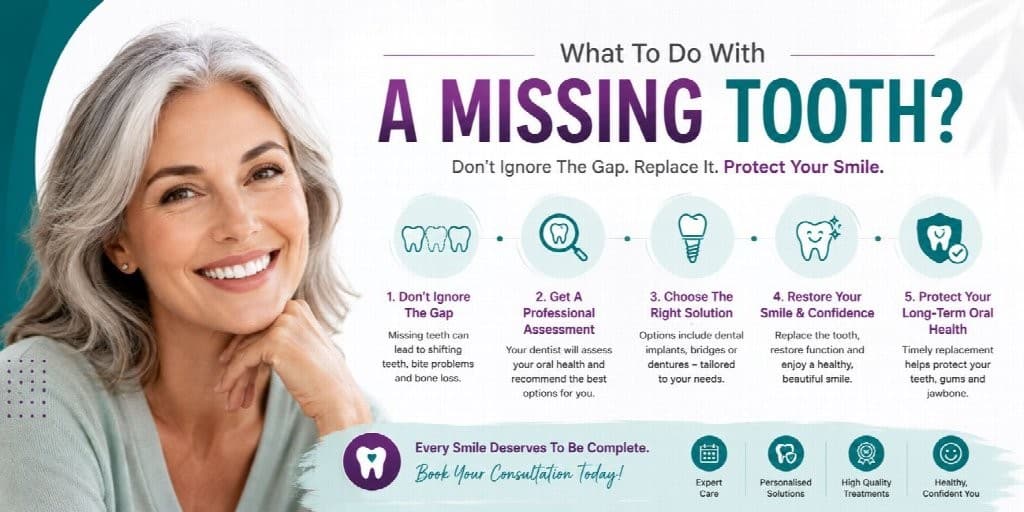
A missing tooth is not only a cosmetic concern. Teeth work together as part of a system. When one tooth is lost, the surrounding teeth, gums and jawbone may gradually change.
Possible effects include:
- Difficulty chewing on one side
- Changes in speech, especially with front teeth
- Food trapping around the gap
- Neighbouring teeth tilting into the space
- The opposing tooth moving into the gap
- Bite imbalance
- Jawbone shrinkage in the missing-tooth area
- Reduced confidence when smiling
- Greater pressure on remaining teeth
The impact depends on which tooth is missing, how long it has been absent, the patient’s bite and the health of the remaining teeth.
Does Every Missing Tooth Need to Be Replaced?
Not always. Some missing teeth do not require replacement, especially wisdom teeth or teeth that do not affect function or appearance.
However, you should not assume that a gap is harmless. A dentist can assess whether the space is likely to cause problems and whether replacement would be beneficial.
Replacement may be more important when:
- The gap is visible when smiling
- Chewing is affected
- Several teeth are missing
- Teeth are drifting or tilting
- Food is trapping around the space
- The bite feels uneven
- The missing tooth is important for support
- The patient wants a fixed solution
- Future implant treatment is being considered
Main Options for Replacing Missing Teeth
Missing teeth may be replaced with dental implants, dental bridges or dentures. Each option has different benefits, limitations and maintenance requirements.
Dental Implants
Dental implants are used to replace missing tooth roots. An implant is placed into the jawbone and can support a crown, bridge or denture.
A single implant can support one replacement crown. Several implants may support a bridge or help stabilise a denture.
Patients considering this option should arrange an assessment with a qualified Dental Implant Dentist. The dentist needs to check gum health, bone volume, medical history, bite forces and oral hygiene before deciding whether implants are suitable.
Benefits of Dental Implants
Dental implants may offer:
- A fixed replacement tooth
- Natural-looking appearance
- Strong chewing support
- Independent support without relying on neighbouring teeth
- Replacement of one, several or all missing teeth
- Support for dentures in selected cases
- Long-term stability when maintained properly
Important Considerations
Dental implants are not suitable for everyone. They require healthy gums, enough bone, good oral hygiene and ongoing maintenance.
Smoking, uncontrolled gum disease, certain medical conditions and poor plaque control may increase the risk of complications.
Implant crowns cannot decay like natural teeth, but the gum and bone around implants can become inflamed if plaque is not controlled. This is why regular dental hygiene and professional reviews remain essential.
Bone Grafting Before Dental Implants
When a tooth is lost, the jawbone in that area may gradually shrink because it no longer receives stimulation from the tooth root.
If there is not enough bone to support an implant, bone grafting may be recommended. A bone graft is a procedure used to rebuild or increase bone volume in the area where an implant is planned.
Bone grafting can make implant treatment possible for some patients, but it may increase treatment time, cost and complexity. Not everyone needs a bone graft, and suitability must be assessed individually.
Dental Bridges
A dental bridge replaces a missing tooth by using support from neighbouring teeth or implants.
Conventional Bridges
A conventional bridge is usually fixed to crowns placed on the teeth beside the gap. This can provide a fixed replacement without implant surgery.
However, neighbouring teeth may need to be prepared. This may be more acceptable if those teeth already have large fillings or would benefit from crowns, but less ideal if they are healthy and untouched.
Resin-Bonded Bridges
A resin-bonded bridge, sometimes called an adhesive bridge, uses a small wing bonded to the back of a neighbouring tooth. It may be more conservative and is often used for selected front-tooth gaps.
Its suitability depends on the bite, the size of the gap and the condition of the supporting tooth.
Dentures
Dentures are removable appliances used to replace missing teeth. A partial denture replaces one or more teeth, while a full denture replaces all teeth in an arch.
Dentures may be suitable when:
- Several teeth are missing
- A removable option is preferred
- Implant surgery is not suitable
- A more affordable option is needed
- A temporary replacement is required after extraction
Dentures require daily cleaning and may need adjustment as the gums and bone change over time.
Comparing Tooth Replacement Options
| Option | Fixed or removable? | Best suited for | Main advantage | Main limitation |
|---|---|---|---|---|
| Dental implant | Fixed | One or more missing teeth with suitable bone and gum health | Does not normally rely on neighbouring teeth | Requires surgery and sufficient bone |
| Implant bridge | Fixed | Multiple missing teeth | Can replace several teeth with fewer implants | Higher complexity and cost |
| Conventional bridge | Fixed | Gaps with suitable supporting teeth | Fixed replacement without implant surgery | May require preparation of adjacent teeth |
| Resin-bonded bridge | Fixed but conservative | Selected front-tooth gaps | Less drilling in suitable cases | May debond or be unsuitable for heavy bites |
| Partial denture | Removable | One or more missing teeth | Often more affordable and non-surgical | May feel less stable |
| No replacement | No appliance | Selected low-risk cases | Avoids immediate treatment | Teeth and bite may change over time |
How Tooth Decay and Missing Teeth Are Connected
Tooth decay is one of the reasons teeth are lost. When decay is ignored, the tooth can become weakened, infected or fractured. If it cannot be restored, extraction may be needed.
Missing teeth can then create new oral-health challenges. Food trapping, shifting teeth and difficulty cleaning may increase the risk of further decay or gum problems around the remaining teeth.
This is why prevention and replacement planning should be considered together. Saving natural teeth where possible is usually the first priority, but when a tooth is lost, the gap should be assessed properly.
The Role of Cosmetic Dentistry
Cosmetic dentistry is often associated with appearance, but it should always be planned around oral health.
Treatments such as teeth whitening, composite bonding, veneers, Invisalign and dental implants can improve the smile, but they require a healthy foundation.
For example:
- Teeth whitening should be carried out only after suitability is assessed
- Composite bonding should not be placed over active decay
- Invisalign requires healthy teeth and gums before movement begins
- Dental implants need excellent plaque control and stable gum health
- Veneers and crowns should be planned conservatively where possible
A good dental plan considers prevention, function, appearance and maintenance together.
When to Seek Urgent Dental Advice
Some dental symptoms should not be ignored. Contact a dentist promptly if you experience:
- Severe toothache
- Facial swelling
- A broken tooth
- A loose adult tooth
- Pain when biting
- Pus or a bad taste from the gum
- A lost crown or filling causing pain
- Bleeding that does not stop
- Trauma to the mouth or teeth
Early help may prevent a problem from becoming more serious.
Dental Care at Lodge Causeway Dental Centre
Lodge Causeway Dental Centre is an established dental practice in Fishponds, Bristol, providing general, preventive, restorative and cosmetic dentistry.
Patients looking for experienced Bristol dentists can access routine examinations, dental hygiene, emergency dental care, white fillings, tooth decay treatment, dental implants, composite bonding, Invisalign, teeth whitening and other restorative options.
This broad range of services can be helpful because tooth decay, missing teeth and cosmetic concerns often overlap. A patient may need hygiene care before implant treatment, whitening before bonding, or restorative treatment before considering cosmetic dentistry.
Key Takeaways
Tooth decay and missing teeth are easier to manage when they are assessed early.
Important points to remember:
- Tooth decay is caused by plaque bacteria producing acids from sugars
- Brushing twice daily with fluoride toothpaste helps protect enamel
- Reducing the frequency of sugar exposure is important
- Dental hygiene appointments support gum health and plaque control
- Untreated decay can lead to pain, infection and tooth loss
- Missing teeth may affect chewing, speech, confidence and bite balance
- Dental implants, bridges and dentures are common replacement options
- Bone grafting may be needed if there is not enough bone for an implant
- Implant crowns still require excellent oral hygiene and maintenance
- Cosmetic dentistry should be planned on a healthy foundation
Final Thoughts
Preventing tooth decay starts with simple daily habits: fluoride toothpaste, effective brushing, interdental cleaning, sensible sugar intake and regular dental visits. These steps help protect natural teeth and reduce the risk of pain, infection and tooth loss.
If a tooth is already missing, the best option depends on the cause of tooth loss, the condition of the surrounding teeth, gum health, bone levels, budget and personal preferences. Dental implants, bridges and dentures can all be appropriate in different situations.
The most useful first step is a professional dental assessment. A dentist can explain what is happening, what risks apply and which treatment options are most suitable for restoring health, function and confidence.


